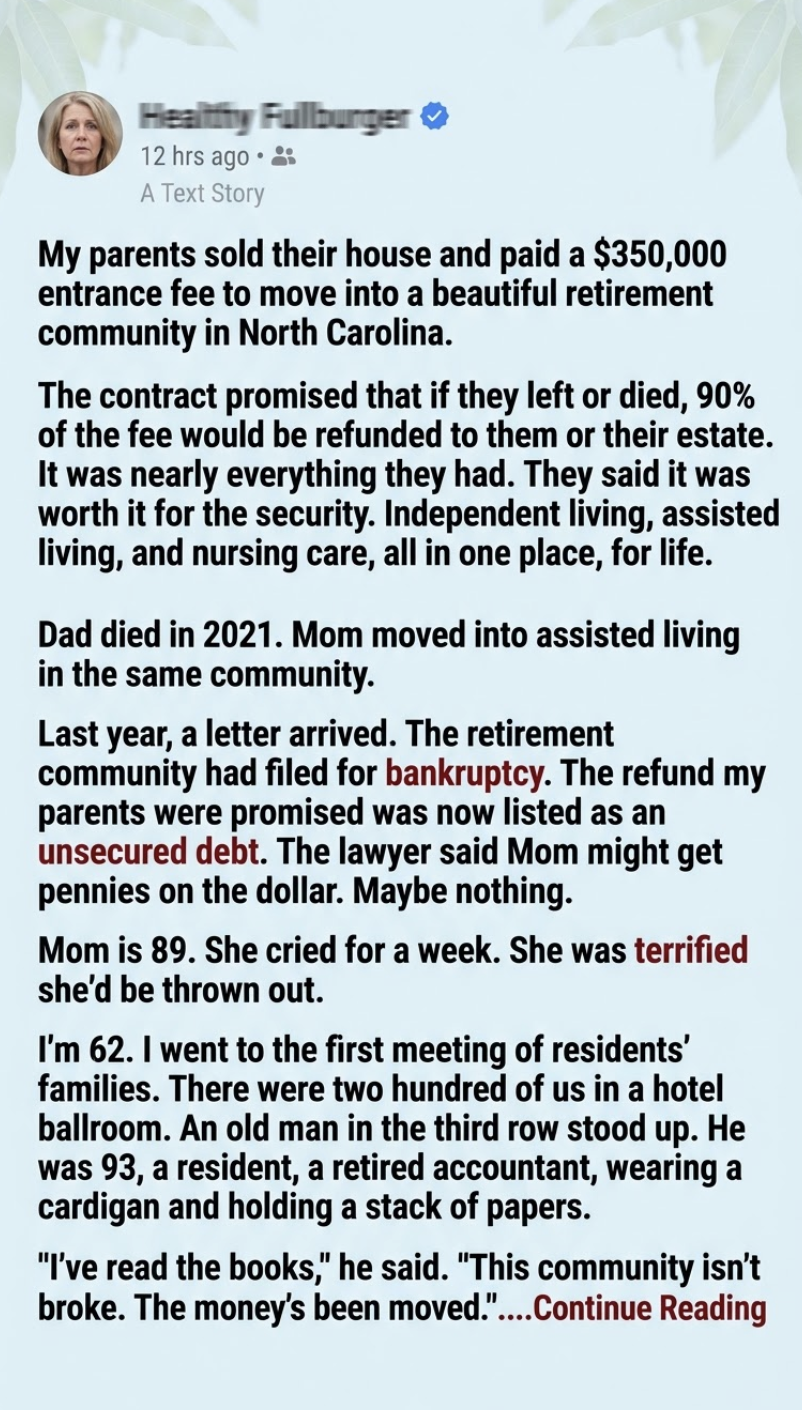
In 2016, my parents sold the house they had lived in for forty-two years.
They didn’t want to burden us.
They didn’t want to maintain a yard anymore.
And after my father had a small health scare, they wanted the security of knowing they could move from independent living to assisted living and eventually nursing care without having to start over somewhere else.
They found a beautiful retirement community in North Carolina.
It had walking paths, a library, a dining room with white tablecloths, a swimming pool, gardens, and staff who greeted residents by name.
The entrance fee was $350,000.
It was nearly everything my parents had.
But the contract promised something that made them feel safe.
If they left the community or died, 90% of the entrance fee would be refunded to them or their estate.
My father read the contract three times.
My mother asked questions.
The sales representative told them they were making a secure investment in their future.
“They’ll take care of us,” Mom said.
Dad nodded.
“That’s what we’re paying for.”
They signed.
Dad died in 2021.
Mom was devastated, but she remained in the community.
She moved from independent living into assisted living, exactly as the contract had promised she could.
She was eighty-four.
She still enjoyed her morning coffee with friends, the weekly bingo games, and the small garden outside her window.
She believed she was safe.
Then, last year, a letter arrived.
The retirement community had filed for bankruptcy.
The refund my parents had been promised was now listed as an unsecured debt.
The lawyer explained that Mom might receive pennies on the dollar.
Maybe nothing.
Mom was eighty-nine years old.
She cried for a week.
Not because she wanted to become rich.
Because she was afraid.
“Will they make me leave?” she asked.
I told her I would find out.
But I had no idea how complicated that answer would become.
I was sixty-two when I attended the first meeting of residents’ families.
There were nearly two hundred people in a hotel ballroom.
Some had brought folders.
Some had brought lawyers.
Some were crying.
Others were angry.
A woman beside me whispered that her parents had lost more than $400,000.
A man behind me said his mother had been told the refund would take years.
Everyone seemed to have the same question.
Where had the money gone?
Then an old man in the third row stood up.
He was ninety-three.
He wore a gray cardigan, carried a thick stack of papers, and introduced himself as Walter Hayes.
“I spent forty years as an accountant,” he said.
The room became quiet.
“I’ve read the books.”
He held up his papers.
“This community isn’t broke.”
People began whispering.
Walter waited.
Then he said:
“The money’s been moved.”
The room erupted.
“What do you mean?”
“Moved where?”
“Are you saying they stole it?”
Walter raised his hand.
“Please. Let me explain.”
He had spent months studying the company’s financial statements, bankruptcy filings, property records, and public documents.
He wasn’t making accusations based on rumors.
He was looking at numbers.
According to his analysis, the retirement community’s operating company had been carrying enormous liabilities related to refundable entrance fees.
But the properties themselves had been transferred among affiliated entities over several years.
Some buildings were owned by one company.
The contracts were held by another.
The management company was separate.
And the financial records showed transactions between related entities that Walter believed required serious scrutiny.
He pointed to one page.
“Look at this.”
A lawyer in the front row leaned forward.
Walter continued.
“Residents paid entrance fees. The company promised refunds. But the money wasn’t sitting in a simple account waiting to be returned.”
He turned another page.
“Instead, the financial structure is complicated. Properties, operating entities, debt, related-party transactions. The bankruptcy filing tells us who owes money. It doesn’t automatically tell us where every dollar went.”
Someone shouted:
“Then find it!”
Walter nodded.
“That’s exactly what we need to do.”
I called my mother’s attorney the next morning.
He had initially told us the refund was likely an unsecured claim.
But when I explained Walter’s findings, he agreed to review the financial records more closely.
We joined a group of families who hired independent counsel.
Walter became the unofficial research coordinator.
He didn’t call himself a hero.
He didn’t promise anyone their money back.
He simply kept saying:
“Follow the documents.”
The first major discovery came several weeks later.
A group of residents’ attorneys found that some properties associated with the retirement community had been transferred to related companies before the bankruptcy.
The transfers were not automatically illegal.
But several residents’ families questioned whether the transactions had been conducted fairly and whether they had affected the community’s ability to honor refund obligations.
The bankruptcy court would have to examine the evidence.
Walter had been right about one thing.
The situation was far more complicated than the letter had suggested.
At the next meeting, Walter stood up again.
This time, he didn’t carry his entire stack of papers.
He carried one page.
“Everyone keeps asking where the money went,” he said.
He paused.
“But that’s not the only question.”
He looked around the ballroom.
“We also need to ask who knew what was happening—and when.”
A woman in the front row began crying.
Her husband had died six months earlier.
She had been counting on the refund to pay for her own care.
Walter continued.
“These contracts were sold to elderly people who believed they were buying security. If the companies involved made decisions that put that security at risk, those decisions need to be examined.”
For the first time, I saw the room change.
We were no longer just frightened families.
We were people who had decided to ask questions together.
My mother didn’t attend the meetings.
At eighty-nine, the stress was too much.
She watched the news from her apartment and asked me every few days whether anything had changed.
“Will I still have my room?”
I couldn’t promise her anything.
But I told her what I knew.
The bankruptcy process was continuing.
The residents’ attorneys were investigating the financial structure.
The community continued operating, though its future was uncertain.
And no one had told Mom she needed to move.
I visited her every Sunday.
One afternoon, she showed me a photograph of Dad.
He was standing beside the garden when they first moved in.
He looked proud.
“We thought we had made the right decision,” she said.
I sat beside her.
“You did the best you could with the information you had.”
She looked at me.
“Your father always said we should read the fine print.”
I smiled sadly.
“He did.”
“But we read it. We asked questions. We were told the refund was protected.”
She began crying again.
I held her hand.
“You don’t have to solve this, Mom.”
She whispered:
“I just don’t want to lose everything.”
Months passed.
The residents’ legal team continued examining the bankruptcy records.
The court reviewed disputed transactions.
Financial experts were brought in.
The process was slow.
There were no instant victories.
No dramatic check arrived overnight.
But the residents were no longer relying solely on the company’s explanation.
They had their own lawyers.
Their own financial experts.
Their own organized records.
And Walter Hayes was still working.
At ninety-three, he attended meetings with a notebook, a calculator, and the same gray cardigan.
One day, I asked him why he was doing so much.
He looked at me as though the answer were obvious.
“My wife lived here,” he said.
“She died two years ago.”
He paused.
“I promised her this place would be safe for the people who came after us.”
Then he looked at the papers.
“I don’t know how much money we’ll recover. I can’t promise that.”
“But I can promise you this: we’re not going to stop asking where it went.”
The first meaningful breakthrough came when the court-appointed professionals identified additional financial records that helped clarify the movement of assets among the affiliated entities.
Some transactions were challenged.
Some were explained.
Others remained under review.
The residents’ legal team began pursuing claims based on the evidence.
The bankruptcy didn’t suddenly disappear.
The refund promises didn’t magically become guaranteed.
And nobody could honestly tell Mom she would receive the entire amount.
But the investigation had changed the situation.
The families now had information.
They had legal representation.
They had a voice.
And they had a ninety-three-year-old retired accountant who had refused to accept that a complicated financial statement was the same thing as an answer.
One evening, I visited Mom after dinner.
She was sitting by the window, watching the sun set over the gardens.
I told her about the latest meeting.
About Walter.
About the financial records being reviewed.
About how the residents were continuing to fight.
She listened quietly.
Then she asked:
“Do you think your father would be proud?”
I looked at the photograph on her dresser.
“Yes.”
She smiled.
“Because he always believed people should stand up for what was right.”
I took her hand.
“That’s what we’re doing.”
She looked out the window again.
For the first time in months, she didn’t cry.
At the next residents’ meeting, Walter stood up one more time.
He was ninety-three.
His hands were shaking slightly as he unfolded his papers.
But his voice was steady.
“I want everyone to understand something,” he said.
“We may not recover every dollar. The law is complicated. Bankruptcy is complicated. These contracts are complicated.”
He looked at the families.
“But we are not powerless.”
He held up his papers.
“We have records. We have evidence. We have attorneys. And we have each other.”
The room stood and applauded.
I looked around at the two hundred people who had come to that first meeting frightened and confused.
Some were still angry.
Some were still grieving.
Some were still terrified of losing their homes.
But nobody was sitting alone anymore.
My mother is still eighty-nine.
She still lives in the community.
Her future remains uncertain, and the refund issue has not been resolved completely.
But she no longer believes she has to face it alone.
And neither do the other residents.
When I think about that first meeting, I remember the old man in the third row.
The cardigan.
The stack of papers.
The words that changed the entire room.
“I’ve read the books. This community isn’t broke. The money’s been moved.”
He didn’t promise us a miracle.
He didn’t promise revenge.
He simply reminded us that when powerful institutions tell ordinary people to accept an answer, ordinary people still have the right to ask for the records.
And sometimes, the most important person in the room isn’t the lawyer.
It’s the ninety-three-year-old man who refuses to stop reading.
Because when people have spent their entire lives saving for security, they deserve answers—not silence, not excuses, and not the assumption that they’re too old to fight for themselves.