The Debt of the Scar
The chaos outside St. Jude’s wasn’t from a natural disaster; it was a multi-car pileup just three blocks away, sending a wave of panicked, bloodied people toward the ER. I stood on the curb, directing the triage teams, my hands steady from thirty years of practice, even as the world around me felt like it was fracturing.
Then I saw him.
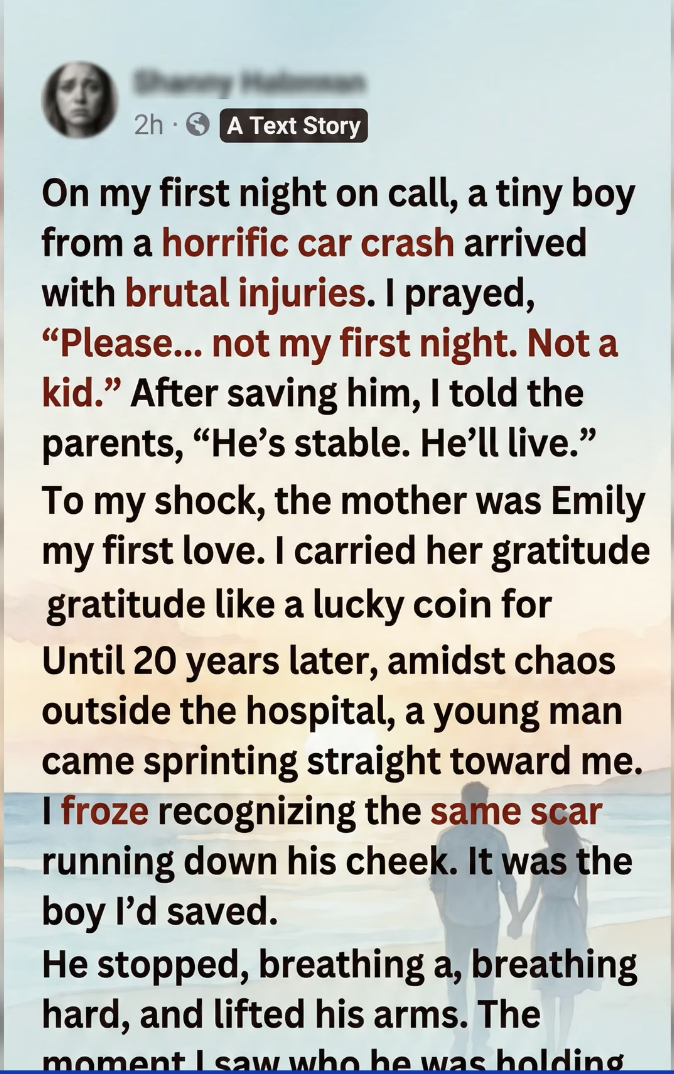
He wasn’t a patient on a gurney. He was a force of nature, sprinting through the gridlock of idling ambulances. When he reached the sidewalk, he skidded to a halt in front of me. I didn’t look at his clothes or his face first—I looked at the jagged, silver lightning bolt of a scar that ran from his left temple down to the corner of his jaw.
I had sewn that scar. Two decades ago, on a night that smelled of rain and copper, I had spent six hours piecing a four-year-old back together. I remember the way my hands had shaken when I looked up from the operating table and saw Emily, her face pale and ghost-like behind the glass. She was the girl who had broken my heart in med school, and there I was, holding her son’s life in my palms.
“Dr. Aris?” the young man gasped, his lungs burning.
“Leo,” I whispered. I hadn’t seen him since he was a toddler. “Leo, what’s happened?”
He didn’t speak. He simply stepped forward and adjusted the weight of the person in his arms. My heart stopped.
It was Emily.
She was unconscious, her hair matted with glass and grey dust, but her face was unmistakable. The “lucky coin” of her gratitude that I’d carried for twenty years suddenly felt like a heavy weight. I realized then that the universe wasn’t giving me a gift; it was demanding a second miracle.
The Second Operation
“She was in the lead car,” Leo choked out as we rushed the gurney into Trauma Room 4. “The truck… it didn’t even brake. She pushed me down, Doc. She took the whole hit.”
The irony was a bitter pill. Twenty years ago, I saved the son for the mother. Now, the son had carried the mother back to me.
The surgery was a blur of monitors and the rhythmic hiss-click of the ventilator. It was more complicated than Leo’s had been; time hadn’t been kind to Emily’s heart, and the impact had caused a tear in her aorta. Every time her blood pressure dipped, I felt a phantom pain in my own chest.
“Don’t you dare,” I muttered under my breath, stitching with a precision that felt almost supernatural. “You don’t get to leave yet.”
The Full Circle
Four hours later, I stepped into the waiting room. Leo was sitting in the same plastic chair his father had occupied two decades earlier. He looked up, his eyes searching mine, that silver scar on his cheek twitching with anxiety.
I sat down next to him. I didn’t say a word at first; I just reached out and placed a hand on his shoulder.
“She’s in recovery,” I said. “She’s stable. She’s going to live.”
Leo collapsed into himself, sobbing with a relief so profound it shook the bench. After a moment, he wiped his eyes and looked at me. “Why did you do it? You didn’t even know we were in the city. You haven’t seen us in years.”
I looked at the scar on his face—the map of my first great success and my first great heartbreak.
“Twenty years ago, I promised a kid he’d see his mom again,” I told him. “I wasn’t about to break that promise today.”
As the sun began to rise over the hospital, I realized that some debts aren’t paid in money or favors. They are paid in the quiet, circular grace of life—where the hands that save the child are eventually the only hands trusted to save the mother.