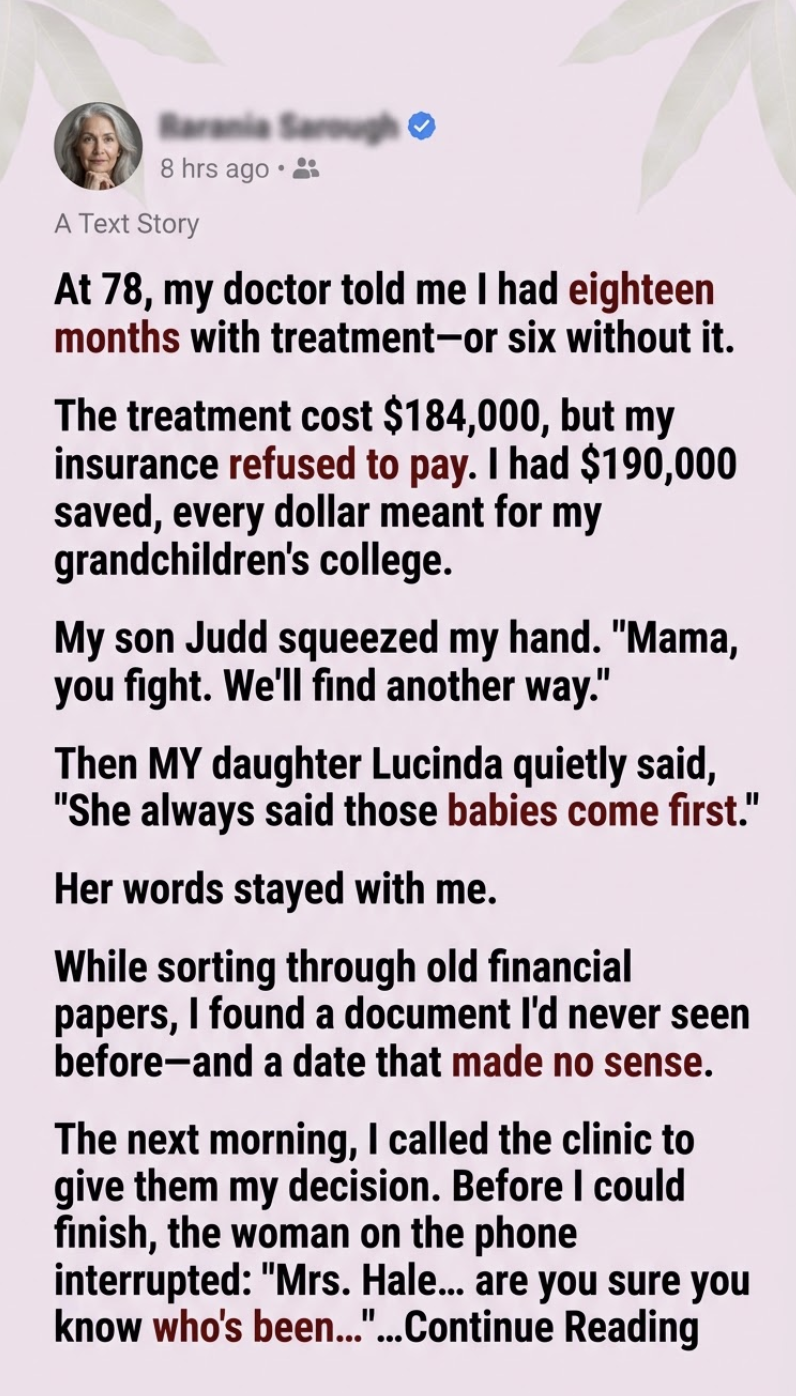
At seventy-eight, my doctor gave me a choice I never imagined having to make.
“Eighteen months with treatment,” he said gently. “Possibly six without it.”
The treatment would cost $184,000.
My insurance had refused coverage, and my savings totaled $190,000. Every dollar had been set aside for one purpose: my grandchildren’s college education.
I had spent years saving that money. Skipped vacations, postponed home repairs, and worked long after retirement age because I wanted those children to have opportunities I never had.
My son, Judd, squeezed my hand.
“Mama, you fight. We’ll find another way.”
I looked at my daughter, Lucinda.
She sat quietly beside the window.
Then she said something I couldn’t forget.
“She always said those babies come first.”
I knew exactly what she meant.
For years, I had told my children that their children would always come first. I wanted my grandchildren to have a future, even if it meant I had to go without.
That night, I couldn’t sleep.
I sat at my kitchen table, surrounded by old financial statements, insurance letters, and documents I’d collected over the years.
Then I found something strange.
It was a financial authorization dated fourteen months earlier, listing my savings account and a transfer arrangement I didn’t recognize.
The amount was $184,000.
I read it twice.
The document appeared to authorize a financial representative to access funds intended for medical expenses.
But the signature looked like mine, and I had no memory of signing it.
Then I noticed the date.
It was the same week Lucinda had asked me to bring my financial papers to her house so she could help organize them.
I didn’t accuse anyone.
I took photographs of the document, placed it in a folder, and called my bank the next morning.
They confirmed that an account inquiry and transfer request had been submitted, but the transaction had not been completed. The authorization was under review.
Then I called the clinic to give them my decision about treatment.
Before I could finish, the woman on the phone interrupted.
“Mrs. Hale, are you sure you know who’s been contacting our billing department?”
My heart began pounding.
“What do you mean?”
She explained that someone had called the clinic several times, claiming to represent me. That person had asked about my savings, my insurance denial, and whether I planned to use my personal funds for treatment.
“Who was it?” I asked.
The woman hesitated.
“The caller identified herself as Lucinda Hale.”
I closed my eyes.
My daughter.
The same daughter who had reminded everyone that my grandchildren came first.
I asked the clinic to preserve the call records and provide information through the proper authorization process. Then I contacted my attorney.
A few hours later, Lucinda called.
“Mom, did you find the paperwork?”
I held the phone tightly.
“What paperwork, Lucinda?”
She went quiet.
Then she said, “I was only trying to help.”
I asked her why she had contacted the clinic without telling me.
She began crying.
She explained that she had been worried about the grandchildren’s college money. She believed I would spend everything on treatment and leave nothing for them.
But that wasn’t the whole story.
My attorney later discovered that the financial document had been prepared as part of an attempt to move a portion of my savings into an account controlled by a family financial arrangement.
Lucinda had been listed as an authorized representative.
The transfer had not gone through, and the bank was investigating the disputed authorization.
When I asked her directly whether she had submitted the paperwork, she finally admitted that she had helped prepare it.
“I thought you would agree eventually,” she whispered.
I felt something inside me break.
“Lucinda, I haven’t even decided whether I want treatment. How could you make that decision for me?”
She couldn’t answer.
Judd arrived that evening. When I told him what had happened, he was furious, but I asked him to sit down.
“I don’t want anyone fighting over my money,” I said. “I want the truth, and I want to make my own decisions.”
He took my hand.
“Mama, you don’t have to choose between us and your health.”
For the first time in days, I felt I could breathe.
I arranged another meeting with my doctor to discuss treatment options, costs, possible financial assistance, and the realistic benefits and risks. My attorney helped me protect my accounts and challenge the disputed authorization.
I also made one decision about my savings.
I would not spend them simply because someone expected me to preserve them.
And I would not refuse treatment simply because my family wanted an inheritance.
My life was still mine.
A week later, Lucinda came to visit.
She stood in the doorway, crying.
“Mom, I’m sorry. I was scared the children would lose their future.”
I looked at her for a long moment.
“Your children have a future, sweetheart. But so do I. And I am still here.”
She sat beside me.
I didn’t promise to forgive her that day. Trust would take time, and the financial review was not finished.
But I finally understood something I wish I had learned years earlier.
I had spent my entire life putting my children and grandchildren first.
That didn’t mean I had to put myself last.
At seventy-eight, I still had choices to make, dreams to protect, and a life worth fighting for. And this time, the most important person I needed to consider was me.