At 29, I never expected to have to prove to my stepfather that I owned the roof over his head.
He always said, “You live under my roof, so you follow my rules.”
The problem was that the mortgage payment came out of my bank account every month.
My father died when I was sixteen. He left behind enough money for a down payment on a house, and my mother’s attorney made sure the deed was placed in my name. I was too young to understand how important that paperwork was. All I knew was that I wanted a place where I felt safe, somewhere no one could tell me I didn’t belong.
Years later, my mother remarried.
My stepfather gradually began acting like the house was his. He moved his belongings into every room, made decisions without asking me, and treated my opinions like disrespect.
Then a woman started sleeping in the guest room.
When I asked who she was and why she was staying there, my stepfather snapped.
“Don’t ask questions about my personal business. You live under my roof.”
I looked at him, almost unable to believe what I had just heard.
My roof.
My mortgage.
My property taxes.
And somehow, I was expected to keep quiet in my own home.
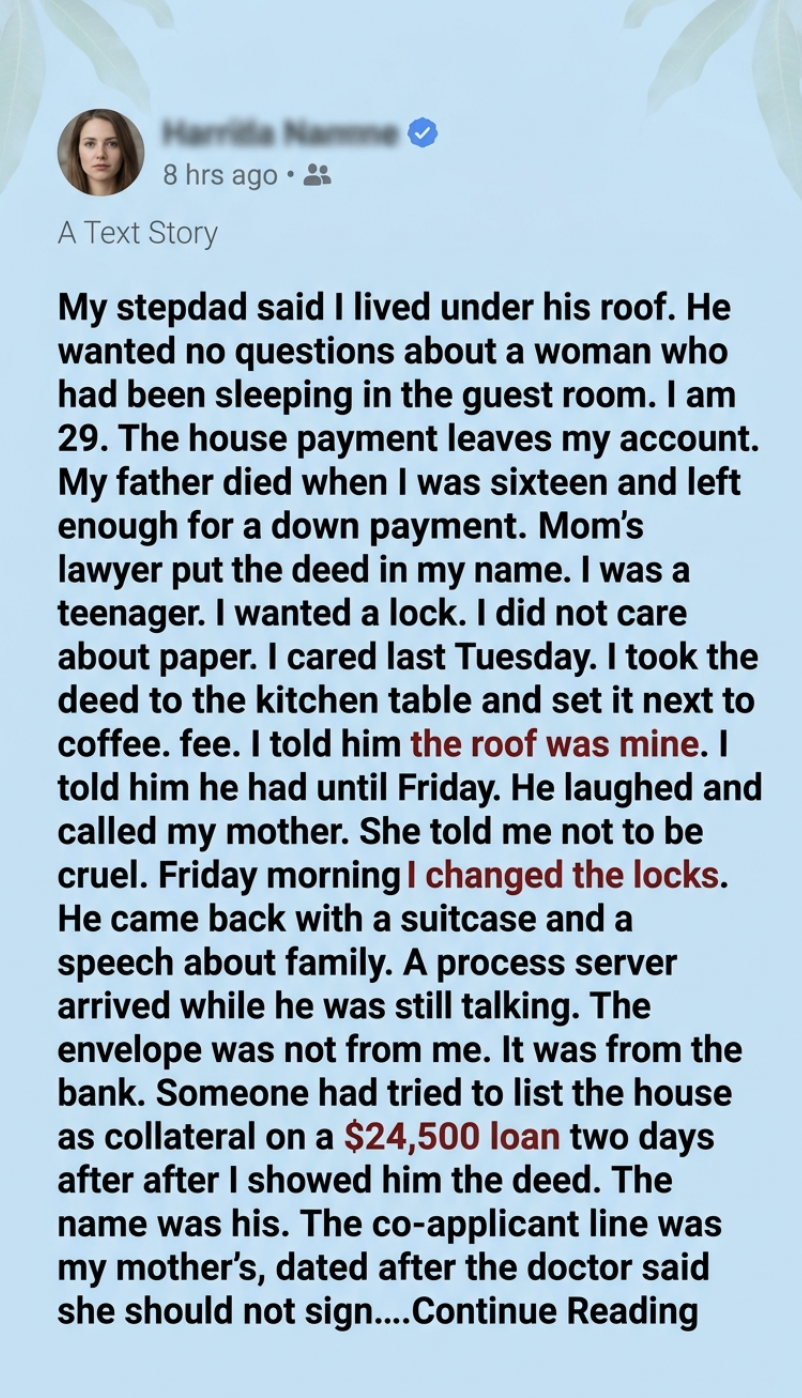
Last Tuesday, I took the deed out of my filing cabinet and placed it on the kitchen table beside his coffee.
“Read it,” I said.
He barely glanced at it before laughing.
“You really think a piece of paper makes you the boss of this family?”
“It makes me the owner of this house.”
His expression hardened.
I told him the guest room was no longer available for whatever arrangement he was making. I told him that if he couldn’t respect the ownership of the property, he needed to find somewhere else to live.
He called my mother.
She came into the kitchen, already upset.
“Don’t do this,” she said. “He’s your stepfather. You can’t just throw family out.”
I told her I wasn’t throwing anyone out because of an argument. I was protecting my home after being disrespected in it.
My stepfather called me spoiled, heartless, and ungrateful.
Then I gave him until Friday.
By Friday morning, I had changed the locks.
I didn’t yell. I didn’t argue. I simply made sure I had copies of the deed, mortgage statements, insurance documents, and everything else that established ownership.
My stepfather came back carrying a suitcase.
“You’ve lost your mind,” he said. “Your mother and I are married. This is a family home.”
I stood in the doorway.
“It’s my home. You don’t get to decide that because you live here.”
He started talking about how family was supposed to forgive, how I was making my mother miserable, how nobody would ever treat me the same after this.
Then the doorbell rang.
A process server stood on the porch holding an envelope.
My stepfather stopped talking.
The envelope wasn’t addressed to me.
It was a notice from the bank regarding a suspicious loan application involving my property.
A $24,500 loan.
The bank had received an application to use the house as collateral. The applicant was my stepfather. The co-applicant was my mother.
The application had been submitted two days after I placed the deed on the kitchen table.
I opened the paperwork and read the names again.
My stepfather’s signature was there.
My mother’s signature was there, too.
But the date was after her doctor had advised her against signing financial documents without assistance because of her medical condition.
I felt my stomach turn.
My mother had told me not to be cruel.
But someone had apparently been willing to put my home at risk without my permission.
I called the bank’s fraud department immediately. I explained that I was the sole property owner, that I had not authorized any loan secured by my home, and that I needed the application investigated. I asked them to preserve every document and signature associated with it.
Then I called my attorney.
My stepfather stood in the hallway, his suitcase beside him.
“You’re making this bigger than it needs to be,” he said.
I looked at him.
“No. Someone tried to make a $24,500 loan using my property. I’m making sure it doesn’t happen again.”
My mother began crying.
She said she didn’t know how the application had been submitted. She said he had told her it was only paperwork for a financial arrangement. She insisted she never intended to hurt me.
I didn’t know what to believe anymore.
The bank froze the application while it reviewed the documents. My attorney advised me not to make accusations I couldn’t prove and to keep every communication in writing.
For the first time, I stopped trying to convince my mother that I deserved respect.
I simply protected what was legally mine.
My stepfather eventually left with his suitcase. My mother stayed for a while, but the silence between us was heavier than any argument we had ever had.
A few weeks later, the bank confirmed that the loan had never been approved and that the application could not proceed without the required property-owner authorization. The investigation into the signatures continued.
I didn’t celebrate.
I sat alone at the kitchen table where I had once placed the deed beside his coffee.
The same table where he had laughed at me.
The same table where I had been told not to ask questions.
I finally understood that owning a house wasn’t just about having your name on a piece of paper.
Sometimes, it meant being willing to defend your boundaries when the people you love insist you shouldn’t have any.
My father had left me that house because he wanted me to have somewhere secure to stand.
And I wasn’t going to let anyone turn that security into something I had to beg for.