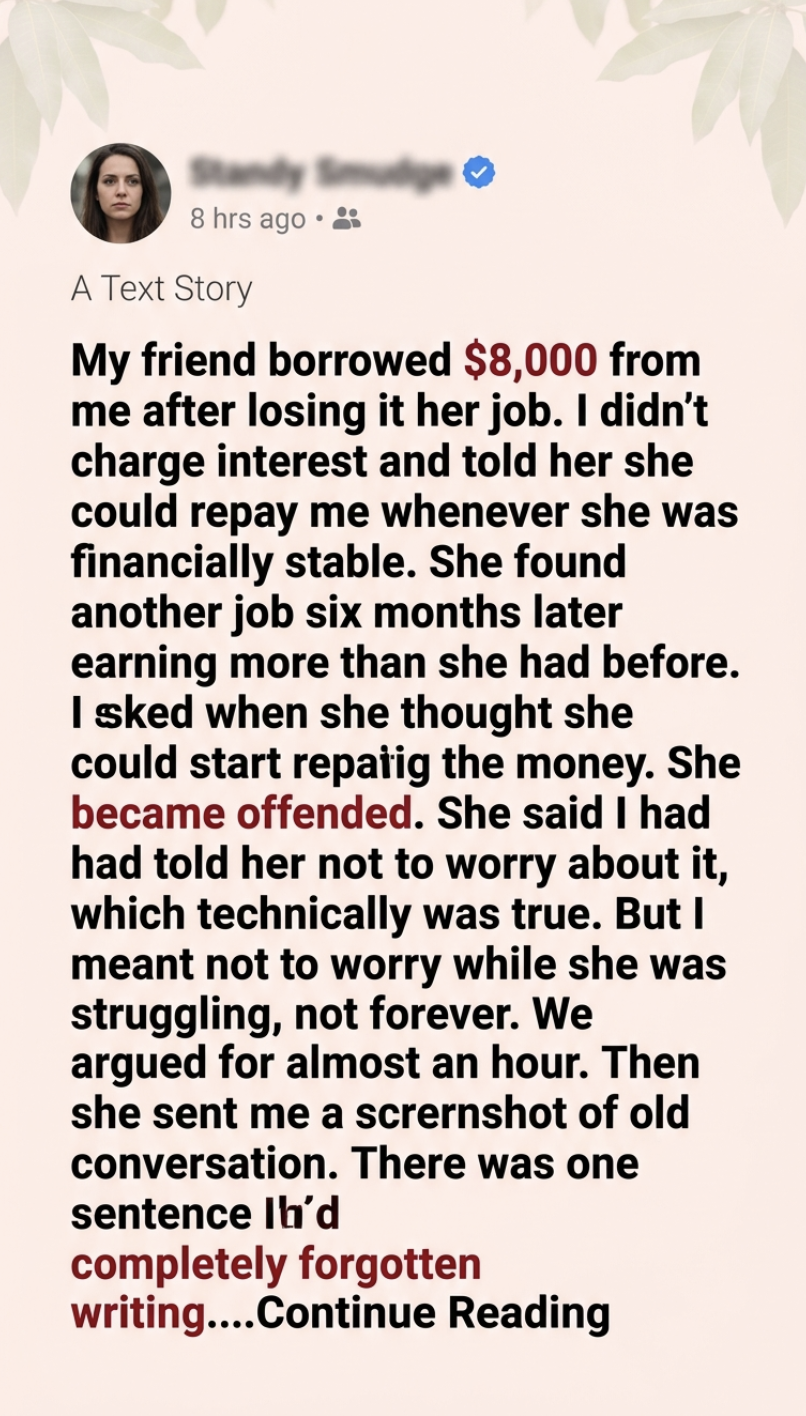
My friend borrowed $8,000 from me after losing her job.
She was going through a difficult time, struggling to pay rent and cover basic expenses. I had some savings, so I offered to help.
I didn’t charge interest.
“Pay me back whenever you’re financially stable,” I told her. “Don’t worry about it right now.”
She thanked me repeatedly and promised she wouldn’t forget what I had done.
Six months later, she found another job. Not only was she employed again, but she was earning more than she had at her previous position.
I was genuinely happy for her.
A few weeks later, I finally brought up the loan.
“Hey, now that things are getting better, when do you think you could start paying back the $8,000? Even small monthly payments would be fine.”
Her expression changed immediately.
“Seriously? You’re asking me for money already?”
I was confused.
“It’s been six months. You have a new job. I thought we could work out a repayment plan.”
She crossed her arms.
“You told me not to worry about it.”
“I said not to worry while you were struggling. I never said you didn’t have to repay it.”
She became defensive.
We argued for almost an hour. I explained that I had helped her because I cared about her, but $8,000 was still a significant amount of money to me.
She insisted I was changing the agreement.
Finally, she sent me a screenshot of our old conversation.
“Read this again,” she wrote.
I opened it.
There was my original message, sent the night she had asked for help.
“I’ve got you. Take the money. Don’t worry about paying me back. Your friendship means more to me than $8,000.”
I read it once.
Then again.
My stomach sank.
I had completely forgotten writing that final sentence.
I scrolled through the conversation, hoping there was another message clarifying what I meant.
There wasn’t.
I called her.
“Did you understand that as me forgiving the loan?”
She replied, “Yes. I thought you were helping me, not lending me money with an invisible deadline.”
I sat quietly.
For the first time, I realized that we might both have been telling the truth about what we believed had happened.
I remembered intending to give her breathing room, not a permanent gift. But I had written something that could reasonably be understood as forgiving the debt.
I couldn’t simply pretend those words didn’t exist because I had forgotten them.
I told her I needed time to think.
The next day, I reviewed our messages and spoke with a lawyer about what my written statement might mean. I didn’t want to threaten her or make assumptions about my legal rights.
Eventually, I contacted her again.
“I understand why you thought I meant it was a gift. I should have been clearer. I never intended to create confusion between us.”
She replied that she appreciated me acknowledging that.
We agreed to meet for coffee.
Our friendship was still strained, but at least we were finally discussing what had actually been said instead of arguing about what each of us remembered.
I learned a difficult lesson that week.
Generosity is important, but clear communication matters just as much.
When money and friendship are involved, one careless sentence can create years of misunderstanding.
I still believe helping someone during a difficult season is one of the best things you can do.
But I also learned never to leave an important financial agreement to assumptions.
Sometimes the biggest problem isn’t that someone forgot a promise. It’s that two people remember making completely different promises in the first place.