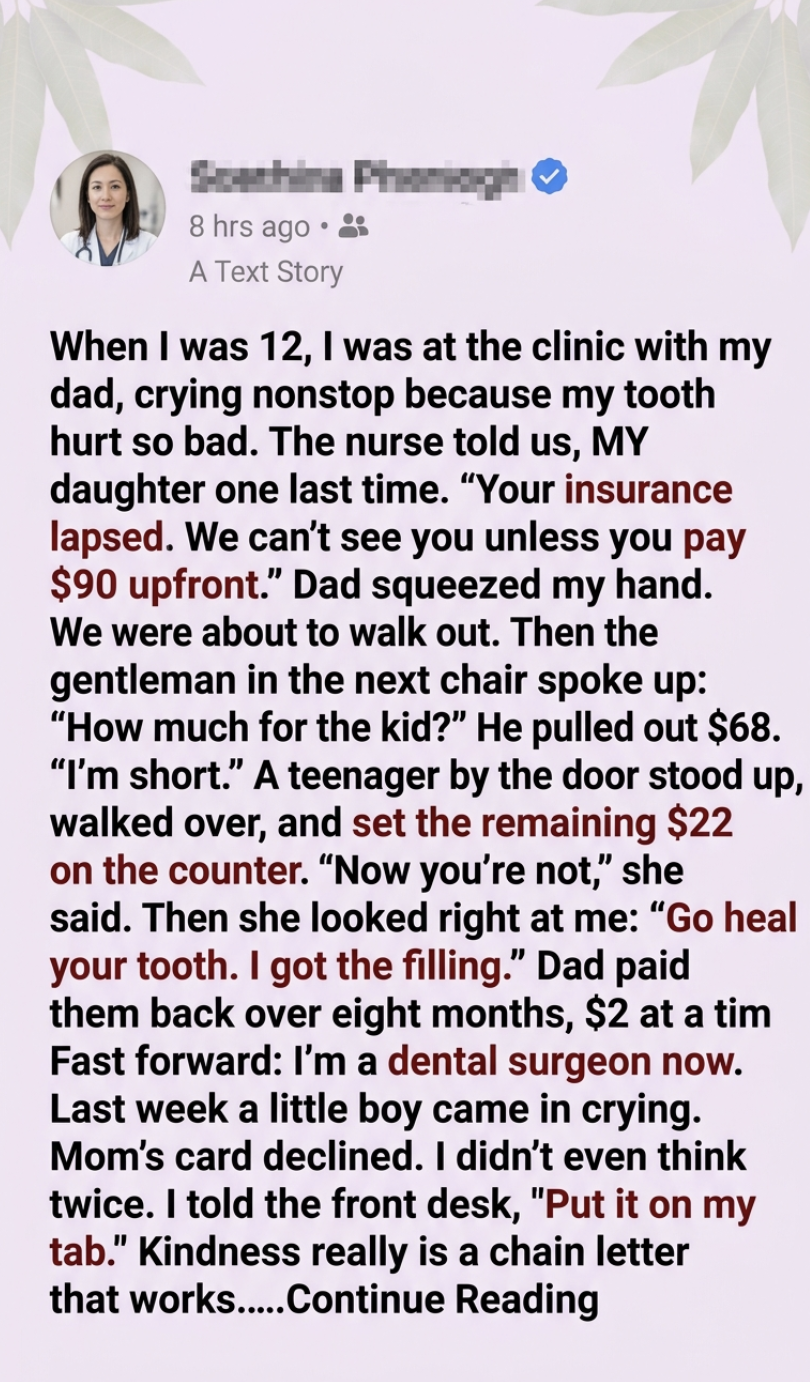
When I was 12 years old, I sat in a clinic waiting room beside my father, crying because my tooth hurt so badly I could barely speak.
My father held my hand while I tried to stop the tears.
Finally, a nurse approached us with a clipboard.
“I’m sorry,” she said. “Your insurance has lapsed. We can’t treat your daughter unless you pay $90 upfront.”
My father checked his wallet.
I watched his face change.
He counted what he had, looked at the nurse, and quietly said, “We’ll have to come back.”
We were preparing to leave when the gentleman sitting nearby spoke up.
“How much does the child need?”
The nurse repeated the amount.
He reached into his pocket and pulled out some cash.
“I have $68,” he said. “I’m short.”
Before my father could respond, a teenager sitting near the entrance stood up.
She walked over, placed two $10 bills and two $1 bills on the counter, and smiled.
“Now you’re not.”
Then she looked directly at me.
“Go get that tooth fixed, sweetheart. I’ve got the rest.”
I remember staring at her, wondering why someone who didn’t even know my name would help me.
My father tried to thank them, but the gentleman simply waved him off.
“Take care of your little girl.”
That afternoon, I received the treatment I needed.
My father never forgot what those two strangers had done. He insisted on paying them back, even though they told him not to worry about it.
Over the next eight months, he managed to repay the $90 in tiny installments of $2 whenever he could.
He wanted me to understand something important:
When someone helps you during a difficult moment, you should never forget it.
I carried that lesson with me through high school, university, and dental school.
Today, I’m a dental surgeon.
Last week, a little boy came into my clinic holding his mother’s hand. His cheeks were wet with tears, and he kept pointing to his painful tooth.
His mother looked exhausted.
When the receptionist processed her card, it was declined.
She tried another card.
Declined again.
“I’m so sorry,” she whispered. “I thought there was enough. Can we come back another day?”
I looked at the little boy.
He was trying so hard not to cry.
For a moment, I was twelve again, sitting beside my father in that clinic waiting room.
I remembered the $68.
I remembered the teenager’s $22.
And I remembered how it felt when two strangers decided that a child’s pain mattered more than the money in their pockets.
I turned to the front desk.
“Put the treatment on my tab.”
The mother looked at me in disbelief.
“Are you sure? I’ll find a way to pay you back.”
I smiled.
“You don’t have to worry about that today. Let’s take care of your son.”
She started crying, but this time they were tears of relief.
As I prepared the little boy for treatment, I thought about the two strangers who had helped me all those years ago.
I never learned their full names.
I never had the chance to tell them that their kindness helped shape the person I became.
But perhaps I didn’t need to find them.
Perhaps the best way to thank them was to do for someone else what they had once done for me.
My father taught me to repay kindness. Those strangers taught me that sometimes the greatest repayment is passing it forward.
And that little boy left my clinic with a healthier smile—and one more reason to believe that strangers can be good people.