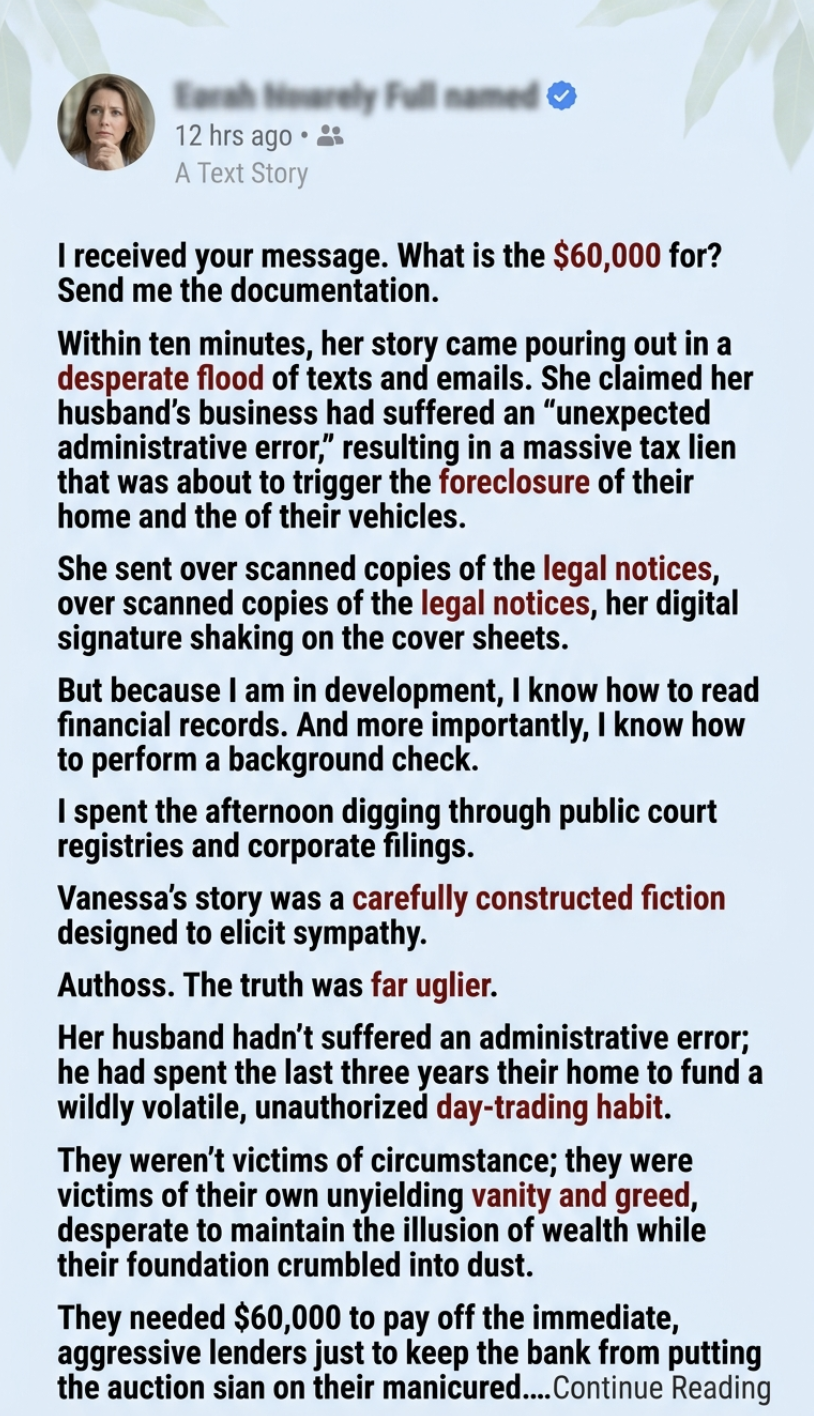
“I received your message. What is the $60,000 for? Send me the documentation.”
That was my entire reply to Vanessa.
Within ten minutes, my phone erupted with texts and emails. Her explanation came pouring out in a desperate flood.
She claimed her husband’s business had suffered an unexpected administrative error, triggering a massive tax lien. According to her, the lien threatened to force the foreclosure of their home and the repossession of their vehicles.
She attached scanned legal notices, account statements, and several cover sheets bearing her digital signature.
She said they needed $60,000 immediately.
But I wasn’t going to transfer that kind of money simply because someone was frightened and asking urgently.
I work in development, and reviewing complicated information is part of my professional life. I know how to examine records, identify inconsistencies, and distinguish an official document from a convincing-looking explanation.
So I spent the afternoon checking public court registries and corporate filings.
What I discovered was nothing like Vanessa’s story.
There was no evidence of the administrative error she described. Instead, the public records revealed a pattern of financial trouble that had been developing for years.
Her husband had reportedly spent the last three years using money connected to their household and business finances to fund an increasingly risky, unauthorized day-trading habit.
The losses had accumulated. Payments had fallen behind. Private lenders were now demanding repayment.
Their financial crisis wasn’t caused by one sudden mistake.
It was the result of years of decisions they had apparently kept hidden.
The $60,000 wasn’t simply going to clear an unexpected tax problem. It appeared to be intended to satisfy immediate lenders and delay further consequences while they tried to preserve their lifestyle.
They weren’t asking me to rescue a thriving family business from an administrative error.
They were asking me to finance the consequences of a financial situation they hadn’t honestly explained.
I read Vanessa’s messages again.
She had described their beautiful home, their vehicles, and their family’s future as if everything could disappear overnight unless I sent the money.
But nowhere had she explained the trading losses.
Nowhere had she mentioned the private lenders.
And nowhere had she acknowledged that the situation had been building for years.
I replied:
“I’ve reviewed the information you sent and the public records I could verify. Your explanation doesn’t match what I’ve found. I’m not transferring $60,000 based on incomplete or misleading information. If you believe there is a legitimate tax liability, provide the official notices and contact details for the relevant authorities. Any further financial discussion will need independent verification.”
Her response came almost immediately.
“You don’t understand. We’re family. Are you really going to let us lose everything?”
I stared at the screen.
Family had become the word people used whenever they wanted me to ignore questions they didn’t want to answer.
I wasn’t going to do that.
I told her I would not send money directly to her or her husband. If there were legitimate debts, they needed to be reviewed by qualified legal and financial professionals. I also made clear that I would not become responsible for loans, guarantees, or financial arrangements I had never agreed to.
The messages continued for days.
First came panic. Then anger. Then accusations that I cared more about money than people.
But I didn’t change my answer.
I wasn’t celebrating their hardship. I wasn’t hoping their home would be lost. I simply refused to let an emotional emergency become an excuse for an unverified $60,000 transfer.
Eventually, I understood the real lesson.
Sometimes the most expensive mistake isn’t losing money.
It’s allowing someone else’s poor decisions to become your responsibility because they know exactly which emotional buttons to press.
I was willing to help someone facing a genuine crisis. I was not willing to finance a lie to protect the appearance of a perfect life.