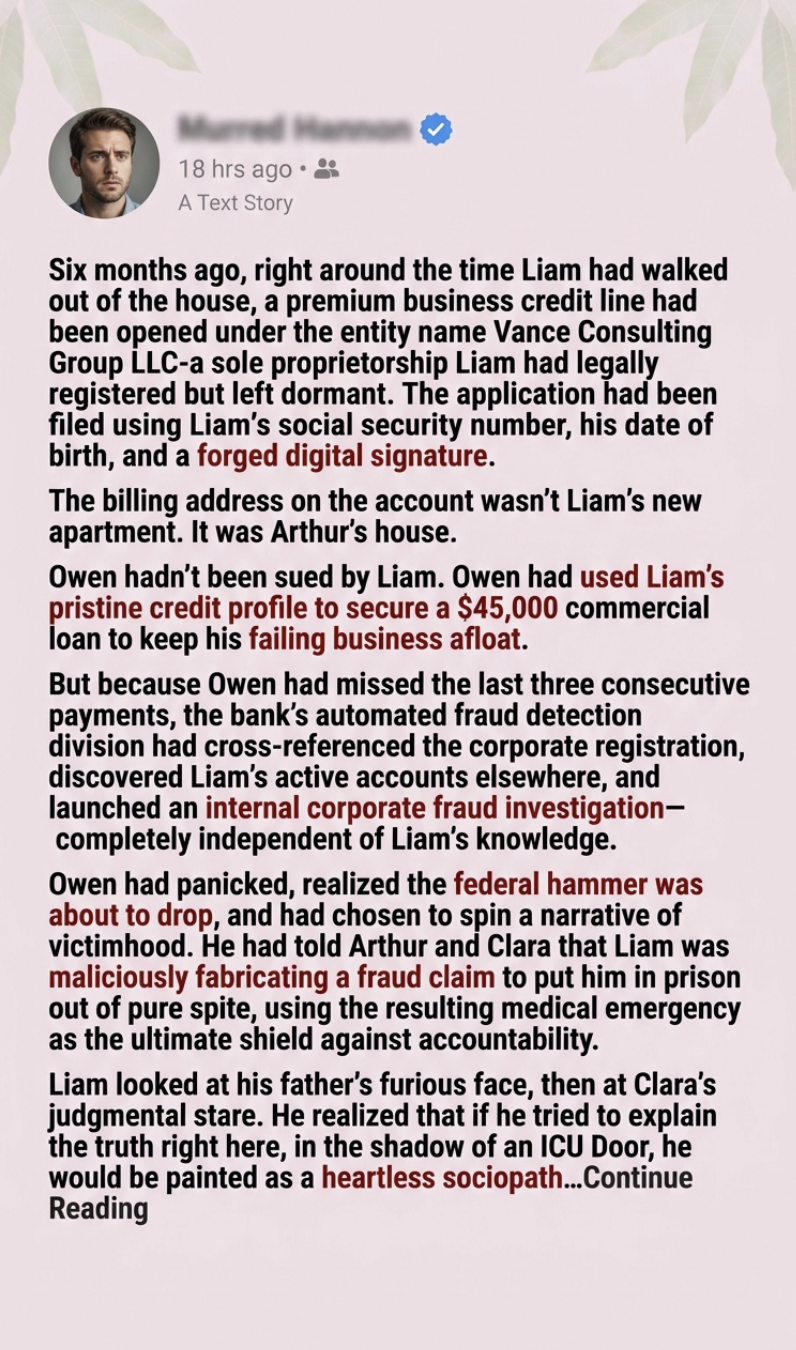
Six months earlier, around the time Liam had walked out of the family home, someone had opened a premium business credit line under the name Vance Consulting Group LLC.
It was a sole proprietorship Liam had legally registered but left dormant.
The application contained his Social Security number, date of birth, and what appeared to be his digital signature.
There was only one problem.
Liam had never applied for the credit line.
The billing address wasn’t his new apartment. It was his father Arthur’s house.
At first, Liam didn’t understand what was happening. Then the pieces began to fall into place.
Owen hadn’t been sued by Liam. Owen had used Liam’s clean credit profile to secure a $45,000 commercial loan to keep his failing business afloat.
And he had done it without Liam’s permission.
Owen had already missed three consecutive payments. The bank’s fraud detection division had noticed inconsistencies between the business registration and Liam’s other active financial accounts. It had begun an internal investigation into the suspicious application.
Liam hadn’t initiated that investigation.
He hadn’t even known the bank was looking into it.
But Owen had found out.
Panicking, he had gone to Arthur and Clara with a completely different story. He claimed Liam was fabricating a fraud allegation out of revenge, deliberately trying to send his own brother to prison.
Then came the medical emergency.
Owen had apparently decided that if he could make himself look like a victim, the family might stop asking questions about the money.
And now Liam was standing outside an ICU room, facing his father’s fury.
Arthur’s expression was hard.
“How could you do this to your own brother?” he demanded.
Clara stood beside him, her arms folded. Her eyes were filled with disappointment.
Liam looked from his father to Clara.
He understood something immediately: if he tried to explain every detail in that hallway, he would be accused of being heartless for discussing money while Owen was in intensive care.
So he didn’t argue.
He took a slow breath.
“Dad, I didn’t open that account. I didn’t borrow that money. And I didn’t start the bank’s investigation.”
Arthur shook his head.
“Your brother says you did.”
“Then ask him for the loan documents.”
Clara stepped forward.
“Liam, this isn’t the time.”
He nodded.
“You’re right. It’s not the time to argue. But it is the time to stop accusing me of something I didn’t do.”
He reached into his jacket and took out his phone.
“I have the bank’s correspondence, the account details, and the records showing when the application was submitted. I’m giving everything to my attorney and the bank’s fraud investigators. They can establish who did what.”
Arthur’s expression changed slightly.
For the first time, he seemed unsure.
Liam continued.
“I want Owen to recover. I really do. But his medical condition doesn’t make me responsible for a $45,000 loan I never authorized.”
Then he turned toward the elevator.
He wasn’t abandoning his brother. He was refusing to become another casualty of the deception.
The following morning, Liam’s attorney submitted a formal identity-theft report and disputed the account with the bank. He also requested preservation of the application records, digital signature data, access logs, and communications connected to the loan.
The bank confirmed that its investigation was already underway. Liam cooperated fully and avoided contacting Owen directly about the allegations.
Weeks later, the family began receiving questions they could no longer dismiss.
Who had submitted the application? Who had access to Liam’s personal information? Why had the billing address been Arthur’s house? And where had the $45,000 actually gone?
Those questions required evidence, not family opinions.
Arthur eventually called Liam.
His voice was quieter than before.
“I didn’t know,” he said.
Liam looked out his apartment window.
“Neither did I, Dad. That’s why I reported it.”
There was a long silence.
Then Arthur asked whether Liam would come home.
Liam didn’t answer immediately.
“I’ll always hope Owen gets better. But trust isn’t restored by pretending nothing happened. We need the truth first.”
For the first time in months, Liam wasn’t trying to convince his family to believe him.
He was allowing the evidence to speak.
Owen may have been able to borrow money using Liam’s identity, but he couldn’t make Liam responsible for a crime he hadn’t committed.