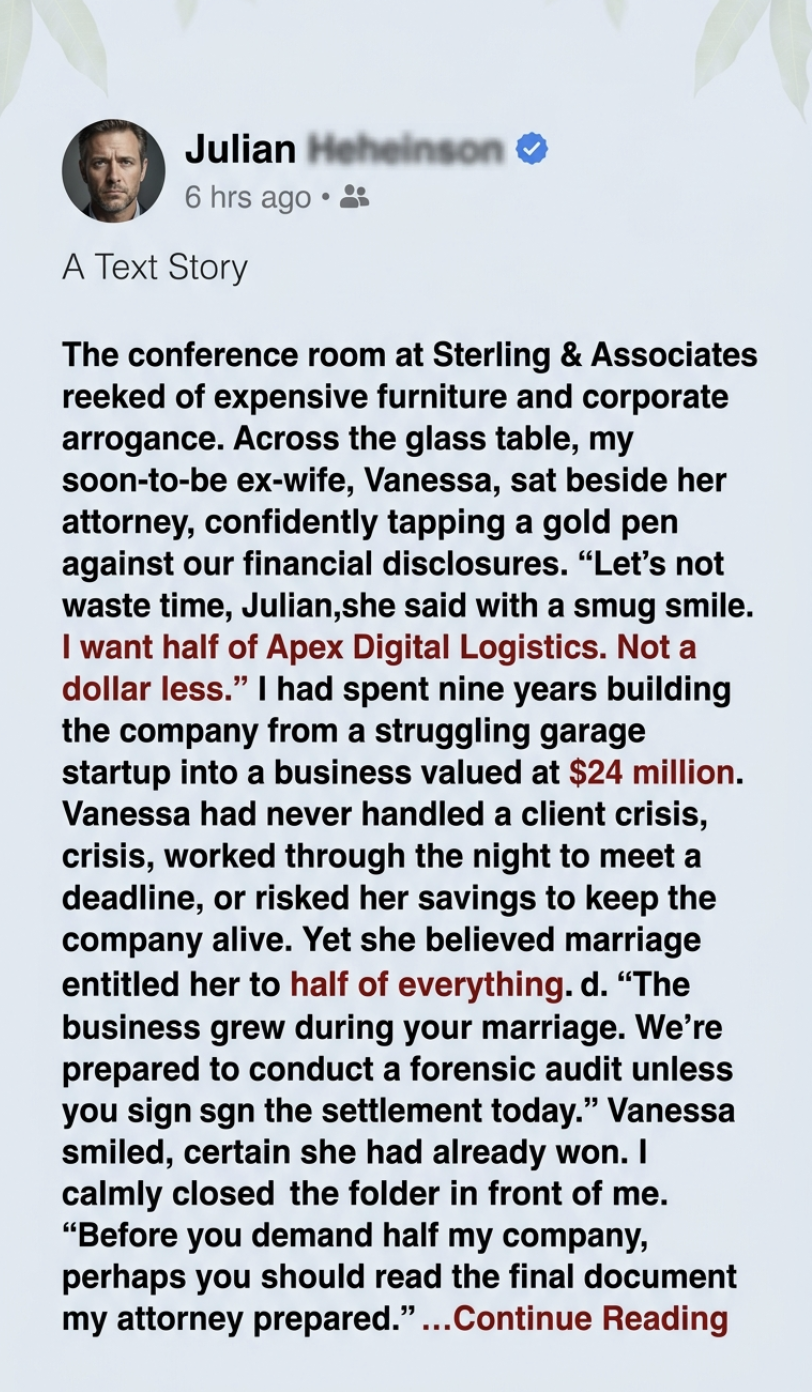
The conference room at Sterling & Associates reeked of expensive furniture and corporate arrogance.
Across the glass table, my soon-to-be ex-wife, Vanessa, sat beside her attorney, confidently tapping a gold pen against our financial disclosures.
“Let’s not waste time, Julian,” she said with a smug smile. “I want half of Apex Digital Logistics. Not a dollar less.”
I had spent nine years building the company from a struggling garage startup into a business valued at $24 million.
Vanessa had never handled a client crisis, worked through the night to meet a deadline, or risked her savings to keep the company alive. Yet she believed marriage entitled her to half of everything.
Her attorney leaned forward.
“The business grew during your marriage. We’re prepared to conduct a forensic audit unless you sign the settlement today.”
Vanessa smiled, certain she had already won.
I calmly closed the folder in front of me.
“Before you demand half my company, perhaps you should read the final document my attorney prepared.”
My attorney, Daniel, placed a separate envelope on the table.
Vanessa glanced at it.
“What is that supposed to be?”
“Documentation concerning the ownership and financing history of Apex Digital Logistics,” Daniel replied.
Her attorney opened the envelope and began reviewing the contents.
The first document was the company’s original incorporation record, dated three years before Julian and Vanessa married.
The second showed the initial funding: my personal savings, a small business loan, and money borrowed from a former colleague. There was no contribution from Vanessa.
The third contained nine years of financial records, documenting how the company had been funded, developed, and expanded.
Vanessa’s smile began to fade.
“That doesn’t change the fact that we were married while the company became successful,” her attorney said.
Daniel nodded.
“Correct. Which is why we’re not making assumptions about what is or isn’t subject to division. We’re prepared to examine the applicable law, the company’s records, and any legitimate claims involving marital contributions or the increase in value.”
I appreciated that Daniel wasn’t promising an automatic victory. The company had grown during our marriage, and I understood that the legal questions needed to be examined carefully.
Then he placed one final document on the table.
It was a record of a transfer Vanessa had authorized eighteen months earlier.
She leaned forward.
“What does that have to do with anything?”
Daniel opened the accompanying bank statements.
During that period, several large payments had been made from our joint account to a consulting company Vanessa had described as a temporary investment. The records showed that the company was connected to a relative of hers.
The payments totaled $340,000.
I had discovered the transfers during our financial review. At first, I thought they were legitimate business expenses. But the invoices didn’t match the services described, and the supposed consulting work had no clear deliverables.
We had requested further documentation through the appropriate legal process.
Vanessa’s attorney studied the records.
“Do you have evidence that these payments were unauthorized or improper?”
Daniel slid another page across the table.
“We have the transaction history, the invoices, the correspondence, and the company’s registration records. We’re asking for a full accounting before either party agrees to a final financial settlement.”
Vanessa stopped tapping her pen.
“Julian, you said you weren’t going to bring this up.”
I looked at her.
“You demanded a forensic audit of my company. I agreed that the finances should be examined. That means all of them.”
Her attorney quietly asked for a recess.
For the first time that morning, Vanessa looked uncertain.
When the meeting resumed, her attorney no longer demanded an immediate fifty-percent transfer of Apex Digital Logistics. Instead, he requested time to review the documentation and discuss the disputed transactions.
Daniel agreed to continue negotiations through the proper legal process.
There was no dramatic courtroom victory that afternoon. No judge declared the company entirely mine, and no one walked out with a check.
But something important had changed.
The settlement would no longer be based on Vanessa’s demands or my willingness to avoid conflict. It would be based on verified records, applicable law, and a complete accounting of both parties’ finances.
As we left the conference room, Vanessa caught up with me.
“You could have handled this differently,” she said.
I stopped.
“I tried handling things quietly. But you came here demanding half of something without even acknowledging what happened to our joint money.”
She looked away.
I continued.
“I built Apex from nothing. I’m willing to let the law determine what is fair. But I’m not going to sign away my future just because you think I’ll be too afraid of a fight to defend it.”
Then I walked toward the elevator.
For nine years, I had built a company by solving problems one at a time. Now I faced the hardest business decision of my life: separating my personal future from a marriage that had become a financial dispute.
I didn’t know exactly how the divorce would end.
But I knew I would no longer negotiate against myself.
A $24 million company had taken nine years to build. I wasn’t going to let one afternoon of pressure decide its future.