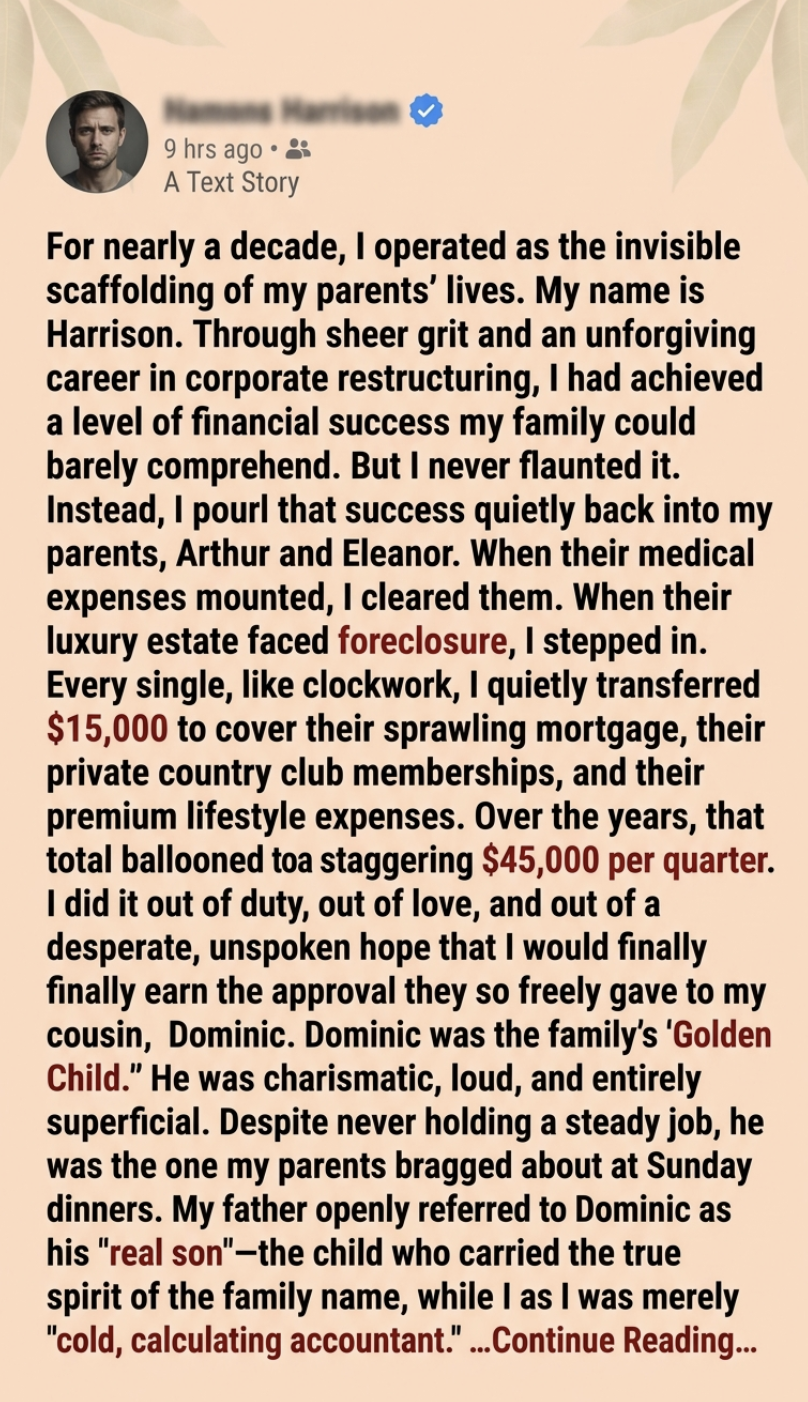
For nearly a decade, I was the invisible foundation holding my parents’ comfortable lives together.
My name is Harrison. Through years of relentless work in corporate restructuring, I had built a level of financial success my family could barely imagine.
But I never showed it off.
Instead, I quietly poured that success back into the two people I had spent my entire life trying to make proud: my parents, Arthur and Eleanor.
When their medical bills became overwhelming, I paid them. When their luxury estate nearly faced foreclosure, I stepped in. And every month, without fail, I transferred $15,000 to cover their mortgage, country club memberships, and expensive lifestyle.
That was $45,000 every quarter.
Over the years, the money added up to a fortune. I never complained. I told myself it was what a good son did. More than that, I secretly hoped that one day my parents would finally look at me with the same pride they showed someone else.
That someone was my cousin, Dominic.
Dominic was the family’s undisputed Golden Child. Charming, loud, and effortlessly confident, he could turn an ordinary dinner into a performance. Despite never maintaining a steady job, he was constantly praised at Sunday gatherings.
My father, Arthur, never bothered hiding his preference.
“Dominic is the real son this family needed,” he once declared during dinner.
Everyone laughed awkwardly.
Then he turned toward me.
“You’re too cold, Harrison. Always calculating numbers. Money isn’t everything.”
I sat there quietly, remembering that the mortgage payment due the following week was coming directly from my account.
My mother, Eleanor, simply smiled and changed the subject.
I swallowed the insult, as I had done countless times before.
I kept paying.
I paid because I loved them. I paid because I wanted to believe their appreciation would eventually become genuine. And I paid because some part of me still hoped that if I gave enough, I would finally become the son they were proud to call their own.
But one evening, everything changed.
During a family gathering, my father raised his glass and announced that Dominic was the person he trusted most to carry on the family legacy.
Then he revealed that he had made an important change to his will.
I listened carefully.
My name wasn’t mentioned.
Instead, Dominic was being given the family property and the inheritance my parents had spent years telling me we would eventually discuss together.
I didn’t argue.
I didn’t remind them about the medical bills, the mortgage payments, or the hundreds of thousands of dollars I had quietly contributed.
I simply asked one question.
“Does Dominic know who’s been paying for all of this?”
My father’s smile vanished.
“That’s none of his concern,” he replied. “You’ve always had more than enough.”
That was when I finally understood.
They hadn’t mistaken my generosity for love.
They had mistaken it for an endless obligation.
And for the first time in nearly ten years, I decided to stop paying for a place where I was never truly welcome.
I didn’t make a scene. I didn’t threaten anyone.
I went home, opened my banking account, and canceled the $15,000 monthly transfer.
Then I removed every secondary card connected to my corporate account.
Three weeks passed without a single call asking how I was doing.
Until the first of the month.
My phone lit up with a message from Eleanor:
“Transfer the mortgage money. The bank says we’re already two days late.”
I stared at the screen for a long moment.
Then I typed:
“The monthly payments have ended. If Dominic is the real son of this family, perhaps it’s time he helped carry the responsibilities, too.”
I pressed send.
And within seconds, my phone began ringing.
For the first time, my family was desperate to hear from me.
But I had a feeling it wasn’t my voice they missed.
It was the money
For nearly a decade, I was the invisible foundation holding my parents’ comfortable lives together.
My name is Harrison. Through years of relentless work in corporate restructuring, I had built a level of financial success my family could barely imagine.
But I never showed it off.
Instead, I quietly poured that success back into the two people I had spent my entire life trying to make proud: my parents, Arthur and Eleanor.
When their medical bills became overwhelming, I paid them. When their luxury estate nearly faced foreclosure, I stepped in. And every month, without fail, I transferred $15,000 to cover their mortgage, country club memberships, and expensive lifestyle.
That was $45,000 every quarter.
Over the years, the money added up to a fortune. I never complained. I told myself it was what a good son did. More than that, I secretly hoped that one day my parents would finally look at me with the same pride they showed someone else.
That someone was my cousin, Dominic.
Dominic was the family’s undisputed Golden Child. Charming, loud, and effortlessly confident, he could turn an ordinary dinner into a performance. Despite never maintaining a steady job, he was constantly praised at Sunday gatherings.
My father, Arthur, never bothered hiding his preference.
“Dominic is the real son this family needed,” he once declared during dinner.
Everyone laughed awkwardly.
Then he turned toward me.
“You’re too cold, Harrison. Always calculating numbers. Money isn’t everything.”
I sat there quietly, remembering that the mortgage payment due the following week was coming directly from my account.
My mother, Eleanor, simply smiled and changed the subject.
I swallowed the insult, as I had done countless times before.
I kept paying.
I paid because I loved them. I paid because I wanted to believe their appreciation would eventually become genuine. And I paid because some part of me still hoped that if I gave enough, I would finally become the son they were proud to call their own.
But one evening, everything changed.
During a family gathering, my father raised his glass and announced that Dominic was the person he trusted most to carry on the family legacy.
Then he revealed that he had made an important change to his will.
I listened carefully.
My name wasn’t mentioned.
Instead, Dominic was being given the family property and the inheritance my parents had spent years telling me we would eventually discuss together.
I didn’t argue.
I didn’t remind them about the medical bills, the mortgage payments, or the hundreds of thousands of dollars I had quietly contributed.
I simply asked one question.
“Does Dominic know who’s been paying for all of this?”
My father’s smile vanished.
“That’s none of his concern,” he replied. “You’ve always had more than enough.”
That was when I finally understood.
They hadn’t mistaken my generosity for love.
They had mistaken it for an endless obligation.
And for the first time in nearly ten years, I decided to stop paying for a place where I was never truly welcome.
I didn’t make a scene. I didn’t threaten anyone.
I went home, opened my banking account, and canceled the $15,000 monthly transfer.
Then I removed every secondary card connected to my corporate account.
Three weeks passed without a single call asking how I was doing.
Until the first of the month.
My phone lit up with a message from Eleanor:
“Transfer the mortgage money. The bank says we’re already two days late.”
I stared at the screen for a long moment.
Then I typed:
“The monthly payments have ended. If Dominic is the real son of this family, perhaps it’s time he helped carry the responsibilities, too.”
I pressed send.
And within seconds, my phone began ringing.
For the first time, my family was desperate to hear from me.
But I had a feeling it wasn’t my voice they missed.
It was the money.