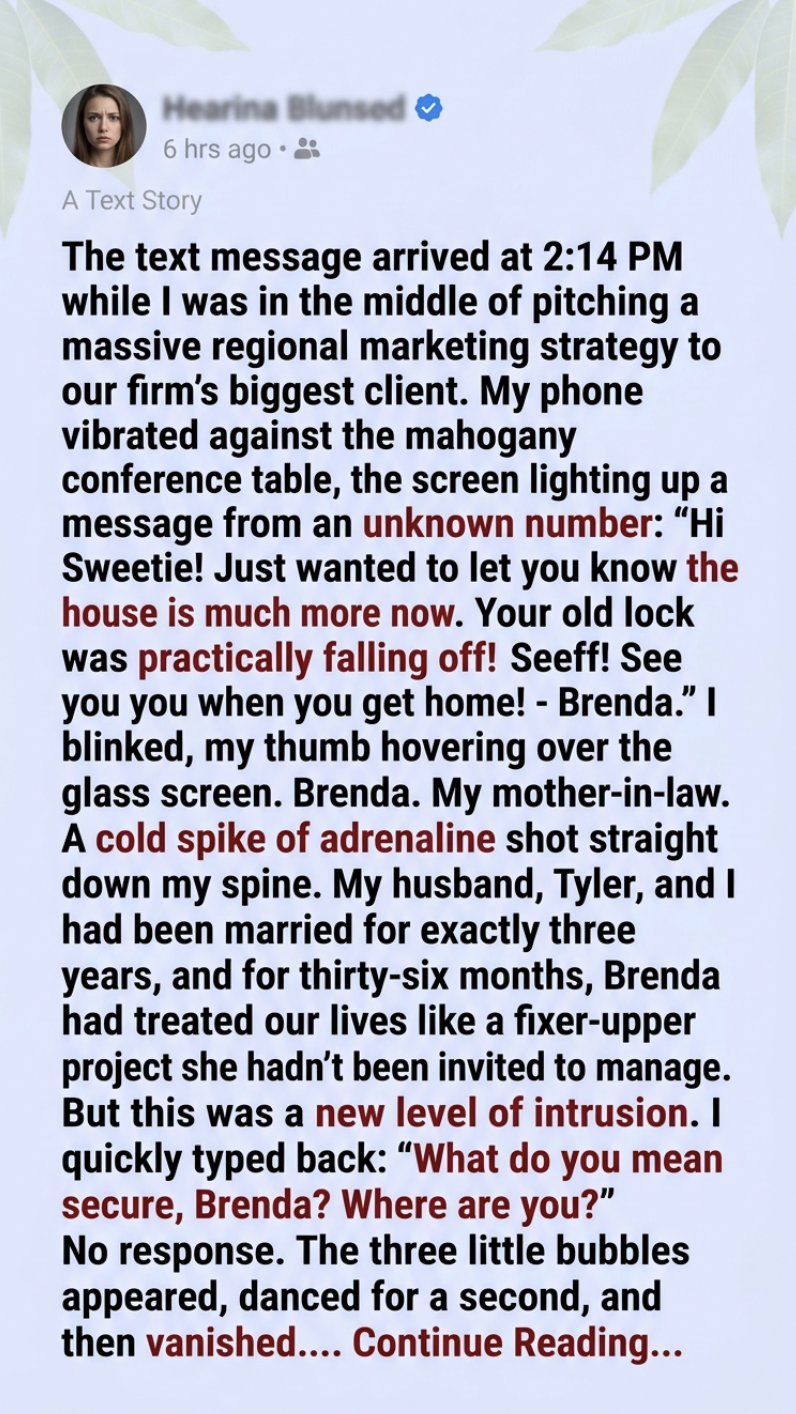
The text message arrived at 2:14 p.m., while I was pitching a major regional marketing strategy to our firm’s biggest client.
My phone vibrated against the mahogany conference table.
I glanced down, expecting an update from my husband, Tyler.
Instead, I saw a message from an unknown number.
“Hi, Sweetie! Just wanted to let you know the house is much more secure now. Your old lock was practically falling off! See you when you get home! —Brenda.”
I blinked.
Brenda.
My mother-in-law.
A cold wave of adrenaline rushed through me.
Tyler and I had been married for exactly three years, and for thirty-six months, Brenda had treated our marriage like a home renovation project she had been hired to manage.
She criticized our furniture, rearranged our kitchen, questioned our spending, and regularly appeared without warning.
But changing the locks on our house?
That was something else entirely.
I quickly typed:
“What do you mean you changed the locks, Brenda? Where are you?”
The typing bubbles appeared.
Then disappeared.
No answer.
I excused myself from the meeting, walked into the hallway, and called Tyler.
He answered on the fourth ring.
“Hey, sweetheart. Everything okay?”
“Did you give your mother permission to change our house locks?”
Silence.
Then he sighed.
“Look, I was going to tell you.”
My stomach tightened.
“Tell me what?”
“Mom thought the back door wasn’t secure. She found a locksmith who could replace everything. It’s not a big deal.”
“Tyler, this is our house. Why wasn’t I consulted?”
“She was just trying to help.”
I closed my eyes.
“Did she change every lock?”
“I think so.”
“And does she have the new keys?”
Another pause.
“Yeah. She said she’d keep a spare.”
I felt my hands begin to shake.
“Why does your mother have unrestricted access to our home?”
He lowered his voice.
“Can we talk about this tonight? I’m at work.”
I ended the call.
For the rest of the afternoon, I couldn’t concentrate.
I kept imagining Brenda walking through our house, deciding which parts of our lives needed her approval.
At 5:30, I drove home.
When I reached the front door, my old key wouldn’t turn.
I tried again.
Nothing.
The lock was completely different.
I called Tyler, but he didn’t answer.
Then I noticed a small electronic keypad beside the door.
There were two access codes written on a piece of paper tucked beneath the flowerpot.
One was labeled BRENDA.
The other was labeled TYLER.
My name wasn’t there.
I stood on the porch, staring at those two codes.
Apparently, my mother-in-law had changed the locks on my home and decided I didn’t need access information.
I called Brenda.
She answered cheerfully.
“Oh, you’re home already!”
“Brenda, what’s the new entry code?”
“Oh, sweetheart, Tyler has it. I thought I’d make things easier by keeping the spare key myself.”
“Why isn’t my code on the keypad?”
She laughed.
“You’re always so busy. I didn’t want you getting confused.”
I couldn’t believe it.
“Brenda, I need you to understand something. This is my home too.”
Her voice suddenly became cold.
“Don’t be ungrateful. I’m the one who arranged everything.”
I hung up.
A neighbor happened to be outside and recognized me. She let me use her phone to call Tyler again.
This time, he answered.
“I’m coming home,” he said.
When he arrived, he entered the code and opened the door.
I walked inside.
The house looked different.
The spare bedroom had been rearranged. Several boxes were stacked against the hallway wall, and the filing cabinet in our home office was open.
I immediately noticed that some of our important documents were missing.
My passport folder.
Our property insurance paperwork.
The envelope containing our original purchase documents.
“Tyler, where are our files?”
He looked confused.
“Mom said she moved some things so they wouldn’t get damaged during the lock replacement.”
“Where?”
He didn’t know.
I walked toward the living room and noticed a cardboard storage box beside the sofa.
Inside were folders, photographs, and several personal documents.
Then I found something that made my heart sink.
A printed email between Brenda and Tyler.
The subject line read:
Future Living Arrangements.
I read the first paragraph.
Brenda had been suggesting that Tyler and I should eventually let her move into our house permanently. She believed the extra bedroom should become hers, and she had even suggested that I might prefer moving closer to my office.
At the bottom, Tyler had replied:
“Let’s get the security situation sorted first. We can discuss the rest later.”
I turned toward him.
“What does this mean?”
He stared at the email.
“It’s not what you think.”
“Then explain it.”
He rubbed his forehead.
“Mom has been worried about being alone. She thought living closer to us would be easier.”
“And you discussed giving her space in our home without talking to me?”
“I never agreed to anything.”
“But you let her change our locks, control access, and move our documents.”
He had no answer.
That evening, I called a locksmith and arranged to have the entry system reviewed. I also contacted an attorney to understand our ownership rights and what steps we could take regarding unauthorized access and the removal of personal documents.
We checked the house together.
Nothing appeared to be missing permanently, but we made an inventory and secured our important paperwork.
The next morning, Brenda arrived carrying a basket of muffins.
She smiled as she entered.
“Good morning! I brought breakfast.”
I didn’t smile back.
“Brenda, you need to give us every copy of the new keys and every access code.”
She looked offended.
“Why? I’m family.”
“Being family doesn’t give you permission to control our home.”
She turned toward Tyler.
“Are you going to let her speak to me like this?”
For once, Tyler didn’t immediately defend her.
He looked at his mother.
“Mom, you should have asked both of us before changing the locks.”
Brenda’s expression hardened.
“I was only helping.”
“Then you should have helped by calling us first.”
She placed the basket on the counter and left without another word.
Over the next few days, we replaced the access system with one we both controlled. We established clear rules about visits, spare keys, and privacy.
Tyler and I also had a long conversation about boundaries.
I told him I didn’t expect him to stop loving his mother.
I expected him to recognize that being married meant making decisions about our home together.
He finally admitted that he had avoided confronting Brenda because he didn’t want another argument.
But avoiding conflict had allowed her to cross a line that should never have been crossed.
A few weeks later, Brenda sent me a message.
“I hope you’re happy now. I was only trying to protect my son.”
I read it twice before replying.
“Brenda, Tyler is your son, but this is our home. We appreciate genuine help. We will not accept decisions being made for us without our consent.”
I put my phone down.
For three years, I had tried to keep the peace by overlooking small intrusions.
But I finally understood that every time I stayed silent, Brenda believed she had permission to go further.
The new locks were eventually replaced.
The documents were secured.
And the access codes belonged to the people who actually lived in the house.
I hadn’t lost my home.
I had simply stopped allowing someone else to run it.
Because marriage means building a life together—not giving your mother-in-law a master key to control it.