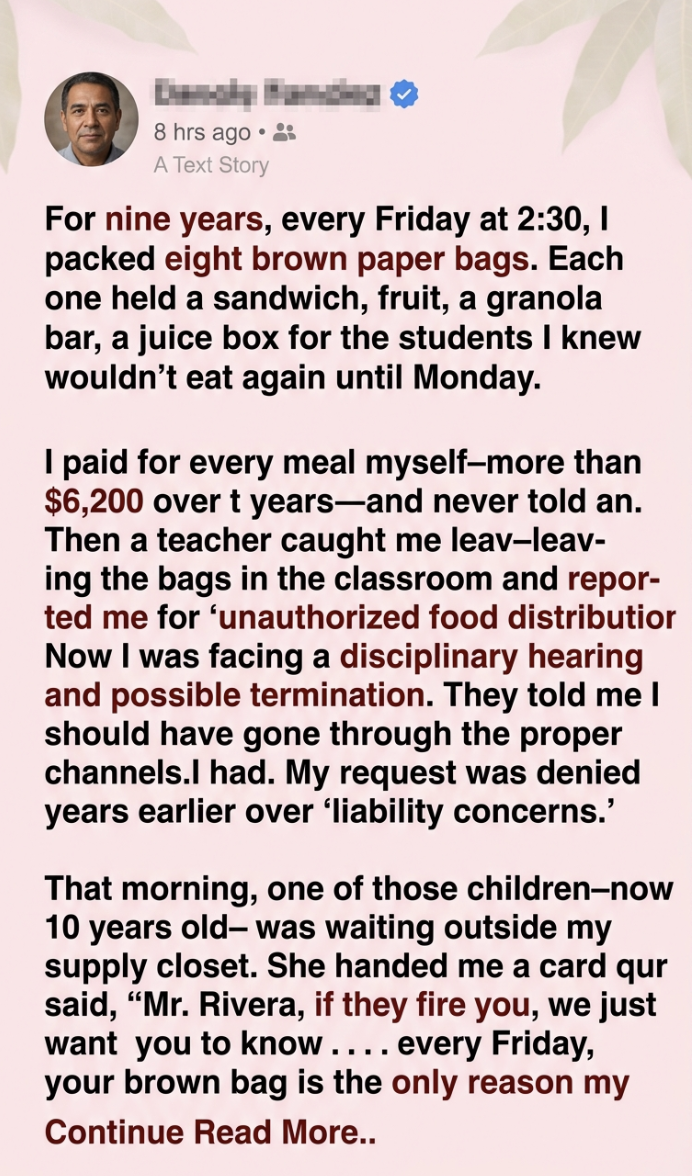
For nine years, every Friday at exactly 2:30 p.m., I packed eight brown paper bags.
Each one contained a sandwich, a piece of fruit, a granola bar, and a juice box.
I knew the eight students who needed them.
They were children who often came to school hungry on Monday mornings and quietly admitted they didn’t know when they would eat again after Friday’s lunch.
So I did something simple.
I made sure they had food for the weekend.
I paid for every sandwich, every apple, and every juice box myself. Over nine years, I spent more than $6,200.
I never asked for recognition. I never told the other teachers. I simply left the bags where the children could collect them privately before going home.
Then, one Friday, everything changed.
A teacher saw me placing the bags in the classroom and reported me for unauthorized food distribution.
A few days later, I received a notice requiring me to attend a disciplinary hearing.
The accusation was serious. I could face suspension or even termination.
The administrator looked across the table and said, “Mr. Rivera, you should have gone through the proper channels.”
I stared at him.
“I did.”
Nine years earlier, I had submitted a formal request asking the school to establish a weekend food program. I had explained that some students were going home without enough food.
My request was denied because of liability concerns.
I still remembered the exact words.
We cannot take responsibility for food distributed outside approved school programs.
So I found another way to help, quietly, without asking the children to explain their circumstances.
Now I was being punished for it.
That morning, before the hearing began, a little girl named Emma was waiting outside my supply closet.
She was ten years old.
I recognized her immediately. She had been one of the children receiving a brown bag.
She held a folded card in both hands.
“Mr. Rivera,” she whispered, “I made this for you.”
I opened it.
The handwriting was uneven, with a few words crossed out and rewritten.
It said:
“Mr. Rivera, if they fire you, we just want you to know that every Friday, your brown bag is the only reason my little brother and I have dinner on weekends. Thank you for remembering us.”
I read it twice.
Then a third time.
I had spent nine years trying to make sure those children never felt ashamed of being hungry.
But I had never understood how much those little bags meant to them.
I folded the card carefully and placed it in my shirt pocket.
When I entered the hearing room, the administrators were waiting with their documents.
They asked whether I had distributed food without authorization.
“Yes,” I answered.
They asked whether I had used my own money.
“Yes. More than $6,200 over nine years.”
Then they asked why I hadn’t stopped after my original request was denied.
I took Emma’s card from my pocket.
“Because the children were still hungry.”
I placed it on the table.
Nobody spoke for several seconds.
The hearing was paused while the district reviewed my original request, the school’s food policies, and the circumstances surrounding the meals.
A few weeks later, the district announced that I would not be terminated. The disciplinary matter was held for further review, and the school agreed to work with a local community organization to establish a supervised weekend meal program.
It wasn’t an instant victory.
There were forms, meetings, food-safety requirements, and plenty of questions to answer.
But for the first time, the school was discussing how to feed the children instead of simply discussing how to stop me.
The following month, the first approved weekend food bags were distributed.
Eight became twenty-five.
Then more families asked to help.
I kept Emma’s card in my desk drawer.
Nine years of sandwiches, fruit, and juice boxes had cost me $6,200.
But that little handwritten message reminded me that the value of those bags could never be measured by the receipt.
Sometimes, the most important thing an adult can give a child isn’t a lesson, a prize, or a speech.
Sometimes, it’s simply making sure they don’t go hungry over the weekend.