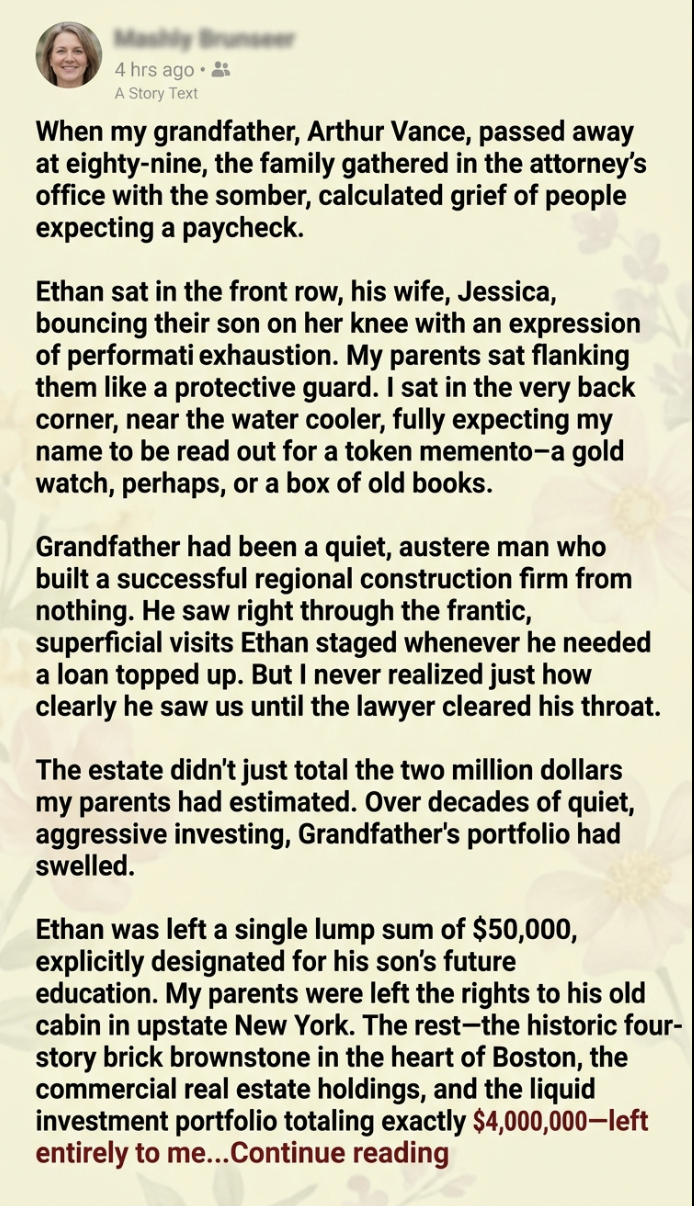
When my grandfather, Arthur Vance, passed away at eighty-nine, our family gathered in his attorney’s office with the solemn expressions of people expecting a substantial inheritance.
My brother Ethan sat in the front row. His wife, Jessica, bounced their young son on her knee, occasionally sighing as though the entire afternoon were an inconvenience.
My parents sat beside them, looking confident and composed.
I sat in the back corner, near the water cooler.
I wasn’t expecting much. Perhaps a gold watch, a collection of old books, or some small keepsake.
Grandfather had built a successful regional construction company from nothing. He was quiet, disciplined, and famously careful with money. He never showed off his wealth, and he had little patience for people who treated him like an ATM.
Ethan had never quite understood that.
His visits usually came when he needed another loan, help with a mortgage payment, or money for an expensive purchase. My parents always defended him, insisting that he was simply going through a difficult period.
I rarely asked Grandfather for anything.
Instead, I visited him because I enjoyed his company. We discussed old buildings, business, history, and the garden he spent hours maintaining. Sometimes we sat together without saying much at all.
I never imagined those ordinary afternoons would matter so much.
The attorney, Mr. Harrison, adjusted his glasses and opened the estate documents.
“Before I begin,” he said, “I want everyone to understand that Mr. Vance reviewed and updated these arrangements with independent legal advice.”
My father nodded impatiently.
“We understand. Let’s get on with it.”
Mr. Harrison began reading.
The first announcement surprised everyone.
Grandfather’s estate was worth considerably more than the $2 million my parents had estimated. Decades of careful investing had grown his holdings into a much larger fortune.
Then came Ethan’s inheritance.
“Ethan Vance will receive a lump sum of $50,000, held specifically for the future educational expenses of his son.”
Jessica stopped bouncing the child.
Ethan leaned forward.
“Fifty thousand?” he asked. “That’s it?”
Mr. Harrison continued.
“My client’s son and daughter-in-law will receive the rights to use and maintain his cabin in upstate New York, subject to the terms outlined in the estate documents.”
My mother looked confused.
Then the attorney reached the final section.
“The historic four-story brownstone in Boston, the commercial real estate holdings, and the liquid investment portfolio, currently valued at approximately $4 million, have been left entirely to his granddaughter.”
For a moment, I didn’t understand what I had heard.
Then everyone turned toward me.
Ethan stood up.
“Wait. What?”
My father looked at Mr. Harrison.
“That’s impossible. There must be some mistake.”
Mr. Harrison remained calm.
“There is no mistake. The documents were properly executed, and Mr. Vance’s instructions were explicit.”
Jessica stared at me.
“Why would he leave everything to her?”
I sat frozen, trying to process the words.
Four million dollars.
The brownstone.
The commercial properties.
The investment portfolio.
Everything.
Ethan shook his head.
“This makes no sense. I was his grandson. I visited him all the time.”
Mr. Harrison closed the folder.
“Your grandfather was very aware of the frequency and circumstances of those visits.”
My father became visibly irritated.
“Arthur wasn’t always thinking clearly toward the end. We need to challenge this.”
The attorney looked directly at him.
“Mr. Vance anticipated that question. He completed the appropriate capacity assessments and received independent legal advice when finalizing his estate plan.”
Then he handed me a sealed envelope.
“Your grandfather asked that I give you this personally.”
My hands trembled as I opened it.
Inside was a letter written in his familiar, careful handwriting.
“My dear girl,
If you are reading this, I am no longer sitting in my garden telling you that old buildings are only as strong as their foundations.
I know the family may be surprised by my decisions. Some may even be angry.
But I want you to understand something.
I did not choose you because you needed the money most. I chose you because you never made me feel that my money was the reason you came to see me.
You listened when I spoke about the business. You asked about the people who worked for me. You remembered the little things.
You never treated me like a balance sheet.
The brownstone and the investments represent decades of work. I want them placed in the hands of someone who understands that wealth comes with responsibility.
Don’t spend your life trying to make everyone happy with what I have left you.
Build something worthwhile.
And never confuse being loved with being financially useful.
With all my love,
Grandpa.”
I couldn’t continue reading.
Tears blurred the page.
Across the room, Ethan was still arguing.
“He should have divided it equally! We’re his family!”
I folded the letter carefully.
“He was our family,” I replied. “He knew all of us. He made his decision.”
My mother reached for my hand.
“Sweetheart, surely we can discuss how to make this fair. Ethan has a family to support.”
I looked at her.
“So do I have a future to build. And Grandpa wanted me to manage what he left responsibly.”
The attorney explained the next steps, including the transfer process, property obligations, taxes, and professional management of the investments. It was clear that receiving an estate of this size was not the same as having four million dollars freely available in a checking account.
I would need to make careful decisions.
And I intended to.
Over the following months, I met with the estate attorney, an accountant, and property managers. I learned the history of the brownstone and reviewed every commercial holding. I also made sure the educational fund for Ethan’s son was handled according to Grandfather’s instructions.
Ethan eventually contacted me.
At first, he asked whether I would give him a larger share. Later, he suggested that we invest in a business together.
I told him I would consider a legitimate business proposal, but I would not hand over money simply because we shared a last name.
He didn’t like that answer.
But I remembered Grandpa’s letter.
For years, I had sat quietly in the background while my family measured importance by who needed the most money and who demanded the most attention.
Grandfather had noticed something different.
He had noticed who showed up when there was nothing to gain.
And that was the inheritance I valued most.
The greatest thing Arthur Vance left me wasn’t the $4 million. It was the reminder that character matters long before anyone knows what you own.