My grandmother, Clara, had always been a quiet woman.
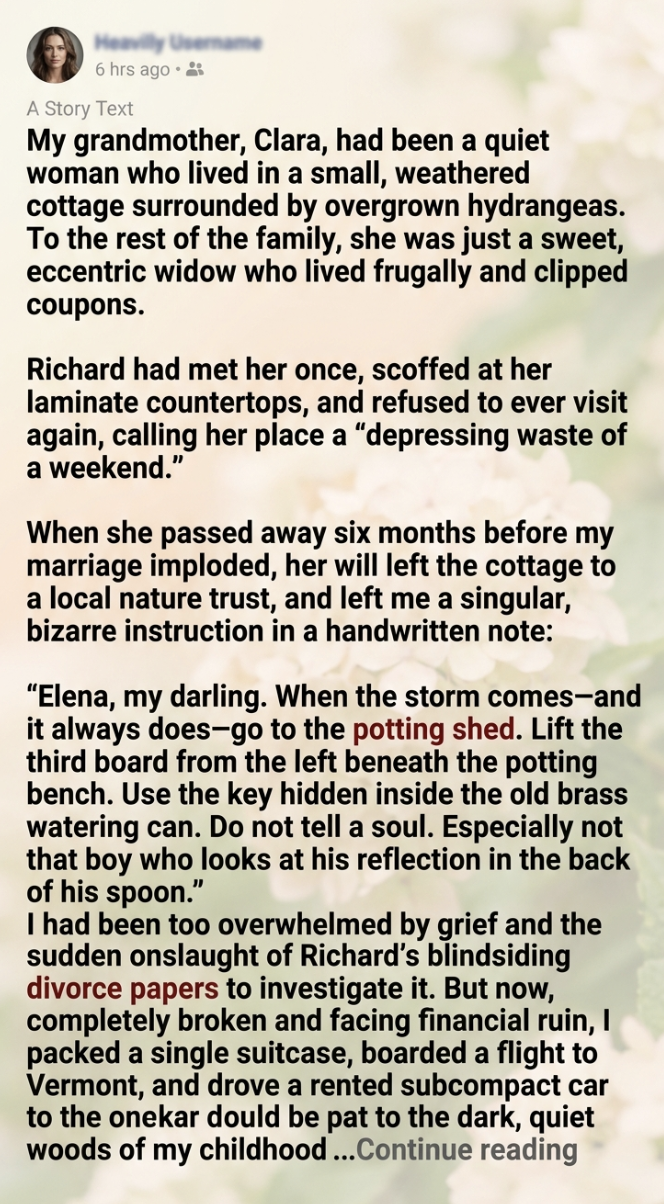
She lived in a small, weathered cottage in Vermont, surrounded by overgrown hydrangeas, peeling garden furniture, and a potting shed that smelled permanently of damp earth and lavender.
To the rest of our family, she was simply a sweet, eccentric widow who clipped coupons, reused tea bags, and refused to replace her old kitchen countertops.
My ex-husband, Richard, had met her once.
He took one look at her modest home, scoffed at the laminate countertops, and later called it a “depressing waste of a weekend.”
He never visited again.
Grandmother Clara never seemed offended. She simply smiled and went back to tending her flowers.
Six months before my marriage collapsed, she passed away. Her will left the cottage to a local nature trust, preserving the land and gardens she had loved for decades.
I received no property and no substantial inheritance.
But I did receive a handwritten note.
It said:
“Elena, my darling. When the storm comes—and it always does—go to the potting shed. Lift the third board from the left beneath the potting bench. Use the key hidden inside the old brass watering can. Do not tell a soul. Especially not that boy who looks at his reflection in the back of his spoon.”
At the time, I was too overwhelmed by grief to understand what she meant.
Then Richard blindsided me with divorce papers.
The man I had shared a home, a bed, and years of my life with suddenly wanted to separate our finances in ways that left me frightened about my future. Legal bills piled up, our shared accounts became a source of conflict, and I discovered that the comfortable life I thought I had was far more fragile than I imagined.
For months, I kept Clara’s note tucked inside my bedside drawer.
Then, with one suitcase and the last of my savings, I boarded a flight to Vermont.
I rented a small car and drove through the darkening woods to the cottage where I had spent so many childhood summers.
The house was quiet. The hydrangeas had grown wild, and the garden gate creaked when I pushed it open.
I stood there for a moment, remembering Clara’s voice telling me not to pick the flowers before they had fully opened.
Then I walked toward the potting shed.
Inside, the familiar smell of damp soil and dried lavender brought tears to my eyes.
I found the old brass watering can exactly where she had described. When I turned it over, something heavy rattled inside.
A small iron key.
My hands trembled as I moved the bags of soil and examined the floor beneath the potting bench.
The third board from the left was slightly loose.
I pried it up.
Beneath it sat a heavy, dust-covered iron strongbox.
For several seconds, I simply stared at it.
Then I inserted the key.
Click.
The lock opened.
Inside were three things: a thick envelope, a leather-bound notebook, and a small collection of official-looking documents tied together with faded ribbon.
The envelope had my name written across it in Clara’s familiar handwriting.
I opened it first.
“My darling Elena,
If you are reading this, then the storm has finally reached you. I wish I could have been there to hold your hand, but I knew there might come a day when you would need to discover the truth without anyone else’s permission.
You have always believed that being loved meant being protected. I want you to understand that being prepared is just as important.”
I stopped reading.
My grandmother had known something.
I opened the notebook.
It contained decades of careful entries—dates, names, account references, and notes about investments. Clara had recorded every purchase and sale with the precision of someone who had spent her life paying attention to details everyone else overlooked.
The documents revealed something I could never have imagined.
My grandmother had quietly built an investment portfolio over more than forty years. She had invested in land, municipal bonds, and shares in several companies long before they became valuable.
She had lived modestly not because she had no money, but because she had never believed wealth needed to announce itself.
There were account statements, ownership records, and instructions from an estate attorney. The portfolio was substantial, but the documents made clear that I could not simply take everything or treat the strongbox as proof of ownership.
I needed professional help to verify the records and understand exactly what Clara had intended.
At the bottom of the box was one final envelope.
Inside was a photograph of us together in her garden. I was about twelve, holding a watering can almost as big as my body.
On the back, she had written:
“Richard thinks a person’s worth can be measured by the kitchen they own, the car they drive, or the reflection they admire. You must never make that mistake, Elena.
I left the cottage to the nature trust because the land deserves to remain wild and beautiful. I left you something different because I wanted you to have choices.
Do not let anyone take those choices away.”
I sat on the cold wooden floor and cried.
Not because I had discovered money.
Because my grandmother had seen me more clearly than the man I had married.
The next morning, I contacted the attorney named in the documents. He arranged to verify the accounts, review the estate records, and explain the legal process. It took weeks of paperwork and careful investigation before I understood the full extent of Clara’s arrangements.
But the most important discovery wasn’t financial.
It was that she had deliberately kept the cottage out of my inheritance so the nature trust could preserve it. She hadn’t forgotten me. She had created two separate gifts, each with a purpose.
And she had trusted me enough to wait until I was ready to understand.
When Richard eventually heard that I had discovered something valuable, he contacted me.
His first message was simple:
“Elena, I think we should talk. We were married for years, after all.”
I read it twice.
Then I put my phone down.
For years, he had treated my grandmother’s little cottage as if it were beneath him. Now that he suspected there was something valuable connected to her name, suddenly he wanted to reconnect.
I didn’t argue. I didn’t explain.
I simply continued working with the attorney and protecting what Clara had left me.
A few months later, I returned to Vermont and visited the cottage. The nature trust had begun restoring the garden, and the hydrangeas were blooming again.
I stood beside the old potting shed, holding Clara’s photograph.
For the first time in a long while, I felt that my life belonged to me again.
Richard had taken the marriage I thought would last forever.
But he hadn’t taken my grandmother’s wisdom, my ability to begin again, or the future I could still build.
And as the wind moved through the hydrangeas, I finally understood her note.
The storm had come.
But Clara had made sure I knew where to find shelter.