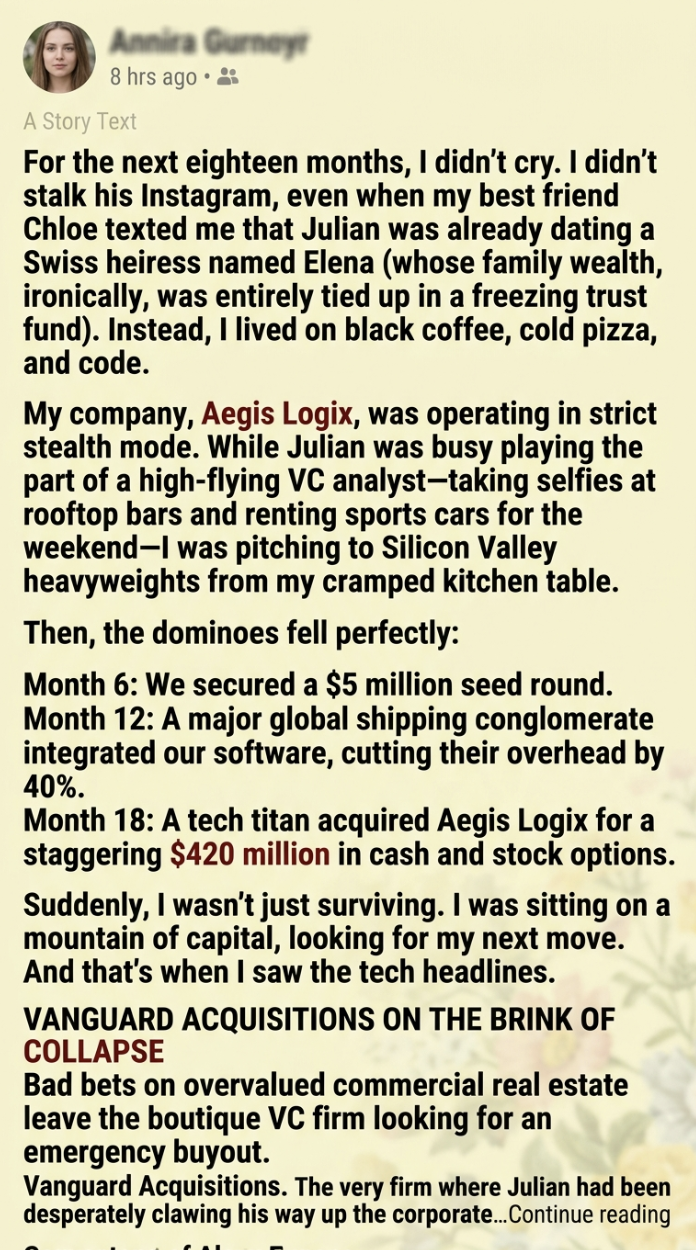
For the next eighteen months, I didn’t cry.
I didn’t stalk Julian’s Instagram, even when my best friend Chloe sent me pictures of him posing beside a Swiss heiress named Elena. Apparently, he had upgraded his girlfriend, his wardrobe, and his lifestyle.
What he hadn’t upgraded was his judgment.
While Julian spent his weekends taking selfies at rooftop bars, renting sports cars, and telling everyone he was destined for greatness as a venture capital analyst, I was building something he never knew existed.
My company was called Aegis Logix.
It operated in strict stealth mode, developing logistics automation software designed to help major shipping companies eliminate costly inefficiencies. I worked from a cramped kitchen table, surviving on black coffee, cold pizza, and a determination I couldn’t quite explain.
I wasn’t interested in proving Julian wrong.
I wanted to prove to myself that losing him hadn’t meant losing my future.
Then the milestones started arriving.
Month 6: The $5 Million Breakthrough
After months of pitching investors, Aegis Logix secured a $5 million seed round. For the first time, I could hire a proper engineering team and accelerate development.
Month 12: The Industry Took Notice
A major global shipping conglomerate integrated our software. Within the first year of deployment, its operating overhead dropped by 40%.
Suddenly, investors who had once ignored my emails were requesting meetings.
Month 18: The $420 Million Deal
A technology giant acquired Aegis Logix for $420 million in cash and stock options.
I stared at the acquisition documents for several minutes, barely believing what I was reading.
Eighteen months earlier, Julian had walked away believing I was an ambitious woman with no future without him.
Now I had built a company worth hundreds of millions.
But I didn’t immediately buy a mansion or announce my success online. I took a few days to breathe, review my finances, and decide what I wanted to do next.
Then, one morning, a headline caught my attention.
VANGUARD ACQUISITIONS ON THE BRINK OF COLLAPSE
The article described a boutique venture capital firm struggling after several aggressive commercial real estate investments lost value. Its investors were demanding answers, its lenders were growing impatient, and the firm was reportedly searching for an emergency buyer.
I read the name twice.
Vanguard Acquisitions.
Julian’s firm.
The very place where he had spent the last eighteen months trying to climb the corporate ladder.
It was owned by Arthur Pendelton, an old-money billionaire famous in financial circles for treating employees as replaceable parts in an enormous machine.
According to the article, Vanguard needed capital, restructuring expertise, and a buyer willing to take on its troubled portfolio.
I leaned back in my chair.
Then I remembered something Julian had once said during our relationship.
“You’ll never understand how real business works. People like you build little projects. People like me make the decisions.”
I almost laughed.
I opened my laptop and contacted my investment team.
“Find out everything we can about Vanguard Acquisitions,” I said. “I want its financial position, outstanding obligations, assets, and potential liabilities. No assumptions. I want the complete picture.”
My chief financial officer paused.
“Are you considering an acquisition?”
“I’m considering an opportunity,” I replied.
A week later, my team returned with a preliminary assessment. Vanguard was in far worse condition than the headlines suggested. But there were still valuable investments, experienced professionals, and promising companies buried beneath its financial problems.
We prepared a confidential proposal.
I wasn’t interested in rescuing Julian’s career. I was interested in making a sound investment, protecting the people affected by Vanguard’s decisions, and building something worthwhile from a struggling business.
Then came the meeting.
Arthur Pendelton sat at the head of a long conference table, surrounded by lawyers and financial advisers. He looked irritated when my team entered.
He expected an established billionaire or an institutional buyer.
Instead, he saw a woman in a simple black suit carrying a thin folder.
“Are we waiting for someone else?” he asked.
My adviser placed the acquisition proposal in front of him.
“No, Mr. Pendelton. She’s leading the offer.”
Arthur glanced at me, then at the document.
His expression changed when he reached the proposed valuation and financing terms.
But the real surprise came when he opened the final page.
There, beneath the name of the acquiring investment group, was the company that had funded the offer.
Aegis Logix Holdings.
Arthur looked up.
“Wait. You’re the founder of Aegis Logix?”
I nodded.
He leaned back, studying me with a completely different expression.
And just as the meeting was about to begin, the conference room door opened.
Julian walked in carrying a folder.
He was halfway through saying, “Mr. Pendelton, the analysts have prepared the revised figures,” when he noticed me.
His smile disappeared.
For eighteen months, he had believed he was moving ahead while I was falling behind.
Now he was standing in a room where I held the investment proposal that could determine the future of his firm.
I looked at him calmly.
“Hello, Julian,” I said. “It’s been a while.”
For the first time since our breakup, he had absolutely nothing to say.
And I hadn’t even turned the first page of my proposal.
Because this meeting wasn’t about revenge.
It was about business—and whether Vanguard deserved a second chance.