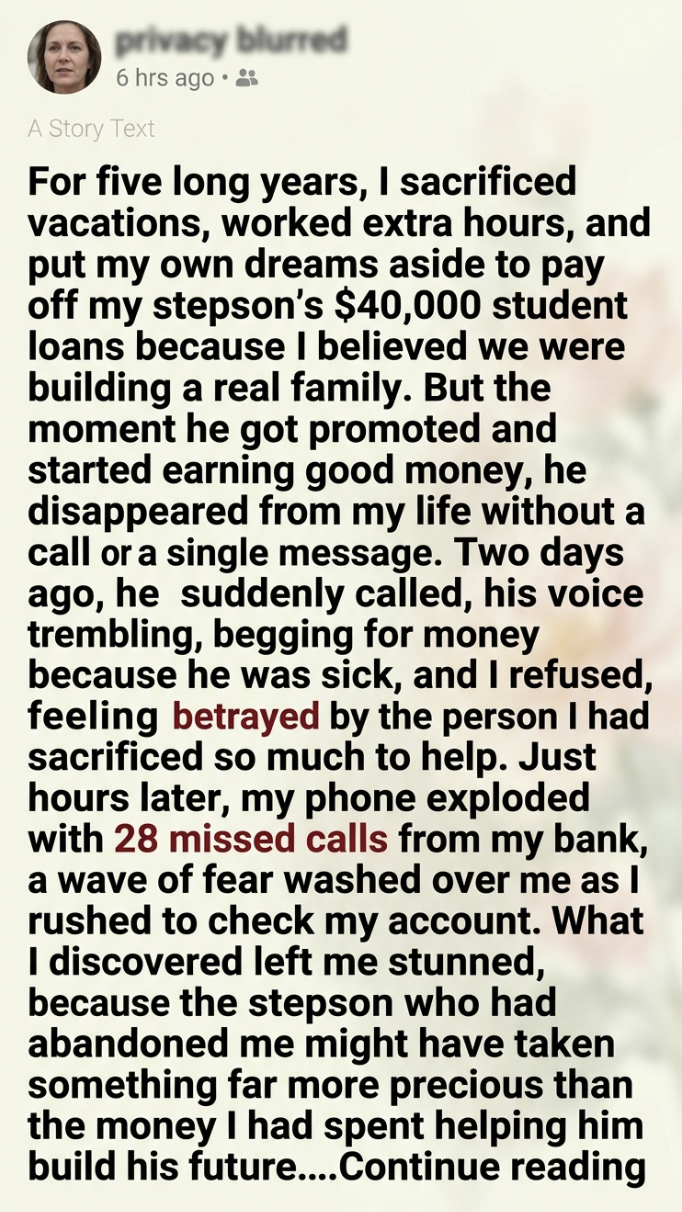
For five years, I believed I was doing what family was supposed to do.
When my stepson, Ethan, graduated from college with $40,000 in student loans, he was overwhelmed. His father had passed away years earlier, and I had promised my late husband that I would always try to be there for his son.
So I made a decision that changed my life.
I would help Ethan pay off his debt.
I worked extra shifts, gave up vacations, postponed replacing my aging car, and stopped buying things I wanted because every spare dollar went toward those loans. While my friends traveled with their families, I stayed home, telling myself that someday Ethan would understand what those sacrifices meant.
Whenever I sent another payment, he thanked me.
“Thank you so much,” he would say. “I won’t forget what you’re doing for me.”
Those words became my reward.
I didn’t expect him to repay every dollar immediately. I didn’t need expensive gifts or public recognition. I simply wanted to believe that we were building a real family, one in which people showed up for each other when life became difficult.
Eventually, Ethan found a good job.
Then he received a promotion.
His salary increased, his apartment became nicer, and his social media filled with photographs of expensive restaurants and weekend trips. I was genuinely happy for him. After years of struggling, he was finally building the future he had dreamed about.
I thought our relationship would grow stronger now that he was financially secure.
Instead, he disappeared.
At first, I assumed he was busy. I sent occasional messages asking how work was going. Sometimes he responded with a brief thumbs-up. Other times, he didn’t respond at all.
I invited him to dinner.
He canceled.
I called on his birthday.
He said he was out with friends and would call me later.
He never did.
Months passed, and I finally stopped making excuses for him. The painful truth was that Ethan had found his footing in life, and apparently, he no longer needed me.
Five years of sacrifice had bought me no guarantee of a lasting relationship.
Still, I never imagined what would happen next.
Two days ago, my phone rang just after breakfast.
Ethan’s name appeared on the screen.
I stared at it in disbelief. It had been months since we had a real conversation.
When I answered, his voice sounded weak and frightened.
“Can you help me?”
I sat down.
“What’s wrong?”
He told me he was sick, that he had medical bills, and that he was struggling to cover his expenses. He needed money urgently.
I listened quietly.
Part of me wanted to ask whether he was feeling better, whether he had seen a doctor, and whether there was someone nearby who could help him.
Another part remembered the lonely holidays, the unanswered messages, and the years I had spent putting his future ahead of my own.
“Ethan,” I finally said, “I helped you because I loved you. I gave up a great deal to help you get started in life. But when you no longer needed my help, you disappeared.”
There was a long silence.
“I know,” he whispered.
“I can’t keep being the person you call only when you need money.”
He began to plead.
“Please. I’m really sick. I don’t know who else to ask.”
My heart ached. I wasn’t certain whether he was exaggerating his situation, and I didn’t want him to suffer. But I also knew that sending money without understanding what was happening wasn’t the answer.
“I can’t send you money right now,” I said. “If you’re ill, please contact your doctor or someone who can help you get appropriate care. If you want to talk honestly about our relationship, I’m willing to listen.”
He hung up without saying goodbye.
I sat at the kitchen table, feeling both guilty and strangely relieved. Setting a boundary with someone I loved was harder than I had imagined.
I tried to return to my morning routine.
Then my phone began ringing again.
One call.
Then another.
Then another.
By lunchtime, I had twenty-eight missed calls from my bank.
My stomach dropped.
I immediately called the number printed on the back of my bank card rather than responding to any unexpected messages or links. After verifying my identity, I asked the representative what was happening.
“Ma’am,” she said carefully, “we’ve detected several unusual activities associated with your account. We need to verify whether you authorized them.”
My hands went cold.
“What activities?”
She explained that there had been attempted transfers and changes to certain account settings. Some transactions had been flagged for review, and the bank needed to confirm which actions were legitimate.
I opened my banking app.
My savings account was still visible, but several details looked unfamiliar. I couldn’t tell immediately whether any money had actually left the account.
“Has someone taken my money?” I asked.
“We’re investigating the activity,” she replied. “Please don’t approve any additional requests or share verification codes with anyone. We’ll guide you through securing the account.”
I followed her instructions, changed my credentials through the bank’s official app, and asked the representative to restrict suspicious activity while the investigation continued.
Then I checked my email.
There was a security notification about an attempted password reset.
The recovery request had been made using information connected to an old email address I had once shared with Ethan when he was in college.
My heart began pounding.
Years earlier, I had helped him organize scholarship forms, student loan documents, and university applications. I had given him access to certain files because I trusted him as family.
Had that old access somehow put my accounts at risk?
I didn’t know.
I called the bank again and asked whether they could identify the source of the activity. They couldn’t yet establish who had initiated it, and they warned me not to assume the identity of anyone without evidence.
But I remembered Ethan’s desperate phone call.
I remembered his silence when I refused to send money.
And I remembered that he was one of the few people who had once known some of my old account details.
I called him.
He didn’t answer.
I sent a message asking whether he had recently tried to access any of my accounts or requested money through my banking information.
No response.
That evening, I contacted my bank’s fraud department again and followed its instructions for documenting the suspicious activity. I also contacted a lawyer to understand what steps I should take if the investigation revealed unauthorized access.
I wasn’t going to make accusations based solely on timing.
But I wasn’t going to ignore the possibility, either.
The following morning, the bank called with an update.
Several attempted transactions had been blocked before they could be completed. One account change had been made using an old recovery method, but the bank was still investigating how the request had been initiated and who was responsible.
I asked whether my money was safe.
The representative confirmed that the bank had secured the affected access while reviewing the activity. She couldn’t promise the investigation was complete, but she explained the next steps and how I could dispute any unauthorized transaction if one was confirmed.
I finally allowed myself to breathe.
Then another call came through.
It was Ethan.
“Please don’t be angry,” he said immediately.
My heart sank.
“Ethan, I need you to answer one question. Did you try to access my bank account?”
He went silent.
For several seconds, I heard only his breathing.
Then he admitted that he had tried to recover access to an old account profile he remembered from the time I helped him with his college paperwork. He claimed he had been looking for an old document containing financial information he thought he needed for his medical expenses. He insisted he hadn’t intended to take money.
I gripped the edge of the table.
“You tried to access my financial information without asking me?”
“I was desperate,” he said. “I didn’t know what else to do.”
“You could have asked me for help. You could have told me what was happening. You could have respected my right to decide what to share.”
He began crying.
“I know I messed up.”
I wanted to believe his explanation, but I had learned that trust couldn’t be restored simply because someone sounded frightened.
“Ethan, the bank is investigating. You need to cooperate with them and provide whatever information they request. I won’t interfere with that process.”
“Are you going to report me?”
“I’ve reported suspicious activity because that’s what I needed to do to protect my account. The bank will determine what happened. I won’t make promises about the outcome.”
He cried harder.
Then he said the words that hurt almost as much as the financial scare itself.
“I thought you would help me no matter what. You always did.”
I closed my eyes.
For five years, I had believed that helping Ethan meant never letting him fall. I had thought love required me to keep sacrificing until he was secure enough to stand on his own.
But somewhere along the way, he had confused my generosity with unlimited access to my life.
“I helped you because I wanted you to have a future,” I told him. “I never agreed to give up my privacy or my financial security. Those are not the same thing.”
He didn’t answer.
I told him that if he was genuinely sick, he should seek appropriate medical care and contact a trusted person nearby. I was willing to have an honest conversation about our relationship, but I would not send money under pressure or ignore what had happened with my account.
Then I ended the call.
Over the following weeks, I cooperated with the bank’s investigation and preserved the relevant messages and notifications. I secured my accounts, reviewed my recovery settings, and removed old access wherever possible.
I also made an appointment with a financial adviser to review my savings and retirement plans.
For the first time in years, I looked at my finances and asked a question I should have asked much earlier:
What did I need to protect my own future?
I had spent five years helping Ethan build his.
I had postponed vacations, driven an unreliable car, and told myself that my sacrifices were worthwhile because they were made for family. I didn’t regret helping him through college. I regretted believing that love meant I had to ignore my own needs.
Ethan eventually sent a longer message.
He apologized for disappearing after his promotion. He acknowledged that he had treated my support as something he could count on without considering the emotional cost to me. He also admitted that he should have spoken to me instead of trying to access old account information.
I read his message more than once.
I wanted to forgive him, but I understood that forgiveness and trust were different things.
I replied that I was willing to talk when we could do so honestly, but rebuilding our relationship would take time. Any further discussion about money would happen openly, without pressure, and with clear boundaries.
He agreed.
I still don’t know exactly how our relationship will look in the future. The bank’s review has its own process, and I intend to let it run its course rather than assume the worst or pretend nothing happened.
But I know what has changed in me.
I no longer measure my worth by how much I can give someone else.
I can care about Ethan without financing every crisis. I can hope he recovers from his illness without giving him unrestricted access to my savings. And I can acknowledge the good I did for him without allowing that generosity to become an obligation to accept disrespect.
For five years, I believed I was building a family by paying off $40,000 in student loans.
Perhaps I did help him build a future.
But I also learned that a real family is built on honesty, respect, and responsibility—not on one person sacrificing everything while another remembers them only when trouble arrives.
I had helped Ethan take his first steps into adulthood.
Now it was time for me to protect the life I had spent so many years putting second.
And that wasn’t selfish.
It was long overdue.