I was the youngest, the quiet one, and the sibling who had skipped the traditional corporate ladder to build an independent life as an automation engineer and digital asset creator.
While my siblings talked about promotions, mortgages, and country club memberships, I usually sat at the edge of the room, playing the role of the agreeable, unbothered little brother.
They assumed I had settled for less because I lacked ambition.
The truth was that I had simply built a life they didn’t understand.
“Austin, honey, can you check the thermostat upstairs?” my mother called from the kitchen, wiping her hands on an apron. “It’s freezing up there, and your father’s knees are acting up.”
“On it, Mom,” I replied, rising from my armchair.
I welcomed the excuse to escape the noise downstairs. My older siblings had spent the afternoon comparing salaries, investment properties, and expensive renovations. Maya, my sister, had just returned from another business trip and was talking about her latest promotion as though the rest of us were an audience she had paid to entertain.
I walked up the carpeted stairs, passing a row of old family photographs—stiff, smiling portraits from a time before we grew into wildly different adults.
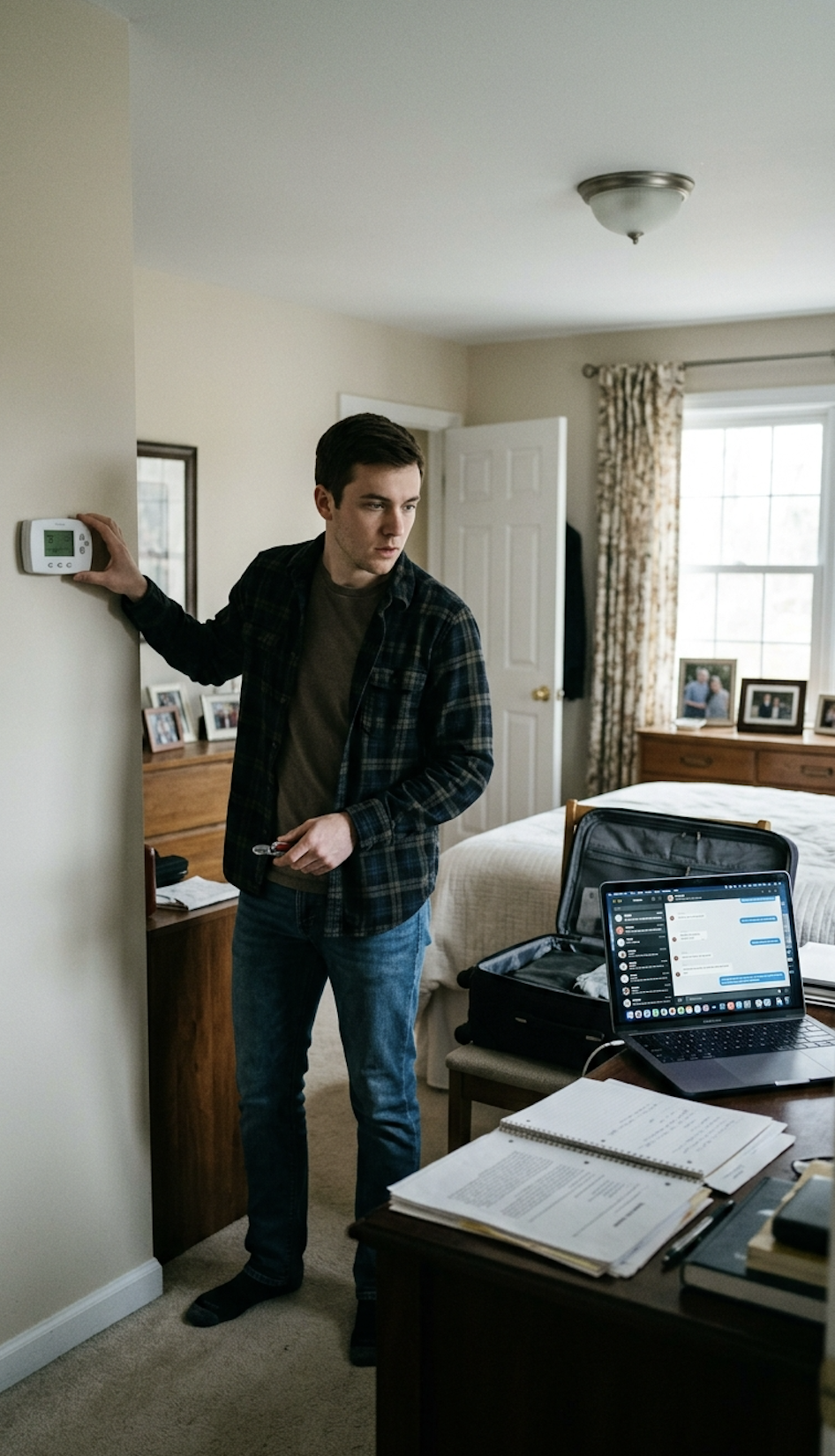
The guest bedroom door stood open. Maya was staying there for the weekend, and the secondary thermostat control was mounted on the wall near her closet.
As I adjusted the dial, a soft, repetitive pinging caught my attention.
It came from Maya’s laptop, which sat open on the vanity table.
Her messaging app was still synced, and new messages were arriving rapidly. I had no intention of reading them. Privacy was a basic courtesy, even in a family that treated boundaries as optional.
I turned toward the door.
Then my own name flashed across the screen in bold.
AUSTIN.
I stopped.
The message beneath it read:
Has anyone figured out how much money he’s actually making? Mom says he barely covers his expenses.
Another message appeared almost immediately.
He plays with computers all day. There’s no way he’s making what he claims.
I felt my jaw tighten.
I had never claimed to be rich. I had simply stopped explaining my work to people who had already decided it wasn’t real.
Then another message appeared.
Good. Keep Dad from asking questions about his business. We need him to agree before Austin realizes what we’re planning.
My hand froze on the thermostat.
What were they planning?
A new message arrived from my older brother, Ethan.
Once Dad signs the documents, Austin won’t have any say in the property. He’ll complain, but he always backs down.
Maya replied with a laughing emoji.
Exactly. He’s the quiet one. He hates conflict. Just make him feel like he’s being selfish, and he’ll fold.
I stared at those words until the letters seemed to blur.
For years, I had convinced myself that being underestimated was a small price to pay for keeping the peace. I had listened to their jokes about my unconventional career, accepted their advice about getting a “real job,” and smiled whenever they treated my achievements as a hobby.
But this wasn’t another family joke.
They were discussing me as if I were an obstacle to be managed.
I should have closed the laptop and walked away. Instead, I noticed a file preview attached to the conversation.
FAMILY PROPERTY TRANSFER — FINAL DRAFT.
My father’s name appeared near the top of the document.
Below it were references to a family property that had belonged to our parents for decades. I didn’t know every detail of their estate arrangements, but I knew my father had recently mentioned updating his plans. He had asked each of us to attend a family meeting that weekend.
Apparently, the meeting had a purpose my siblings had neglected to share with me.
A final message appeared.
If he asks why Austin isn’t included, tell him Austin already agreed. Dad trusts us. By the time he checks anything, it’ll be too late.
I stepped back from the vanity.
My heart was pounding, but something else was happening beneath the shock. The familiar urge to laugh things off, apologize for making anyone uncomfortable, and pretend everything was fine began to disappear.
They had mistaken my silence for weakness.
They had mistaken my independence for failure.
And they had mistaken my willingness to avoid arguments for permission to make decisions on my behalf.
I took out my phone and photographed the visible messages and document preview, careful not to open private files or alter anything. Then I closed the laptop and finished adjusting the thermostat.
When I returned downstairs, everyone was gathered around the dining table.
My father was pouring coffee. Ethan was discussing mortgage rates, and Maya was laughing at something my mother had said.
The scene looked ordinary.
That was what made it so unsettling.
“There you are, Austin,” Maya said sweetly. “Get the temperature fixed?”
“Sure did,” I answered, taking my seat.
My father looked up. “Everything all right upstairs?”
I met his eyes.
“Actually, Dad, I think we need to talk about the family property before anyone signs anything.”
The room went quiet.
Maya’s smile faltered for half a second before she recovered.
“What property?” she asked.
“The one in the transfer documents.”
Ethan put down his coffee cup.
My mother looked from me to my father, clearly trying to understand why the conversation had taken such a sudden turn.
My father frowned. “What transfer documents?”
I didn’t look at Maya. I kept my eyes on him.
“I think you should see what your children have been discussing before you agree to anything.”
For the first time that afternoon, nobody had a clever remark about my career, my income, or my future.
Maya’s face had gone pale.
“ Austin,” she said quietly, “you’ve misunderstood something.”
“Then explain it,” I replied. “Tell us why you were planning to make Dad believe I had already agreed to something I hadn’t even seen.”
My father slowly set down the coffee pot.
“Is that true, Maya?”
She opened her mouth, but no answer came.
Ethan leaned forward. “This is a private family matter. We can discuss it later.”
“No,” I said, surprising even myself with the steadiness of my voice. “You were happy to discuss it when you thought I wasn’t part of the conversation. Now I’m here.”
My father asked me to show him the evidence.
I placed my phone on the table.
He read the messages in silence. With every line, the color drained from his face. When he reached the part about telling him I had already agreed, he looked directly at Maya.
“Were you going to make me sign something under false pretenses?”
Maya began to cry.
She said the family was trying to protect everyone’s interests. She said I was independent and didn’t need the property as much as Ethan did. She said they had assumed I wouldn’t object.
Not once did she explain why they had planned to lie.
I listened until she ran out of words.
Then I said, “You didn’t ask whether I needed anything. You didn’t ask what I thought was fair. You decided I was the easiest person to take something from because I wouldn’t make a scene.”
Nobody spoke.
My father pushed the documents away.
“No one is signing anything today,” he said firmly. “I’ll have an independent attorney review every page. No one speaks for Austin, and no one claims he agreed to something he never approved.”
Maya wiped her eyes. Ethan stared at the table. My mother reached for my hand, but I needed a moment before I could accept the gesture.
I hadn’t gone upstairs looking for a fight. I had gone to adjust a thermostat.
Yet one careless message had revealed a truth I could no longer ignore: the people who called me the quiet one had counted on my silence to protect their plans.
That evening, I left my parents’ house without an argument or a dramatic goodbye.
I didn’t need to prove that my business was successful. I didn’t need to list my income, show them my accounts, or explain the life I had built beyond their expectations.
My worth had never depended on their approval.
Over the following weeks, my father arranged an independent legal review, and the proposed transfer was put on hold until every beneficiary’s rights and every document could be properly examined. I made it clear that I would not sign anything under pressure, and I would not accept anyone speaking on my behalf.
Maya eventually sent me a message saying she hoped we could move forward.
I told her that forgiveness was possible, but trust would have to be rebuilt through honesty and action.
For years, I had thought keeping the peace meant keeping quiet.
Now I understood the difference.
Being the quiet one doesn’t mean you have no voice. It means that when you finally speak, you should have something worth saying—and the courage to stand by it.