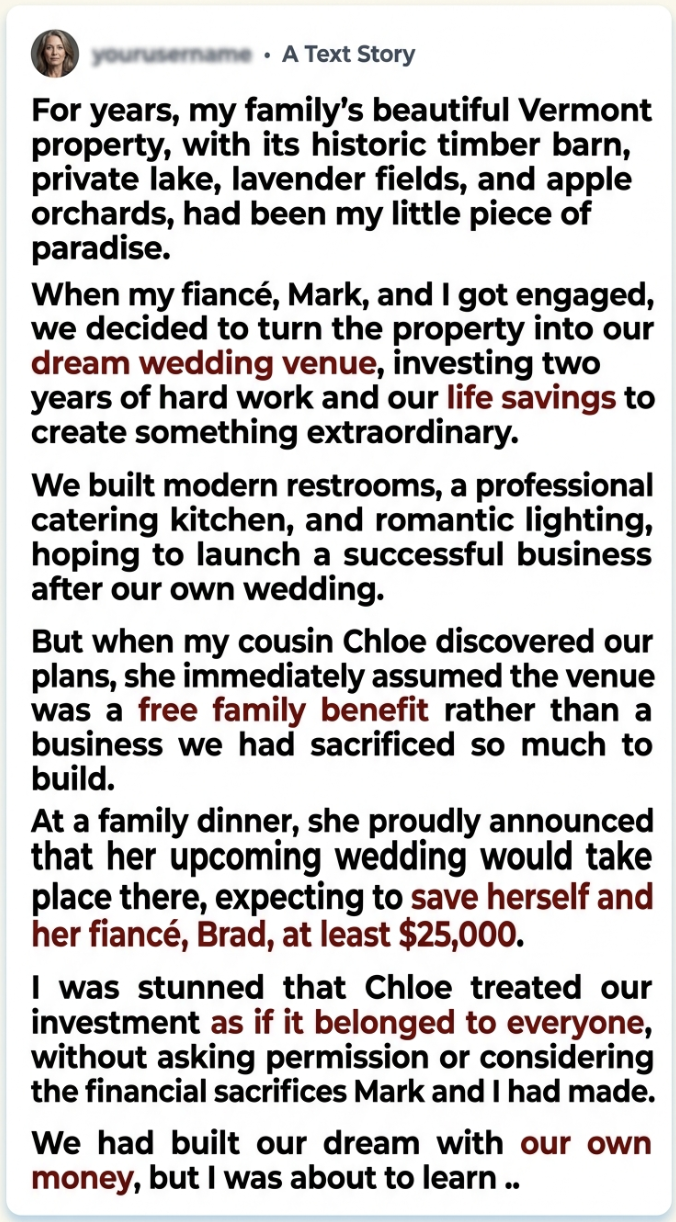
For years, my family’s beautiful Vermont property had been my little piece of paradise.
It was the kind of place people stopped talking when they first saw it. A historic timber barn stood beside rolling lavender fields. A private lake reflected the mountains in the distance, while rows of apple trees stretched across the hills. In autumn, the entire property glowed with shades of gold, orange, and crimson.
My grandmother used to say that the land had a way of bringing people together.
As a child, I believed her.
I remembered picking apples with my cousins, running barefoot through the grass, and sitting beside the lake while the adults told stories about generations of our family. The property was where we celebrated birthdays, Thanksgiving weekends, and the small victories that made life meaningful.
It wasn’t just land.
It was our history.
So when my fiancé, Mark, and I became engaged, we had an idea that seemed almost too beautiful to be true.
We would transform part of the property into a professional wedding venue.
Couples could exchange vows beneath the old trees, celebrate in the restored timber barn, and dance beneath warm strings of lights while the lake shimmered in the background.
We wanted to preserve the property’s character while creating something that could support itself financially for years to come.
It was more than a business idea.
It was our dream.
But dreams are expensive.
For two years, Mark and I poured our savings, weekends, and every spare ounce of energy into making it happen. We hired contractors, navigated permits, repaired old structures, and installed modern restrooms. We built a professional catering kitchen, improved the parking area, upgraded the electrical system, and carefully designed the lighting.
There were nights when I sat at the kitchen table surrounded by invoices, wondering whether we had taken on more than we could handle.
Mark would sit beside me, wrap his hand around mine, and say, “One day, people are going to celebrate the happiest moments of their lives here.”
I held on to those words.
We postponed vacations. We delayed buying new cars. We turned down expensive dinners and learned to celebrate small milestones instead.
When the kitchen passed inspection, we opened a bottle of inexpensive sparkling cider.
When the barn’s renovation was completed, we stood in the middle of the floor and imagined hundreds of couples dancing beneath the lights.
And when we finally photographed the property for our business website, I cried.
Not because everything was perfect, but because we had built something extraordinary through our own effort.
We planned to host our own wedding there first, then officially launch the venue business afterward.
We had a budget, a calendar, and a list of bookings we hoped to secure.
For the first time, our future felt tangible.
Then my cousin Chloe found out.
Chloe had always been the sort of person who confused being invited with being entitled.
If someone bought a new car, she wanted to borrow it. If someone rented a vacation house, she asked whether she could stay for free. If a relative offered to help with one expense, Chloe somehow turned that favor into an expectation that would last for years.
Whenever anyone challenged her, she would smile and say, “Come on. We’re family!”
My grandmother used to brush off her behavior.
“Chloe doesn’t mean any harm,” she would say. “She just gets excited.”
But I had learned that people who never face consequences for crossing boundaries rarely develop the habit of respecting them.
Still, Chloe was my cousin. We had grown up together, shared holidays, and attended each other’s important family events.
I wanted to believe she would be happy for us.
I was wrong.
The trouble began at a Sunday family dinner.
We were gathered around my aunt’s dining table when Chloe announced that she and her fiancé, Brad, had finally settled on a wedding date.
Everyone applauded.
Brad smiled, and Chloe lifted her glass.
“We’re going to have the most beautiful wedding,” she said. “And I’ve already figured out the perfect location.”
I smiled politely.
“Have you found a venue?”
She looked directly at me.
“Of course! Your property.”
For a moment, I thought I had misunderstood her.
“My property?”
“The wedding venue you’re building! The barn, the lake, the lavender fields—everything is absolutely gorgeous. I showed Brad the pictures, and he said it was exactly what we wanted.”
She turned toward the rest of the family.
“Can you imagine? Our own family venue! We’ll save at least twenty-five thousand dollars compared with those ridiculous commercial venues.”
A few relatives nodded appreciatively.
Someone even said, “That’s wonderful! What a blessing to have family who can help.”
I looked at Mark.
He had stopped eating.
Chloe continued speaking as though the decision had already been made.
“We’ll have the ceremony by the lake, dinner in the barn, and dancing outside. I’ll need the venue for the whole weekend, obviously, because the decorators will need time to set everything up.”
She took another sip of wine.
“And since it’s family, we won’t have to deal with contracts and deposits. That would just make things awkward.”
The room fell quiet.
I put down my fork.
“Chloe, we haven’t offered you the venue.”
She blinked.
“What?”
“We haven’t discussed hosting your wedding. You haven’t asked us, and we haven’t agreed to anything.”
Her smile disappeared.
“Oh, come on. Don’t be like that.”
“Like what?”
“Businesslike. We’re cousins.”
I felt my cheeks grow warm.
“Chloe, Mark and I have spent two years renovating that property. We used our savings to build a business. It isn’t a free venue for anyone who happens to be related to us.”
She gave a dismissive laugh.
“You’re acting like we’re strangers asking to rent a hotel ballroom.”
“No,” I said. “I’m acting like someone who has invested a tremendous amount of money and time into a business.”
Brad shifted uncomfortably in his chair.
“Chloe, maybe we should talk about this later.”
But she wasn’t listening.
“Honestly, I thought you’d be happy to help. You know how expensive weddings are. Why would you charge your own cousin when you could give us the place for free?”
I stared at her.
Because the question revealed exactly what she thought of our sacrifice.
She could see the finished property.
She could see the photographs, the beautiful lake, the restored barn, and the romantic lighting.
What she couldn’t—or wouldn’t—see was the work behind it.
She hadn’t been there when contractors discovered expensive structural problems. She hadn’t helped us compare bids or spent weekends cleaning construction dust from the barn. She hadn’t watched us move money from our personal savings to cover unexpected expenses.
She wanted the beautiful result without acknowledging the cost.
“Because this is how we earn back our investment,” I said. “We have operating expenses, insurance, staffing, maintenance, and future bookings to consider.”
Chloe rolled her eyes.
“You have a lake, a barn, and some lights. It’s not as if we’re asking you to build another property.”
Mark finally spoke.
“We built the restrooms, the kitchen, the lighting, and the infrastructure. None of that was free.”
Chloe looked at him as though he had insulted her.
“I wasn’t talking to you.”
Mark’s jaw tightened.
“You’re talking about a business we built together. So yes, you’re talking to me.”
My aunt intervened.
“Now, everyone, let’s not argue. Chloe is excited about her wedding. I’m sure you can work something out.”
That sentence nearly broke my heart.
Not because my aunt was trying to keep the peace, but because keeping the peace seemed to mean asking us to surrender whatever someone else wanted.
I took a breath.
“If Chloe wants to book the venue, she can request our availability and receive the same information as any other customer. We can discuss a family discount if we choose to offer one. But there will be no automatic free weekend, and there will be a written agreement.”
Chloe stared at me.
“You would actually charge me?”
“Yes.”
The word landed harder than I expected.
She pushed her chair back.
“Unbelievable. I can’t believe you’d put money ahead of family.”
Then she walked out of the dining room.
Brad followed her after muttering an awkward apology.
The rest of dinner continued in strained silence.
On the drive home, Mark reached for my hand.
“You did nothing wrong,” he said.
“I know. But why does it feel as though I did?”
“Because you’ve been taught that saying no is the same as hurting someone.”
I looked out the window at the passing trees.
He was right.
And the next few weeks would prove just how determined Chloe was to make me feel guilty for protecting what we had built.
The following morning, I found a message from her in our family group chat.
She had posted a photograph of the estate with the caption:
Can’t wait to celebrate our wedding at the most beautiful family venue in Vermont! So grateful to have such an amazing place for our special day.
Several relatives had already responded with heart emojis and congratulations.
My stomach dropped.
Chloe had announced the venue to the entire family as though we had confirmed the booking.
I called her.
“Take that post down.”
“Why?”
“Because you don’t have a reservation.”
“It’s just an announcement. You’re making this unnecessarily complicated.”
“Then it should be easy to correct it.”
She sighed dramatically.
“You know what? This is embarrassing. People are asking me about the wedding, and now I have to tell them my own cousin won’t help me.”
“You can tell them the venue hasn’t been booked.”
“You’re really going to do this?”
“Yes.”
She hung up.
A few minutes later, she deleted the post.
But the damage had already been done. Several relatives contacted me, asking why I was making Chloe pay for a venue on family land.
I explained that the property was being operated as a business and that we had never agreed to host her wedding.
Some understood.
Others accused me of becoming arrogant now that I owned something valuable.
One relative even said, “Your grandmother would never have treated family this way.”
That comment hurt.
My grandmother had loved the property deeply, and I had spent years trying to preserve what made it special. I knew she believed in generosity.
But I also remembered something else she used to say.
“Never promise what you cannot afford to give, and never let someone else decide what your kindness should cost.”
I held on to that.
Mark and I continued preparing for our first wedding season.
We signed our first legitimate booking, finalized the vendor policies, and arranged a professional site inspection for prospective clients. We also made sure every booking would include clear terms covering access, setup, cleanup, insurance, and payment.
We were building a real business.
And we could not risk it because Chloe wanted a free weekend.
Then, six weeks before her proposed wedding date, the situation escalated.
Chloe called me late one evening.
“I need to talk to you about the venue,” she said.
I sat down at the kitchen table.
“I’m listening.”
“Brad’s parents have already told their relatives the wedding will be at your property. Invitations are going out next week.”
I closed my eyes.
“Chloe, I told you that you don’t have a booking.”
“I thought you’d come around.”
“That was never an agreement.”
She began crying.
“You’re going to ruin my wedding.”
“No, Chloe. I’m not. You chose a date and announced a location without securing it.”
“We’re family!”
“And I’ve explained what that means to me. It means I care about you. It does not mean you can commit my property without permission.”
Her crying turned to anger.
“Fine. If you want to humiliate me, I’ll make sure everyone knows what kind of person you really are.”
She ended the call.
I sat in silence for several minutes.
Then Mark came into the kitchen and found me staring at the phone.
“What happened?”
I told him.
He shook his head.
“We need to protect the business. If she’s telling people the venue is booked, we should put everything in writing.”
The next morning, we sent Chloe a polite but formal message confirming that no reservation existed and that the property was not available to her unless a booking was agreed upon in writing.
We didn’t threaten her.
We didn’t insult her.
We simply made the facts clear.
For a few days, nothing happened.
Then Chloe’s mother called.
She spoke in a soft, wounded voice.
“Your cousin is devastated. She’s been planning this wedding for months.”
“She hasn’t booked our venue.”
“But you know how much this means to her.”
“I do. And if she wants to discuss a paid booking, she can contact us.”
“Surely you could make an exception.”
I looked through the window at the barn.
The sunlight was falling across the restored timber beams. The lavender fields were beginning to bloom, and the lake looked like polished glass.
I thought about the months when we had worried about whether we could afford the next phase of construction.
I thought about Mark working late after his regular job to help finish the kitchen.
I thought about every sacrifice we had made.
“We’ve already offered to discuss a reasonable family rate,” I said. “But we cannot give away the business weekend without considering our costs and commitments.”
She sighed.
“I hope you understand what this will do to the family.”
I felt the familiar guilt rising.
Then I remembered that Chloe had created this situation herself.
“I hope we can get through it,” I replied. “But I won’t agree to something simply because everyone is pressuring me.”
Her response was silence.
And for the first time, I didn’t rush to fill it.
The following Sunday, the family gathered for another dinner.
I almost didn’t attend, but Mark reminded me that I had every right to sit at the same table as my relatives without apologizing for running a business.
Chloe arrived late.
She barely acknowledged me.
After dinner, she stood beside the fireplace and announced that she and Brad had a problem.
“The venue situation is becoming a nightmare,” she said. “We have a date, we have guests expecting to attend, and now we have to find somewhere else because someone in this family has decided money matters more than relationships.”
Several people looked at me.
I didn’t speak.
Then Brad cleared his throat.
“Chloe, that’s not exactly fair.”
She turned toward him.
“What?”
“We didn’t have a booking. We knew that.”
The room went quiet.
Chloe stared at him.
“I told you she’d let us use it.”
“You told me you were sure she would. I asked you whether you’d confirmed it, and you said you didn’t think we’d need a contract because we were family.”
For the first time, another person was saying what I had been trying to explain.
Brad continued.
“I thought you were going to talk to Amanda and Mark. I didn’t realize you’d announced everything before they agreed.”
Chloe’s face reddened.
“You’re supposed to be on my side!”
“I’m supposed to be honest with you.”
He looked around the room.
“We should have asked. We should have waited. And we shouldn’t have told people the venue was booked.”
I felt my shoulders relax slightly.
Not because Brad had taken my side, but because someone had finally acknowledged the truth.
Chloe sat down abruptly.
My aunt looked uncomfortable.
“Well,” she said, “perhaps we all need to calm down.”
But I had spent too long being told to calm down whenever I refused to give in.
I spoke gently.
“I want Chloe to have a beautiful wedding. I genuinely do. But Mark and I have invested two years of our lives and our savings into this property. If we give away our first major booking weekend, we lose income we need to operate the business. If we make exceptions without clear terms, we risk creating problems for ourselves and our other clients.”
I paused.
“This isn’t about whether I love my cousin. It’s about whether our work and our decisions deserve respect.”
No one answered immediately.
Then my grandmother’s older sister, who had been quietly listening at the end of the table, nodded.
“Your grandmother worked hard for everything she had,” she said. “She was generous, but she never taught us that we could take what belonged to someone else.”
I felt tears sting my eyes.
It was the first time that evening I had felt understood.
Chloe looked down at her hands.
She didn’t apologize that night.
But she stopped arguing.
Over the next week, she and Brad found another venue that fit their budget. It wasn’t on a private lake, and it didn’t have lavender fields, but it was beautiful and available on their chosen date.
Their wedding went ahead.
I sent Chloe a thoughtful card and wished them well. I didn’t attend the ceremony because she had made it clear she wanted distance from me, and I respected that choice.
For a while, we barely spoke.
The family remained divided, though the arguments gradually faded. Some relatives eventually admitted that they had misunderstood the situation. Others never did.
Mark and I focused on our business.
Our first wedding season was demanding, but our clients loved the property. Couples exchanged vows beside the lake, danced beneath the barn lights, and sent us photographs of the moments they would remember for the rest of their lives.
Every booking reminded me why we had worked so hard.
We weren’t selling access to a lake or a beautiful barn.
We were creating a place where people could celebrate milestones that mattered.
One autumn afternoon, several months after Chloe’s wedding, I received a message from her.
Can we talk? Just the two of us?
I hesitated before agreeing.
We met at a small café near town.
Chloe looked different. She seemed tired, and for once she wasn’t dressed as though she were arriving for a photoshoot.
She stirred her coffee for a long time before speaking.
“I owe you an apology.”
I waited.
“I was so focused on having the wedding I wanted that I convinced myself you would eventually agree. I told everyone before I had permission, and when you said no, I acted as though you’d betrayed me.”
She looked up.
“I made you responsible for fixing a problem I created.”
I felt a tightness in my chest.
For months, I had imagined what I might say if Chloe ever apologized. I had rehearsed explanations and arguments in my head.
But sitting across from her, I realized I didn’t want to punish her.
I wanted her to understand.
“You hurt me,” I said. “Not because you wanted a beautiful wedding, but because you treated everything Mark and I sacrificed as though it didn’t matter.”
She nodded, her eyes filling with tears.
“I know that now.”
“Do you?”
“Yes. I think I finally understand that being family doesn’t mean someone owes you whatever you want.”
For a moment, neither of us spoke.
Then I reached across the table and touched her hand.
“I want us to have a relationship,” I said. “But it has to be one where we ask instead of assume, and where no doesn’t automatically mean someone doesn’t love us.”
She squeezed my hand.
“I understand.”
Our relationship didn’t become perfect overnight.
There were awkward holidays and conversations that required patience. Trust took time to rebuild.
But the next spring, Chloe visited the property with Brad.
They asked if they could book the venue for their first anniversary celebration.
They completed the application, reviewed the contract, paid the deposit, and followed the same process as everyone else.
We offered them a modest family rate because we wanted to—not because anyone demanded it.
On the day of their celebration, Chloe stood beside the lake and watched the evening light settle over the lavender fields.
She turned to me.
“I never really saw what you built here until now,” she said.
I looked at the barn, the orchards, and the string lights glowing against the dusk.
“Neither did I,” I admitted. “Not until we finished.”
We laughed softly.
And for the first time in a long while, being family felt simple again.
Today, Mark and I still run the venue. The property has become everything we hoped it would be: a place where couples begin their lives together, where families gather, and where beautiful memories are made.
I still believe in generosity.
I still believe that family should support one another.
But I no longer believe that love requires me to surrender something simply because someone shares my last name—or my childhood memories.
The people who truly care about you will respect the effort behind what you build.
They will ask before making plans with your time, your money, or your property.
And when you say no, they may feel disappointed, but they won’t insist that your boundary is proof of your lack of love.
I spent two years building a dream venue, but the greatest lesson it taught me was this: family is a reason to treat each other with respect—not a license to take what someone else worked hard to earn.