The envelope arrived on a Tuesday morning.
It was thick, expensive, and stamped with the name of a law firm I recognized immediately.
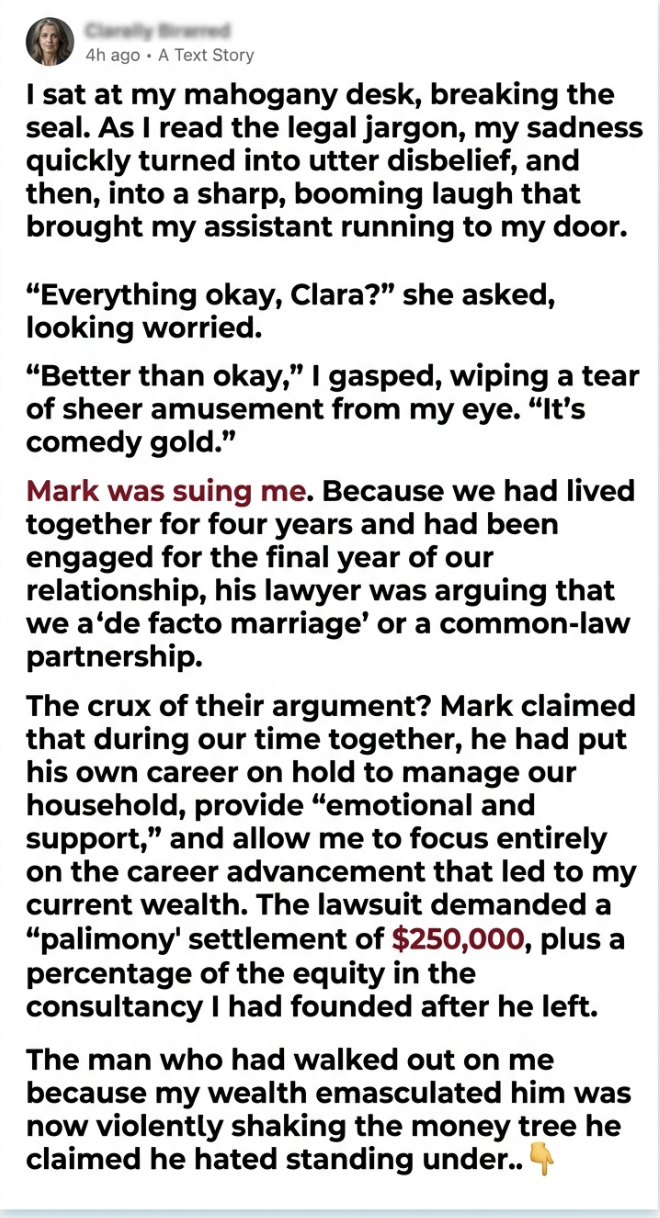
I sat at my mahogany desk, staring at it for several seconds before breaking the seal.
At first, I assumed it was another business matter. My consulting firm handled complicated contracts, corporate negotiations, and disputes between people who believed money could solve every problem.
I had spent years learning how to remain calm when someone placed an unreasonable demand in front of me.
But nothing could have prepared me for the name printed across the first page.
Mark.
My former fiancé.
The man who had walked out of my life because he couldn’t bear the thought of having a successful woman beside him.
I began reading.
Within minutes, my sadness turned to disbelief.
Then disbelief turned into something so absurd that I burst out laughing.
It was a loud, unexpected laugh—the kind that comes when life presents you with something so outrageous that crying would take too much energy.
My assistant, Rebecca, hurried to my office.
“Clara? Is everything all right?”
I held up the document, trying to catch my breath.
“Better than all right,” I managed. “Apparently, my ex-fiancé believes he deserves a quarter of a million dollars because he once lived with me.”
Rebecca blinked.
“I’m sorry. What?”
I turned the page.
“It’s comedy gold.”
But as I continued reading, my laughter slowly faded.
Because beneath the ridiculous legal language was something that hurt far more than I wanted to admit.
Mark wasn’t merely asking me for money.
He was trying to rewrite our entire relationship.
According to his attorney, our four years of living together, combined with the final year we spent engaged, had created what they described as a de facto marriage or common-law partnership.
The claim argued that Mark had sacrificed his own career to manage our household, provide emotional and domestic support, and allow me to concentrate on the professional success that eventually made me wealthy.
The demand was $250,000 in a proposed palimony settlement, plus a share of the equity in the consulting firm I had founded after our relationship ended.
I read that paragraph twice.
Then I put the papers down.
Mark had left me because my success made him feel small.
Now he was arguing that my success belonged partly to him.
I leaned back in my chair and looked through the glass wall of my office.
My employees were moving between meetings. Phones were ringing. Clients were waiting for decisions.
This business—the company Mark now wanted a piece of—had been built through years of long nights, difficult negotiations, missed holidays, and the kind of pressure that left me staring at the ceiling at three in the morning.
He hadn’t been there when I was terrified that my first major client would walk away.
He hadn’t been there when a project failed and I had to find a way to pay my employees anyway.
He hadn’t been there when I sat alone in an empty office after everyone else had gone home, wondering whether I had made a terrible mistake by risking everything I had on my own judgment.
He had been gone.
And now he wanted credit for the life I had built after losing him.
I closed the document.
Then, for the first time that morning, I allowed myself to remember how we had arrived here.
Four years earlier, Mark and I had moved into a small apartment together.
Back then, my consulting business was still struggling to find its footing. I worked long hours, answered emails late at night, and accepted nearly every opportunity that might help me establish a reputation.
Mark had a steady job, a charming smile, and a way of making ordinary evenings feel special.
He used to bring home dinner when I worked late. He would sit beside me on the sofa while I reviewed proposals, occasionally rubbing my shoulders when I looked exhausted.
In those early days, I believed we were building a life together.
I thought partnership meant supporting one another through different seasons.
Some months, I paid more of the household expenses because my income was higher.
Other months, Mark covered things when my business payments arrived late.
We weren’t perfect, but we were trying.
When my company finally began growing, I was delighted.
I thought our shared future was becoming more secure.
I imagined buying a home, getting married, and perhaps starting a family when the time was right.
I pictured us sitting on a porch years later, laughing about the tiny apartment where everything had begun.
But success changed the way Mark saw me.
At first, the signs were small.
When a client praised my work at dinner, Mark would interrupt to tell a story about his own achievements.
When I received an award, he congratulated me but spent the rest of the evening complaining that his colleagues didn’t appreciate him.
When I began earning significantly more than he did, he stopped asking about my day.
Instead, he started asking how much money I had made.
I tried to be understanding.
I knew that professional setbacks could damage a person’s confidence. I knew that watching someone you love succeed might stir up insecurities you weren’t proud of.
I never expected Mark to compete with me.
I wanted us to celebrate one another.
One evening, after I had secured a major contract, I came home carrying a bottle of wine and takeout from his favorite restaurant.
“I have wonderful news,” I told him.
He was sitting at the kitchen table, staring at his laptop.
“What now?” he asked without looking up.
I stopped.
“I signed the contract.”
He finally looked at me.
“How much?”
I told him.
His expression changed.
For a moment, I thought he was surprised.
Then he said, “So now you’re making more than I do in a month from one deal?”
I smiled uncertainly.
“It was a good negotiation.”
He closed his laptop.
“Must be nice.”
I set the food on the counter.
“Mark, what’s wrong?”
“Nothing.”
But his voice told me everything.
From that night onward, every success became another uncomfortable conversation.
If I worked late, he accused me of caring more about my business than our relationship.
If I bought something for myself, he asked whether I thought money made me special.
If I offered to pay for a vacation, he said he didn’t want to feel like a guest in his own relationship.
I tried to reassure him.
I told him that I didn’t care who earned more.
I told him I admired him for who he was, not for his salary.
I even suggested that we sit down together and talk about our finances so neither of us would feel uncomfortable.
But the problem was never really the money.
The problem was what my success represented to him.
Every time I achieved something, he seemed to hear a message I had never spoken.
That he was falling behind.
That he was less important.
That the woman he loved no longer needed him.
I could not make him believe otherwise.
And the more I tried, the more exhausted I became.
Eventually, he began describing himself as the person who had sacrificed everything for me.
He said he had taken on more household responsibilities so I could focus on work.
He complained that my business had consumed our relationship.
He told friends that he was tired of being treated like an accessory to my career.
Some of those complaints contained a grain of truth.
I had worked hard.
There were evenings when I was distracted, weekends when I checked emails, and celebrations when I arrived late because a client needed something urgently.
I wasn’t a perfect partner.
But I had never asked Mark to abandon his ambitions.
I had never demanded that he give up his career.
And I had never promised him ownership of a business I built myself.
I believed we could discuss our problems honestly.
Instead, he began treating my success as an accusation.
The final break came on a rainy Thursday evening.
I had just returned from a difficult client meeting. I was tired, hungry, and eager to tell Mark that we had secured a new long-term contract.
But when I entered the apartment, his suitcase was standing beside the door.
I looked at it.
Then I looked at him.
“What is that?”
He didn’t answer immediately.
“I can’t keep doing this, Clara.”
My heart sank.
“Doing what?”
“Living in your shadow.”
I stared at him.
“My shadow?”
He laughed bitterly.
“You have the company, the money, the recognition. Everyone asks about your business. Everyone wants to know what you’re doing next. I’m just the man who lives with you.”
I put my bag down.
“Mark, I have never asked you to feel that way.”
“You don’t have to ask. It’s obvious.”
I stepped closer.
“Then let’s talk about it. We can work on this. We can find a way for both of us to feel valued.”
He shook his head.
“I’m tired of trying to prove that I matter.”
I felt tears rise in my eyes.
“You matter to me.”
“Not enough.”
Those two words hurt more than anything else he said.
Because I had spent years trying to make him feel secure, while quietly wondering why I was the one who always had to become smaller.
He picked up his suitcase.
I remember standing in the doorway, watching the man I loved prepare to leave.
“Are you really walking away from us because my career is going well?” I asked.
He looked at me for a long moment.
Then he said, “I need to be with someone who doesn’t make me feel like I have to compete.”
I wanted to tell him that love was never supposed to be a competition.
I wanted to tell him that I would have celebrated his success just as proudly as I celebrated my own.
Instead, I asked one final question.
“If my business failed tomorrow, would you stay?”
He didn’t answer.
He simply picked up his suitcase and walked out.
For months, I blamed myself.
I wondered whether I had been too ambitious.
Whether I had worked too much.
Whether I should have turned down opportunities to make him feel more comfortable.
I replayed conversations in my mind, searching for the moment when I could have saved us.
Eventually, I realized that I could not build a healthy relationship by continually apologizing for being successful.
I returned to work.
I hired a coach, leaned on trusted friends, and slowly rebuilt the parts of my life that had been consumed by trying to make the relationship work.
The company continued to grow.
I bought a home of my own.
I traveled.
I made new friends.
I learned to enjoy quiet evenings without feeling guilty for not spending them proving my love to someone.
Then, after nearly a year apart, Mark sent me a message.
He said he missed me.
He said he had been thinking about our engagement.
He said he regretted the way things ended.
For a brief moment, my heart did something foolish.
It hoped.
I wondered whether he had finally understood that my success had never been a threat to him.
But the conversation quickly changed.
He asked about the company.
He asked how much it had grown.
He asked whether I was still living in the same house.
Then he asked whether I had ever considered what he had given up during our relationship.
I felt the old uneasiness return.
I told him that I was willing to have an honest conversation about our past, but I was not interested in reopening a relationship built on resentment.
He stopped responding.
I thought that was the end of it.
Until the envelope arrived.
Now I sat in my office, reading a legal demand from the man who had left me because he could not accept my success.
My sadness slowly hardened into determination.
I called my attorney, Daniel Brooks.
He had represented my company for several years and had helped me navigate difficult contracts and business disputes.
When I explained the situation, he listened without interrupting.
Finally, he asked, “Did you and Mark ever marry?”
“No.”
“Did you sign any agreement giving him ownership of your company?”
“No.”
“Did you make any written promise to pay him a settlement if the relationship ended?”
“No.”
“Good,” he said. “Now, let’s not assume that makes the entire claim disappear. We need to examine the facts, the applicable law, and exactly what his lawyer is alleging.”
His calmness helped me breathe.
He explained that the legal significance of living together and being engaged depends on the jurisdiction and the specific facts. The labels in Mark’s letter did not automatically establish a right to my money or business equity.
We would need to review the evidence carefully.
So we did.
We gathered financial records, company formation documents, tax returns, emails, and the records showing how household expenses had been handled.
We reviewed what Mark had actually contributed, what I had paid, and whether any agreement existed concerning the company.
The evidence did not support the sweeping picture painted in his demand letter.
Mark had not put his career on hold under any agreement with me.
He had continued working for much of our relationship. He had made his own professional choices, and we had divided household responsibilities informally, as many couples do.
I had often paid a larger share of our expenses because I earned more.
But I had never promised him a share of my future business.
My attorney advised me not to respond emotionally or contact Mark directly about the allegations.
We would handle everything through the proper legal process.
For the first time since receiving the letter, I felt that I had a plan.
Then my sister called.
She had heard about the lawsuit through a mutual friend.
“Clara, what is happening? Mark says you’re refusing to acknowledge everything he sacrificed for you.”
I closed my eyes.
Even after everything, he was still telling the story in a way that made him the wounded hero.
“I am acknowledging what actually happened,” I replied. “I am not agreeing to pay him $250,000 simply because he says he deserves it.”
“But he supported you.”
“Yes. And I supported him. We were partners. We shared a home. That doesn’t mean every contribution becomes a bill someone can present years later.”
My sister sighed.
“I just don’t want this to become ugly.”
“Neither do I.”
“Could you offer him something to make it go away?”
I stared out of the window.
That was the part I found most painful.
People who knew nothing about the evidence were already asking me to pay for peace.
They weren’t asking Mark why he had waited until my business became valuable to demand a share.
They weren’t asking whether his claims were supported.
They simply wanted me to give him something so everyone could stop feeling uncomfortable.
I had spent years doing that in my relationship.
I would not spend the rest of my life doing it for everyone else.
“I want this resolved fairly,” I said. “But I will not pay a demand simply because someone is pressuring me.”
The legal process took time.
There were letters, document requests, and meetings between the attorneys. My lawyer challenged the factual and legal basis of the claim and insisted that Mark provide evidence supporting the settlement he demanded.
The process was exhausting.
Some nights, I wondered whether it would have been easier to write a check and move on.
Then I remembered the way Mark had left.
I remembered asking whether he would stay if my business failed.
And I remembered that he had never answered.
I was not going to let fear make this decision for me.
Eventually, Mark’s side could not substantiate the sweeping claims in the original demand.
The negotiations changed.
The demand for a quarter of a million dollars and a percentage of my company’s equity was withdrawn. No ownership interest in my consulting firm was transferred to Mark, and I did not pay the settlement he had initially demanded.
The dispute was resolved through the legal process, based on the facts and the applicable law.
When my attorney called to tell me the matter was over, I sat quietly at my desk.
I had expected to feel triumphant.
Instead, I felt tired.
Then I felt relieved.
And finally, I felt something I hadn’t experienced in a long time.
Freedom.
Not the freedom of winning an argument.
The freedom of no longer having to defend my worth to a man who had confused love with ownership.
A few weeks later, Mark sent me one final message.
He wrote that he never intended for things to become so bitter. He said he had felt overlooked during our relationship and had wanted recognition for the ways he believed he had supported me.
I read the message carefully.
Perhaps he genuinely felt hurt.
Perhaps he had convinced himself that his financial demand was justified.
I could acknowledge his feelings without accepting his version of events.
I replied briefly.
“I hope you find peace, Mark. I am grateful for the good moments we shared, but I am moving forward. I wish you well.”
Then I put my phone away.
I didn’t block him out of anger.
I simply stopped waiting for him to understand.
That was the real ending.
For years, I had believed that if I loved someone enough, reassured them enough, and sacrificed enough, they would eventually feel secure beside me.
But I had learned that another person’s insecurity could not be cured by making myself smaller.
I could support a partner.
I could share my home.
I could compromise.
But I could not build a healthy future with someone who saw my success as a debt I owed him.
I still have difficult days.
Sometimes I remember the man who brought me dinner during my early business struggles and sat beside me when I was exhausted.
Those memories were real.
Our relationship had not been entirely bad, and I don’t need to pretend it was.
But good memories do not erase harmful choices.
And loving someone once does not mean you must keep giving them access to your life forever.
Today, my company continues to grow.
My office is filled with people who respect one another’s abilities. I work with clients who value my judgment, and I spend time with friends who celebrate my achievements without making me feel guilty for them.
I have also learned to protect the life I built.
My finances are organized. My legal documents are in order. My personal relationships are based on mutual respect rather than fear of abandonment.
Most importantly, I no longer apologize for being ambitious.
I don’t apologize for earning money.
And I don’t apologize for wanting a partner who is proud to stand beside me.
Sometimes I think about the envelope that arrived that Tuesday morning.
At first, I laughed because the demand seemed absurd.
But now I understand why I laughed.
It was the moment I finally saw how far Mark had moved from the man I thought I knew.
He had once walked away because he couldn’t bear the thought of standing beside a successful woman.
Then he returned, asking the law to give him a piece of the success he had resented.
He wanted the reward without the relationship.
The money without the commitment.
The benefits of a partnership he had chosen to end.
And I finally understood that I was not responsible for making that contradiction work.
I had loved him.
I had supported him.
I had tried to build a future with him.
But I did not owe him my future simply because he had once been part of my past.
The greatest victory wasn’t keeping my money. It was realizing that I could lose a relationship without losing myself.
And if there is one lesson I want other women—and anyone who has ever been made to feel guilty for succeeding—to remember, it is this:
You can love someone without financing their resentment.
You can appreciate what someone once contributed without agreeing that they own what you built afterward.
And you can walk away from a relationship without carrying the burden of proving that you were worth staying for.
My ex-fiancé wanted $250,000 because he believed my success was partly his. I chose to protect what I had built—and, for the first time in years, I stopped confusing guilt with love.