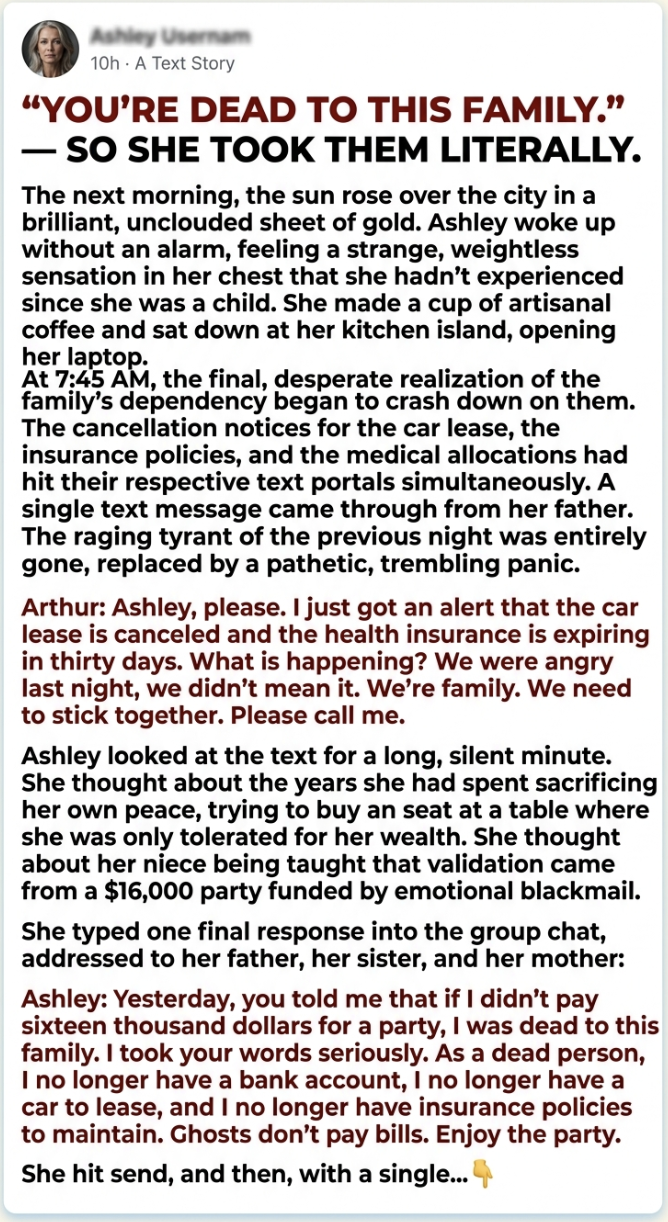
The next morning, the sun rose over the city in a brilliant sheet of gold.
For the first time in years, Ashley woke up without an alarm, without a list of emergencies waiting on her phone, and without the familiar knot of anxiety tightening in her chest.
She lay still for a moment, staring at the ceiling.
Something felt different.
The house was quiet. No one was demanding money. No one was reminding her of a bill that needed to be paid before noon. No one was calling her selfish because she had dared to say no.
For the first time in years, she felt as though she could breathe.
She got out of bed, made herself a cup of coffee, and sat at the kitchen island with her laptop.
Outside, the city was beginning another ordinary day.
Inside, Ashley was about to discover what it felt like to stop being the person who held everyone else’s life together.
At 7:45 a.m., her phone vibrated.
Then it vibrated again.
And again.
Within seconds, the screen was filling with notifications.
The car lease payment arrangement had been canceled. The additional insurance policies she had been funding were no longer set to renew under her account. The medical expense allocations she had voluntarily maintained for her parents were being discontinued according to the notices she had arranged to send.
None of these decisions had happened overnight. They were the result of arrangements Ashley had managed for years, often quietly, often without anyone asking what the responsibility cost her.
Now those arrangements were ending.
And for the first time, her family was being forced to confront the financial reality she had been shielding them from.
Then a message arrived from her father.
Arthur.
The man who had spent the previous evening shouting at her.
The man who had told her that if she refused to pay $16,000 for her niece’s extravagant party, she was no longer welcome in the family.
The same man who had watched her mother and sister agree with him.
His message was short.
“Ashley, please. I just got an alert that the car lease is canceled and the health insurance is expiring in thirty days. What is happening? We were angry last night. We didn’t mean it. We’re family. We need to stick together. Please call me.”
Ashley read it once.
Then she read it again.
She waited for the familiar guilt to arrive.
Usually, it came quickly.
She would imagine her father sitting at home, worried and confused. She would picture her mother crying. She would wonder whether she was being too harsh.
Then she would open her banking app, transfer the money, and tell herself that keeping the peace was worth the sacrifice.
But this morning, the guilt didn’t come as strongly as she expected.
Instead, she remembered the previous evening.
She remembered sitting at her parents’ dining table while her sister, Melissa, explained the plans for her daughter’s extravagant celebration.
A luxury venue.
A designer dessert table.
Professional photographers.
Custom decorations.
A guest list designed to impress people who would probably forget the party within a week.
The total came to $16,000.
And somehow, everyone had decided that Ashley should pay.
Not because she had offered.
Not because she had helped plan the event.
Not because the expense was reasonable.
But because she was the successful one.
She was the daughter with the steady career, the savings account, and the reputation for always finding a way to solve problems.
For years, that reputation had followed her everywhere.
When her father needed help with a car payment, Ashley stepped in.
When her mother struggled with unexpected medical expenses, Ashley contributed.
When Melissa fell behind on household bills, Ashley helped her catch up.
When an emergency appeared, her family called Ashley before they called anyone else.
And when Ashley occasionally admitted that she was tired, her father would remind her that she was fortunate.
“You have a good job.”
“You don’t have children to worry about.”
“You’re better off than the rest of us.”
The implication was always the same.
Because she had managed to build a stable life, she was expected to finance everyone else’s.
Nobody asked whether she wanted to buy a house of her own.
Nobody asked whether she had plans for retirement.
Nobody asked how many vacations she had postponed or how many evenings she had spent worrying about money she had given away.
Her family saw the transfers.
They didn’t see the sacrifices behind them.
Ashley had once believed that this was simply what a good daughter did.
She had grown up hearing that family came first. She had been taught that a loving person didn’t keep score, that generosity was a virtue, and that helping relatives in difficult times was a responsibility rather than a burden.
Those lessons weren’t wrong.
But somewhere along the way, her family had turned them into a rule that applied only to her.
They could ask.
She had to give.
They could make mistakes.
She had to fix them.
They could become angry when she hesitated.
She had to apologize for making them uncomfortable.
And if she ever tried to set a limit, they reminded her of everything they had supposedly done for her.
Even when the help they described had happened years ago, they treated it like a debt she could never finish repaying.
The $16,000 party had finally exposed what Ashley had been trying not to see.
Her family didn’t simply expect her help anymore.
They believed they were entitled to it.
The previous evening, when Ashley had calmly explained that she wasn’t willing to spend $16,000 on a single celebration, her father had slammed his hand against the table.
“After everything this family has done for you, you can’t even do this one thing?”
Ashley had tried to remain composed.
“Dad, I have helped with the car, the insurance, the medical expenses, and countless other things. I can’t keep paying for everything.”
Melissa had folded her arms.
“You make it sound like we’re a burden.”
Her mother had sighed.
“Why must you always turn everything into an argument? It’s your niece’s special day.”
Ashley had looked at her mother.
“I’m not saying she doesn’t deserve a special day. I’m saying I shouldn’t have to spend $16,000 to prove that I love her.”
That was when her father had delivered the words that changed everything.
“If you refuse to pay, then you’re dead to this family.”
The room had gone silent.
Ashley had looked at the people around the table, waiting for someone to tell him he had gone too far.
Her mother looked away.
Melissa said nothing.
And her father sat back as though he had finally won.
Ashley remembered feeling something inside her go very still.
She had spent years trying to earn a place in that family.
She had paid bills, solved problems, and swallowed her disappointment because she thought that one day they might finally look at her and see a daughter rather than a financial safety net.
But in that moment, she understood how conditional their acceptance had become.
Her place at the table depended on what she was willing to pay.
So she had stood up, collected her purse, and walked out.
Now, the following morning, her father was asking her to come back.
Not because he had apologized for humiliating her.
Not because he had acknowledged the unfairness of his demand.
But because the consequences of her absence had begun to reach his own life.
Ashley stared at his message for a long time.
Then another message arrived.
This one was from Melissa.
“Ashley, what have you done? Mom is crying. Dad says the insurance is ending. You can’t just abandon us because of one argument.”
Ashley closed her eyes.
One argument.
That was what they were calling it.
Not years of financial pressure.
Not the constant assumption that she would pay.
Not the threat that she would be cast out if she refused.
One argument.
She opened the family group chat.
Her mother had already sent three messages.
“Please, everyone, calm down.”
“We need to discuss this as a family.”
“Ashley, sweetheart, please answer your father.”
Sweetheart.
The word used to sound comforting.
Now it felt like a familiar key being turned in a lock.
Ashley took a slow breath and began typing.
She didn’t insult anyone.
She didn’t list every dollar she had ever contributed.
She didn’t threaten to reveal their private financial problems.
She simply wrote what they had said and what she had decided.
“Yesterday, Dad told me that if I didn’t pay $16,000 for the party, I was dead to this family. I took his words seriously.
“You have all treated my help as an obligation for years, but I am no longer willing to continue financial arrangements simply because you expect me to.
“I am not responsible for paying for the party, the car, or every other expense that comes along. Any insurance or medical arrangements in my name will be handled according to their terms, with appropriate notice and time to make other plans.
“I love you, but I will not be threatened into proving it with money.
“You told me I was dead to this family. I am done trying to earn my place here by paying for it.”
She paused.
Then she added one final sentence.
“Ghosts don’t pay bills.”
She hit send.
For several seconds, she simply stared at the screen.
Then she placed the phone facedown on the counter.
Her hands were shaking.
She had expected to feel powerful.
Instead, she felt exhausted.
Because setting a boundary with strangers was one thing.
Setting one with the people who had raised you was another.
You could know that you were doing the right thing and still mourn the relationship you wished you had.
You could love your parents and still refuse to finance their expectations.
You could want your sister to be happy and still say no to a demand that threatened your own financial security.
And you could walk away from an unhealthy arrangement without wishing harm on anyone.
Ashley finished her coffee.
Then she opened her laptop and returned to work.
For the next hour, she answered emails, reviewed a project report, and prepared for a meeting.
She didn’t send any money.
She didn’t call to calm her father down.
She didn’t apologize for the message.
At 9:12 a.m., her phone rang.
It was her father.
She let it go to voicemail.
He called again.
Then her mother.
Then Melissa.
By lunchtime, she had received more messages from her family than she had received in the previous two weeks combined.
The irony was almost unbearable.
For years, she had called them to check on their lives.
She had asked whether her father’s appointments had gone well, whether her mother needed anything from the pharmacy, and whether Melissa was managing her expenses.
Most of the time, they answered briefly before returning to whatever they were doing.
But now that Ashley had stopped providing money, everyone suddenly needed her attention.
That evening, she finally listened to her father’s voicemail.
His voice was no longer angry.
“Ashley, please call me. I know things got heated last night. Your mother is upset, and we need to figure out what we’re going to do. I didn’t mean what I said. You know how I get when I’m stressed.”
She listened until the message ended.
Then she sat quietly for several minutes.
He had not said, “I’m sorry I threatened you.”
He had not said, “I was wrong to make your love conditional.”
He had not said, “We have taken your generosity for granted.”
He had said he was stressed.
And he wanted to figure out what they were going to do.
Ashley understood that he was frightened. Losing financial support could create genuine difficulties, and she didn’t want her parents to go without necessary medical care.
But caring about their welfare did not mean she had to resume every payment.
The insurance arrangements needed to be handled responsibly. Her parents needed time to review their options, obtain appropriate coverage, and make decisions based on their circumstances.
She was willing to communicate about those practical matters.
What she was no longer willing to do was surrender her financial future because someone had threatened to stop loving her.
The following afternoon, her mother called again.
This time, Ashley answered.
“Sweetheart,” Evelyn began, “we need to talk.”
“I’m listening.”
Her mother sighed.
“Your father was upset. He shouldn’t have said what he said.”
Ashley waited.
“He didn’t mean that you were actually dead to us.”
“Then why did he say it, Mom?”
Her mother was silent.
Finally, she replied, “He felt hurt that you wouldn’t help your niece.”
Ashley looked out her kitchen window.
“Did anyone ask why I was hurt?”
Her mother didn’t answer.
Ashley continued.
“I have helped this family for years. I never asked you to repay me. I never demanded praise. I did it because I love you. But I can’t keep living as though my own future matters less than everyone else’s comfort.”
“We never wanted you to feel that way,” Evelyn whispered.
“Maybe not. But that is how I’ve felt.”
For the first time, Ashley allowed herself to say it without softening the words to protect her mother’s feelings.
“I want to have a relationship with you. I want to see you and Dad. I want to celebrate my niece. But I want those things because we’re family, not because I paid for them.”
Her mother began to cry.
Ashley felt the familiar pull of guilt.
She wanted to comfort her.
She wanted to say everything was fine.
But it wasn’t fine, and pretending otherwise would only return them to the same place.
So she said, “I love you, Mom. But things have to change.”
They ended the call without resolving everything.
It wasn’t a happy ending.
Not yet.
But it was an honest beginning.
Over the next several weeks, Ashley’s family had to confront the practical reality of managing their own expenses. They reviewed the car lease, explored their insurance options, and reconsidered what they could afford.
The party plans changed, too.
Melissa initially blamed Ashley for ruining her daughter’s celebration. But when she began looking at the budget herself, she realized there were less expensive ways to create a meaningful event.
They eventually chose a simpler venue, invited fewer guests, and focused on the people who mattered most.
The party went ahead.
It wasn’t the lavish spectacle Melissa had imagined.
There were no elaborate designer installations or expensive displays meant to impress the neighborhood.
There was music, food, laughter, and a little girl surrounded by people who loved her.
Ashley attended.
She brought her niece a thoughtful gift and hugged her tightly.
“I love you,” she whispered.
Her niece smiled.
“I love you, Aunt Ashley.”
And in that moment, Ashley felt a kind of peace she hadn’t experienced in years.
Her niece had not asked for a $16,000 party.
She had simply wanted her family to be there.
The adults had been the ones who turned a celebration into a test of loyalty.
After the party, Melissa approached Ashley.
For a moment, Ashley expected another accusation.
Instead, her sister looked down at her hands.
“I was angry with you,” Melissa admitted. “I thought you were refusing to help because you didn’t care about us.”
Ashley waited.
“But when I started looking at everything we were spending, I realized I had become used to you stepping in. I didn’t even think about what it meant for you.”
She swallowed.
“I’m sorry.”
Ashley felt tears gather in her eyes.
It wasn’t enough to erase years of resentment, but it was the first time Melissa had acknowledged the problem without blaming Ashley for it.
“Thank you for saying that,” Ashley replied.
They hugged, awkwardly at first, then more sincerely.
Their relationship would need time to heal.
There would be more conversations, more boundaries, and perhaps more misunderstandings.
But at least they had begun to see one another as sisters rather than as a person who needed help and a person who was expected to provide it.
Her father took longer.
For several months, he remained defensive.
He complained that Ashley had overreacted. He insisted that family members should help one another. He occasionally suggested that she had become too independent and forgotten where she came from.
Ashley stopped arguing.
She no longer needed to convince him that her boundaries were reasonable.
She simply maintained them.
When she chose to help, she helped because she wanted to.
When she couldn’t help, she said no.
And when someone tried to turn guilt into a financial obligation, she ended the conversation.
Eventually, her father began to understand that his daughter was not going to return to the old arrangement.
One Sunday afternoon, he called and asked whether he could visit.
Ashley agreed.
He arrived carrying a small box of pastries from the bakery she used to love as a child.
They sat at her kitchen island, the same place where she had read his desperate message weeks earlier.
For a while, they talked about ordinary things.
Then he placed his coffee cup on the counter.
“I’ve been thinking about what happened,” he said.
Ashley waited.
“I shouldn’t have told you that you were dead to the family.”
“No,” she replied. “You shouldn’t have.”
He looked down.
“I was angry. I felt as though you were turning your back on us.”
Ashley shook her head.
“I was trying to stop losing myself.”
He looked at her, confused.
So she explained.
“I spent years making sure everyone else was okay. I thought that if I helped enough, you would understand how much I loved you. But when I couldn’t afford to give you what you wanted, you threatened to take away the one thing I was trying to protect: my place in this family.”
Her father’s eyes filled with tears.
“I didn’t realize you felt that way.”
“I know,” Ashley said softly. “That’s part of what hurt.”
He was silent for a long time.
Then he said, “I’m sorry.”
It wasn’t a perfect apology.
It didn’t erase everything.
But it was the first time he had apologized without immediately explaining why he had been justified.
Ashley reached across the counter and held his hand.
“I love you, Dad. But I need you to understand that my love isn’t measured by how much money I give you.”
He nodded.
“I understand.”
This time, she wanted to believe him.
And she gave him the opportunity to show her through his actions.
Months later, Ashley still helped her parents in ways she could comfortably afford. Sometimes she drove her mother to an appointment. Sometimes she brought groceries when they were needed. Occasionally, she helped them compare insurance plans or review a bill.
But she no longer automatically took responsibility for every expense.
She began saving for a home of her own.
She took a vacation she had postponed for years.
She spent weekends with friends without checking her phone every few minutes to see whether another family emergency had appeared.
And, little by little, she discovered how peaceful life could be when she stopped treating every request as a test of her worth.
She never forgot the message her father had sent that morning.
“We’re family. We need to stick together.”
He had been right about one thing.
Families should stick together.
But sticking together does not mean one person carries everyone while the others criticize how the load is being carried.
It means sharing responsibility.
It means respecting a person’s limits.
It means understanding that love cannot be demanded through threats, and loyalty cannot be purchased with guilt.
Most importantly, it means remembering that the person who always says yes may be the person who most needs someone to ask whether they are okay.
For years, Ashley had been the dependable daughter.
The emergency fund.
The problem solver.
The person who could always be counted on.
But she was a person, too.
She had dreams, fears, plans, and a future that deserved protection.
The morning she stopped paying for everything was not the morning she stopped loving her family.
It was the morning she finally began treating herself as someone worth caring for.
And that was the most important lesson she learned.
You can love your family without financing every decision they make. You can forgive them without accepting the same treatment again. And you can say no without becoming a bad daughter, sister, or aunt.
Because the people who truly love you should want you at the table even when you arrive empty-handed.
And if your place in the family disappears the moment your money does, you may need to ask yourself a painful question:
Were they holding on to you because they loved you?
Or because they had grown accustomed to everything you gave?
Ashley had spent years trying to buy a place in a family that should never have charged her admission.
The day she stopped paying, she finally began to understand her own worth.
She didn’t lose her family by saying no. She discovered which relationships were strong enough to survive it.