My name is Hannah, and for twenty-six years, I was the ghost in my own family.
I was present at every holiday dinner, every family photograph, and every celebration. Yet somehow, I was always the person nobody remembered to ask about.
My younger sister, Beatrice, was the family’s pride and joy. She collected Ivy League degrees, country club memberships, and professional awards as if they were precious jewels. My parents, Charles and Evelyn, spoke about her accomplishments with the kind of reverence most people reserved for royalty.
When Beatrice earned a degree, my mother hosted a dinner.
When she received a promotion, my father invited his business associates to celebrate.
When she entered a prestigious social circle, my parents acted as if the entire family had moved up in the world.
And when I graduated with a degree in forestry and soil science, my father asked me whether I planned to spend the rest of my life digging holes.
I still remember that afternoon.
I had come home holding my diploma, hoping—just once—that he might look at me with the same pride he showed my sister.
Instead, he glanced at the certificate and said, “You could have done so much better.”
My mother barely looked up from her magazine.
“Your sister is building a future,” she said. “You should think seriously about yours.”
I wanted to tell them that I had chosen my field because I loved the land. I loved the smell of rain on dry soil, the quiet of the timberlands, and the knowledge that a healthy forest could outlive the people who planted it.
I wanted to explain that success did not always wear an expensive suit or arrive in a luxury car.
But I had learned that my parents were not interested in understanding me.
They were interested in correcting me.
So I took my diploma upstairs and placed it in a drawer.
I never asked them to celebrate it again.
There was only one person in the family who never made me feel ashamed of who I was.
My grandfather, Hannah Senior.
He had built our family’s vast timber estate from almost nothing. He had started with rough land, worn-out equipment, and a determination that seemed stronger than any obstacle life placed in front of him.
He knew what it meant to work when nobody was watching.
He knew the difference between owning land and understanding it.
And unlike my parents, he never measured a person’s worth by the title printed on a business card.
When I was a child, he would take me into the woods before sunrise. He taught me to recognize damaged trees, test the soil, and understand why some sections of the land flourished while others slowly deteriorated.
“People see the trees, Hannah,” he once told me. “They don’t see the years of work beneath them.”
I never forgot those words.
As I grew older, I began helping him with the timberlands. I studied the drainage systems, reviewed harvesting schedules, examined erosion problems, and learned how careless management could destroy land that had taken generations to build.
My parents considered it an embarrassing hobby.
Grandpa called it responsibility.
Whenever Beatrice visited him, she talked about investment returns, property values, and the social prestige attached to owning such a large estate.
Whenever I visited, we talked about the land itself.
Sometimes we barely spoke at all.
We would walk between the trees, listen to the wind, and stop beside the old wooden fence that marked the northern boundary.
Those quiet afternoons became the most valuable memories of my life.
Because Grandpa never treated me like a disappointment.
He treated me like someone worth knowing.
Then, as he grew older, his health began to decline.
I visited him whenever I could. I helped organize documents, accompanied him on walks when his strength allowed it, and listened when he wanted to talk about the estate’s future.
My parents visited, too, particularly when important business decisions were involved.
Beatrice occasionally arrived with flowers and a beautiful smile.
But I noticed something that troubled me.
The moment Grandpa mentioned land management, timber yields, or the condition of the forests, my parents’ attention drifted elsewhere.
They wanted to discuss the estate’s market value.
Grandpa wanted to discuss what would happen to it after he was gone.
One afternoon, while we sat on the porch overlooking the timberlands, he turned to me.
“Do you think your family understands what this place is worth?”
I looked toward the distant trees.
“Financially?”
He shook his head.
“No. I mean what it is really worth.”
I thought for a moment.
“It took a lifetime to build,” I answered. “And it could take only a few years to ruin.”
He studied me quietly.
Then he nodded.
“That is what I wanted to hear.”
At the time, I didn’t understand why he had asked.
I would remember that conversation later.
But by then, it would be too late to ask him what he had meant.
Grandpa passed away on a cold Thursday morning.
The news reached me before sunrise.
I remember sitting on the edge of my bed, holding my phone, unable to move.
I had known his health was failing. I had tried to prepare myself for the day when I would no longer hear his voice.
But knowing someone is growing old does not prepare you for the silence they leave behind.
For days, I moved through life as if I were underwater.
I kept thinking about our walks through the woods, his weathered hands, and the way he always called me by my name as though it mattered.
At the funeral, my parents accepted condolences with perfect composure.
Beatrice wore black designer clothing and spoke quietly with several family friends.
Everyone said the same things.
He had been a remarkable man.
He had built something extraordinary.
His legacy would live on.
I stood near the back and wondered whether anyone else understood that the man they were praising had been the only person who truly saw me.
Two weeks later, we gathered at Mr. Vance’s law office to hear the will.
The room was formal and expensive, with dark wood paneling, leather chairs, and tall windows overlooking a manicured lawn.
My father sat with his back perfectly straight.
My mother wore a silk scarf and a solemn expression that seemed carefully rehearsed.
Beatrice sat beside them, scrolling through her phone.
I took the chair at the far end of the table.
My suit was the only decent one I owned, and I felt painfully aware of how different I looked from the rest of my family.
Mr. Vance, an elderly attorney who had represented my grandfather for decades, adjusted his spectacles and opened the first document.
“To my daughter-in-law, Evelyn, and my son, Charles, I leave the primary residential estate in Connecticut.”
My mother nodded solemnly.
My father exhaled as if he had been waiting for that sentence for weeks.
Mr. Vance continued.
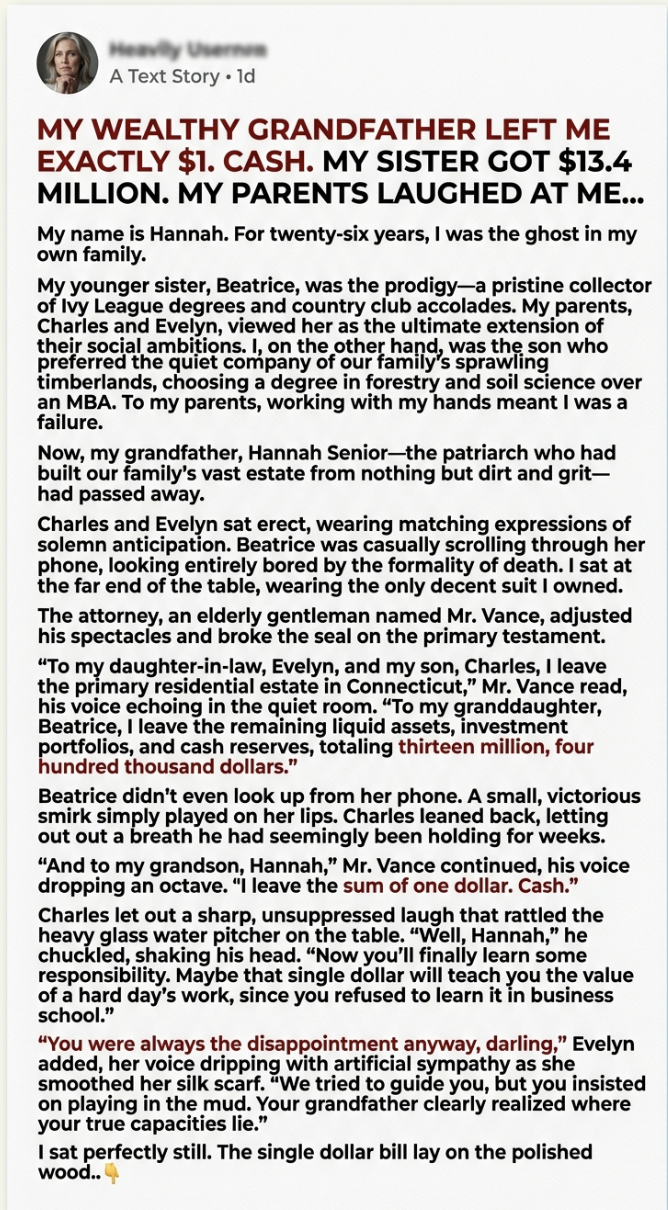
“To my granddaughter, Beatrice, I leave the remaining liquid assets, investment portfolios, and cash reserves, totaling thirteen million, four hundred thousand dollars.”
Beatrice didn’t even look up from her phone.
A small smile appeared at the corner of her mouth.
My father leaned back in his chair.
Then Mr. Vance paused.
He looked at the next page.
“And to my granddaughter, Hannah, I leave the sum of one dollar. Cash.”
For a moment, the room was completely silent.
Then my father laughed.
It was a sharp, ugly sound that seemed to bounce off the polished walls.
“Well, Hannah,” he said, shaking his head. “Now perhaps you’ll finally learn some responsibility.”
He pointed toward the dollar Mr. Vance had placed on the table.
“Maybe that single dollar will teach you the value of a hard day’s work. You refused to study business, and now you can see where that decision has taken you.”
My mother smoothed her scarf.
“You were always the disappointment, darling,” she said with artificial sympathy. “We tried to guide you, but you insisted on playing in the mud. Your grandfather clearly understood your limitations.”
Beatrice finally put down her phone.
“Honestly, Hannah, don’t make this uncomfortable,” she said. “Grandpa knew what everyone was good at.”
She glanced at the dollar.
“Perhaps he was trying to send you a message.”
I looked at the bill lying in front of me.
One dollar.
That was what my family believed my grandfather thought I was worth.
I could have argued.
I could have reminded them of the countless hours I had spent helping Grandpa with the timberlands while they discussed the estate as though it were a line on a balance sheet.
I could have told them that I had visited him when there was nothing to gain.
But grief had already taken so much from me that afternoon.
I didn’t have the strength to beg my family to recognize something they had spent twenty-six years refusing to see.
So I sat quietly.
My father interpreted my silence as defeat.
“Take it gracefully, Hannah,” he said. “There is no shame in accepting that some people are simply better suited to certain things.”
I looked at him.
For the first time, I didn’t feel the familiar urge to defend myself.
I didn’t need him to understand.
I didn’t need Beatrice to approve.
And I didn’t need my mother to tell me that I had finally made her proud.
I simply needed to know why Grandpa had done this.
Mr. Vance cleared his throat.
“Before we conclude, there is one additional matter.”
My father frowned.
“What matter?”
Mr. Vance carefully closed the first document.
“Your father specifically instructed me to read a second statement before anyone leaves this room.”
Beatrice sighed.
“Oh, for heaven’s sake. Is there more paperwork?”
Mr. Vance did not respond to her.
Instead, he reached into his briefcase and removed a sealed envelope bearing my grandfather’s handwriting.
I recognized it immediately.
The letters were slightly uneven, and the final stroke of his signature curved upward.
My heart began to pound.
Mr. Vance broke the seal.
Then he began to read.
“To my family: If you are hearing these words, I have left this world, and you are gathered to discuss what remains of my life.”
My mother’s expression changed.
My father leaned forward.
Mr. Vance continued.
“I know some of you will be pleased with the division of my assets. I also know that one of you will be disappointed. Before you decide what this means, I ask you to listen carefully.”
He paused.
“I have spent a lifetime watching people confuse wealth with worth. I have watched people admire expensive possessions while ignoring the labor that made them possible. I have watched others dismiss quiet work because it brings neither applause nor social recognition.”
My hands began to tremble.
Grandpa was speaking about me.
Not because he was defending me directly, but because he understood the world I had lived in.
Mr. Vance continued reading.
“Hannah, if you are sitting at this table, I suspect your father has already made a joke about the dollar I left you.”
My father went rigid.
Beatrice stopped smiling.
I felt tears rise in my eyes.
Grandpa had known.
He had known exactly what would happen.
The attorney turned the page.
“That dollar is not a measure of your worth. It is a reminder that money can be counted in seconds, but a person’s character takes a lifetime to understand.”
Nobody moved.
Then Mr. Vance placed the letter on the table.
“There is a separate trust agreement,” he explained. “It concerns the management and future ownership of the timberlands.”
My father immediately sat forward.
“The timberlands? Those are part of the estate.”
“Some are,” Mr. Vance replied. “But not all.”
He opened a thick folder and began explaining the arrangement my grandfather had established years earlier.
A substantial portion of the working timberland had been placed into a separate, properly documented trust. The trust had its own succession provisions, independent of the liquid assets addressed in the first testament.
The trust agreement named me as its designated successor, subject to the conditions and responsibilities outlined in the legal documents.
My father stared at the attorney.
“That can’t be right.”
“It is right,” Mr. Vance said calmly. “Your father established this arrangement after receiving professional legal and financial advice. He updated the documents as necessary, and the trust’s provisions are clear.”
Beatrice looked at me as if she were seeing me for the first time.
“How much land are we talking about?”
Mr. Vance explained that the trust covered a substantial portion of the family’s working timberlands, including the areas I had helped Grandpa manage. The assets were considerable, but the trust also carried long-term obligations involving conservation, maintenance, taxes, and responsible forestry.
It wasn’t a pile of money waiting to be spent.
It was a living enterprise that required careful management.
My father looked furious.
“So you’re telling us she gets the land?”
“I’m telling you,” Mr. Vance replied, “that your father made a legally documented decision about the future of his timberland assets. The trust must be administered according to its terms.”
My mother turned toward me.
“Hannah, did you know about this?”
I shook my head.
“No.”
And it was the truth.
Grandpa had never promised me an inheritance.
He had never told me I would receive anything.
He had simply taught me how to care for the land and asked me to think about what it meant to preserve something for the next generation.
My father stood abruptly.
“This is absurd. Beatrice has the education and experience to manage valuable assets.”
Mr. Vance remained composed.
“The trust’s succession provisions were established by your father. His reasoning is included in his statement.”
He lifted the letter again.
“Let me finish.”
My father sat down.
The attorney continued.
“I chose Hannah because she never asked what the land could do for her. She asked what she could do to keep it healthy.”
I covered my mouth.
“I watched her learn from mistakes. I watched her work without an audience. I watched her return to the land even when her family made her feel that her education was worth less than a business degree.”
My mother lowered her eyes.
“I do not leave Hannah these responsibilities because she is my favorite. I leave them to her because she has demonstrated the patience, knowledge, and judgment required to carry them.”
The room felt smaller with every sentence.
“I leave Beatrice my liquid assets because she has pursued the life she wants, and I hope she uses those resources wisely. I leave Charles and Evelyn their home because they have made their life there.”
Then came the words that broke me.
“Hannah, if you are listening, I want you to understand something. I never expected you to prove your worth to me. You were worthy when you were a child walking beside me through the woods. You were worthy when your father dismissed your degree. You were worthy when the rest of the family failed to see what I saw.”
My tears fell onto my hands.
For twenty-six years, I had tried to earn that kind of recognition from my parents.
Grandpa had given it to me without asking me to earn a single word of it.
His letter ended with a final instruction.
“Take care of the land, Hannah. But take care of yourself, too. Never let the people who measure everything in dollars convince you that your life is worth less because you chose a different path.”
Mr. Vance lowered the letter.
Nobody spoke.
My father looked as though the room had been turned upside down.
Beatrice’s phone lay forgotten on the table.
My mother stared at the trust documents, then at me.
Finally, my father found his voice.
“So that’s it? You think you’re qualified to run a timber estate because you spent time walking around with him?”
I looked at him.
For the first time, I didn’t feel small.
“I studied forestry and soil science, Dad. I’ve worked on those properties. I understand the management plans, the drainage issues, the harvesting schedules, and the long-term risks. Grandpa didn’t choose me because I was his granddaughter. He chose me because I know the work.”
My father opened his mouth, but no answer came.
Beatrice leaned back.
“This is unbelievable. I have spent years building a career, and now Hannah gets all this land?”
“No,” I said quietly. “You received the inheritance Grandpa designated for you. I received the responsibility he designated for me.”
She stared at me.
I continued.
“Those aren’t the same thing.”
For the first time in my life, I saw my sister struggle to find a response.
She had always believed that success meant receiving the most impressive reward.
I had learned that some responsibilities were valuable precisely because they could not be measured by the size of a check.
Mr. Vance gathered the documents and explained the next steps for administering the trust.
I listened carefully.
There would be legal work, financial reviews, management decisions, and years of responsibility ahead. I wasn’t suddenly a carefree millionaire. The land required investment, and its future would depend on the choices I made.
But for the first time, I had been entrusted with something that matched the person I had worked so hard to become.
As the meeting ended, my father approached me.
“You should have told us you were involved in the timberlands.”
“I wasn’t hiding anything,” I replied. “I was working.”
He looked at me with an expression I couldn’t quite identify.
“Your grandfather could have handled this differently.”
I thought about the dollar.
Perhaps he could have.
But Grandpa had known my family. He had known that if he had simply announced that he believed in me, my parents might have dismissed his words as sentiment.
Instead, he had left behind a documented plan and a message that could not be laughed away.
My mother touched my arm.
“Hannah, we are still your parents.”
I looked at her.
“I know.”
“We are family.”
I nodded.
“Yes, we are.”
For a moment, she seemed relieved.
Then I added, “But being family doesn’t mean you get to decide my worth.”
Her hand fell away.
I walked out of the office carrying a single dollar bill.
I didn’t throw it away.
I didn’t frame it or turn it into a trophy.
I placed it in my wallet.
Not because I wanted to remember my family’s cruelty, but because I wanted to remember the day I stopped allowing their judgment to define me.
In the months that followed, I began working with the trust’s advisers and forestry professionals. We reviewed the condition of the land, assessed the financial obligations, and developed a long-term management plan.
I learned things I hadn’t known before.
Some sections needed restoration. Certain harvesting practices needed to change. There were opportunities to improve sustainability while protecting the estate’s financial future.
The work was difficult.
There were no glamorous parties or newspaper headlines.
Some days involved reviewing spreadsheets and contracts. Others meant walking muddy trails with specialists, checking damaged areas, and making decisions that would not produce results for years.
But I loved it.
For the first time, I wasn’t trying to become someone my family would respect.
I was doing work I respected myself.
Beatrice called occasionally to ask about the trust.
At first, she sounded skeptical.
Later, her questions became more practical.
She began to understand that the timberlands weren’t simply valuable property. They were a complicated business, a natural resource, and a responsibility that could be damaged by poor decisions.
My relationship with her remained difficult, but something had changed.
She could no longer dismiss my career as a hobby.
I didn’t use that fact to humiliate her.
I didn’t remind her of what she had said in the attorney’s office.
I simply continued doing the work.
My father took longer to change.
For months, he referred to the trust as Grandpa’s strange decision.
He continued insisting that a business degree would have made me better qualified.
But eventually, he began asking questions about the management reports.
One afternoon, he accompanied me to the northern boundary, where Grandpa had taught me to examine the soil.
We walked in silence for several minutes.
Then my father stopped beside an old tree.
“Your grandfather brought me here when I was young,” he said.
I looked at him.
“He did?”
He nodded.
“He wanted me to understand the land. I was too impatient. I thought the important part was what we could sell.”
He stared at the trees.
“I suppose he was trying to teach me something I never learned.”
It was the closest he had come to admitting that he had been wrong.
I didn’t rush to comfort him.
I didn’t tell him that everything was forgiven.
I simply stood beside him and allowed the silence to remain.
Sometimes, healing begins when people finally stop arguing with the truth.
A year after the will was read, I returned to the old wooden fence where Grandpa and I had once sat together.
The afternoon sun filtered through the trees, and the wind moved softly through the branches.
I took the dollar from my wallet.
It had become slightly worn around the edges.
I held it in my hands and remembered my father’s laughter, my mother’s artificial sympathy, and Beatrice’s smirk.
Then I remembered Grandpa’s voice.
People see the trees. They don’t see the years of work beneath them.
I folded the dollar and put it back in my wallet.
I no longer needed to prove anything to my family.
The estate was not my revenge.
The trust was not a weapon.
And my grandfather’s confidence in me was not an excuse to look down on the people who had once looked down on me.
It was an opportunity to do something worthwhile.
I continued managing the timberlands, protecting the soil, improving the forests, and planning for the generations that would come after me.
Somewhere along the way, my parents began to speak about my work differently.
They stopped calling it playing in the mud.
They started calling it stewardship.
But by then, I had learned a lesson that was far more valuable than their approval.
You do not need the people who underestimated you to admit they were wrong before you can build a meaningful life.
For twenty-six years, I had been the ghost in my own family.
My parents saw a disappointing daughter. My sister saw someone who could never compete with her accomplishments.
My grandfather saw a person who cared enough to do the work when nobody was watching.
He was the one who understood me.
And when he was gone, he left me more than land.
He left me the freedom to stop asking other people for permission to be proud of myself.
I still keep that single dollar.
It reminds me that the smallest thing someone leaves you can sometimes carry the greatest meaning.
My family thought Grandpa had given me nothing.
They were wrong.
He gave me responsibility, purpose, and the confidence to live according to my own values.
And in the end, that was worth far more than thirteen million dollars.
Because the greatest inheritance isn’t always the money someone leaves behind.
Sometimes, it’s the belief they place in you when everyone else has already decided you will never amount to anything.