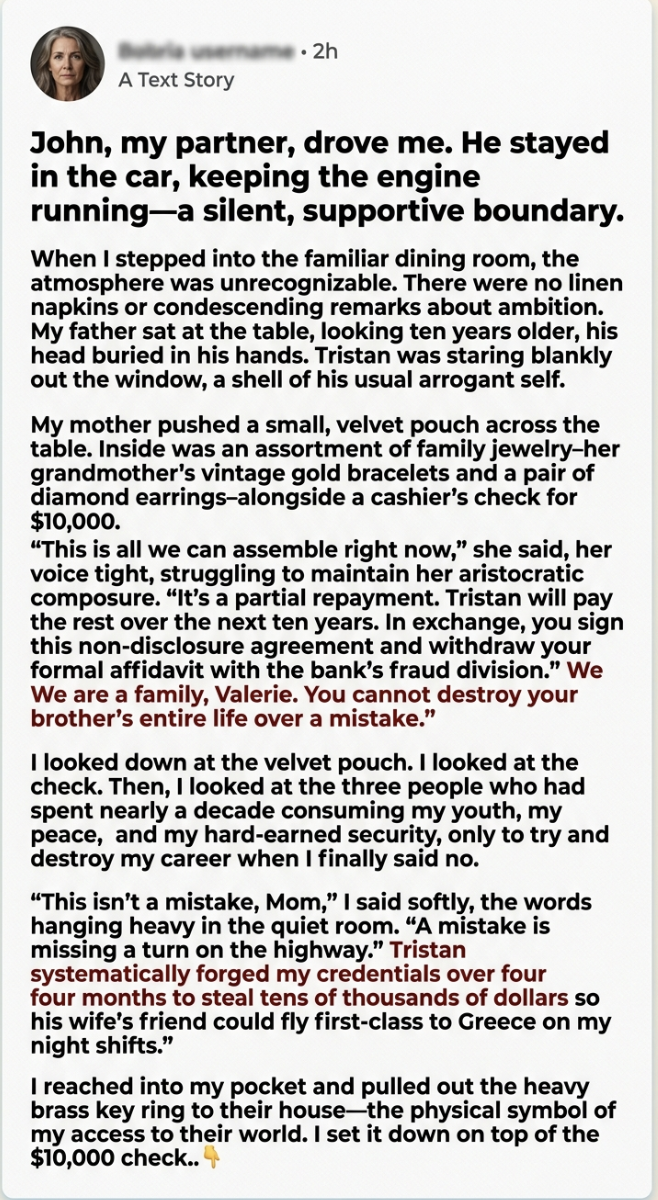
John, my partner, drove me to my parents’ house that afternoon.
He didn’t ask whether I was sure I wanted to go. He didn’t tell me to forgive them because they were family. And he didn’t remind me that my mother had cried on the phone the night before.
He simply drove.
When we reached the house, he parked at the curb and left the engine running.
“I’ll be right here,” he said gently. “You don’t have to stay longer than you want to.”
I nodded, grateful for the one person in my life who understood that loving someone did not mean surrendering every boundary you had.
Then I stepped out of the car and walked toward the front door of the house where I had spent most of my childhood trying to prove that I was good enough.
The house looked exactly the same.
The white curtains. The polished brass doorknob. The flowerpots my mother changed with the seasons because she believed a respectable home should always look perfect.
But when I entered the dining room, I barely recognized the family sitting inside it.
There were no neatly folded linen napkins. No expensive wineglasses. No casual remarks about how I should be more ambitious, more grateful, or more willing to help my brother.
My father sat at the head of the table with his face buried in his hands.
He looked older than I remembered him.
Tristan sat beside him, staring blankly through the window. The confidence that had once made him speak over everyone else was gone. His shoulders sagged, and his eyes looked exhausted.
For years, Tristan had been the son whose mistakes were explained away and whose problems became everyone else’s responsibility.
I had been the daughter who was expected to clean up after him.
When he lost money, I was asked to help.
When he made promises he couldn’t keep, I was expected to protect the family from embarrassment.
When I worked long shifts and saved every dollar, my parents called me responsible.
When Tristan spent money he didn’t have, they called him unlucky.
And when I finally refused to rescue him, they called me selfish.
Now, for the first time, nobody seemed to know what to say.
My mother sat at the opposite end of the table. Her back was straight, her hair carefully arranged, and her expression controlled.
But I could see the strain around her eyes.
She reached for a small velvet pouch and pushed it toward me.
“This is all we can assemble right now,” she said.
Her voice carried the familiar authority I had heard throughout my childhood, although something in it trembled.
I opened the pouch.
Inside were several pieces of family jewelry: my grandmother’s vintage gold bracelets, a pair of diamond earrings, and a small brooch I remembered seeing pinned to my grandmother’s coat when I was a little girl.
Beside the pouch lay a cashier’s check for $10,000.
My mother folded her hands.
“It’s a partial repayment. Tristan will pay the rest over the next ten years.”
Then she paused before delivering the real reason she had summoned me.
“In exchange, you sign this non-disclosure agreement and withdraw your formal affidavit with the bank’s fraud division.”
I looked at her.
She continued quickly, as if speaking faster might make the request sound reasonable.
“We are a family, Valerie. You cannot destroy your brother’s entire life over a mistake.”
A mistake.
The word settled over the table like dust.
I looked at my father, hoping he might finally speak up for me.
He didn’t.
I looked at Tristan.
He continued staring out the window.
And suddenly, I remembered all the nights I had sat alone at my kitchen table, checking my accounts after exhausting shifts, trying to understand how someone had gained access to my credentials.
I remembered the sinking feeling when I discovered transactions I had never authorized.
I remembered the embarrassment of explaining to the bank that the financial activity connected to my name wasn’t mine.
I remembered wondering whether my career, my credit, and the future I had worked so hard to build could disappear because someone in my own family had decided my identity was theirs to use.
And I remembered what happened when I refused to stay quiet.
My own family had turned against me.
They accused me of exaggerating. They said I was trying to humiliate Tristan. My mother told relatives that I had become cold and unforgiving. My father suggested I was allowing money to come between us.
Not once did they ask how frightened I had been.
Not once did they ask what it felt like to discover that the people who knew me best had been willing to risk everything I had worked for.
They were concerned about Tristan’s future.
Mine, apparently, was negotiable.
I lowered the jewelry into the pouch and placed it beside the check.
“Mom,” I said quietly, “do you remember when Grandma gave me those bracelets?”
Her expression changed.
“Of course I do.”
“She told me they were supposed to remind me that family was something you protected, not something you used.”
My mother looked down at the table.
I continued.
“I kept that lesson with me for years. I thought it meant helping whenever someone needed me. I thought it meant keeping private problems private, even when I was the one getting hurt.”
I looked at Tristan.
“But somewhere along the way, protecting the family became protecting Tristan from the consequences of his own decisions.”
“Valerie,” my father finally muttered, “please. Let’s not make this worse.”
I turned toward him.
“Worse for whom, Dad?”
He lifted his head.
“For all of us.”
I nodded slowly.
“That is exactly what I have been asking myself. Why does everyone keep talking about what this is doing to all of us when I’m the one whose identity was used?”
Nobody answered.
I took a breath.
“This wasn’t a misunderstanding. It wasn’t a forgotten bill or a loan that got out of hand.”
I looked directly at my brother.
“Tristan systematically forged my credentials over four months to obtain tens of thousands of dollars. The money helped cover expenses that included a first-class trip to Greece for his wife’s friend while I was working night shifts and saving for my own future.”
My brother finally turned away from the window.
“Valerie, I never thought it would get this far.”
For a moment, I felt the old instinct rise inside me.
I wanted to ask what he had been thinking.
I wanted him to explain how he could look at my life and see something he was entitled to take.
Most of all, I wanted him to say he was sorry.
Not sorry because the bank had discovered the fraud.
Not sorry because he was afraid of losing his reputation.
Sorry because he had hurt his sister.
Instead, he looked at me and said, “I didn’t want to hurt you.”
I felt my throat tighten.
“But you were willing to,” I replied.
His face crumpled slightly.
For the first time, I saw something other than arrogance in his expression. I saw fear, shame, and the realization that the excuses which had protected him for years could no longer repair what he had done.
But I had learned something painful by then.
Feeling sorry was not the same as taking responsibility.
And being frightened of the consequences was not the same as regretting the harm.
My mother pushed the check closer to me.
“Please, Valerie. Take the money. Take the jewelry. We can work something out privately. The bank doesn’t need to be involved anymore.”
I stared at the check.
Ten thousand dollars.
After everything that had happened, she was asking me to accept a fraction of the money involved and sign away my right to tell the truth.
She wanted the problem to disappear.
She wanted the family name protected.
She wanted the neighbors to keep believing we were respectable people who gathered around a beautiful dining table and loved one another.
But she still wasn’t asking what justice looked like for me.
I reached into my pocket and pulled out the heavy brass key ring to my parents’ house.
I had carried those keys for years.
They gave me access to the front door, the garage, and the little side entrance my father always used.
Whenever my parents needed help, I could let myself in.
Whenever Tristan needed a place to stay, I could open the door.
Whenever something went wrong, I was the person they called because they knew I would come.
Those keys had once made me feel trusted.
Now they felt like a symbol of a responsibility I had never agreed to carry forever.
I placed the key ring directly on top of the $10,000 check.
The metal struck the table with a small, unmistakable sound.
My mother stared at it.
“What are you doing?”
“Giving these back.”
Her face tightened.
“Valerie, don’t be dramatic.”
I almost smiled.
For years, I had swallowed my anger to keep the peace. I had accepted unfairness because I didn’t want to be the daughter who caused a family argument.
Now that I was finally refusing to cooperate with a lie, she called me dramatic.
“I am not trying to punish anyone,” I said. “I’m simply no longer willing to carry the consequences of someone else’s choices.”
My father rubbed his forehead.
“So you’re just going to let your brother lose everything?”
I looked at him for a long moment.
“No, Dad. Tristan made choices that put his future at risk. I’m not the person who made those choices, and I’m not the person who can make them disappear.”
“But he’s your brother!”
“And I’m your daughter.”
My voice broke on those words.
For the first time that afternoon, I couldn’t keep the hurt out of it.
“I’m your daughter, too. I was the one working through the night. I was the one saving money. I was the one trying to build a secure future. When I needed my family to believe me, you chose to believe the person who had hurt me.”
My father looked away.
I wiped my eyes.
“I didn’t want to be in this position. I didn’t wake up one morning hoping to report my own brother. I wanted him to tell the truth. I wanted all of you to listen. I wanted to believe that if I explained how serious this was, somebody would finally stand beside me.”
I looked at my mother.
“But you didn’t ask me to come here so you could understand what happened. You asked me to come here so I would make it go away.”
The room became painfully quiet.
Then Tristan spoke.
“What do you want from me, Valerie?”
I looked at him.
For years, I had imagined what I would say if he ever asked that question.
I thought I might demand an apology. I thought I might list every sacrifice I had made for him. I thought I might finally tell him exactly how much his behavior had cost me.
But standing there, I realized I didn’t want another argument.
“I wanted you to respect me enough not to do this in the first place,” I said. “Now I want you to take responsibility for what you did.”
He lowered his eyes.
“I can’t sign away the truth to make this easier for you. Any repayment must be handled honestly, and I will not withdraw a truthful statement simply because our parents are afraid of what happens next.”
My mother shook her head.
“You’re choosing strangers over your own blood.”
“No, Mom. I’m choosing the truth over a lie.”
I picked up the velvet pouch and gently pushed it back toward her.
“Keep Grandma’s jewelry. It shouldn’t have been part of this conversation.”
Then I stepped away from the table.
My father said my name, but I didn’t turn around.
I walked through the hallway, past the family photographs that lined the walls. There I was at graduation, smiling in a borrowed gown. There was Tristan at his first birthday party, held in our backyard. There were pictures from Christmas mornings, summer vacations, and family celebrations.
Every photograph told the same story: a family that looked happy from the outside.
I wondered how many other people had stood in their own hallways, looking at old family pictures and trying to understand when love had become so complicated.
At the front door, I paused.
For a moment, I wanted to put the keys back in my pocket.
I wanted to return to the old routine, where I answered every call and fixed every problem because that was what I had always done.
But I knew where that road led.
So I opened the door and walked out.
John saw me immediately.
He switched off the engine, stepped out, and came around to open the passenger door.
He didn’t ask whether I had won the argument.
He didn’t ask whether Tristan had apologized.
He simply took my hand.
And I began to cry.
Not because I regretted what I had done.
Because I was finally grieving the family I had spent so many years hoping mine would become.
Three months later, the situation was still being handled through the proper channels.
I didn’t withdraw my truthful statement. I didn’t sign the non-disclosure agreement. And I didn’t accept the jewelry or the check as payment for my silence.
The bank continued its investigation, and Tristan had to face the financial and legal consequences of his actions. Any repayment arrangements would have to be genuine, documented, and handled without requiring me to conceal what had happened.
My parents were furious at first.
Then they were embarrassed.
Eventually, they became quiet.
I heard through a relative that my father had begun selling some of his unnecessary possessions to help address the financial mess. My mother stopped telling people that I had destroyed the family. Perhaps she finally understood that other people asking questions was not the same thing as me causing the problem.
Tristan eventually sent me a letter.
It wasn’t perfect.
He admitted that he had convinced himself he could use my information temporarily and fix everything before I noticed. He admitted that he had counted on my reputation for being responsible and my history of protecting him.
He also admitted that he had expected our parents to pressure me into staying quiet.
That last admission hurt the most.
He hadn’t simply betrayed my trust.
He had trusted that my family would help him get away with it.
At the end of the letter, he wrote, “I know saying I’m sorry doesn’t fix anything. I don’t expect you to forgive me now. I just wanted you to know that I understand why you walked away.”
I read the letter twice.
Then I put it in a drawer.
I wasn’t ready to forgive him, but I no longer felt responsible for making him feel better about what he had done.
That was progress.
My mother called several weeks later.
Her voice was softer than I remembered.
“Valerie, I miss you.”
I closed my eyes.
“I miss you, too, Mom.”
“Can we have dinner sometime? Just the two of us?”
I wanted to say yes immediately. The little girl inside me still wanted her mother’s approval, still wanted to believe that everything could return to the way it had been.
But I had learned that reconciliation without accountability was just another way of repeating the past.
“Maybe,” I told her. “But we need to be honest with each other. I can’t go back to pretending nothing happened.”
She was silent for a long time.
Then she said, “I understand.”
I didn’t know whether she truly did.
But for the first time, I wasn’t willing to sacrifice my peace just to find out.
A month later, we met for coffee.
She didn’t ask me to withdraw anything. She didn’t mention the check. She didn’t tell me that Tristan was suffering.
Instead, she asked about my work.
She asked how John was doing.
And, after a long pause, she said, “I should have listened to you.”
It wasn’t a dramatic apology. There were no tears or grand promises.
But it was the first time she had acknowledged my pain without immediately explaining away someone else’s behavior.
I accepted her apology cautiously.
Trust would take time. Perhaps it would never return to what it had been.
And that was something I had finally learned to accept.
I still loved my family.
I always would.
But I no longer believed that loving them required me to surrender my security, my dignity, or my right to tell the truth.
The brass keys stayed with my parents.
The family jewelry stayed with my mother.
And the $10,000 check was never cashed.
I kept nothing from that afternoon except the lesson it taught me.
Sometimes the hardest betrayal isn’t what a family member takes from you. It’s watching the people who raised you ask you to remain silent so they can protect the person who took it.
I used to believe that being a good daughter meant always opening the door, answering the phone, and finding a way to help.
Now I understand that a door can remain closed without a heart becoming cruel.
I can love my brother without covering up his actions.
I can love my parents without accepting their unfair demands.
And I can forgive someone someday without pretending that what happened was acceptable.
Because family should be a place where you can tell the truth without being treated like the enemy.
And if protecting the family requires destroying one person’s future to preserve another person’s reputation, then perhaps the family isn’t being protected at all.
Perhaps the truth is simply exposing what was already broken.
I didn’t walk away from my family because I stopped loving them. I walked away because I finally understood that I deserved to be loved without being used.