The moment my mother saw the candle in my hand, her face changed.
Not because she was disappointed that I had forgotten my sister’s wedding.
Not because she thought the gift was inappropriate.
She was embarrassed.
Embarrassed that her successful son had arrived at his sister’s wedding carrying a simple candle that probably cost less than the dinner sitting on the table.
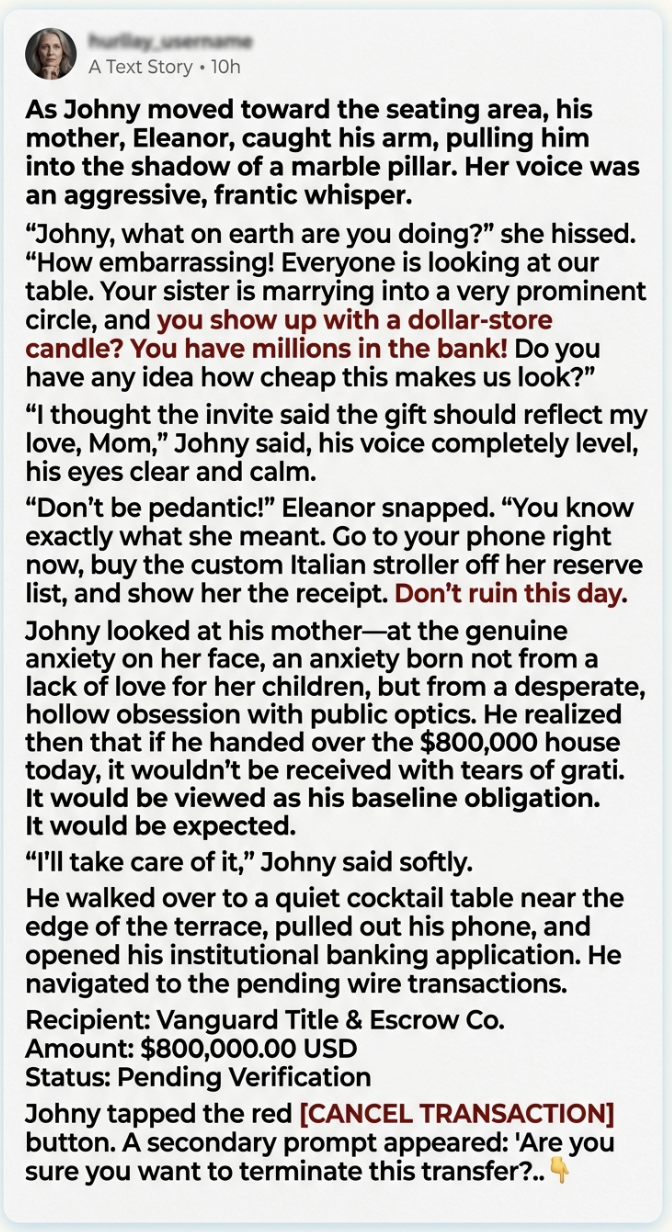
As I walked toward the seating area, my mother, Eleanor, suddenly grabbed my arm and pulled me behind one of the marble pillars.
“Johny, what on earth are you doing?” she whispered sharply.
I looked at her.
“What do you mean?”
She glanced around nervously before lowering her voice.
“Everyone is looking at our table. Your sister is marrying into a very prominent family, and you show up with a dollar-store candle?”
She shook her head.
“You have millions in the bank. Do you have any idea how cheap this makes us look?”
For a moment, I didn’t answer.
I simply looked at the woman who had raised me.
My mother had always been very concerned about appearances.
Growing up, she taught us that family reputation mattered.
What the neighbors thought mattered.
What relatives said at Thanksgiving mattered.
What people posted about us mattered.
But somewhere along the way, I realized something painful.
My sister’s happiness seemed to matter most when other people could see it.
I glanced down at the candle in my hand.
It wasn’t expensive.
It wasn’t wrapped in designer paper.
It wasn’t from some luxury boutique.
But I had chosen it myself.
The invitation had specifically said that gifts should reflect love rather than price.
So that’s what I brought.
Love.
Apparently, that wasn’t enough.
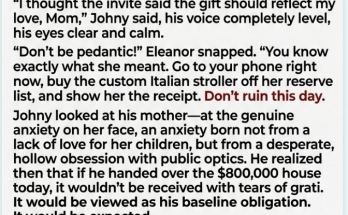
“I thought the invitation said the gift should reflect my love, Mom,” I said calmly.
She rolled her eyes.
“Don’t be pedantic.”
Her voice became even more urgent.
“You know exactly what she meant.”
Then she leaned closer.
“Go to your phone right now. Buy the custom Italian stroller from her reserve list. It’s expensive, but you can afford it. Then show her the receipt.”
I stared at her.
“Today?”
“Yes, today!”
“Why?”
“Because it’s her wedding day, Johny!”
I almost laughed.
Not because anything was funny.
Because suddenly I understood.
My sister wasn’t being asked to receive a gift.
She was being presented with an expectation.
And I was being asked to perform it.
I looked across the ballroom.
My sister was surrounded by people.
She was smiling.
Photographers were taking pictures.
Her new husband’s family stood nearby, dressed perfectly, laughing and congratulating one another.
Everything looked beautiful.
Perfect.
But standing there behind that marble pillar, I remembered something nobody else seemed to remember.
I remembered every time I had helped my family when nobody was watching.
When my sister needed tuition, I helped.
When Mom needed a new roof, I quietly paid part of it.
When Dad’s business went through a difficult year, I covered several expenses without asking for recognition.
When my sister moved into her first apartment, I helped with the deposit.
When she needed a car, I helped her find one.
And every time I helped, my family said the same thing.
“That’s what family does.”
I believed them.
For years, I thought family meant giving without keeping score.
I thought love meant helping when someone needed you.
But eventually, something changes.
People stop saying thank you.
They start saying, “Of course you’ll help.”
And that’s when generosity quietly turns into obligation.
My mother looked at me again.
“Johny, please. Don’t make this difficult.”
I looked at her face.
There was genuine anxiety in her eyes.
But it wasn’t anxiety about whether her daughter was happy.
It was anxiety about what other people might think.
And suddenly, I understood something that broke my heart.
If I gave my sister an $800,000 house today, my mother wouldn’t see it as an extraordinary sacrifice.
She would see it as something I was supposed to do.
The house wasn’t just a gift anymore.
In their minds, it was becoming my responsibility.
My obligation.
My role as the successful son.
I took a slow breath.
“I’ll take care of it,” I said.
My mother immediately relaxed.
“Good.”
She squeezed my arm.
“I knew you would do the right thing.”
I smiled faintly.
She walked away.
She never asked what I meant.
That was the part that hurt the most.
I walked toward a quiet cocktail table near the edge of the terrace.
Nobody was watching me now.
Nobody except me.
I pulled out my phone.
Opened my banking application.
Then I navigated to the pending wire transactions.
There it was.
Recipient: Vanguard Title & Escrow Co.
Amount: $800,000.00
Status: Pending Verification
The money was supposed to purchase the house I had planned to give my sister and her new husband.
I’d arranged everything weeks earlier.
I had planned to surprise her.
I imagined handing her the keys.
I imagined her crying.
I imagined my mother hugging me.
I imagined my sister telling me she would never forget what I’d done for her.
But standing there with that cheap candle still in my hand, I realized something.
I wasn’t sure they would remember.
They might remember the house.
They might remember the address.
They might remember how much it was worth.
But would they remember why I gave it?
I stared at the screen.
My thumb hovered over the red button.
CANCEL TRANSACTION
For several seconds, I couldn’t move.
Then a small message appeared.
Are you sure you want to terminate this transfer?
I swallowed hard.
I thought about all the years I’d spent trying to prove that I was a good son.
A good brother.
A dependable member of the family.
And then I realized I had spent years confusing being useful with being loved.
I pressed YES.
The transfer disappeared.
Just like that.
$800,000 stayed in my account.
But something else changed that afternoon.
For the first time in my life, I stopped trying to purchase my place in my own family.
I put my phone back into my pocket.
Then I walked into the reception.
My sister saw me.
She smiled.
“Johny! You made it!”
I smiled back.
“Of course I did.”
She hugged me.
For a moment, I almost told her everything.
But I didn’t.
Because I wasn’t trying to punish her.
She hadn’t asked for the house.
She hadn’t demanded the money.
She was simply living inside a family system that had taught her to expect certain things.
So I handed her the candle.
She looked at it.
Then she laughed softly.
“This is so simple.”
“I know.”
She turned it over in her hands.
Then, unexpectedly, her expression softened.
“I actually love it.”
I looked at her.
“You do?”
She nodded.
“It’s kind of beautiful.”
She smiled.
“I don’t need another expensive thing, Johny.”
Those words hit me harder than she could have known.
My mother, standing several feet away, overheard.
Her face tightened.
But my sister didn’t notice.
She hugged me again.
“Thank you for coming.”
And for the first time that day, I believed her.
Later that evening, my mother confronted me.
“Where’s the house?”
I knew immediately what she meant.
I looked at her.
“What house?”
She stared at me.
“The house you were giving your sister.”
I remained silent.
“You canceled it, didn’t you?”
“Yes.”
Her face fell.
“Johny, how could you?”
I took a breath.
“Mom, I was going to give her a house worth $800,000.”
“So?”
That one word told me everything.
“So?” I repeated.
She crossed her arms.
“You have the money.”
I nodded.
“I do.”
“You can afford it.”
“I can.”
“So why wouldn’t you?”
I looked at her for a long moment.
“Because I finally realized that being able to give something doesn’t mean I owe it to everyone.”
She didn’t respond.
I continued.
“I’ve spent years helping this family because I loved you. But somewhere along the way, you stopped seeing my help as love.”
Her eyes narrowed.
“You became accustomed to it.”
Silence.
Then I said the sentence I’d been afraid to say for years.
“I don’t want to be the person my family only values when I can pay for something.”
My mother looked away.
Neither of us spoke.
A few weeks later, my sister called me.
She told me she had learned about the house.
She apologized.
I expected anger.
Instead, she said something I will never forget.
“Johny, I’m sorry.”
“For what?”
“For making you feel like you had to give me things to prove you loved me.”
I closed my eyes.
For years, I had waited for someone in my family to understand.
Not the money.
Not the house.
Not the bank account.
Just me.
My sister continued.
“You don’t owe me anything.”
I smiled.
“That means more to me than the house ever could.”
We talked for almost an hour that night.
And our relationship changed.
Not because I gave her $800,000.
Because I finally stopped.
I stopped trying to earn love.
I stopped measuring my worth by what I could provide.
And I stopped allowing my family’s expectations to disguise themselves as love.
I still helped my family when I genuinely wanted to.
But now, when I gave, it was because I chose to.
Not because someone told me what a good son was supposed to do.
Years later, I still have that little candle.
My sister gave it back to me after the wedding.
She had written a note on the bottom.
“The best gift was that you came.”
I keep it on my desk.
Because every time I look at it, I remember the day I learned one of the hardest lessons of adulthood:
Family should never make you feel guilty for having boundaries.
And if someone only appreciates you when you’re paying, rescuing, sacrificing, or giving…
they may not be appreciating you at all.
They may simply be appreciating what you provide.
Sometimes the most loving thing you can do for your family isn’t giving them everything you have.
Sometimes it’s teaching them that your love was never for sale in the first place.