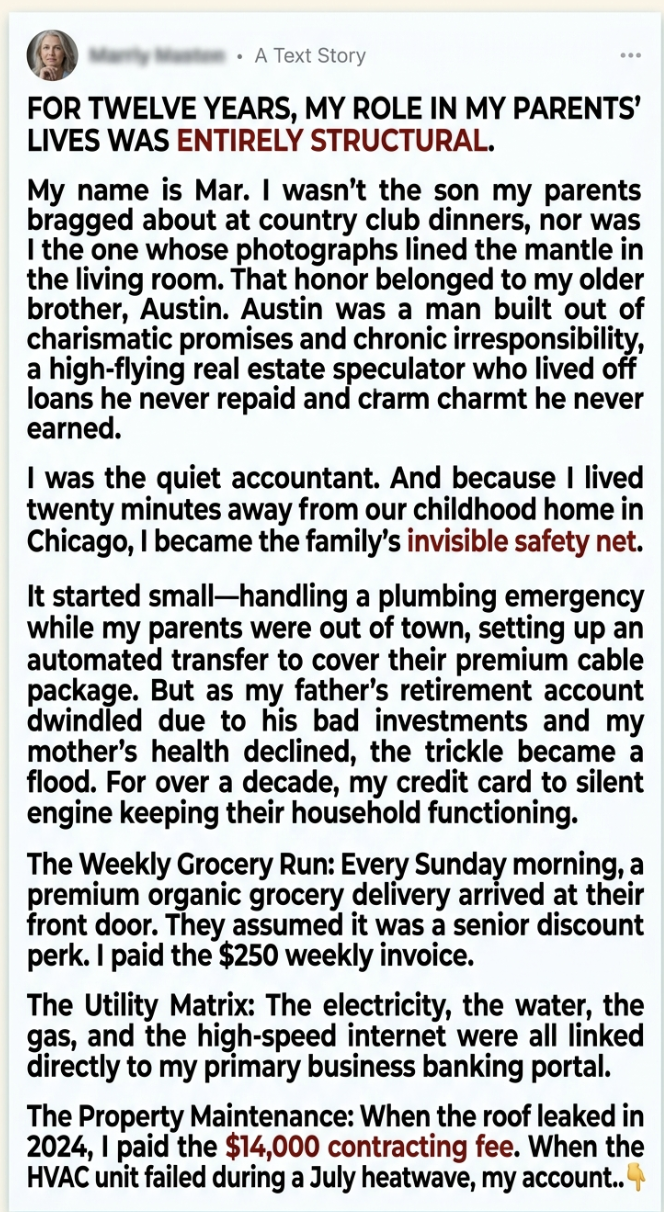
For twelve years, my role in my parents’ lives was never emotional.
It was structural.
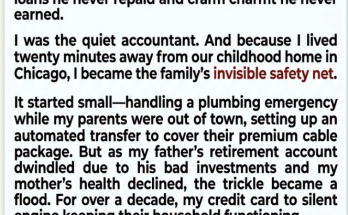
I wasn’t the son they bragged about at country club dinners.
I wasn’t the son whose photographs filled the mantel.
That role belonged to my older brother, Austin.
Austin was charming.
Confident.
Always making promises.
And almost never keeping them.
He was a real estate speculator who had somehow convinced everyone that his next deal would make him rich, even though most of his previous deals had left behind unpaid loans and angry creditors.
My parents called him ambitious.
I called him expensive.
And then there was me.
Mar.
The quiet accountant.
The dependable son.
The one who lived twenty minutes away from my childhood home in Chicago.
Because I was close, I became the family’s invisible safety net.
At first, I didn’t mind.
Family helps family.
That’s what I’d been taught.
When my parents were out of town and a pipe burst under the kitchen sink, I handled the plumber.
When my father’s automatic payment stopped working, I fixed it.
When their internet was disconnected, I called the company.
Small things.
Harmless things.
Then my father’s retirement account started shrinking because of a series of bad investments.
My mother’s health became more fragile.
And somehow, without anyone ever sitting me down and asking, I became responsible for keeping their household running.
For more than a decade, my money quietly paid for their life.
Every Sunday morning, a premium organic grocery delivery arrived at their front door.
My parents thought they were receiving some kind of senior discount.
They weren’t.
I was paying the $250 weekly bill.
The electricity was connected to my business banking account.
So were the water, gas, and high-speed internet.
I paid them automatically.
I didn’t even think about them anymore.
Then came the expensive problems.
In 2024, a storm damaged their roof.
The contractor quoted $14,000.
My father sighed when he told me.
“I don’t know what we’re going to do.”
I remember looking at him.
“You don’t have to worry about it.”
I paid the bill.
A few months later, their HVAC system died during a July heatwave.
My mother called me crying.
She said she couldn’t sleep because the house was unbearably hot.
I paid for the replacement.
When their refrigerator stopped working, I bought another one.
When the washing machine flooded the laundry room, I paid for the repairs.
When property taxes came due and my father’s account was short, I transferred the money.
I never kept score.
That was my mistake.
Because when you help people for long enough without keeping score, they eventually stop seeing it as help.
They start seeing it as your responsibility.
My parents stopped saying thank you.
Austin stopped asking.
He simply assumed.
He would call my mother and say,
“Mar will handle it.”
And somehow, that became the family rule.
Mar would handle it.
Then one evening, I received a call from Austin.
I was sitting at my kitchen table reviewing business reports.
“Hey,” he said casually.
“What do you need?”
“Dad’s account is short again.”
I closed my laptop.
“How much?”
“About eight thousand.”
I was quiet.
Then I asked,
“What happened?”
He laughed.
“Nothing happened. They just need some help.”
I looked at the spreadsheet in front of me.
For the first time, I opened a separate document.
I started adding everything.
Groceries.
Utilities.
Insurance.
Repairs.
Property taxes.
Medical expenses.
Emergency calls.
The roof.
The HVAC.
Everything.
When I finished, I stared at the total.
I had paid more than $180,000 toward my parents’ household over the years.
And that didn’t include the money I’d loaned Austin.
I sat there for a long time.
Not angry.
Just tired.
Then I realized something painful.
My family didn’t know what I had sacrificed.
Because I had made sacrificing look effortless.
The next morning, I called my parents.
“I’m making some changes.”
My father immediately asked,
“What kind of changes?”
“I’m no longer paying the household expenses.”
There was silence.
Then my mother said,
“What?”
“I’ll help you transition everything into your own accounts. But after that, you’re responsible for your bills.”
My father’s voice hardened.
“After everything we’ve done for you?”
I almost couldn’t believe what I was hearing.
“Dad, what have you done for me?”
He didn’t answer.
My mother started crying.
“You’re abandoning us.”
“No,” I said quietly.
“I’m stopping myself from disappearing.”
That sentence changed everything.
For the first time, they had to look at the household budget.
The subscriptions.
The utilities.
The insurance.
The property expenses.
The taxes.
All the things that had magically been paid for twelve years.
Then Austin called.
He was furious.
“You can’t do this.”
“Why not?”
“Because Mom and Dad depend on you.”
I looked out my window.
“No, Austin.”
“They depend on me because everyone else decided I would.”
He became quiet.
Then he said something I’ll never forget.
“You’re their son.”
I answered,
“So are you.”
That was the first time I had ever said it.
And it was the last time I needed to.
The following months were difficult.
My parents had to sell some things.
They canceled expensive services.
They downsized their insurance plan.
My father finally admitted that some of his investments had been irresponsible.
And Austin?
He had to start paying his own debts.
For the first time in his adult life, he couldn’t call our parents and tell them that Mar would fix everything.
Something unexpected happened.
My parents became more independent.
My father learned how to manage his accounts again.
My mother started keeping track of household expenses.
And Austin finally got a real job.
Not because I forced him to.
Because there was nobody left to rescue him.
A year later, my mother called me.
I almost didn’t answer.
When I did, she was quiet for several seconds.
Then she said,
“I owe you an apology.”
I didn’t say anything.
She continued.
“We thought you were just the responsible one.”
My throat tightened.
“You weren’t just responsible,” she said.
“You were carrying us.”
I looked down at my hands.
For twelve years, I’d wanted them to notice.
But when they finally did, I discovered I didn’t need their recognition anymore.
My mother began crying.
“We didn’t realize how much you were doing.”
“I know.”
“Why didn’t you tell us?”
I smiled sadly.
“Because I thought that’s what family did.”
There was silence.
Then she said,
“No, Mar.”
Her voice broke.
“That’s what you did.”
That sentence stayed with me.
Because for twelve years, I thought love meant quietly paying the bills, solving emergencies, and making sure everyone else was okay.
Now I understand something different.
Helping your family is love.
But allowing your family to make your sacrifice invisible isn’t.
I still help my parents.
But now they ask.
They budget.
They contribute.
And sometimes, I say no.
And you know what?
We’re still family.
Perhaps even more than before.
Because now, when my mother calls me, she isn’t calling because the electricity was shut off.
She calls because she wants to know how I’m doing.
And after twelve years of being the person everyone depended on, hearing those words means more to me than any thank-you ever could.
“How are you, Mar?”
For the first time, I finally believe she actually wants to know.