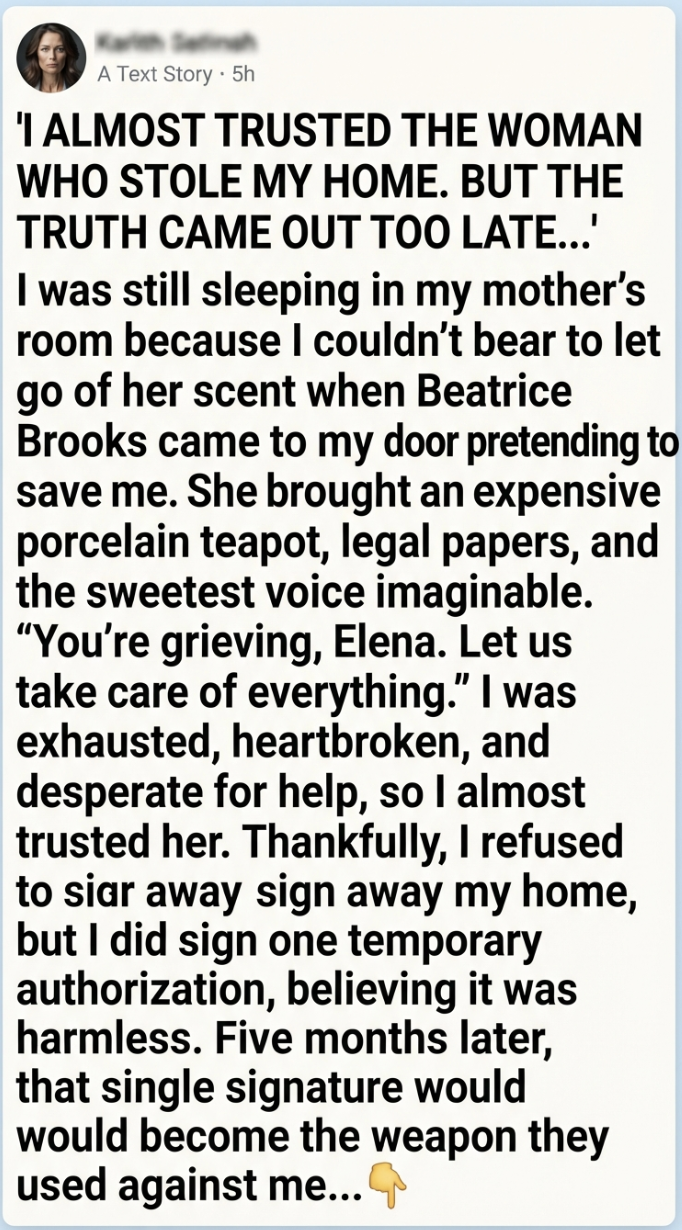
I was still sleeping in my mother’s room because I couldn’t bear to let go of her scent when Margaret Holloway came to my door pretending to save me.
It had been only three weeks since Mom’s funeral.
Her closet was still full.
Her slippers were still beside the bed.
And every night, I would lie beneath her old quilt and convince myself that if I closed my eyes, I could pretend she was still somewhere in the house.
Then Margaret arrived.
She wasn’t family.
She was one of Mom’s oldest friends.
She carried an expensive porcelain teapot wrapped in tissue paper, a leather folder filled with legal documents, and the kindest smile I had seen since my mother died.
“Lydia,” she whispered, placing a hand on my shoulder. “You shouldn’t have to deal with all of this alone.”
I was exhausted.
I hadn’t slept properly in weeks.
I hadn’t eaten much.
And I certainly didn’t understand the mountain of paperwork Mom had left behind.
So when Margaret said, “Let us take care of everything,” I almost cried with relief.
Almost.
She sat at my kitchen table and poured tea as though she belonged there.
“Your mother trusted me,” she said.
“I know.”
“She worried about you.”
That made me look up.
“What did she say?”
Margaret smiled sadly.
“She said you were too trusting.”
The words hurt.
But they also sounded exactly like something Mom would have said.
Margaret opened her folder.
“These are just temporary authorizations. Nothing permanent. They allow me to communicate with the bank, the insurance company, and the estate attorney while you’re grieving.”
I read the first page.
Then the second.
My head was spinning.
“Does this give you control of the house?”
Margaret laughed softly.
“Oh, sweetheart. Of course not.”
Something about the way she said it bothered me.
I pushed the papers away.
“I don’t want to sign anything transferring my home.”
“You aren’t.”
“I want to have an attorney look at it first.”
Her expression changed for less than a second.
Then the sweet smile returned.
“Of course.”
She gathered the papers.
“But there is one authorization here that really needs to be signed quickly. It’s only temporary.”
I hesitated.
“What does it do?”
“It allows me to request information on your behalf.”
“That’s all?”
“That’s all.”
I should have stopped there.
I should have called an attorney.
I should have trusted the uncomfortable feeling in my stomach.
Instead, I signed.
One page.
One signature.
One tiny decision made while I was exhausted and grieving.
Margaret kissed my cheek.
“You did the right thing.”
Then she left.
For the next few weeks, everything seemed normal.
Until the letters started arriving.
First, a bank statement.
Then a notice from the insurance company.
Then a letter from a law office I’d never heard of.
I called the number.
A woman answered.
“Good afternoon. Holloway Estate Services.”
My blood ran cold.
“Why do you have my information?”
There was a pause.
“Ms. Carter, you authorized Ms. Holloway to act on your behalf.”
“I authorized her to request information.”
“Yes.”
“Not to act for me.”
Another pause.
“I believe you should speak with your attorney.”
My hands started shaking.
I hung up.
That evening, I called Margaret.
She didn’t answer.
I tried again.
Nothing.
Then I received a text.
Margaret: “Please don’t panic. Everything is being handled exactly as your mother intended.”
I stared at the message.
Exactly as Mom intended?
That night, I barely slept.
The next morning, I found something in Mom’s desk.
An envelope.
My name was written on it in her handwriting.
Lydia — Open only if someone tries to make you feel guilty for protecting your home.
My heart stopped.
I opened it.
Inside was a single handwritten page.
My darling Lydia,
If you’re reading this, someone has probably told you that I’m worried about what will happen to you after I’m gone.
Don’t believe anyone who uses my name to pressure you.
Especially if they tell you that you must sign something immediately.
I read the sentence twice.
Then three times.
Mom knew.
Somehow, Mom knew.
At the bottom of the page was a phone number.
Under it, she had written:
“Call Daniel Mercer.”
I didn’t know the name.
But I called.
A man answered on the fourth ring.
“Daniel Mercer.”
“My name is Lydia Carter. My mother was Eleanor Carter.”
There was silence.
Then his voice changed.
“Eleanor is your mother?”
“Yes.”
“Then you need to come to my office today.”
My stomach dropped.
“Why?”
“Because your mother came to see me six months before she died.”
I gripped the phone.
“What did she tell you?”
“She told me she believed someone was trying to get control of her estate.”
I couldn’t breathe.
“Who?”
Daniel didn’t answer immediately.
Instead, he asked:
“Have you signed anything since her death?”
I closed my eyes.
“Yes.”
“What did you sign?”
“A temporary authorization.”
Another silence.
Then he said something that made my blood run cold.
“Lydia, that may be the document your mother was afraid of.”
I drove to his office immediately.
Daniel spread the paperwork across his desk.
He studied the signature.
Then he looked at me.
“This authorization is far broader than you were told.”
“How broad?”
“It gives Margaret access to financial records, estate correspondence, and—depending on how it was presented to third parties—authority to represent your interests in negotiations.”
I felt sick.
“But she said it was temporary.”
“It may be.”
“Then why are you worried?”
“Because temporary authority can still be used to create permanent consequences.”
I stared at him.
“What is she trying to do?”
Daniel opened another folder.
“Your mother left you the house.”
I already knew that.
“She also left you her investment accounts.”
I nodded.
“But there was one condition.”
“What condition?”
“You could not sell the property for eighteen months.”
“Why?”
Daniel looked directly at me.
“Because your mother believed you would be pressured to sell it.”
My eyes filled with tears.
“By Margaret?”
“I don’t know.”
He pushed a document toward me.
“But someone has already contacted a real-estate company about your property.”
My heart dropped.
“Who?”
Daniel turned the paper around.
The name was printed at the bottom.
Margaret Holloway.
I couldn’t speak.
For weeks, Margaret had been telling me she was helping protect Mom’s wishes.
Meanwhile, she had been preparing to sell Mom’s house.
And my signature was sitting in her folder.
But the worst part hadn’t happened yet.
Daniel made another discovery.
A week later, we learned that Margaret had already been telling people I was emotionally incapable of managing the estate.
She had told the bank I was “unstable with grief.”
She had told a realtor I was “likely to agree to a sale.”
And she had apparently told several relatives that Mom had been worried I would waste my inheritance.
I couldn’t believe it.
Then my phone rang.
It was my cousin, Sarah.
“Lydia, I need to ask you something.”
“What?”
“Did you agree to sell the house?”
“No.”
“Because Margaret told everyone you did.”
My hands went numb.
That night, I confronted Margaret.
She was sitting in a café across town.
When I walked in, she didn’t look surprised.
She simply sighed.
“You found out.”
“You lied to me.”
“I protected you.”
“You tried to sell my mother’s house.”
“No,” she said calmly. “I tried to prevent you from losing it.”
“That makes no sense.”
“It will.”
She leaned closer.
“Your mother owed money.”
“What?”
“Not to a bank.”
My heart began pounding.
“To whom?”
Margaret smiled.
“To me.”
I stared at her.
She claimed Mom had borrowed money from her before she died.
She produced a handwritten agreement.
According to her, Mom had promised to repay nearly $180,000.
And if she didn’t, Margaret claimed she had the right to recover the debt from the estate.
I looked at the document.
The signature looked like Mom’s.
But something felt wrong.
I took a photograph and sent it to Daniel.
His response came five minutes later.
“Do not sign anything. Do not speak to her alone.”
The next morning, Daniel found the truth.
The document was fake.
Not only was the signature inconsistent with Mom’s known signatures, but the paper itself had been created months after the date Margaret claimed Mom had signed it.
The police became involved.
The bank froze the questionable transactions.
The realtor withdrew from the sale.
And suddenly Margaret’s confidence disappeared.
But there was still one question.
Why had she done all of this?
The answer came from an old email Mom had saved.
Margaret had been facing serious financial problems.
She had borrowed money from several people.
She believed Mom’s estate could solve those problems.
And when Mom refused to help her, Margaret began looking for another way.
The “temporary authorization” I signed was supposed to make everything easier.
Instead, it became the weapon she thought would give her access to my inheritance.
But Mom had prepared for exactly that possibility.
At the end of her estate file was one final letter.
Daniel handed it to me.
I recognized Mom’s handwriting immediately.
Lydia,
If someone tells you they are helping you, watch what they ask you to sign.
Love isn’t measured by how sweet someone’s voice sounds.
Sometimes the person offering you a hand is simply trying to find out how tightly they can hold you.
I started crying.
Then I read the final sentence.
And if Margaret is the one who comes to your door, please remember one thing: I trusted you to protect yourself.
I looked at Daniel.
“Mom knew she would come?”
Daniel nodded.
“She suspected.”
Months later, Margaret was held accountable for what she had done.
The house remained mine.
I never sold it.
Instead, I repaired the kitchen Mom loved, planted roses beneath her bedroom window, and turned the spare room into a small library.
But I kept the porcelain teapot Margaret had brought that first day.
People ask me why.
The truth is simple.
I keep it as a reminder.
Not of Margaret.
Of the woman I was before that day.
The woman who believed kindness automatically meant good intentions.
The woman who thought saying “I trust you” was enough.
And the woman who learned that sometimes grief makes us vulnerable to people who know exactly what to say.
Five months after I signed that “harmless” authorization, I stood in my mother’s kitchen and realized something.
The signature almost cost me my home.
But it also led me to the truth.
Because if Margaret had never tried to take what wasn’t hers, I might never have discovered just how carefully my mother had protected me.
Mom knew she couldn’t be there forever.
So she left me more than a house.
She left me a warning.
And, in the end, that warning saved everything.
The greatest inheritance my mother gave me wasn’t the home.
It was learning never to sign away my future just because someone offered to carry my grief for me.