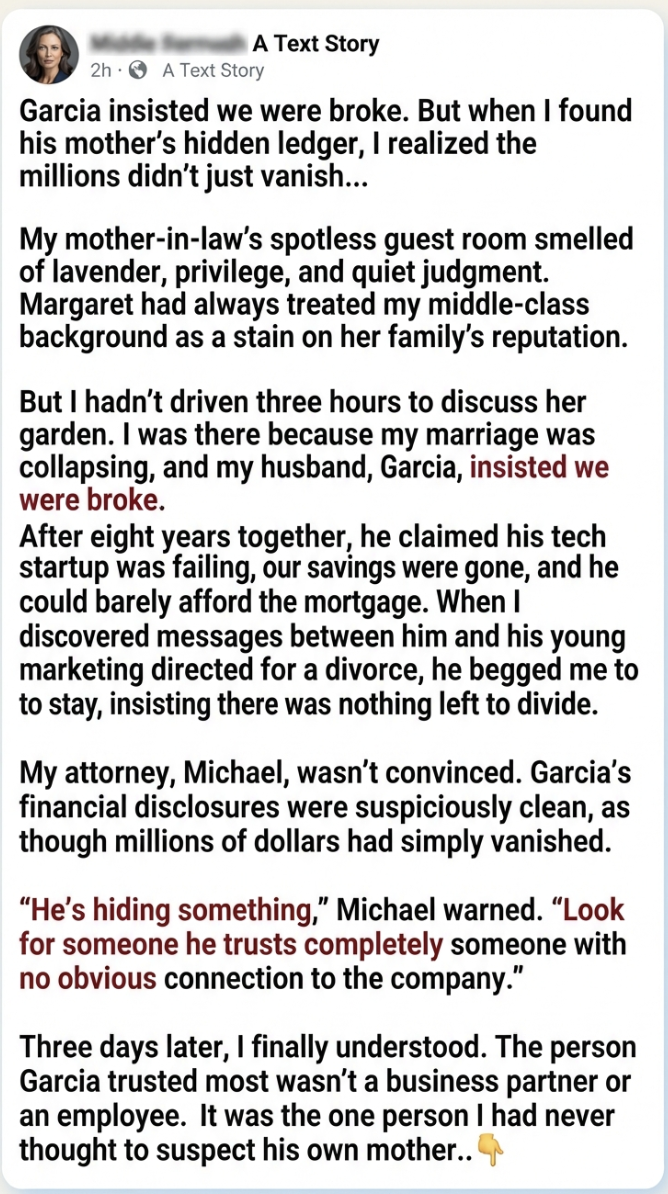
My mother-in-law’s spotless guest room smelled of lavender, privilege, and quiet judgment.
Margaret had always made it clear that she considered my middle-class background a stain on her family’s reputation. From the moment I married her son, Garcia, she treated me as though I were a temporary guest in a world I had never truly belonged to.
She criticized my clothes, questioned my career choices, and regularly reminded me that her family had built its wealth through generations of hard work. Whenever Garcia and I disagreed, she somehow found a way to suggest that I was the source of his unhappiness.
Yet that Thursday afternoon, I had driven three hours to her elegant home because my marriage was collapsing, and I needed answers that my husband refused to give me.
For eight years, I had believed Garcia and I were building a life together. We had bought a beautiful home, saved for our future, and supported his dream of establishing a technology startup. I had endured uncertain years, long evenings, and countless postponed plans because I believed his business would eventually succeed.
Then, almost overnight, everything supposedly disappeared.
Garcia told me the company was failing. He claimed investors had withdrawn, major contracts had collapsed, and debts had consumed nearly all our savings. According to him, we were barely managing the mortgage, and there was nothing left to protect.
At first, I believed him.
I knew startups could fail. I had watched Garcia work late into the night, attend conferences, and spend weekends preparing presentations for potential investors. I understood that entrepreneurship involved risk, and I had never expected our lives to be financially perfect.
But then I discovered messages between Garcia and his young marketing director.
The conversations were far more personal than professional. They included private jokes, affectionate comments, and references to meetings that Garcia had never mentioned to me.
When I confronted him, he initially dismissed the messages as harmless workplace communication. But the more I asked, the more his explanations changed.
Eventually, he admitted that their relationship had crossed boundaries.
That was when I asked for a divorce.
Garcia was stunned. He cried, apologized, and promised to end the relationship. He insisted that the affair had been a mistake caused by pressure at work and that he still loved me.
But when I asked about our finances, his answer was always the same.
“There’s nothing left,” he told me. “The company is failing, our savings are gone, and I can barely afford the mortgage. We have no money to divide.”
I wanted to believe him, but something about his explanation felt incomplete.
My attorney, Michael, felt the same way.
During our first meeting, he reviewed Garcia’s financial disclosures, business records, and the documents we had collected during our marriage. The statements showed little in the way of assets, and the liabilities appeared unusually straightforward.
Too straightforward.
“Financial difficulties can be genuine,” Michael explained, “but these disclosures don’t give us a complete picture of what happened to the money. We need to establish whether assets were transferred, whether there are undisclosed interests in other entities, and whether the records accurately reflect the company’s position.”
He turned a page in the file.
“Garcia is claiming that millions of dollars have effectively vanished. Yet there are gaps in the transaction history that we need to investigate.”
I leaned forward.
“Do you think he’s hiding money?”
“I think the records raise questions that haven’t been answered,” Michael replied. “We should follow the evidence rather than make assumptions. Look for someone he trusts completely—someone who might have information about financial arrangements that aren’t obvious from the company disclosures.”
I left his office with those words repeating in my mind.
Someone Garcia trusted completely.
I thought about his business partners, his accountants, and the investors who had once attended his company events. But none of them seemed likely to hold the full picture. Garcia had always been careful about protecting his business information, even from people who worked closely with him.
Then I remembered Margaret.
She had never liked me, but Garcia trusted her without question. He consulted her about major purchases, business decisions, and family matters. Whenever he faced a difficult situation, he often called her before speaking to anyone else.
Margaret had also been unusually calm when Garcia announced that his company was struggling.
While I was worried about our home and savings, she had assured me that her son would manage somehow. She had even suggested that I should be more supportive instead of questioning him during such a difficult period.
At the time, I had assumed she was simply defending her son.
Now, I wondered whether she knew something I did not.
Three days after speaking with Michael, I drove to Margaret’s home.
She welcomed me with a polite smile and led me into the guest room, where everything was arranged with the precision of a luxury hotel. Fresh lavender filled the air. Pale curtains framed the tall windows, and an expensive vase sat on the bedside table.
“It’s been a while,” she said, smoothing the sleeve of her blouse. “I hope you’ve come to your senses about the divorce.”
I sat in the chair beside the window.
“I came because I need to understand what’s happening with Garcia’s finances.”
Her expression barely changed.
“I thought you were leaving him because of another woman.”
“I am leaving because of the affair and the dishonesty. But I also need to know where our money went.”
Margaret gave a small sigh.
“Garcia’s company is struggling. He’s under tremendous pressure. Surely you understand that business isn’t always successful.”
“I understand that businesses can fail. But I don’t understand why his financial records don’t explain what happened to our savings.”
She folded her hands.
“Perhaps you should let the lawyers handle it.”
“That is exactly what I’m doing.”
For a moment, Margaret’s composure slipped. She glanced toward the hallway before looking back at me.
“Garcia has always been a generous son,” she said. “He has helped this family in ways you probably don’t know about.”
I studied her face.
“What kind of help?”
“Family matters,” she replied. “Nothing you need to concern yourself with.”
The answer unsettled me.
I had spent eight years sharing a home and finances with Garcia. If he had been transferring significant amounts of money to his mother, those transactions were directly relevant to the financial disclosures in our divorce.
“I think I do need to concern myself with it,” I said. “Especially if our marital assets were involved.”
Margaret’s eyes narrowed.
“You seem to have become very suspicious.”
“I’ve learned to ask questions when the answers don’t make sense.”
She stood and walked toward the window.
“Garcia is my son. I will always protect him.”
There it was.
Not a denial. Not an explanation.
A declaration of loyalty.
I realized then that Margaret was unlikely to volunteer anything that could harm her son. I thanked her for the conversation, collected my coat, and left without revealing what Michael and I had discussed.
On the drive home, I called him.
“She knows something,” I said. “She didn’t confirm anything, but she was very careful about what she said.”
“Did she mention specific accounts or transfers?” Michael asked.
“No. But she said Garcia had helped the family financially.”
“That’s worth examining, but we need evidence. Don’t access her private documents or accounts. We’ll request the relevant records through the proper legal process.”
I agreed.
Over the following days, Michael and his team reviewed the documents available to us and identified several transactions that required further investigation. Some payments had been described as consulting expenses, while others were associated with business arrangements involving companies that were not clearly identified in Garcia’s disclosures.
A number of transfers appeared to have been made shortly before Garcia told me the startup was insolvent.
The amounts were significant, but we could not yet establish who ultimately controlled the funds or whether the transfers represented legitimate business expenses, loans, or something else.
Michael submitted formal requests for relevant financial records and asked Garcia to provide additional documentation.
Garcia responded through his attorney, insisting that the business had been transparent and that he had no undisclosed personal assets.
But the documents that followed raised more questions.
One company listed in the records had Margaret as a director. Another had an address associated with a property she owned. Several payments had been made to entities linked to those businesses.
I stared at the documents Michael showed me during our next meeting.
“Is this where the money went?” I asked.
“We have evidence of transfers to companies associated with your mother-in-law,” he said. “But we still need to establish the nature of those transfers, the ownership structure, and whether any assets remain under Garcia’s control.”
I felt a strange combination of relief and disbelief.
For weeks, I had been told that our savings had disappeared because of a failed business. Now there was evidence that substantial amounts had been moved through companies connected to the woman who had spent years telling me I did not belong in her family.
“Why would Margaret agree to this?” I whispered.
Michael looked at the file.
“We can’t determine her motives from these records alone. We need to find out what she knew, what she received, and what the transactions were intended to accomplish.”
A formal financial review was initiated as part of the divorce proceedings. The lawyers exchanged additional documents, and the relevant financial institutions were asked to provide records through appropriate legal channels.
As the information emerged, the picture became clearer.
Garcia’s startup had indeed faced financial difficulties, but the business had not simply lost every asset it once held. Before its position deteriorated, certain funds and business interests had been transferred into entities connected to Margaret.
Some of the transfers had been described as loans. Others were recorded as payments for services, though the supporting documentation was incomplete. A separate agreement showed that Margaret’s company had acquired an interest in a valuable software product developed by Garcia’s startup.
The transactions had not been properly explained in Garcia’s initial financial disclosures.
And Margaret was not simply a relative who had offered temporary assistance.
She had become a central figure in a series of financial arrangements that needed to be examined.
When Michael explained the findings, I felt my hands go cold.
“How much?” I asked.
“The value is still being assessed,” he said. “We shouldn’t rely on a single estimate until the business interests and outstanding obligations are independently reviewed. But the records indicate that the amount potentially connected to these arrangements is substantial.”
I leaned back in my chair.
For so long, I had been frightened that Garcia’s business failure had destroyed everything we had worked for. Now I was facing the possibility that the story had been deliberately presented in a way that made me believe there was nothing left to divide.
The betrayal was no longer limited to the affair.
It had reached into the foundation of our shared financial life.
Michael advised me to remain careful. The transactions needed to be evaluated under the laws governing our divorce, and the legal consequences would depend on the ownership records, the agreements, and the evidence of each person’s involvement.
He reminded me that suspicious transfers did not automatically establish fraud or guarantee that every asset could be recovered.
I understood.
I did not want revenge. I wanted an accurate accounting and a fair resolution.
A week later, Garcia called me directly.
“I heard you’re investigating my mother,” he said.
“I’m asking for a complete financial disclosure.”
“You’re making this much worse than it needs to be.”
“Then provide the records that explain where the money went.”
He sighed.
“My mother helped me when the company was in trouble. She didn’t do anything wrong.”
“Then why weren’t the transfers disclosed?”
“Because the business arrangements are complicated.”
“Complicated doesn’t mean they should be hidden.”
There was a long silence.
Then Garcia said something I would remember for a long time.
“You have no idea what my family has done for me.”
I closed my eyes.
“Maybe I don’t. But I know what you promised me when we got married. We agreed to build a life together, make financial decisions together, and be honest with each other. You can’t use your family as a reason to exclude me from decisions that affected our marriage.”
He became defensive.
“You’re acting as though I’ve stolen from you.”
“I’m acting as though I have a right to know what happened to our shared finances.”
Garcia ended the call shortly afterward.
I sat quietly for several minutes, feeling the weight of everything that had changed. I had once believed that the most painful part of our separation would be losing the person I loved.
Now I was beginning to understand that I was also grieving the future I thought we had been building.
The legal process continued.
Margaret’s company provided some documents in response to the formal requests, while other records required further clarification. The lawyers examined the agreements, payment histories, and business valuations. Garcia’s legal team disputed some of the interpretations and argued that the transfers were legitimate arrangements made to support a struggling company.
The disagreement could not be resolved through accusations alone. Independent financial specialists were engaged to review the records and assess the relevant business interests.
As the review progressed, Michael identified evidence that Garcia had retained an economic interest in at least one entity connected to the transferred assets. The initial disclosures had not adequately explained that interest.
This finding changed the direction of the negotiations.
Garcia could no longer rely solely on the claim that the startup had failed and nothing remained. The financial arrangements had to be accounted for, and the parties needed to determine which assets and obligations were legally relevant to the divorce.
Margaret was also asked to clarify her role in the transactions.
For the first time, her confidence appeared to weaken.
She had spent years presenting herself as the person who understood money, status, and family responsibility better than anyone around her. Now her own business records were under scrutiny, and the questions could not be dismissed as the concerns of a daughter-in-law she considered unsuitable.
A few weeks later, Margaret asked to meet with me.
I agreed, but only after informing Michael and arranging to meet in a public place.
She arrived wearing a cream-colored suit and carrying a structured handbag. Her appearance was as polished as ever, but her expression was tense.
“I think we should talk without the lawyers,” she said.
“We can talk, but I’m not making any financial agreements outside the legal process.”
She looked disappointed.
“I never wanted this situation to become so ugly.”
“Neither did I.”
Margaret stirred her tea.
“Garcia came to me when the company was failing. He was frightened. He believed that if the business collapsed, he would lose everything. I agreed to help him protect what he had built.”
“Why did you hide the arrangements from me?”
She looked down.
“He said you were already considering leaving him. He didn’t want you to become involved in the business problems.”
I felt a wave of disbelief.
“I was considering leaving because I found messages between him and another woman. The financial situation was something I was trying to understand. He used the problems as a reason to convince me that I would leave the marriage with nothing.”
Margaret did not respond immediately.
“I thought I was helping my son,” she finally said.
“Did you think about what it meant for me?”
She looked toward the window.
“I didn’t think you would pursue the matter this far.”
Her answer revealed more than she probably intended.
For years, Margaret had believed that her influence over Garcia would protect him from difficult consequences. She had expected me to accept his explanations, step away from the marriage, and leave the family’s financial arrangements undisturbed.
But I was no longer willing to accept a version of events that had not been supported by the records.
“I’m not doing this to punish you or Garcia,” I said. “I want the truth, and I want the divorce handled fairly. If the transactions were legitimate, the documents should establish that. If assets were improperly concealed, the legal process should address it.”
Margaret’s eyes filled with tears, though her voice remained controlled.
“Garcia is my only son.”
“And I was his wife.”
For the first time, she had no immediate reply.
We ended the meeting without an agreement. I returned to Michael with a clear account of the conversation, and he documented the information appropriately for the ongoing proceedings.
Over the following months, the financial review established a more complete picture of Garcia’s business interests, the transfers involving Margaret’s companies, and the outstanding liabilities. Some transactions were supported by legitimate agreements, while others required adjustments to the financial disclosures and further negotiation.
The parties ultimately reached a settlement through their legal representatives. The agreement accounted for the assets and liabilities that were determined to be relevant to the marriage, while resolving the disputed financial interests without the need for a prolonged public trial.
The settlement did not restore the marriage, nor did it erase the hurt caused by the affair and the financial secrecy. But it gave me a clearer understanding of my financial position and a way to move forward.
Garcia had wanted me to believe that there was nothing left to divide.
The records showed that the reality was far more complicated.
When the divorce was finalized, I moved into a modest home of my own. It was smaller than the house Garcia and I had shared, but it was peaceful, bright, and entirely mine to shape.
I bought a simple dining table, filled the kitchen with plants, and hung photographs of the people who had supported me through the hardest months.
For the first time in years, I made decisions without wondering whether Margaret would approve.
I did not celebrate the end of my marriage. There were still mornings when I woke up remembering the early years with Garcia, when we had been young, hopeful, and convinced that love could help us overcome every obstacle.
I could acknowledge that those memories were genuine without allowing them to excuse what had happened later.
Garcia eventually sent me a letter. He apologized for the affair, the financial concealment, and the way he had allowed his mother to become involved in decisions that should have been handled transparently between us.
He wrote that he had been afraid of losing his business, his reputation, and the life he had imagined for himself. He admitted that he had made decisions based on fear and had repeatedly chosen the easiest explanation over the honest one.
I read the letter twice.
Then I placed it in a drawer.
I did not respond immediately, and I did not feel obligated to offer forgiveness simply because he had finally acknowledged some of the harm he had caused.
Forgiveness, if it ever came, would be my decision. It would not change the importance of accountability or require me to rebuild a relationship I no longer wanted.
Several months later, I received an invitation to a family gathering hosted by one of Garcia’s relatives. Margaret would be there, and I briefly considered attending. But I realized I had no need to return to a family environment where my place had always felt conditional.
I politely declined.
Instead, I spent the weekend with friends who had stood beside me when my life felt uncertain. We cooked dinner, shared stories, and laughed about ordinary things.
At one point, Chloe raised her glass.
“To new beginnings,” she said.
I smiled.
“To knowing your worth,” I replied.
That evening, as I returned to my quiet home, I thought about the woman who had once sat in Margaret’s spotless guest room, trying to understand why her marriage was falling apart.
She had arrived believing she needed to convince her mother-in-law to tell the truth.
But the real turning point had come when she stopped relying on explanations and began asking for evidence.
The hidden financial arrangements had been complicated. The legal process had been exhausting. And the betrayal had been deeper than she could have imagined.
Yet she had learned that she did not need to match someone else’s wealth, social status, or family reputation to deserve respect.
Her background had never been a stain.
Her questions had never been unreasonable.
And her decision to seek a fair accounting had never been an act of disloyalty.
Margaret had once treated her as though she would never truly belong in the family. Garcia had assumed that his financial explanations would be accepted without scrutiny.
But neither of them could decide what kind of life she deserved to build.
She had entered the marriage believing that love meant standing beside someone through success and failure. She left understanding that partnership also required honesty, mutual respect, and the courage to face difficult truths together.
The greatest discovery had not simply been that Garcia’s mother was connected to the hidden financial arrangements.
It was that the person she had never thought to suspect had been trusted with decisions that affected her future, while she herself had been kept in the dark.
And once she knew the truth, she chose not to let the family’s wealth, influence, or expectations determine her next step.
Sometimes, the greatest betrayal comes not from a stranger or a business partner, but from the people who were supposed to protect the trust you placed in them. And sometimes, finding the truth is the first step toward reclaiming a life you thought you had lost.