For years, Kimberly believed she had a happy marriage.
Her husband, Riley, wasn’t cruel. He didn’t shout at her, disappear for days, or deliberately make her life difficult. He worked hard, loved their children, and helped around the house whenever she asked.
From the outside, they seemed like a couple who had figured out how to build a good life together.
Their home was comfortable. Their children were doing well. They celebrated birthdays, attended family gatherings, and took photographs on holidays.
Friends often told Kimberly how lucky she was.
“Riley seems like such a good husband.”
And Kimberly always smiled.
“He is.”
She wasn’t lying.
Riley was a good man in many ways.
But there was a part of their marriage that nobody saw, including Riley.
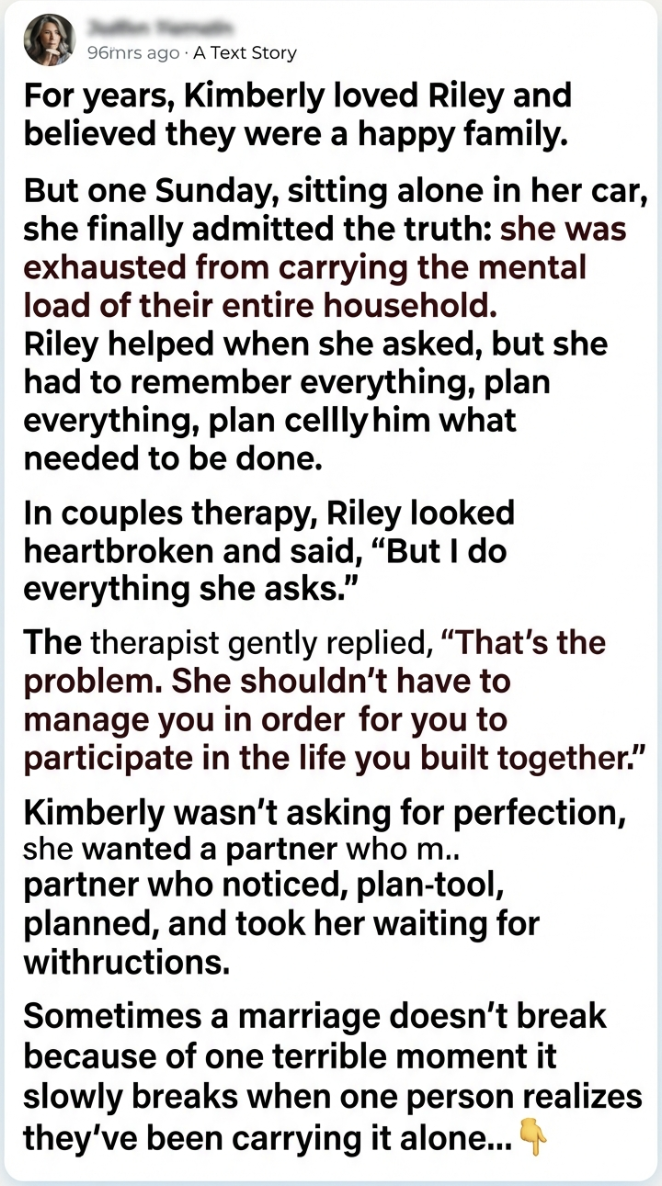
Kimberly was exhausted from being the person who remembered everything.
She remembered the children’s school schedules, the grocery lists, the dentist appointments, the birthdays, the bills, the family gatherings, the household repairs, and the countless small responsibilities that kept their lives running.
Riley helped whenever she asked.
But she always had to ask.
And after years of carrying the responsibility of noticing, planning, reminding, and organizing, Kimberly began to feel less like a partner and more like the manager of a household that never closed.
She didn’t know how to explain that the problem wasn’t the work Riley did.
It was the work she had to do before he could do it.
And one Sunday afternoon, sitting alone in her car outside their house, she finally admitted something that frightened her.
She loved her husband, but she no longer had the energy to keep living the way they were.
The Sunday That Changed Everything
It was an ordinary Sunday.
The children were inside watching television, and Riley was relaxing on the sofa after finishing a few things in the garage.
Kimberly had spent the morning preparing breakfast, washing clothes, changing the children’s bedsheets, checking the school calendar, and planning meals for the coming week.
She had also remembered to order a birthday gift for Riley’s mother, confirm a school event, and pay a bill that was due the following day.
Nobody had asked her to do all those things.
Nobody had even noticed that she had done them.
When she finally sat down, Riley called from the living room.
“Kim, have you seen my blue shirt?”
She closed her eyes.
“It’s in the wardrobe, on the left.”
“Thanks, sweetheart.”
A few minutes later, he called again.
“Do you know where the children’s swimming bags are?”
“Near the laundry basket.”
“Great. And what are we having for dinner?”
Kimberly looked at the kitchen counter.
She had already prepared a list of meals for the week, but she hadn’t started dinner.
“I’m not sure yet.”
Riley laughed.
“Whatever you make will be fine.”
He meant it as a compliment.
But Kimberly felt something inside her sink.
Even deciding what everyone would eat had become her responsibility.
She stood up, walked into the kitchen, and stared at the refrigerator.
There were reminders attached to the door.
A school permission slip.
A dentist appointment card.
A grocery list.
A note about an upcoming parent meeting.
She looked at them for a long time.
Then she picked up her car keys.
“I’m going out for a little while,” she called.
“Okay,” Riley answered. “Do you need anything?”
“No.”
She walked outside, got into her car, and drove to a quiet parking area a few streets away.
She didn’t turn on the radio.
She didn’t call a friend.
She simply sat in the driver’s seat with both hands resting on the steering wheel.
For the first time that day, nobody needed anything from her.
And instead of feeling relaxed, she began to cry.
Not because of one terrible event.
Not because Riley had betrayed her.
But because she couldn’t remember the last time someone had noticed she was overwhelmed before she had to explain it.
She wiped her face and looked through the windshield.
Then she whispered to herself,
“I can’t keep doing everything.”
It was the first time she had said those words aloud.
And once she heard them, she couldn’t pretend she hadn’t meant them.
A Marriage Built on Unspoken Expectations
Kimberly and Riley had been married for seventeen years.
When they first met, Riley had been attentive, funny, and thoughtful.
He remembered small details about her.
He surprised her with coffee before work.
He planned weekend trips.
He noticed when she was tired and encouraged her to rest.
They had built their life together gradually.
When their first child arrived, they adjusted to sleepless nights and new responsibilities.
When their second child was born, their schedules became more complicated.
Riley worked full-time, and Kimberly balanced her own career with the demands of raising the children.
They divided some tasks, but over time, the division became less deliberate.
Kimberly started managing the school calendar because she was more familiar with it.
She organized medical appointments because she knew the children’s schedules.
She planned family visits because she was usually the one communicating with relatives.
Riley took care of tasks when she assigned them.
If the car needed servicing, she told him.
If the children needed new shoes, she told him.
If the pantry was running low, she told him.
If a school deadline was approaching, she reminded him.
At first, it didn’t seem like a serious problem.
Kimberly was organized.
Riley trusted her judgment.
They were busy, and they believed they were doing what worked for their family.
But the years passed, and the arrangement became permanent.
Kimberly became the person responsible not only for completing tasks but also for remembering that they existed.
And that invisible responsibility gradually consumed her energy.
One evening, she tried to explain it to Riley.
They were sitting at the dining table after the children had gone to bed.
“Riley, I need you to take more responsibility around the house.”
He looked up from his phone.
“Of course. Just tell me what you need.”
Kimberly paused.
“That’s what I’m talking about.”
He frowned.
“What?”
“I don’t want to have to tell you everything.”
Riley looked genuinely confused.
“But I do everything you ask.”
She nodded.
“I know you do.”
“Then what’s wrong?”
She searched for the right words.
“I need you to notice things yourself. I need you to think ahead. I need you to take responsibility without waiting for me to assign it.”
Riley leaned back in his chair.
“Kim, I can’t read your mind.”
“I know you can’t. But you live here, too. These are your children, too. You know the school schedule. You know when the laundry needs doing. You know we have bills and appointments.”
“I just don’t want to do something the wrong way.”
“Then learn how to do it.”
Her voice was still calm, but Riley looked hurt.
“I feel like nothing I do is good enough.”
Kimberly immediately felt guilty.
“That’s not what I’m saying.”
“Then what are you saying?”
She looked down at her hands.
“I’m saying I’m tired of being the only person who has to think about all of it.”
Riley didn’t respond.
The conversation ended without an argument.
But nothing changed.
And Kimberly began to understand that explaining her exhaustion was becoming another task she had to manage.
The Small Things That Added Up
Over the following months, Kimberly tried to make her needs clearer.
She asked Riley to take responsibility for the children’s school communications.
He agreed, but she still had to remind him to check the school portal.
She asked him to plan the weekly groceries.
He made a list once, but he asked her what the family usually bought, which meals they preferred, and what was already in the cupboards.
She asked him to arrange a birthday gathering for their youngest child.
He booked a venue but forgot to send the invitations until Kimberly reminded him.
Each time, Riley felt he was making an effort.
And he was.
But Kimberly still had to oversee the process.
She had to remember the deadline, explain the requirements, check the details, and follow up to ensure everything had been completed.
Even when Riley finished the task, she remained responsible for making sure it happened.
One Friday, Kimberly returned home after a particularly demanding day at work.
The kitchen was untidy.
The laundry basket was full.
The children needed help preparing for a school activity.
Riley was sitting at the table looking at his laptop.
“Hey, sweetheart,” he said. “You look exhausted.”
“I am.”
“What’s for dinner?”
Kimberly stopped walking.
Riley looked up.
“What?”
“Nothing.”
She went into the kitchen and began preparing a simple meal.
After dinner, she helped the children organize their school materials, packed their bags, and checked the next day’s schedule.
Riley washed the dishes.
When he finished, he came into the living room.
“See? I helped.”
Kimberly looked at him.
“I know you did.”
“Then why are you upset?”
She wanted to explain.
She wanted to tell him that washing the dishes was helpful, but she had already spent the entire evening deciding what needed to happen next.
She had planned dinner, monitored homework, checked the school materials, and made sure the children were ready.
But she was too tired to explain it all again.
“I’m just tired, Riley.”
He nodded.
“Then you should get some rest.”
She looked at him and realized he believed that rest was the solution.
He didn’t understand that she couldn’t truly rest while her mind was still tracking everything that needed to be done.
That night, Kimberly lay awake long after Riley had fallen asleep.
She wasn’t thinking about leaving.
Not yet.
She was thinking about how a marriage could contain affection and goodwill while still leaving one person deeply lonely.
The Conversation That Finally Reached Him
A few weeks later, Kimberly suggested couples therapy.
Riley was surprised.
“Do you really think we need that?”
“I do.”
“Are we having serious problems?”
She looked at him.
“Yes.”
He seemed genuinely shocked.
“Why didn’t you tell me?”
Kimberly took a long breath.
“I have, Riley. Many times.”
He looked down.
“Okay. I’ll go.”
Their first session was uncomfortable.
The therapist, Dr. Evelyn Carter, asked them to describe what had brought them there.
Riley spoke first.
“I love Kimberly. I work hard for our family. I help with the house and the children whenever she asks. But lately, it feels like nothing I do makes her happy.”
Kimberly listened quietly.
Then it was her turn.
“I love Riley, too. He’s not a bad husband. But I’m exhausted. I carry the responsibility of remembering and planning everything. Even when he helps, I have to manage the help.”
Riley shook his head.
“But I do everything she asks.”
Dr. Carter looked at him gently.
“That’s the problem. She shouldn’t have to manage you in order for you to participate in the life you built together.”
Riley stared at her.
The therapist continued.
“Kimberly isn’t asking you to perform every task perfectly. She’s asking you to share responsibility for recognizing what needs to be done, planning how to do it, and following through.”
Riley looked at Kimberly.
“I didn’t realize you felt that way.”
Kimberly’s eyes filled with tears.
“I’ve been trying to tell you.”
Dr. Carter allowed a moment of silence.
Then she explained that household responsibility included more than the visible tasks. It also involved anticipating needs, remembering commitments, making decisions, and carrying the concern that something might be forgotten.
Riley listened.
For the first time, he began to understand why Kimberly could feel exhausted even when he believed he was helping.
“I thought you were just better at organizing,” he said.
“I became better at it because someone had to do it,” Kimberly replied.
He looked at her.
“I’m sorry.”
She nodded.
“I appreciate that. But I need more than an apology.”
Dr. Carter encouraged them to identify areas Riley could take full responsibility for, rather than waiting for Kimberly to delegate each step.
They agreed to start with school communications, medical appointments, and planning the children’s weekly activities.
Riley would manage those responsibilities from beginning to end.
Kimberly wouldn’t need to remind him or supervise the process.
It was a beginning.
But a beginning wasn’t the same as a solution.
When Effort Wasn’t Enough
For a while, things improved.
Riley began checking the school calendar.
He arranged the children’s appointments.
He planned meals and handled grocery shopping without asking Kimberly to prepare the list.
He also began noticing small things around the house that needed attention.
Kimberly appreciated the changes.
She felt some of the pressure easing.
But the deeper issue remained.
Riley was changing his behavior because he had been asked to do so.
Kimberly still had to explain why the change mattered and how it affected her.
She didn’t want to become responsible for teaching her husband how to be a partner for the rest of their marriage.
During another therapy session, Dr. Carter asked them how the changes were going.
Riley smiled.
“Much better. I’m doing more, and we’re arguing less.”
Kimberly nodded.
“Yes, some things are better.”
The therapist turned toward her.
“But?”
Kimberly hesitated.
“I still feel like I’m waiting for the next thing to go wrong.”
Riley frowned.
“What does that mean?”
“It means I’m still carrying the emotional responsibility of our household. I know you’re trying, but I don’t feel like we’ve changed the way we make decisions together.”
Riley’s expression fell.
“I thought I was doing what you wanted.”
“You are doing more of the tasks. But I need us to think like partners, not like one person is responsible for everything and the other person is helping.”
Riley was quiet.
For the first time, he didn’t immediately defend himself.
He looked at the therapist.
“How do I change that?”
Dr. Carter explained that lasting change required initiative and consistency. Riley needed to treat their shared responsibilities as his own, not as extra work he performed to satisfy Kimberly.
It also meant that Kimberly needed space to stop overseeing every detail, even if Riley did some things differently from the way she would have done them.
They both had work to do.
And they both needed to decide whether they were willing to keep doing it.
The Evening Kimberly Made Her Decision
Several months into therapy, Kimberly and Riley attended a school event for their children.
They sat together in the audience.
Their youngest child stood onstage, smiling nervously before beginning a short presentation.
Kimberly watched proudly.
Riley reached for her hand.
She let him hold it.
For a brief moment, she remembered the early years of their marriage.
Their first apartment.
Their late-night conversations.
The excitement of becoming parents.
The dreams they had shared.
She still loved many things about Riley.
But she also knew she had become emotionally distant.
After the event, they drove home together.
The children fell asleep in the back seat.
Riley glanced at her.
“You were quiet tonight.”
“I was thinking.”
“About what?”
“Us.”
He tightened his grip on the steering wheel.
“Are we okay?”
Kimberly looked out the window.
“I don’t know.”
He took a breath.
“I’m trying, Kim.”
“I know you are.”
“Then can we keep working on this?”
She looked at him.
“I don’t know if I have anything left to give.”
He was silent for a long time.
Finally, he asked,
“Do you want a divorce?”
Kimberly felt tears rise in her eyes.
She hadn’t wanted to hurt him.
She hadn’t wanted to reach this point.
But she had spent too long hiding how serious her exhaustion had become.
“I think I need us to live separately for a while,” she said.
Riley looked stunned.
“Because of the housework?”
“No. Because of everything the housework represents.”
He pulled into the driveway and switched off the engine.
“Kimberly, I love you.”
“I know.”
“Then why can’t we fix this?”
She looked at him sadly.
“Because I don’t want to spend the rest of my life explaining why I need a partner.”
Riley’s eyes filled with tears.
“I never wanted you to feel alone.”
“I believe you.”
“Then please don’t give up on us.”
Kimberly reached for his hand.
“I haven’t made this decision because I stopped caring about you. I’ve made it because I need to care about myself, too.”
That night, they agreed to take time apart and discuss what their future would look like with the support of their therapist.
It wasn’t an impulsive decision.
It was one they had reached after years of trying to understand a problem that neither of them had known how to solve.
The House Felt Different Without Her
When Kimberly moved into a small apartment nearby, the children stayed connected to both parents through a carefully arranged schedule.
She made sure they knew the separation wasn’t their fault.
Riley struggled with the change.
For the first time, he had to manage the full routine during his parenting days without Kimberly quietly filling in the gaps.
He had to remember school deadlines, prepare meals, plan activities, and handle unexpected changes.
At first, he found it overwhelming.
One evening, he called Kimberly.
“I didn’t realize how much you did.”
She was quiet.
“I know.”
“I thought I was sharing the work.”
“You were sharing some of the tasks.”
He sighed.
“I understand the difference now.”
Kimberly didn’t respond immediately.
She was glad he was beginning to understand, but she also knew that his realization couldn’t erase years of exhaustion.
“I wish I’d understood sooner,” he said.
“So do I.”
They spoke about the children, their schedules, and an upcoming school event.
The conversation was respectful.
For once, Kimberly didn’t feel responsible for managing Riley’s emotions or reassuring him that everything would be fine.
She could simply talk to him as the other parent of their children.
That was a relief she hadn’t expected.
Learning to Live as Kimberly Again
The first months in her apartment were unfamiliar.
Kimberly had to adjust to a smaller space, a different routine, and evenings without the familiar sounds of family life.
There were days she missed Riley.
There were days she missed the house.
There were days she wondered whether she had made the right decision.
But there were also moments when she felt unexpectedly peaceful.
She could finish work and decide what to do with her evening.
She could read without mentally reviewing the next day’s responsibilities.
She could take a walk without planning everyone else’s schedule first.
She began meeting friends again.
She returned to a hobby she had abandoned years earlier.
She started writing down her own goals—not the family’s goals, not the children’s plans, and not the tasks that needed to be completed.
Her own goals.
Some were small.
Others were dreams she had postponed for years.
She realized that she had spent so much time thinking about what everyone needed that she had stopped asking herself what she wanted.
And slowly, she began rebuilding a sense of identity beyond being a wife and mother.
She remained deeply involved in her children’s lives.
She still cared about Riley.
But she no longer believed that love required her to carry every responsibility herself.
The Conversation That Brought Closure
Nearly a year after their separation, Kimberly and Riley met at a quiet café.
Their children were doing well.
They had established a stable parenting routine.
They had continued therapy, though their conversations increasingly focused on co-parenting and the future of their relationship.
Riley looked at her across the table.
“I’ve been thinking about what you said that night.”
Kimberly waited.
“You said you didn’t want to spend the rest of your life explaining why you needed a partner.”
She nodded.
“I remember.”
“I think I understand now.”
He took a breath.
“I thought being a good husband meant working hard, helping when I could, and being there when you needed me. I didn’t understand that you were carrying the responsibility of making sure everything happened.”
Kimberly listened.
“I should have noticed more,” he continued. “I should have taken responsibility without waiting for you to ask.”
She looked down at her coffee.
“I needed that years ago.”
“I know.”
He paused.
“Do you think we could ever try again?”
Kimberly didn’t answer immediately.
She still cared about him.
She could see that he had made genuine changes.
But she had also learned that a person’s growth didn’t automatically mean a relationship had to be restored.
“I don’t know, Riley,” she said honestly. “I can see that you’re changing. And I respect the work you’ve done.”
He nodded.
“But I also need to be honest about where I am. I don’t want to return to our marriage simply because things are better now.”
He looked at her with sadness.
“Do you still love me?”
“Yes,” she replied. “But love isn’t the only thing a marriage needs.”
He lowered his eyes.
“I understand.”
They sat quietly for a while.
There was sadness between them, but also a sense of acceptance.
They had built a family together.
They had shared many good years.
And they would continue to share the responsibility of raising their children.
But Kimberly no longer felt obligated to preserve their marriage at the cost of her own well-being.
A Different Kind of Family
Eventually, Kimberly and Riley decided to finalize their divorce.
They worked with their attorneys to make arrangements that prioritized their children’s stability and respected both parents’ responsibilities.
It wasn’t a decision made out of anger.
It was a decision made after honest conversations, therapy, and a long period of reflection.
Their children needed time to adjust.
Kimberly and Riley made a commitment to speak respectfully about each other and never put the children in the middle of their disagreements.
At the final meeting, Riley looked at Kimberly.
“I wish I had understood sooner.”
She nodded.
“So do I.”
He looked down at the papers.
“I never thought our marriage would end this way.”
“Neither did I.”
He signed his name.
Then Kimberly signed hers.
The paperwork was complete.
They walked outside together.
Riley looked at her.
“I hope you’re happy, Kim.”
She smiled gently.
“I hope you find happiness, too.”
They hugged briefly.
It wasn’t the embrace of a couple beginning a new life together.
It was the embrace of two people acknowledging a chapter that had mattered, even though it had ended.
Kimberly walked toward her car.
For a moment, she looked back at the building.
She thought about the years they had shared.
The children.
The celebrations.
The ordinary evenings.
The arguments.
The therapy sessions.
The difficult decision to leave.
She felt grief.
But beneath it, she also felt relief.
Not because Riley had been a terrible husband.
But because she had finally stopped ignoring the exhaustion she had carried for so long.
The Life She Had Forgotten to Make Space For
A few months later, Kimberly sat in her apartment on a Sunday afternoon.
Sunlight fell across the living-room floor.
A book rested on the table beside her.
Her phone was quiet.
There were still responsibilities.
There were still school schedules, parenting arrangements, bills, and ordinary problems that came with life.
But she no longer felt solely responsible for holding everything together.
Riley had become more independent and involved as a parent.
He planned his time with the children, communicated with their teachers, and managed the responsibilities in his own household.
Kimberly no longer had to oversee his part of their shared parenting life.
She was still learning how to let go of the habit of checking everything.
Sometimes she caught herself preparing reminders she no longer needed to send.
Sometimes she worried that something might be forgotten.
But she was learning that other adults could take responsibility for their own commitments.
And she was learning that rest didn’t have to be earned by completing every task first.
One Sunday, her daughter called.
“Mom, what are you doing?”
“Reading.”
“Just reading?”
Kimberly laughed.
“Yes, just reading.”
“That’s nice.”
Her daughter paused.
“Are you happy?”
Kimberly looked around her quiet apartment.
She thought about the question.
“I’m finding my way,” she answered. “And I’m learning to take care of myself.”
Her daughter smiled through the phone.
“I’m glad, Mom.”
After they hung up, Kimberly returned to her book.
She felt something she hadn’t felt in a long time.
Space.
Space to think.
Space to rest.
Space to make mistakes.
Space to be a person whose worth wasn’t measured by how much she could manage for everyone else.
She didn’t regret loving Riley.
She didn’t regret the family they had built.
But she no longer believed that staying married was the only way to honor those years.
Sometimes two people can care deeply about each other and still need to make different choices.
Sometimes one person can genuinely try to change, while the other has already reached the end of what they can give.
And sometimes leaving isn’t about punishing someone.
It’s about recognizing that the life you are living no longer allows you to be fully yourself.
Kimberly hadn’t asked for a perfect husband.
She had wanted a partner who noticed, planned, and shared the responsibility of their life without waiting for instructions.
She had wanted to feel that someone was thinking alongside her, not simply responding to her requests.
She had wanted to be cared for without having to organize the care herself.
And when she finally understood that she could no longer keep asking for the same things, she made a decision that changed her future.
She left a marriage that had once brought her happiness, even though it had not been defined by cruelty or betrayal.
She left because exhaustion had become her everyday life.
And she chose to make room for a different one.
A marriage doesn’t always end because someone is a villain. Sometimes it ends because love alone cannot carry the weight of an unequal partnership.
Kimberly would always remember the good years with Riley.
But she would also remember the Sunday afternoon when she sat alone in her car and finally admitted she was exhausted.
That moment hadn’t made her selfish.
It had made her honest.
And when she finally began living with that honesty, she discovered that choosing herself didn’t mean she had stopped caring about the people she loved.
It meant she had finally included herself among them.