The chapel had never felt so quiet.
Rows of flowers surrounded the front of the room.
Photographs of my children stood beside the altar.
People I had known for years sat with their heads lowered, unable to find words that could possibly make the day easier.
I sat in the front row.
I hadn’t spoken much since the funeral began.
There was simply nothing to say.
My children were gone.
And every breath felt like an effort.
Then the chapel doors opened.
Two police officers walked inside.
At first, nobody moved.
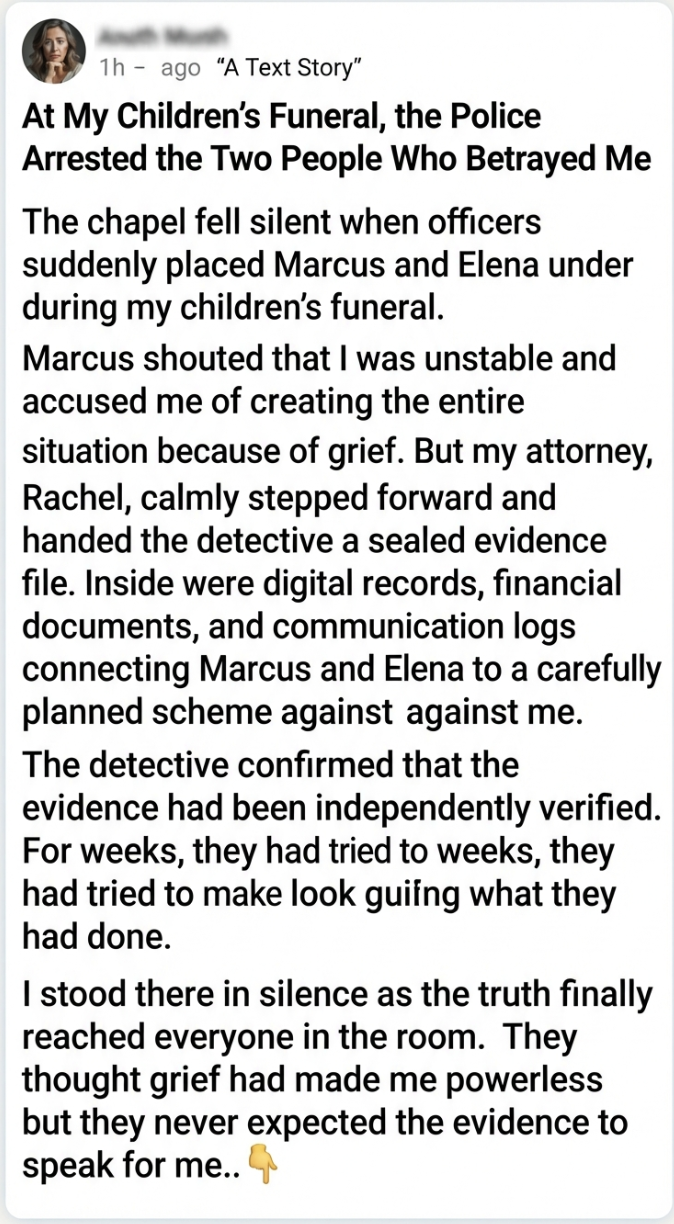
The officers spoke quietly to one another before walking directly toward Marcus and Elena.
Marcus looked confused.
“What is this?”
One of the officers showed him his badge.
“Marcus, please stand.”
He immediately looked toward me.
Then toward the people around him.
“What is happening?”
Elena stood beside him.
“This is a mistake.”
The officer remained calm.
“You both need to come with us.”
The chapel erupted into whispers.
Marcus raised his voice.
“This is because of her!”
He pointed toward me.
“She isn’t thinking clearly! She’s grieving!”
I didn’t respond.
Marcus continued.
“She has been accusing everyone for weeks!”
Elena shook her head.
“We tried to help her.”
The officer didn’t argue.
He simply repeated,
“You need to come with us.”
Marcus became louder.
“She created this entire situation!”
That’s when my attorney, Rachel, stood.
She had been sitting quietly several rows behind me.
She walked toward the officers carrying a sealed evidence file.
“Detective,” she said calmly, “you’ll want this before you proceed.”
The detective accepted the file.
“What is it?”
“Independently verified records related to the investigation.”
He opened it.
Inside were financial documents.
Digital communication records.
Transaction histories.
Copies of emails.
And records showing communication between Marcus and Elena during the weeks before everything fell apart.
The detective read through several pages.
His expression changed.
Marcus stopped talking.
Elena looked at him.
Then at the detective.
Rachel said nothing.
She didn’t need to.
The evidence spoke for itself.
Three weeks earlier, I had believed Marcus was one of the few people I could trust.
He had been a longtime family friend.
Elena had been someone I considered almost like a sister.
After the tragedy, they were among the first people to offer help.
They brought meals.
They made phone calls.
They offered to handle paperwork.
They told me I shouldn’t worry about finances while I grieved.
I believed them.
Why wouldn’t I?
I was barely functioning.
I trusted the people standing beside me.
Then strange things began happening.
Financial accounts were being accessed.
Documents were being requested.
Messages were being sent from accounts I hadn’t authorized.
And someone had begun telling people that I was behaving irrationally.
At first, I assumed everyone was simply overwhelmed.
Then Rachel called me.
“Have you authorized these transactions?”
“What transactions?”
She sent me copies.
I stared at them.
Money had been moved from an account connected to my children’s estate.
Documents had been requested without my approval.
And several messages appeared to have been sent using information only Marcus and Elena should have known.
I felt sick.
Rachel didn’t tell me what to believe.
She told me what to do.
“Don’t confront them yet.”
“Why?”
“Because we need evidence.”
So we gathered it.
Quietly.
Carefully.
Legally.
Every document was preserved.
Every relevant message was verified.
Every financial record was reviewed.
Rachel brought in an independent specialist to authenticate the digital records.
The more we discovered, the clearer the pattern became.
Marcus and Elena had been communicating privately about gaining control over certain assets and documents belonging to my family.
They had also discussed making me appear unreliable so that other people would question my ability to manage my affairs.
Their plan depended on one thing.
My grief.
They believed that if they repeated the same story often enough, people would believe it.
They were wrong.
The detective continued reading.
Finally, he looked at Marcus.
“These communications appear to contradict your earlier statements.”
Marcus shook his head.
“No.”
The detective turned another page.
“Are you saying these messages aren’t yours?”
Marcus hesitated.
“I don’t know.”
Rachel spoke calmly.
“They were independently authenticated.”
Elena suddenly became angry.
“This is ridiculous!”
The detective looked at her.
“Please remain calm.”
“You don’t understand!”
“We understand enough to continue the investigation.”
Marcus looked at me.
“You did this.”
I finally looked back at him.
“No.”
My voice was quiet.
“I didn’t do anything.”
“You wanted us arrested!”
“No.”
I looked toward the evidence file.
“I wanted the truth documented.”
He stared at me.
For the first time, he seemed to understand.
I hadn’t fought them with accusations.
I hadn’t screamed.
I hadn’t tried to convince everyone in the room.
I had simply collected the facts.
The detective continued explaining that the evidence had been independently reviewed and that the arrests were based on the investigation, not merely on my allegations.
That distinction mattered to me.
I didn’t want revenge.
I wanted the truth.
The officers escorted Marcus and Elena toward the chapel doors.
Marcus stopped.
He turned around.
His expression had changed.
The anger was gone.
He looked frightened.
“Elena,” he whispered.
She didn’t answer.
Then he looked at me.
For a moment, I thought he might apologize.
Instead, he said,
“I never thought you’d figure it out.”
The chapel became completely silent.
I looked at him.
“You underestimated me.”
He lowered his head.
Then the officers took them outside.
The doors closed.
And the chapel became quiet again.
Rachel returned to my side.
“You okay?”
I nodded.
“I don’t know.”
“That’s understandable.”
I looked at the photographs near the altar.
“I didn’t want this to happen here.”
“I know.”
“I wanted today to be about my children.”
Rachel placed the evidence file on the chair beside me.
“It still is.”
I looked at her.
She continued.
“What happened today doesn’t change who they were.”
I nodded.
She was right.
The investigation could continue.
The legal process could take months.
Marcus and Elena would have the opportunity to respond through that process.
But none of that changed the reason we were gathered.
My children.
Their lives.
Their memories.
The people they had loved.
That was what mattered.
After the funeral, I went home alone.
The house was painfully quiet.
I walked into my children’s rooms.
Everything was still where they had left it.
Books.
Photographs.
Small personal belongings.
I stood in the doorway for a long time.
I thought about everything that had happened.
The betrayal.
The investigation.
The arrests.
The accusations.
The whispers.
And then I realized something.
Marcus and Elena had assumed grief made me powerless.
They thought I would be too overwhelmed to notice what was happening.
They believed they could control the story because I was too heartbroken to defend myself.
But grief hadn’t erased my judgment.
It had simply taught me to move more carefully.
I didn’t need to become loud to become strong.
I didn’t need to threaten anyone.
I didn’t need to convince every person who doubted me.
I needed facts.
And I needed patience.
Months later, the investigation continued.
Some claims were confirmed.
Others required additional review.
The legal proceedings were still ongoing.
I learned not to confuse an arrest with a final judgment.
That distinction mattered.
The truth had to be established through evidence and due process.
But one thing was already clear.
The story Marcus and Elena had tried to tell about me could no longer stand on its own.
There were records.
There were verified communications.
There were financial documents.
There was a timeline.
And there were facts that couldn’t simply be explained away as grief.
I returned to the chapel several months later.
It was empty.
I sat in the same front row.
The room felt different.
Not because the loss had disappeared.
It hadn’t.
But because I no longer felt surrounded by questions.
I thought about the day Marcus had pointed at me and called me unstable.
I remembered how badly I had wanted to defend myself.
Then I remembered Rachel’s advice.
“Let the evidence speak.”
So I did.
And it had.
I looked toward the altar.
“I miss you,” I whispered to my children.
Then I took a slow breath.
“I’ll keep going.”
Not because the pain was gone.
Not because everything was suddenly okay.
But because they deserved to be remembered for their lives—not only for the circumstances surrounding their deaths.
And I deserved to rebuild a life that belonged to me.
A year after the funeral, I still kept the evidence file.
Not as a trophy.
Not as a reminder of revenge.
I kept it because it represented something important.
The moment I stopped allowing other people to tell my story for me.
Marcus and Elena thought grief had made me powerless.
They were wrong.
Grief had made me quieter.
It had made me more careful.
It had made me understand that sometimes the strongest response isn’t an argument.
It’s documentation.
It’s patience.
It’s allowing facts to be examined properly.
And when the truth finally emerged, I didn’t need to stand in the middle of the room and announce that I had been right.
Everyone had seen it for themselves.
I had lost something I could never replace.
But I refused to let that loss become another person’s opportunity to control my life.
The arrests were not my victory.
The evidence was not my revenge.
The real victory was much quieter.
It was sitting in my children’s empty home months later and knowing that, despite everything, I had protected their memory, protected the truth, and refused to let anyone rewrite what happened.
They thought grief had made me powerless.
They never expected the truth to become stronger than the story they had created.
And when the truth finally reached everyone in that chapel, I didn’t have to say another word.
The evidence spoke for me.