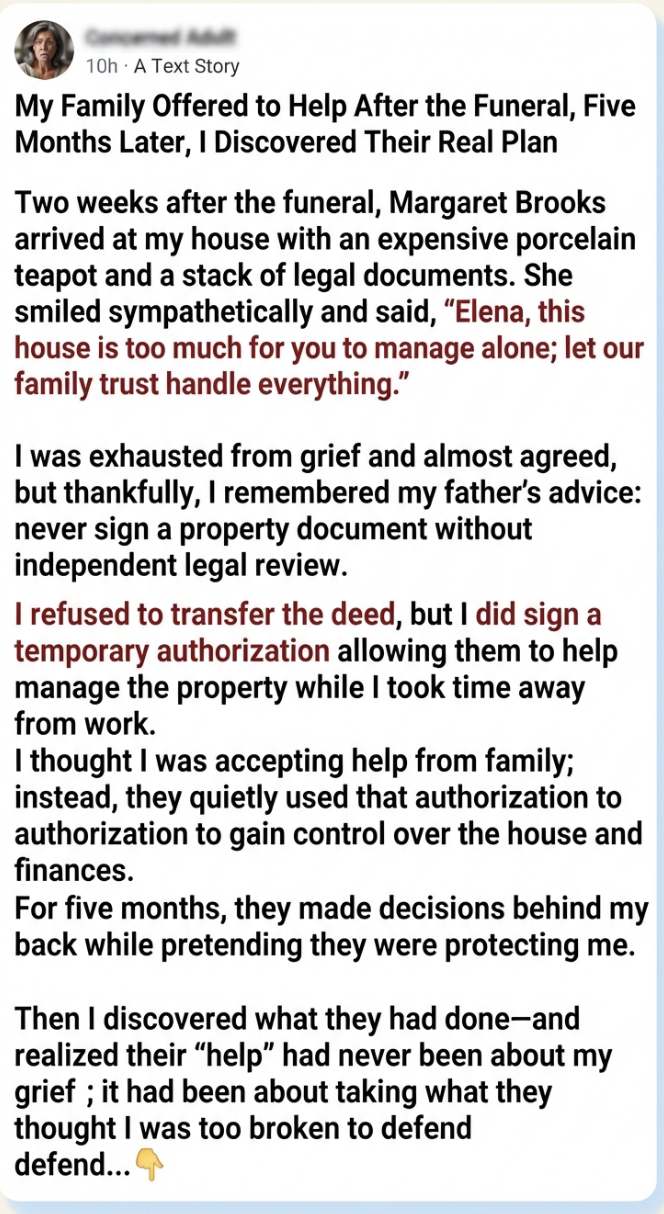
Two weeks after my father’s funeral, Margaret Brooks arrived at my house carrying an expensive porcelain teapot and a stack of legal documents.
I was still learning how to walk through the house without expecting to hear my father’s voice.
Every room contained a memory.
His reading glasses were still on the table.
His gardening gloves were still beside the back door.
His favorite chair still faced the window.
I wasn’t ready to think about anything else.
Margaret knew that.
She smiled sympathetically as she placed the teapot on the kitchen counter.
“Elena,” she said softly, “you shouldn’t have to handle everything alone.”
I looked at the documents in her hand.
“What are those?”
“Just some paperwork.”
She pulled out a chair.
“Your father left you a lot to manage. The house, the accounts, the maintenance, the property taxes. It’s too much for one person.”
I rubbed my tired eyes.
“I’ll manage.”
“You don’t have to.”
She pushed the documents toward me.
“Our family trust can take care of everything temporarily.”
I looked at the first page.
There were references to property management, financial authorization, maintenance expenses, and banking arrangements.
Something about it made me uncomfortable.
Then I remembered something my father had told me years earlier.
“Never sign a property document because someone makes you feel guilty for taking your time.”
He had repeated another sentence even more often:
“If it’s really good for you, it’ll still be good for you after an independent lawyer reads it.”
I looked at Margaret.
“I need a lawyer to review this.”
Her smile disappeared for half a second.
Then it returned.
“Of course.”
She made it sound like I had said something completely unreasonable.
“I only want to help.”
“I know.”
I didn’t sign the transfer documents.
But I was exhausted.
I needed time away from work.
I needed someone to handle basic maintenance and bills.
So I agreed to a limited temporary authorization allowing them to manage certain routine matters while I recovered.
I thought I was accepting help from family.
I didn’t realize I had just given them a door.
And over the next five months, they slowly tried to turn that door into ownership.
The first month passed quietly.
Margaret sent me occasional updates.
“Property taxes handled.”
“Roof inspection scheduled.”
“Insurance renewed.”
“Utility payments organized.”
Everything sounded normal.
I thanked her.
I trusted her.
After all, she was family.
Then, in the second month, she suggested refinancing.
“It’s just an option,” she said.
“The house is valuable, and the trust could secure better financing terms.”
I immediately said no.
“I don’t want a loan against the house.”
“Of course.”
She didn’t argue.
That should have reassured me.
Instead, it became the first thing that bothered me.
Because Margaret stopped mentioning the house altogether.
Then my cousin Daniel called.
He casually asked,
“How are things going with the property?”
“Fine.”
“Good. Margaret said the renovations were progressing.”
I froze.
“What renovations?”
There was a pause.
“Nothing major.”
“What renovations, Daniel?”
He suddenly became uncomfortable.
“I thought you knew.”
I called Margaret.
She didn’t answer.
She called me back three hours later.
“You heard about the repairs?”
“I heard about renovations.”
“Just improvements.”
“What improvements?”
She listed several things.
Painting.
Landscaping.
Kitchen updates.
New security equipment.
I frowned.
“Who authorized all that?”
“The trust.”
“I didn’t.”
“You gave us management authority.”
“For maintenance.”
“Some of these things were necessary.”
I looked around my father’s house.
Nothing seemed necessary.
That night, I requested copies of every invoice.
Margaret sent them the next morning.
The total was nearly $86,000.
I stared at the number.
There was no way ordinary maintenance had cost that much.
I began reading the invoices.
A landscaping company I had never heard of.
A construction company owned by Daniel’s business partner.
A consulting company connected to Margaret’s husband.
And several payments described only as “property administration.”
I called my father’s old attorney.
He agreed to meet me.
I brought every document I had.
He read quietly for nearly an hour.
Then he looked at me.
“Elena, who prepared this authorization?”
“Margaret.”
“Did you have independent legal advice before signing?”
“No.”
He nodded.
“That matters.”
“What does?”
“The authorization may give them broader authority than you understood.”
My stomach tightened.
“How broad?”
He turned the document toward me.
“They may have been able to negotiate contracts, authorize expenses, communicate with financial institutions, and act as your representative regarding certain property matters.”
I stared at the page.
“But they couldn’t sell the house.”
“Not directly, based on this document.”
“Then what are they doing?”
He pointed to another section.
“Preparing the property for transfer or refinancing could be part of the strategy.”
My hands went cold.
“Strategy?”
He looked at me carefully.
“I don’t want to speculate. We need records.”
So we started looking.
Bank statements.
Invoices.
Property records.
Trust correspondence.
Email communications.
Everything.
And five months after my father’s funeral, we found it.
A draft agreement.
It wasn’t addressed to me.
It was addressed to a private investment company.
The document described my father’s property as a potential trust-controlled asset.
My name appeared only as the current beneficiary.
I read the sentence three times.
Then I found another document.
A proposed refinancing agreement.
Then another.
A valuation report.
The house was estimated at $1.8 million.
And beside the valuation was a handwritten note:
“Owner likely to accept settlement if presented as family protection arrangement.”
I stared at those words.
Owner likely to accept.
They weren’t protecting me.
They were calculating how to persuade me.
I felt sick.
But I wasn’t going to confront them yet.
My father’s lawyer told me to stay calm.
“Don’t accuse anyone until we’ve gathered everything.”
So I waited.
Three days later, Margaret came to my house.
She brought another cup of tea.
She smiled.
“How are you feeling?”
“Better.”
“Good.”
She sat across from me.
“We’ve been thinking about your future.”
I said nothing.
“You really shouldn’t have to worry about this property anymore.”
I smiled politely.
“What do you suggest?”
She leaned forward.
“We think the trust should take full responsibility.”
“And what does that mean?”
“Nothing complicated.”
She reached into her bag.
“We could purchase the property from you at a fair value.”
There it was.
I looked at her.
“You want to buy my father’s house?”
“It’s not about wanting the house.”
“Then what is it about?”
“We’re trying to protect you.”
I nodded slowly.
“From what?”
She hesitated.
“From making emotional financial decisions.”
I almost laughed.
Instead, I asked,
“How much?”
She gave me a number.
$1.1 million.
I stared at her.
“You said the property was worth $1.8 million.”
Her expression changed.
“Market conditions are complicated.”
“Your own valuation says $1.8 million.”
She became silent.
I continued.
“And the proposed refinancing documents show the trust expected to use the property as collateral.”
She looked at me.
“How did you get those?”
I didn’t answer.
She stood.
“Elena, you’re misunderstanding.”
“No.”
My voice remained calm.
“I finally understand.”
She tried to explain.
She said the family had only been trying to help.
She said grief had made me vulnerable.
She said they were concerned I might lose the property because I wasn’t managing everything.
Then I asked the question she wasn’t expecting.
“If you were protecting me, why did you prepare a document describing me as someone who would accept a discounted settlement?”
She stopped speaking.
The room became silent.
I continued.
“Why did you spend $86,000 on work I never approved?”
Silence.
“Why did you prepare refinancing documents without telling me?”
Nothing.
“And why did you offer me $1.1 million for a property your own valuation says is worth $1.8 million?”
Margaret sat down again.
For the first time, she looked less like a concerned relative and more like someone who had been caught.
“Elena…”
“No.”
I shook my head.
“You don’t get to call this help anymore.”
She looked away.
I had wanted an explanation.
Instead, I finally understood the explanation.
They had looked at my grief and seen weakness.
They had looked at my father’s house and seen an opportunity.
They had looked at the authorization I signed and seen control.
And they had assumed I wouldn’t notice.
They were wrong.
My attorney immediately revoked the authorization and notified the relevant institutions.
The property accounts were secured.
The unauthorized expenses were documented.
The questionable contracts were challenged.
Some of the money was recovered.
Other disputes took months to resolve.
But the house remained mine.
One year after my father’s funeral, I stood in the same kitchen where Margaret had first placed that porcelain teapot.
I picked it up.
Then I put it in a box.
I didn’t want it anymore.
My father had once told me that the most dangerous financial decisions were often the ones disguised as favors.
At the time, I thought he was talking about business.
He wasn’t.
He was talking about people.
I had spent months believing that accepting help meant admitting I was weak.
Eventually, I learned something different.
Accepting help isn’t weakness.
Failing to ask questions is what can make you vulnerable.
My family had believed grief made me incapable of protecting what my father left me.
They were wrong.
Grief didn’t make me powerless.
It simply made me slow down.
And in that quiet period, I finally saw what had been happening around me.
Five months earlier, I had signed a document because I believed family was helping me carry a burden.
Five months later, I discovered they had been trying to turn that help into control.
They thought they were dealing with a grieving daughter who wouldn’t fight back.
Instead, they discovered something my father had taught me long before he died:
You don’t protect what you love by trusting blindly.
You protect it by asking questions, checking the facts, and having the courage to say no—even when the people asking are family.
And when I finally understood their real plan, I didn’t need revenge.
I simply took back control of the life and home my father had trusted me to protect.
Because sometimes the hardest part of losing someone isn’t saying goodbye.
It’s discovering who was waiting for you to become too heartbroken to notice what they were doing.