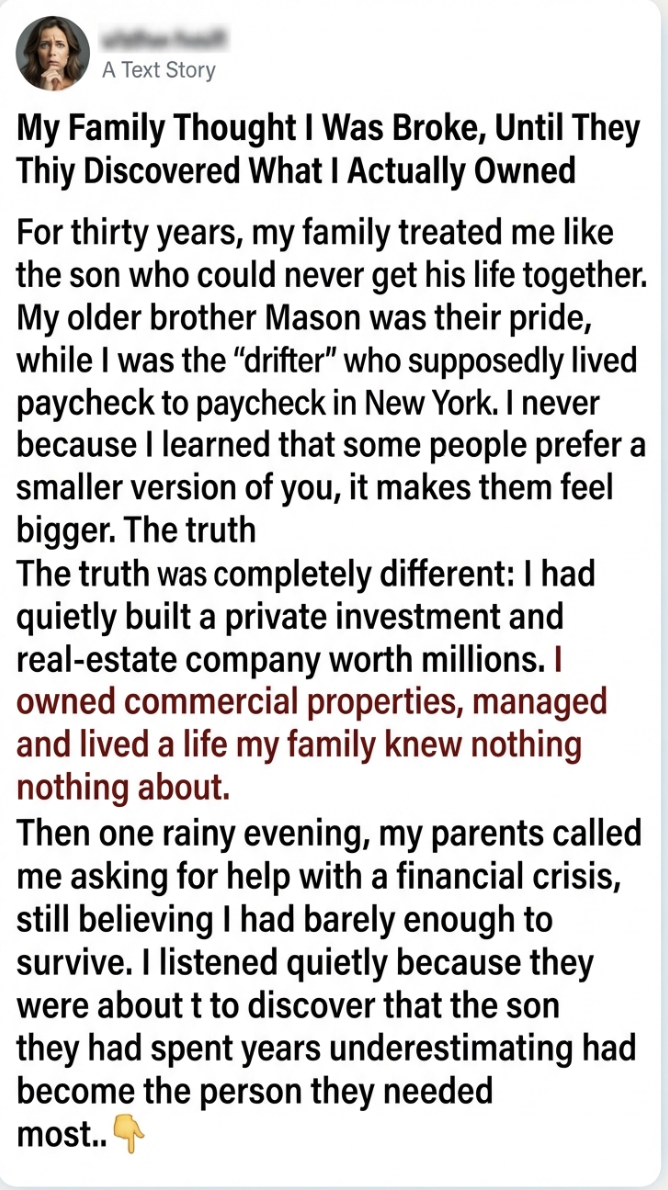
For thirty-four years, my family had a story about me.
And they never bothered to ask whether it was true.
To them, I was the son who had never quite figured life out.
My older brother, Mason, was different.
He was everything they were proud of.
Successful.
Confident.
Well dressed.
Married to a woman my parents adored.
He had a beautiful house outside the city, an expensive car, and a job title my father never got tired of mentioning to his friends.
Whenever relatives asked about us, my mother would smile proudly when she talked about Mason.
Then she would lower her voice when she mentioned me.
“Oh, he’s still in New York.”
“He does some kind of investment work.”
“He moves around a lot.”
“I don’t think he has anything permanent yet.”
Sometimes she even laughed and said, “He’s always been terrible with money.”
I never corrected her.
Not once.
Because I had learned something during my twenties:
Some people don’t want to know who you really are.
They want you to remain the version of you that makes them comfortable.
And my family was comfortable believing I was struggling.
They believed I rented a tiny apartment.
They believed I drove an old car.
They believed I worked long hours just to pay my bills.
They believed I had no savings.
They believed I was one unexpected expense away from financial trouble.
The truth was almost the exact opposite.
For more than a decade, I had quietly built a private investment and real-estate company.
I started with a small apartment building nobody else wanted.
Then another.
Then commercial properties.
Then warehouses.
Then office buildings.
Eventually, I began managing international investment contracts involving companies across three countries.
I never showed off.
I never posted photographs of expensive dinners.
I never bought designer clothes.
I didn’t need anyone’s approval.
By the time I turned forty-one, the company had grown beyond anything I had imagined when I started.
My personal holdings and business interests were worth approximately $18.6 million.
But my family knew none of it.
To them, I was still the son who couldn’t get his life together.
And I was perfectly happy letting them believe it.
Until the rainy evening everything changed.
It was almost nine o’clock when my phone rang.
My mother’s name appeared on the screen.
I answered.
“Mom?”
There was silence.
Then I heard her breathing.
“Are you busy?”
“No. What’s wrong?”
She hesitated.
Then she said something I had never expected to hear.
“We need your help.”
I sat back in my chair.
“What happened?”
My father had invested heavily in a business opportunity with Mason.
The project had collapsed.
There were outstanding loans.
Several payments were overdue.
A property Mason had purchased was carrying a massive mortgage.
And because my father had personally guaranteed part of the financing, the problem had spread to him.
My mother explained everything through a trembling voice.
They needed money.
A lot of it.
Almost $1.9 million.
I didn’t say anything for several seconds.
Then she asked quietly,
“Do you think you could help us with maybe fifty thousand?”
I almost smiled.
Not because it was funny.
Because even now, after thirty-four years, they still thought I was barely surviving.
“Why fifty thousand?” I asked.
“Because we know you don’t have much.”
There it was.
The same assumption.
The same story.
The same version of me.
I looked through the glass wall of my office.
Beyond it was the skyline of Manhattan.
Three floors below me was one of the properties my company owned.
Across town, we owned another commercial building.
In Chicago, there were two more.
In London, we had a minority stake in a logistics company.
And my mother still thought I was struggling to pay rent.
“I’ll come tomorrow,” I said.
She sounded relieved.
“Thank you.”
But I didn’t tell her how much money I had.
I didn’t tell her what I owned.
I didn’t tell her that I could solve the immediate financial problem before breakfast.
Instead, I simply said,
“I want to see the documents first.”
The next morning, I drove to my parents’ house.
Mason was already there.
He looked exhausted.
His expensive jacket was hanging over a chair, and his usual confidence was gone.
When he saw me, he looked surprised.
“You came?”
“Yes.”
My father walked into the room.
“We weren’t sure you could actually help.”
I looked at him.
“I know.”
Mason frowned.
“What does that mean?”
“Nothing.”
We sat around the dining table.
My father placed several folders in front of me.
Loan agreements.
Property documents.
Bank statements.
Investment contracts.
I spent nearly an hour reading everything.
The problem was worse than my mother had described.
Mason hadn’t simply made one bad investment.
He had taken on several obligations at the same time.
My father had guaranteed some of them.
If the situation wasn’t handled carefully, the consequences could affect the entire family.
Finally, I closed the folder.
“You need to restructure this.”
My father nodded.
“We know.”
“You need to sell one of the properties.”
Mason immediately shook his head.
“No.”
“Then you’ll need another source of capital.”
“We don’t have one.”
I looked at him.
“You do.”
Everyone became silent.
My mother stared at me.
“What do you mean?”
I reached into my briefcase.
And placed a black folder on the table.
My father opened it.
Inside was a corporate registration document.
Then another.
Then another.
His eyes moved across the pages.
His expression slowly changed.
“What is this?”
“My company.”
Mason laughed nervously.
“What company?”
I looked at him.
“The company I’ve been building for the last fourteen years.”
He stopped laughing.
My mother picked up another document.
Her hands began to shake.
She saw the names of several commercial properties.
Then investment partnerships.
Then ownership percentages.
Then financial statements.
My father looked at me.
“How much is this?”
“Which part?”
“The company.”
“About eighteen million in assets and equity combined, depending on current valuations.”
Nobody spoke.
Mason stared at me.
My mother whispered,
“Eighteen million?”
I nodded.
My father leaned back.
“But…”
He couldn’t finish the sentence.
“You thought I was broke,” I said quietly.
My mother looked down.
“We didn’t know.”
“No,” I replied. “You didn’t ask.”
That sentence changed the entire room.
For years, I had listened to them describe me as irresponsible.
Unsuccessful.
Lost.
Behind everyone else.
But none of them had ever asked what I was actually doing.
They had judged the outside of my life because I never invited them inside.
Mason looked uncomfortable.
“So all those years…”
“Yes.”
“You were actually doing this?”
“Yes.”
“And you never told us?”
I looked at him.
“When I started buying my first property, Dad told me I was wasting my money.”
My father looked away.
“You said real estate was too risky.”
“I was wrong.”
“You also told me I would never understand business.”
He remained silent.
Mason finally asked,
“Why didn’t you tell us when things started going well?”
I took a breath.
“Because every time something went well for me, someone found a reason to explain it away.”
Nobody answered.
I continued.
“When I bought my first building, Mom said I had gotten lucky.”
“When I expanded, Dad said I was taking unnecessary risks.”
“When I started working internationally, Mason said I was pretending to be more successful than I really was.”
Mason looked down.
“I don’t remember saying that.”
“I do.”
Silence returned.
Then my mother started crying.
“We were proud of Mason.”
“I know.”
“But we never meant to make you feel…”
She couldn’t finish.
I finished the sentence for her.
“Small?”
She nodded.
I didn’t yell.
I didn’t insult anyone.
I simply told them the truth.
“I stopped trying to prove myself a long time ago.”
My father looked at the documents again.
“Can you save Mason’s business?”
I paused.
“Yes.”
Mason looked up.
“Really?”
“Yes.”
His face changed with relief.
But I wasn’t finished.
“I can help.”
My father looked confused.
“Then why did you hesitate?”
“Because helping you doesn’t mean taking responsibility for every decision you’ve made.”
Mason looked uncomfortable again.
I explained the conditions.
I would provide capital to restructure the debt.
But I would not simply hand over money.
The properties would be professionally evaluated.
The risky investments would be sold.
Mason would have to take responsibility for the remaining obligations.
And my father would no longer sign financial guarantees without independent advice.
My mother listened quietly.
Finally, she said,
“You’ve changed.”
I shook my head.
“No.”
She looked at me.
“I just stopped allowing everyone else to define me.”
That afternoon, we began the restructuring process.
It took months.
Some assets were sold.
Some debts were renegotiated.
Mason had to rebuild his business from the ground up.
It wasn’t easy.
But eventually, the crisis was under control.
And something else changed.
My family stopped asking me how much money I had.
Instead, they started asking what I actually wanted from life.
That question meant more to me than the money ever could.
One Sunday afternoon, I returned to my parents’ house for dinner.
My father opened the door.
He looked at me for a moment.
Then he smiled.
“You know,” he said, “I spent thirty years thinking I understood you.”
I smiled.
“You didn’t.”
“I know.”
We walked inside.
Mason was already setting the table.
He looked at me and said,
“I’m sorry.”
I nodded.
“I appreciate that.”
He hesitated.
“I used to think you were behind me.”
“I know.”
“I was wrong.”
I didn’t say anything.
He continued.
“You weren’t behind me.”
He smiled sadly.
“You were just walking a different road.”
For the first time in years, I felt no need to defend myself.
No need to explain.
No need to prove anything.
Because the greatest thing I had built wasn’t the company.
It wasn’t the properties.
It wasn’t the millions of dollars.
It was the ability to live without needing my family’s approval.
For thirty-four years, they had mistaken my silence for failure.
They thought I was broke because I didn’t display my success.
They thought I had nothing because I never showed them what I owned.
But they eventually learned something important.
Not everyone who looks ordinary is struggling.
Some people are simply building quietly.
And sometimes the person everyone underestimates isn’t trying to prove them wrong.
They’re simply too busy building a life that doesn’t require anyone else’s permission.
I never needed my family to discover what I owned.
I needed to discover that my worth had never depended on what they thought I owned in the first place.
And that was the one thing no amount of money could buy.