THE WEDDING PRANK I WAS NEVER SUPPOSED TO HEAR
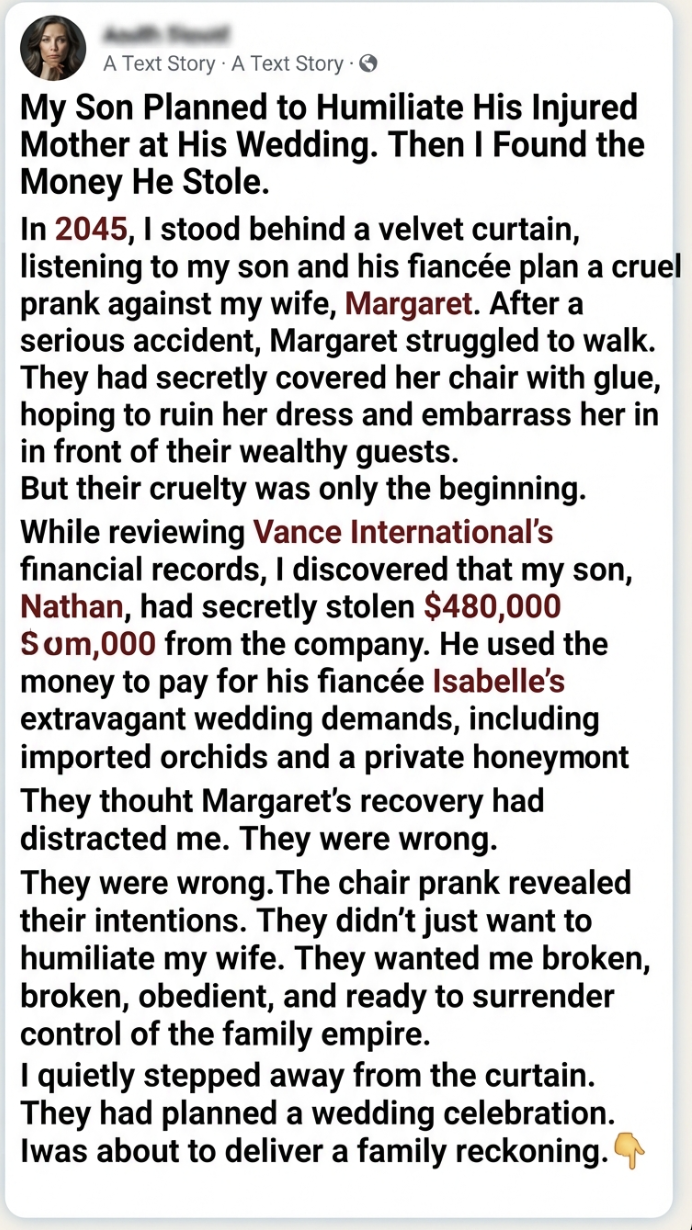
In 2045, I stood behind a velvet curtain inside the ballroom of the Grand Meridian Hotel, listening to my son plan the most humiliating thing anyone had ever intended to do to my wife.
My name is Richard Hayes, and for thirty-one years, I had built Vance International from a small logistics company into a global business.
I had survived market crashes, difficult partnerships, lawsuits, and the death of my closest business associate.
But nothing had prepared me for the sound of my own son laughing while discussing how to embarrass his mother.
My wife, Margaret, had spent the previous eight months recovering from a serious automobile accident.
She had survived multiple fractures and a long rehabilitation process. Although she was improving, walking remained difficult. She often needed a cane or a wheelchair when attending large events.
She hated being treated as fragile.
She hated people staring at her.
Most of all, she hated being made to feel like a burden.
Our son, Nathan, knew all of that.
He knew how hard she had worked to regain her independence.
He knew how many nights she had cried quietly because her body would not move the way it once had.
And yet, behind that velvet curtain, I heard him laughing.
“Just make sure the glue is strong enough,” Nathan said.
A woman giggled.
His fiancée, Isabelle, spoke next.
“I already tested it on the fabric sample. It won’t come off easily. When she tries to stand, the dress will pull against the chair.”
Nathan laughed.
“Imagine the look on her face when everyone turns around.”
Isabelle laughed harder.
“She’ll probably start crying. She always makes everything emotional.”
I stood perfectly still.
My hands were cold.
I had initially come to the ballroom to inspect the arrangements before the wedding rehearsal. Margaret was resting at home, preparing for the ceremony that would take place two days later.
She believed our son was finally ready to begin his own family.
She had spent weeks helping Isabelle choose flowers, reviewing seating arrangements, and paying for additional wedding expenses Nathan had requested.
She had even altered her formal dress so she could sit comfortably during the ceremony.
And they planned to humiliate her in front of hundreds of guests.
I listened for another minute.
Then Nathan spoke again.
“Dad won’t interfere. He’s been too worried about Mom’s recovery. Once the wedding is over, he’ll finally transfer the remaining company shares.”
Isabelle lowered her voice.
“And the board appointment?”
“I’m handling it. After the honeymoon, I’ll be the acting executive director. He’ll have no reason to refuse.”
I stopped breathing for a moment.
The prank was not the real problem.
It was only the beginning.
I quietly stepped away from the curtain.
They thought they were planning a wedding celebration.
They had no idea that I was about to investigate everything my son had been hiding.
THE WOMAN WHO HAD ALWAYS PROTECTED HIM
When I arrived home that evening, Margaret was sitting beside the living-room window.
A blanket covered her legs.
Her cane rested against the armchair.
She was reviewing a list of wedding guests on a tablet.
She looked up and smiled.
“How was the ballroom?”
“Beautiful,” I answered.
“Did the florist finish the centerpieces?”
“Yes.”
“And the orchids?”
“All arranged.”
She smiled with satisfaction.
“I want everything to be perfect for Nathan.”
I sat beside her.
She studied my face.
“What’s wrong?”
“Nothing.”
“Richard.”
She had known me for thirty-eight years. She could detect a lie before I finished speaking.
I looked down at her hands.
“What are you most looking forward to?”
She smiled.
“Seeing our son happy.”
“Even after everything?”
She frowned slightly.
“What do you mean?”
“Nothing. I’m just asking.”
Margaret reached for my hand.
“Nathan has made mistakes, but he’s still our son. I want him to build a good marriage. I want him to learn to be responsible.”
I almost told her everything.
I wanted to warn her.
I wanted to cancel the wedding immediately.
But I remembered the way she had looked when she first learned she might never walk normally again.
She had not wanted pity.
She had wanted dignity.
If I confronted Nathan without evidence, he might deny everything. He might claim that I was overreacting. He might accuse Margaret of misunderstanding his intentions.
So I held her hand and said:
“You deserve to be treated with respect at that wedding.”
She smiled.
“Of course I do.”
I looked into her eyes.
“Promise me you won’t feel obligated to stay anywhere you’re uncomfortable.”
She laughed softly.
“Richard, I’m not made of glass.”
“I know.”
“Then stop looking at me like you’re preparing for a battle.”
I forced a smile.
“I’ll try.”
But I already knew.
The battle had begun.
THE FIRST FINANCIAL WARNING
The following morning, I called Elena Brooks, Vance International’s chief financial officer.
“Can you come to my office before the board meeting?” I asked.
“Of course. Is something wrong?”
“I need a confidential review of several company transactions.”
“What kind of transactions?”
“Payments connected to Nathan’s department, personal reimbursements, vendor invoices, and any transfers authorized through his executive access.”
There was a brief pause.
“Should I involve the internal audit team?”
“Not yet. Begin with a restricted review. Only you and two trusted auditors should have access.”
“Understood.”
I ended the call and opened Nathan’s executive expense reports.
He had been promoted to vice president of strategic development three years earlier.
I had hoped that working inside the company would teach him discipline.
Instead, I had noticed a growing pattern of entitlement.
He expected a larger office.
He demanded a company vehicle.
He complained when his compensation did not match executives who had worked for the company for decades.
Whenever I questioned his spending, he accused me of not trusting him.
“You’re my father,” he had once said. “You should be helping me succeed.”
I had helped him.
I had paid for his education.
I had covered the down payment on his first apartment.
I had funded his initial investment portfolio.
I had even helped him purchase a home after he insisted that he needed a more prestigious address before getting married.
But I had always told him one thing:
“Family support is not a substitute for personal responsibility.”
He had smiled at the time.
Now I wondered whether he had ever listened.
Elena arrived at my office before nine.
I closed the door.
“I need you to examine all payments associated with Nathan’s executive account over the last eighteen months.”
She opened her notebook.
“Are you concerned about a specific transaction?”
“I heard something yesterday that made me concerned.”
“What did you hear?”
“I’ll explain once we know what the records show.”
She studied me but did not press.
“I’ll begin immediately.”
“Please also review any payments connected to Isabelle’s wedding vendors. Do not contact them yet.”
Elena nodded.
“Understood.”
After she left, I stared at the city through my office window.
I had built Vance International by trusting people.
But trust without oversight could become negligence.
And I was beginning to fear that my son had mistaken my trust for weakness.
THE NUMBER THAT DIDN’T BELONG
Elena returned two days later.
The wedding rehearsal was scheduled for that evening.
She entered my office carrying a sealed folder.
Her expression was unusually serious.
“I found something.”
I motioned for her to sit.
“What is it?”
“We identified several irregular transfers from a company development account. They were processed through a vendor listed as Northbridge Event Solutions.”
“What does that company provide?”
“Event management and consulting services, according to the invoices.”
“Is it a legitimate vendor?”
“It is registered. But the ownership information requires additional review.”
She opened the folder.
The first invoice was for $86,000.
The description read:
Executive Hospitality and Event Coordination Services.
The second was for $112,000.
The third was for $74,500.
There were several more.
The total amount was approximately $480,000.
I stared at the number.
“Who authorized these payments?”
“Your son’s executive account approved the expense requests. The final transfers were processed under delegated authorization.”
“Were the services delivered?”
“We are still verifying that. The invoices contain limited detail, and some supporting documents appear duplicated.”
I turned another page.
There were payments for imported orchids, private transportation, luxury accommodation, and a honeymoon account.
I looked at Elena.
“Are these wedding expenses?”
“Several vendor descriptions correspond to the wedding budget provided to us by Nathan’s office. But the payments were recorded as company-related strategic hospitality expenses.”
I leaned back.
My son had not simply spent money irresponsibly.
He may have deliberately disguised personal expenses as business costs.
“Could this be an accounting error?”
“It could be, but the pattern requires a formal investigation. We should not draw conclusions until the records are verified.”
“Have any other executives approved these?”
“Some payments passed through routine processing. But the initial requests appear to have originated from Nathan’s account.”
I closed the folder.
“Secure all relevant records. No one confronts him yet.”
Elena nodded.
“What about the board?”
“Prepare a confidential briefing for the audit committee. We need to follow the company’s procedures.”
She stood up.
I stopped her.
“One more thing.”
“Yes?”
“Check whether any of these payments were connected to the transfer of company shares or changes to executive authority.”
Elena’s face became more serious.
“I’ll review that immediately.”
When she left, I sat alone.
The wedding prank had been cruel.
The financial records were potentially criminal.
And the conversation behind the curtain suggested that Nathan believed he was about to gain control of my company.
He was wrong.
THE HIDDEN PLAN
That evening, I attended the wedding rehearsal.
Margaret wore a beautiful blue dress and walked slowly with her cane.
Nathan greeted her with a hug.
“Mom, you look wonderful.”
She smiled.
“I’m so happy for you.”
Isabelle approached next.
“Margaret, your dress is lovely.”
“Thank you, dear.”
Isabelle kissed her cheek.
For anyone watching, they looked like a loving family.
I saw something else.
Nathan glanced toward the reception chairs.
Then he looked at Isabelle.
She gave him a small nod.
My stomach tightened.
I walked toward the seating area.
“Where will Margaret sit during the reception?” I asked.
Nathan smiled.
“We’ve arranged a special chair for her.”
“What kind of chair?”
“A comfortable one.”
I looked at the chair.
It was upholstered in pale cream fabric.
The design looked expensive.
But something about it seemed unusual.
I touched the armrest.
Nathan immediately stepped forward.
“Dad, don’t worry about it. The staff has everything handled.”
“Of course.”
I withdrew my hand.
A staff member approached to adjust the chair’s position.
I noticed a faint transparent residue along the seat.
I said nothing.
Instead, I turned toward the event coordinator.
“Please make sure my wife has an accessible seating option that she can use safely.”
“Certainly, sir.”
Nathan’s smile faded.
“Dad, you’re making this more complicated than it needs to be.”
“I’m making sure your mother is comfortable.”
“She’ll be fine.”
I looked at him.
“Then there should be no problem with providing another chair.”
He did not answer.
Isabelle stepped in.
“We can arrange something else if you want.”
“Thank you,” I said. “Please do.”
Nathan looked irritated.
He had expected me to ignore the details.
But I had spent my life paying attention to details.
That was how I had built a company.
And it was how I was going to uncover what my son had been doing.
THE NIGHT BEFORE THE WEDDING
At home, Margaret was preparing a small gift for Nathan.
She had purchased a vintage watch that had belonged to her father.
“It’s not new,” she said, holding the box. “But it has meaning.”
I looked at the watch.
It was one of the few valuable possessions she had kept from her childhood.
“You’re giving him this?”
“He’s starting a new chapter. I want him to have something that reminds him of where he came from.”
I struggled to find the right words.
“Margaret, do you ever feel that Nathan takes your kindness for granted?”
She looked at me.
“Sometimes.”
“Why do you keep giving him chances?”
She closed the watch box.
“Because I remember him as a little boy.”
I said nothing.
She continued.
“When he was six, he used to bring me flowers from the garden. When he was twelve, he stayed awake beside you when you were sick. When he was seventeen, he told me he would take care of us one day.”
Her smile faded.
“People change. Sometimes they lose their way. But I don’t want to believe my son is beyond reaching.”
I sat beside her.
“What if someone keeps hurting you?”
“Then I have to set boundaries.”
“Even if it’s family?”
“Especially if it’s family. Love doesn’t mean allowing someone to destroy you.”
I looked at her.
She had no idea how close her words were to the truth.
That night, I received a message from Elena.
We found evidence of additional irregularities. Please call me when you are alone.
I went into my study.
“Tell me.”
Her voice was low.
“We traced several transfers from the development account to Northbridge Event Solutions. The company’s listed director is a nominee connected to one of Nathan’s former university associates.”
“Who is the actual beneficiary?”
“We’re still verifying the ownership chain. But the payments appear to have funded expenses matching the wedding budget.”
“Anything else?”
“Yes.”
She paused.
“We found a draft authorization document that would have expanded Nathan’s executive signing authority after the wedding.”
I closed my eyes.
“Was it approved?”
“Not by the board. The document appears to be incomplete.”
“Who prepared it?”
“An external consultant hired through Nathan’s office.”
I looked at the clock.
The wedding was less than twenty-four hours away.
“Send everything to our legal counsel and the audit committee chair. We will follow the formal process.”
“Understood.”
“And Elena?”
“Yes?”
“Make sure no further transfers can be processed through those accounts without additional approval.”
“I’ll arrange the necessary controls.”
I ended the call.
Then I sat in the dark.
Nathan had planned to humiliate his mother.
He had also been preparing to strengthen his control over the company.
Perhaps he believed that once the wedding was over, I would be too emotionally exhausted to challenge him.
Perhaps he believed that my concern for Margaret had made me distracted.
But he had made one mistake.
He had assumed that love made me blind.
THE WEDDING MORNING
The wedding began at noon.
The Grand Meridian ballroom was decorated with white roses, imported orchids, and crystal lighting.
The arrangements were beautiful.
They were also expensive.
Far more expensive than the budget Nathan had originally presented.
Margaret sat in a wheelchair near the entrance, wearing the blue dress she had chosen for the ceremony.
She looked nervous.
“Do I look all right?” she asked.
I crouched beside her.
“You look beautiful.”
“Are you sure?”
“Absolutely.”
She touched my hand.
“Please don’t let anything spoil today.”
I looked at her.
“I won’t let anyone take away your dignity.”
She smiled, believing I was simply reassuring her.
The ceremony began.
Nathan stood at the front beside Isabelle.
He looked confident.
When Margaret entered, he smiled at her.
For a moment, I wondered whether I had misjudged him.
Perhaps the conversation behind the curtain had been a cruel joke that he had abandoned.
Perhaps the financial records had an explanation.
Then I noticed Isabelle glance toward the reception area.
The chair had been placed near the center of the room.
The original chair was gone.
A different one had been brought in.
I immediately asked a staff member to confirm that it was safe and clean.
The coordinator looked confused.
“This is the replacement chair we arranged.”
“Who requested the change?”
She checked her notes.
“Mr. Nathan Hayes.”
I looked at Nathan across the room.
He was watching me.
His expression was unreadable.
I turned toward the coordinator.
“Please move my wife to the accessible seating area near the family table.”
“Of course.”
Margaret looked surprised.
“Why are we moving?”
“I want you to have more space.”
She nodded.
As the staff member moved her wheelchair, I noticed Nathan whispering urgently to Isabelle.
The prank had failed before it began.
But I knew the wedding was not the place to confront him publicly.
Not yet.
I needed the complete truth.
THE ACCOUNTING COMMITTEE
While the guests attended the reception, the audit committee held a confidential meeting in a private conference room at Vance International’s headquarters.
The committee chair, Helen Ward, joined Elena, our general counsel, and an independent forensic accounting specialist.
I attended by secure video connection.
Helen spoke first.
“We have reviewed the preliminary documentation. The amount under question is approximately $480,000.”
“Is there evidence that the funds were used for personal expenses?” I asked.
The forensic specialist answered.
“We have identified payment patterns consistent with wedding-related purchases. However, we are still verifying the final beneficiaries and whether any legitimate business services were provided.”
“Does the evidence establish that Nathan personally stole the money?”
“Not yet. We can establish that his account initiated or approved several transactions. Determining intent and personal benefit requires further investigation.”
I nodded.
“Then we must use precise language.”
Our general counsel agreed.
“We should avoid making accusations before the review is complete. We can immediately restrict access, preserve records, and request explanations through the appropriate process.”
Helen looked at me.
“Are you comfortable proceeding with an internal investigation involving your son?”
I looked at the documents on my screen.
“No parent is comfortable with this. But my responsibility is to the company, its employees, and its shareholders.”
“And your family?”
“My responsibility to my family does not require me to ignore potential misconduct.”
The meeting continued for more than two hours.
The committee approved an independent investigation.
Nathan’s financial authority was temporarily restricted under the company’s internal controls.
No public announcement was made.
No one contacted the press.
And no one made a final accusation.
We would follow the evidence.
That was the only way to protect both the company and the truth.
THE HONEYMOON ACCOUNT
The investigation uncovered additional details over the next several days.
Northbridge Event Solutions had received payments from Vance International that corresponded with several wedding-related invoices.
Some expenses were legitimate corporate hospitality costs.
Others lacked sufficient documentation.
A private account had been opened to cover part of Nathan and Isabelle’s honeymoon.
The account was not registered in Nathan’s name.
Instead, it was connected to an entity that had received payments from the event management company.
The forensic team traced the transfer chain.
They found that approximately $480,000 had moved through several accounts.
Not all of it could yet be classified as misappropriated funds.
But the records showed that company money had been used to cover expenses that appeared unrelated to Vance International’s business operations.
The investigators also discovered that Nathan had asked a company employee to alter the descriptions of several expenses.
The employee, frightened of losing his job, had complied.
When questioned during the investigation, he provided copies of the original requests.
That evidence changed the situation.
It suggested that the transactions were not simply careless bookkeeping.
There appeared to be an intentional effort to disguise the nature of some expenses.
Our legal counsel informed us that the evidence would need to be evaluated under applicable law and company policy.
Potential consequences could include termination, civil recovery, and referral to authorities if the investigation established unlawful conduct.
I listened quietly.
Then I asked:
“Has Nathan been notified of the investigation?”
“Yes,” the counsel replied. “He has been asked to participate in a formal interview with representation available to him.”
“Good.”
Helen looked at me.
“You understand that this may permanently damage your relationship with him.”
I looked out the window.
“My relationship with my son was already damaged when he decided his mother’s suffering was entertainment.”
THE CONFRONTATION
Nathan came to my office one week after the wedding.
He did not knock.
He entered with a furious expression.
“What is going on?”
I remained seated.
“Please close the door.”
“Dad, you froze my corporate accounts.”
“Your executive access was restricted pending an investigation.”
“You’re humiliating me.”
I looked at him.
“You planned to humiliate your mother.”
His face changed.
For the first time, he looked genuinely startled.
“What are you talking about?”
“I heard you and Isabelle behind the curtain at the ballroom.”
He stopped speaking.
“You discussed covering your mother’s chair with glue.”
Nathan looked away.
“It was a joke.”
“A joke?”
“She wouldn’t have been seriously hurt.”
“You knew she struggled to stand. You knew she was recovering from a serious accident. You planned to embarrass her in front of hundreds of people.”
His jaw tightened.
“Mom is always making everyone uncomfortable with her condition. We wanted to lighten the mood.”
I stood up.
“Do not blame your mother for your cruelty.”
He looked at me angrily.
“You don’t understand what it’s like being around her all the time.”
“I was married to her before you were born.”
“That’s not what I mean.”
“No. You mean that her injury disrupted the image you wanted to present at your wedding.”
He said nothing.
I placed a folder on the desk.
“Now we need to discuss the company.”
His eyes moved toward it.
“What is that?”
“Records concerning approximately $480,000 in payments made through Northbridge Event Solutions.”
He swallowed.
“Those were business expenses.”
“Some may have been. Others appear to be connected to your wedding.”
“You approved my budget.”
“I approved a wedding budget. I did not authorize you to disguise personal expenses as corporate costs.”
He slammed his hand on the desk.
“You were going to give me control of the company anyway!”
“Eventually, perhaps. But leadership is earned through responsibility.”
“I’m your son!”
“And that is why I gave you opportunities other people had to earn.”
He stared at me.
“I deserve to inherit this company.”
I shook my head.
“No one deserves to control a business simply because they were born into a family.”
His face reddened.
“You’re choosing strangers over me.”
“I am choosing integrity over entitlement.”
He stepped backward.
“Is Mom behind this?”
“No.”
“She’s always wanted you to turn against me.”
I felt a deep sadness.
“Your mother defended you even when you gave her reasons not to. She believed you could change.”
Nathan’s voice became bitter.
“She’s weak.”
I closed the folder.
“Leave.”
He stared at me.
“Dad—”
“Leave before you say something you cannot take back.”
He walked toward the door.
Before leaving, he turned.
“You’re going to regret this.”
I looked at him.
“I already regret not noticing the signs sooner.”
The door closed.
I stood alone in my office.
For the first time, I understood that I could not protect my son from every consequence.
And I should not try.
MARGARET LEARNS THE TRUTH
I did not tell Margaret about the chair prank immediately.
I was afraid the information would hurt her recovery.
But secrets have a way of becoming heavier the longer you carry them.
One evening, she found me reviewing the investigation documents.
“What are you reading?”
“Company records.”
“Is it about Nathan?”
I looked up.
She knew.
“Why do you ask?”
“Because he hasn’t called me since the wedding.”
“He’s been busy.”
Margaret studied my face.
“Richard, what happened?”
I set the papers aside.
“There is something you need to know.”
She waited.
I told her about the conversation behind the curtain.
I explained the chair.
I described what I had heard without exaggerating or adding assumptions.
Margaret listened silently.
When I finished, she looked down at her hands.
For several seconds, she did not speak.
Then she asked:
“Did he really say those things?”
“Yes.”
She closed her eyes.
I reached for her hand.
“I’m sorry.”
“Why are you apologizing?”
“Because I should have recognized what was happening sooner.”
She shook her head.
“You can’t control every decision our son makes.”
“I can control whether I protect you now.”
She looked at me.
“Did he actually put glue on the chair?”
“No. We moved you before the reception. The school of thought—”
I stopped and corrected myself.
“The staff found a replacement chair, and we made sure you had safe seating. The prank did not happen.”
Margaret released a slow breath.
“Thank goodness.”
She was quiet for a long time.
Then she said:
“I knew he had become selfish. I didn’t know he could be cruel like that.”
I sat beside her.
“He is responsible for his choices.”
She nodded.
“What about the money?”
“The company is investigating. We do not yet have a final determination on every transaction.”
“Did he steal it?”
“We have evidence of irregular payments and possible misuse. The investigators are verifying the details.”
Margaret looked toward the window.
“Even now, you’re careful not to accuse him before the facts are complete.”
“That is how it should be.”
She gave a sad smile.
“You always wanted to build a company that operated fairly.”
“I still do.”
“Then don’t abandon that principle because he is our son.”
I squeezed her hand.
“I won’t.”
She looked at me.
“And don’t let this destroy you.”
I did not answer immediately.
Because that was the part I was most afraid of.
Not losing money.
Not losing control of the company.
Losing the belief that the child I had raised still existed somewhere inside the man he had become.
THE INVESTIGATION’S FINDINGS
The independent investigation lasted four months.
The final report did not label every payment fraudulent.
Instead, it categorized the transactions based on supporting evidence.
Some expenses were legitimate corporate costs.
Several lacked proper documentation.
A significant portion was connected to personal wedding and travel expenses.
The report found that Nathan had approved payments outside his authorized business purpose and had requested altered descriptions for certain transactions.
The investigation concluded that the company had reasonable grounds to pursue recovery of funds and disciplinary action.
The board held a formal meeting.
Nathan was given an opportunity to respond through the established process.
His representatives argued that he had misunderstood the scope of his authority and that some payments were intended to support corporate relationship-building.
However, the documentation showed that several vendors had provided services specifically for his wedding.
The board determined that Nathan had violated company policies.
His executive position was terminated.
The company began efforts to recover the improperly used funds, subject to legal advice and applicable procedures.
The matter was also referred to the appropriate authorities for review of potential unlawful conduct.
I did not make that decision alone.
The board did not make it because Nathan was my son.
And it did not make it because I was angry.
It made the decision based on the evidence and the company’s obligations.
That distinction mattered.
A family dispute could be emotional.
Corporate governance could not depend on emotion.
ISABELLE’S DECISION
Several weeks after Nathan’s termination, Isabelle requested a meeting with Margaret and me.
We agreed to meet at a quiet café.
She arrived without jewelry or expensive clothing.
Her face looked tired.
“I want to apologize,” she said.
Margaret looked at her.
“For what?”
Isabelle lowered her eyes.
“The chair. The prank. The wedding expenses.”
I remained quiet.
She continued.
“I thought Nathan’s family was going to give him control of everything. I believed I would be part of a wealthy family, and I started expecting things.”
Margaret spoke softly.
“Expecting things is not the same as stealing.”
Isabelle nodded.
“I know.”
“Did you know where the money came from?” I asked.
She hesitated.
“I knew Nathan was using company accounts. He told me his father had approved the expenses.”
“Did you ask to see the approval?”
“No.”
“Why not?”
She looked ashamed.
“Because I wanted the wedding I imagined.”
Margaret’s expression remained sad.
“Your wedding should never have required someone else’s humiliation.”
Isabelle began to cry.
“I know.”
I did not comfort her with promises I could not make.
But I did say:
“You need to be honest about what you knew, what you requested, and what you participated in. The investigation must follow its proper course.”
She nodded.
“I understand.”
Before she left, Margaret said:
“Isabelle, you are responsible for your choices. But you are still young enough to learn from them.”
Isabelle wiped her eyes.
“Thank you.”
She left the café quietly.
I looked at Margaret.
“Do you think she will change?”
Margaret considered the question.
“I hope so. But hope is not proof.”
I smiled faintly.
“That sounds like something I would say.”
She reached for my hand.
“Then perhaps we are both learning.”
THE DAY NATHAN CAME HOME
Six months after the wedding, Nathan returned to our house.
He looked different.
He had sold his luxury vehicle and moved out of the apartment he had purchased with our financial assistance.
The investigation had forced him to face consequences he had spent years avoiding.
Margaret was sitting in the garden.
I stood beside her when Nathan approached.
“Mom,” he said.
She looked up.
“Hello, Nathan.”
He stood several feet away.
“I don’t know how to start.”
Margaret gestured toward a chair.
“You can sit.”
He sat.
For a moment, he said nothing.
Then he looked at her.
“I’m sorry.”
Margaret did not respond immediately.
“Are you sorry because of what you did,” she asked, “or because you lost what you wanted?”
Nathan looked down.
“I don’t know how to answer that.”
“Then take time to find an honest answer.”
He nodded.
“I was angry that your accident changed everything. I was angry that Dad wouldn’t give me control of the company. I thought everyone was standing in my way.”
Margaret listened.
“I thought if I could embarrass you, you would stop making decisions for the family.”
I felt my jaw tighten.
Nathan continued.
“I knew about the chair. I knew it would hurt you emotionally. I still thought it would be funny.”
Margaret closed her eyes briefly.
“Thank you for telling the truth.”
Nathan looked at me.
“I’m sorry about the money.”
I answered carefully.
“The company’s recovery process is separate from our family relationship.”
“I know.”
“You need to take responsibility for both.”
He nodded.
“Will you ever forgive me?”
Margaret looked at him.
“Forgiveness is not the same as restoring trust.”
“I understand.”
“Do you?”
He remained silent.
She continued.
“I love you because you are my son. But I will not allow that love to make me ignore what you did. If you want a relationship with us, you must demonstrate honesty over time.”
Nathan wiped his face.
“I want to try.”
“Then begin with your actions.”
He nodded.
He did not ask for money.
He did not ask for a position at the company.
He did not ask me to intervene in the investigation.
For the first time in years, he left our home without demanding something.
I did not know whether that meant he had changed.
But it was the first sign that he might finally understand the difference between regret and responsibility.
THE FAMILY EMPIRE
A year after the wedding, Vance International underwent several changes.
The board strengthened financial oversight.
Executive expense approvals required additional documentation.
Family members were no longer granted authority solely because of their relationship to the founder.
We created an independent ethics committee.
We introduced mandatory conflict-of-interest disclosures.
And we established a policy requiring all executives to separate personal expenses from company funds, regardless of their position.
Some employees privately told me that the changes should have happened earlier.
They were right.
I had built the company around trust.
But I had failed to recognize that a growing organization required systems stronger than personal relationships.
My son’s actions exposed that weakness.
I could either become defensive or learn from it.
I chose to learn.
Margaret continued her rehabilitation.
She gradually became more independent and began attending a community support group for people recovering from serious injuries.
She no longer apologized for needing assistance.
She no longer worried as much about how others viewed her.
One afternoon, she returned from the group and smiled.
“What happened?” I asked.
“I helped a woman who was afraid to attend her daughter’s graduation.”
“Why?”
“She thought everyone would stare at her wheelchair.”
“What did you tell her?”
Margaret smiled.
“I told her that her daughter would remember that she came. Not whether she walked into the room.”
I looked at her.
“You’re becoming a counselor.”
She laughed.
“No. I’m just learning to use what I’ve been through.”
I hugged her.
She had endured pain, humiliation, and betrayal.
But she had not allowed any of those things to define her.
THE LETTER
Two years after the wedding, I received a letter from Nathan.
He had been working for a small logistics company unrelated to Vance International.
He was earning less money than before.
He lived in a modest apartment.
He had begun repaying part of the funds the company had recovered through the formal process.
The letter was four pages long.
He did not ask for money.
He did not ask for a position.
He did not blame his mother, Isabelle, or me.
He wrote:
Dad,
I used to believe that being your son meant I was entitled to everything you built.
I thought the company was my inheritance before I had earned the right to lead anyone.
I thought Mom’s injury was an inconvenience because it interfered with the wedding image I wanted.
I treated people as obstacles when they did not support what I wanted.
I don’t expect you to trust me because I wrote this letter.
I know that trust has to be earned through actions.
I am trying to understand how much damage I caused.
I don’t know whether I can repair everything, but I want to stop making excuses.
I’m sorry.
Nathan
I read the letter twice.
Then I gave it to Margaret.
She read it quietly.
“What do you think?” I asked.
She folded the paper.
“I think he has finally begun to understand the truth.”
“Do you believe him?”
“I believe the letter is a beginning. We still need to see what he does.”
I nodded.
“Do you want him to come home?”
She looked at me.
“I want him to become someone who can come home without hurting us.”
That answer stayed with me.
Because love was not the same as surrender.
And forgiveness was not the same as forgetting.
THE LAST CONVERSATION
One evening, Nathan visited us again.
He brought a small package for Margaret.
Inside was a simple scarf.
“I remembered you liked this color,” he said.
Margaret touched the fabric.
“Thank you.”
Nathan sat across from us.
He looked nervous but calmer than before.
“Mom, can I ask you something?”
“Of course.”
“Do you hate me?”
Margaret’s eyes softened.
“No.”
“After everything?”
“Yes.”
“Why?”
She took a breath.
“Because hatred would keep me tied to the worst thing you ever did. But loving you does not mean I approve of your choices.”
Nathan looked at me.
“Do you hate me?”
I thought about the chair.
The financial records.
The stolen money.
The wedding.
The years of entitlement.
Then I answered honestly.
“I have been angry. I have been disappointed. I have struggled to understand how you could do those things.”
He lowered his head.
“But I don’t want to spend the rest of my life hating you,” I continued. “I want you to become responsible for your life. That is the only way we can build anything healthy from here.”
Nathan nodded.
“Do you think I’ll ever be part of the company again?”
“No.”
He looked up.
I continued.
“Not because I want to punish you. The board has established governance standards, and your previous conduct means you are not eligible for a leadership role. The company must operate independently of our family relationship.”
He swallowed.
“I understand.”
“If you want to build a career, you must do it through your own work. Not through your surname.”
He nodded slowly.
“I know.”
Margaret reached across the table.
“You can still build a good life, Nathan. But it must be one you build honestly.”
He took her hand.
For several minutes, none of us spoke.
The relationship was not repaired.
The trust was not restored.
The past had not disappeared.
But the conversation was honest.
And sometimes honesty is the first place where healing can begin.
WHAT THE WEDDING TAUGHT ME
I had spent my entire life believing that my greatest responsibility was to build something my family could inherit.
I worked long hours.
I took risks.
I sacrificed time with my wife and son.
I wanted Nathan to have opportunities I never had.
But I eventually realized that providing someone with everything does not automatically teach them gratitude.
Sometimes, constant protection can prevent a person from learning accountability.
I had given Nathan access without demanding enough maturity.
I had mistaken financial support for guidance.
I had ignored warning signs because I wanted to believe that my son would eventually become the man I imagined.
That was my failure.
But his choices were still his own.
The chair prank revealed his cruelty.
The financial investigation revealed the seriousness of his entitlement.
And the months that followed showed me that accountability could not be replaced by anger, money, or family pressure.
I did not cancel the wedding.
I did not publicly humiliate Nathan.
I did not use the company to destroy him.
Instead, I protected my wife, preserved the evidence, followed the proper procedures, and allowed the consequences to develop through facts.
That was not weakness.
That was responsibility.
THE FINAL LESSON
Today, Margaret walks with a cane.
Some days are easier than others.
She still needs help occasionally, and she still becomes frustrated when her body refuses to cooperate.
But she no longer feels ashamed of needing support.
She attends community meetings, spends time with friends, and enjoys her mornings in the garden.
Nathan is still working to rebuild his life.
Our relationship remains limited and carefully structured.
He has learned that apologies do not erase consequences.
He has learned that family loyalty does not mean unconditional access to money.
And he has learned that trust cannot be demanded.
It must be earned.
As for me, I still lead Vance International.
But I no longer believe that protecting a family empire means handing it to the next generation without question.
An inheritance is not merely money.
It is responsibility.
It is character.
It is the ability to make difficult decisions without sacrificing the dignity of others.
My son thought he could humiliate his injured mother and use my concern for her recovery to gain control of everything I had built.
He was wrong.
The chair prank never happened.
The $480,000 investigation exposed the financial decisions he had tried to conceal.
And the family reckoning he feared was not a dramatic act of revenge.
It was the moment I finally stopped protecting him from the consequences of his own choices.
Because the greatest lesson I learned was this:
A parent can love a child without approving their behavior. A family can offer forgiveness without surrendering its boundaries. And no amount of wealth, inheritance, or influence can make cruelty acceptable.
They had planned a wedding to celebrate a new beginning.
Instead, their secret plans forced us to confront a painful truth.
And in the end, I did not lose my family empire.
I discovered that the most valuable legacy I could leave behind was not the company, the money, or the property.
It was the courage to choose integrity—even when the person standing on the wrong side of the truth was my own son.