The first person to call me after I canceled my birthday dinner was my mother.
I watched her name appear on my phone while the waiter stood beside a table set for twelve.
Twelve chairs.
Twelve folded napkins.
Twelve carefully prepared place settings.
And not one member of my family.
I let the phone ring.
Then I turned it face down.
The waiter lowered his voice.
“Sir, would you like us to prepare anything for you to take home?”
I looked at the untouched table.
The candles were still burning.
The wine remained unopened.
The birthday dessert had been decorated with my name in delicate chocolate lettering.
Happy 37th Birthday, Daniel.
I had booked the private dining room at L’Étoile three months earlier.
A three-Michelin-star restaurant.
A carefully selected menu.
A quiet evening with the people I had spent most of my adult life supporting.
The final bill would have been approximately $19,200.
I had expected the expense.
I had not expected to celebrate alone.
“Cancel everything,” I told the waiter.
He hesitated.
“Are you certain?”
“Yes.”
I handed over my black Amex card to settle the applicable cancellation and service charges, then walked out into the cool evening air.
Before I reached my car, I opened the family group chat.
I typed one sentence.
“Enjoy the party. Starting tonight, my financial support ends.”
Then I pressed send.
For several seconds, nothing happened.
Then the message was read.
The typing indicators appeared.
Disappeared.
Appeared again.
And finally, my phone began ringing.
One call.
Then another.
Then five more.
They had forgotten my birthday.
But they were about to remember the day I stopped paying for their lifestyle.
THE DINNER THEY NEVER INTENDED TO ATTEND
My name is Daniel Brown.
At thirty-seven, I had built a successful technology company specializing in secure financial infrastructure.
The company had started in a rented office with two employees and a collection of secondhand equipment.
Over the years, it expanded into several markets.
We developed software used by financial institutions, logistics companies, and large retailers.
The work was demanding.
It required long hours, constant learning, and difficult decisions.
But I loved it.
I had never expected my family to understand every part of my career.
I only wanted them to respect that it mattered to me.
Instead, they had spent years calling it boring.
My brother Nathan often joked that I had become “a glorified spreadsheet manager.”
My sister, Sophie, referred to my company as “the little computer business.”
My mother, Margaret, liked to tell relatives that I was successful only because I had been lucky enough to work in technology.
Whenever I explained a new project, they changed the subject.
Whenever I mentioned a professional achievement, they laughed.
But whenever they needed money, they knew exactly whom to call.
Over the previous eight years, I had provided my family with substantial financial support.
I had helped my mother renovate her home.
I had contributed to Nathan’s business.
I had paid for Sophie’s graduate studies.
I had helped my uncle resolve debts connected to a failed investment.
I had covered medical expenses, legal bills, property taxes, and emergency payments.
The total exceeded $12.4 million.
Some of the money had been formal loans.
Some had been gifts.
Some had been payments I made directly to banks, contractors, schools, and creditors.
The arrangements were not identical, and I had kept records of them all.
But the emotional pattern was always the same.
When I provided money, I was family.
When I declined, I was selfish.
When I asked questions, I was difficult.
And when I succeeded, they acted as though my work was something embarrassing.
Still, I continued helping.
Because I had believed that one day, they might understand that I was not trying to control them.
I was trying to support them.
WHY THE BIRTHDAY MATTERED
My father had died when I was twenty-six.
He had been a reserved man, but birthdays were important to him.
Every year, he would gather the family around one table, regardless of our disagreements.
He used to say:
“People remember the occasions when you make room for them.”
After he passed away, birthdays became one of the few traditions I tried to preserve.
I was not interested in extravagant celebrations.
I could have rented a private yacht or arranged a luxury weekend abroad.
Instead, I chose L’Étoile because I wanted a meaningful evening.
I reserved twelve seats.
My mother.
Nathan.
Sophie.
My uncle Robert.
Several cousins.
Their partners.
And me.
I sent the invitations months in advance.
I confirmed the date twice.
I created a group chat with the menu options and arrival time.
Two weeks before the dinner, I called my mother.
“Everyone is still coming, right?”
“Of course,” she said. “Why wouldn’t they?”
“Because I want everyone to be there.”
She laughed.
“Daniel, it’s your birthday. Stop worrying so much.”
I believed her.
That was my mistake.
Not because I had trusted my family.
But because I had ignored the evidence that they had stopped treating my effort as something valuable.
THE NIGHT OF MY BIRTHDAY
I arrived at L’Étoile at 6:45 PM.
The private dining room was beautiful.
Warm lighting reflected off the glassware.
A long table had been prepared near a wall of dark wood.
A floral arrangement sat in the center.
The restaurant manager greeted me personally.
“Mr. Brown, everything is ready.”
“Thank you.”
“Your guests may arrive shortly.”
I smiled.
“They should.”
At 7:00 PM, no one had arrived.
At 7:15, I checked my phone.
The family group chat was active.
Nathan had sent a photograph of himself at a sports complex.
Sophie responded with a laughing emoji.
I assumed he had stopped somewhere before dinner.
At 7:30, I called my mother.
She did not answer.
I sent a message.
“Are you on your way?”
No response.
At 7:45, the restaurant manager approached.
“Would you like us to begin with the first course when your guests arrive?”
“They should be here soon.”
He nodded politely.
I tried not to look at the empty chairs.
At 8:00, I called Nathan.
He declined the call.
A minute later, he sent a message.
“We’re at Sophie’s event. We’ll see what happens.”
I stared at the screen.
“What event?” I typed.
He did not answer.
At 8:30, he sent a message to the family group.
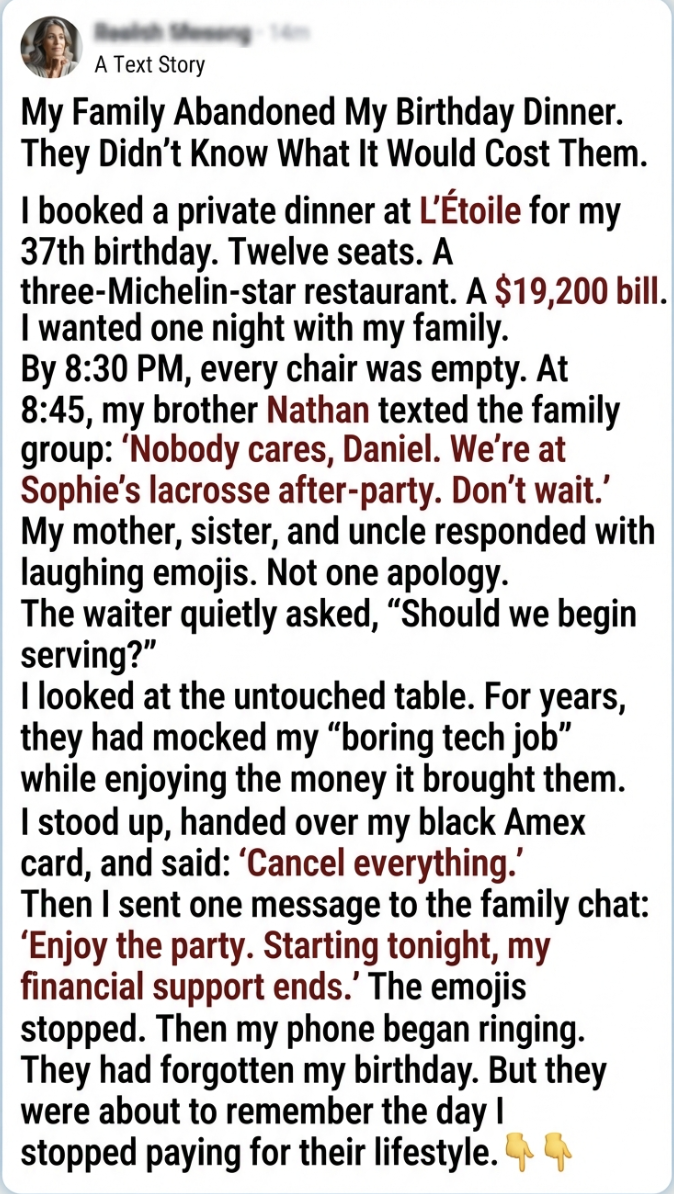
“Nobody cares, Daniel. We’re at Sophie’s lacrosse after-party. Don’t wait.”
Then my mother responded with a laughing emoji.
My sister followed with another.
My uncle added one more.
I looked at the screen.
I read the message again.
Nobody cares, Daniel.
It was not an accident.
It was not a scheduling mistake.
They knew where I was.
They knew I had arranged the dinner.
They knew I was waiting.
And they had decided that my disappointment was amusing.
Something inside me became very quiet.
The waiter approached.
“Should we begin serving?”
I looked at the empty table.
“No.”
“Would you like to wait a little longer?”
I shook my head.
“Cancel everything.”
THE MESSAGE THAT ENDED THE ARRANGEMENT
Outside the restaurant, I sat in my car without starting the engine.
My phone continued vibrating.
My mother called twice.
Nathan called once.
Sophie sent a message.
“Why are you being so dramatic?”
I looked at the words.
Then I opened the family group chat.
I thought about every time I had been asked to help.
The money I had transferred.
The debts I had covered.
The business expenses I had paid.
The family trips I had financed.
The promises that had never been fulfilled.
I thought about how they had always described my support as a responsibility.
As though my success belonged to everyone except me.
Then I typed:
“Enjoy the party. Starting tonight, my financial support ends.”
I did not threaten anyone.
I did not insult them.
I did not announce that I would ruin their lives.
I simply stated a decision.
The message was delivered.
For several seconds, nobody responded.
Then my mother wrote:
“What does that mean?”
Nathan followed:
“Don’t start this tonight.”
Sophie sent:
“You can’t be serious.”
I put my phone away.
For the first time in years, I did not feel obligated to explain myself immediately.
THE FIRST MORNING WITHOUT MY MONEY
The next morning, I woke up to forty-three missed calls.
My mother had called eleven times.
Nathan had called nine.
Sophie had sent a series of messages.
My uncle Robert had left two voice messages.
I listened to the first one.
“Daniel, this is ridiculous. You need to calm down and call me.”
The second message was more urgent.
“Your mother says you’re canceling the transfers. Call me immediately. We have obligations.”
I sat on the edge of my bed.
The word obligations stayed with me.
They had obligations.
So did I.
For years, I had treated their obligations as emergencies while treating my own financial security as something that could wait.
That morning, I contacted my chief financial officer, Elena.
“I need a complete review of all family-related financial arrangements,” I said.
“Are we talking about loans, gifts, and guarantees?”
“All of them.”
“Do you want to suspend everything immediately?”
“Pause new discretionary payments. Continue any legally required obligations until counsel reviews them. I don’t want anyone making assumptions.”
Elena understood.
She had seen how often family requests interrupted my work.
She had also warned me several times that several arrangements were poorly documented.
“I’ll prepare the records,” she said.
I contacted my attorney, David Chen, afterward.
“I want every arrangement reviewed,” I told him. “No retaliation. No unnecessary escalation. Just documentation and clear boundaries.”
David agreed.
“Then we should begin with the guarantees,” he said. “Those can create obligations even when you stop making voluntary payments.”
I had expected my family to be angry.
I had not expected how quickly their financial system would begin to reveal its weaknesses.
WHAT I HAD BEEN PAYING FOR
The first review showed that my support was more extensive than I had remembered.
My mother’s home had a mortgage that I had helped refinance.
Nathan’s business had a revolving credit facility that I had personally guaranteed.
Sophie’s apartment had been purchased with a down payment I had provided.
My uncle Robert had outstanding obligations related to a property investment.
I had also funded a family account used for maintenance, travel, and household expenses.
None of these arrangements was identical.
Some were legitimate gifts.
Some were loans.
Some involved third parties and required additional review.
But one thing was clear.
My family had built their spending habits around the assumption that I would continue helping.
They had not developed a sustainable plan for what would happen if I stopped.
That was not something I had created in one evening.
It had developed over years.
And I had participated in it by refusing to set boundaries.
I had believed that helping them avoid discomfort was an expression of love.
I had not realized that I was also preventing them from confronting their own financial decisions.
NATHAN’S FIRST EMERGENCY
At 10:20 AM, Nathan called.
I answered.
“What happened last night?” he demanded.
“You know what happened.”
“It was Sophie’s event. We didn’t think you’d actually cancel the dinner.”
“You told me not to wait.”
“It was a joke.”
“It wasn’t funny.”
He exhaled impatiently.
“Fine. I’m sorry you were upset. Can you release the business payment now?”
I paused.
“What payment?”
“The transfer for the supplier account.”
“Why is it going through me?”
“Because you agreed to cover the shortfall.”
“When did you plan to repay it?”
“We’ve discussed this.”
“No, Nathan. You’ve avoided discussing it.”
His voice became defensive.
“You know the business is under pressure.”
“Then we need a documented plan.”
“I need the money today.”
“I understand.”
“Daniel, don’t do this.”
“I’m not doing anything to you. I’m reviewing my financial commitments.”
He went quiet.
Then he said:
“You’re punishing everyone because people missed one dinner.”
I looked out the window.
“This is not about one dinner.”
“Then what is it about?”
“It’s about years of being treated like a resource instead of a person.”
He did not respond.
I continued.
“I’m not approving new discretionary transfers. Your business needs independent financial advice.”
“You can’t just abandon us.”
“I’m not abandoning you. I’m ending an arrangement that has become unhealthy.”
He hung up.
For the first time, the word abandonment sounded different.
My family had chosen not to attend my birthday.
Yet they believed I was abandoning them by refusing to continue funding their expenses.
THE SECRET BEHIND THE FAMILY ACCOUNT
Three days into the review, Elena contacted me.
“There’s something you need to see.”
I joined a secure video meeting with her and David.
Elena shared a spreadsheet.
The family account I had funded was not used only for shared expenses.
Over the previous three years, money had been transferred to several accounts controlled by relatives.
Some payments were labeled as property maintenance.
Others were recorded as travel expenses or business advances.
A portion had been used to pay personal credit card bills.
The transactions were not necessarily illegal, and we needed to verify the authorization and documentation for each one.
But I had not approved many of them.
I looked at David.
“Who authorized these?”
“We’re tracing that now,” he said. “Some transfers appear to have been approved through delegated access.”
“Who had access?”
“Your mother and Nathan, according to the account records.”
I felt a familiar heaviness in my chest.
My mother had always insisted that the family account was necessary.
She had told me it simplified expenses.
She had said it helped everyone manage their responsibilities.
But the records suggested that the account had become a source of unmonitored financial support.
I asked Elena to suspend delegated access pending review.
David reminded me that the bank and legal team would need to follow the appropriate process.
I agreed.
Then I asked a question I had avoided for years.
“How much money is still exposed?”
David looked at the figures.
“We need to examine the guarantees and contracts. But the potential exposure is significant.”
I nodded.
“Then we’ll deal with it properly.”
MY MOTHER’S VERSION OF THE STORY
That evening, my mother arrived at my office without an appointment.
My assistant called to ask whether I wanted to see her.
I agreed.
She entered the room wearing the same expression she had used throughout my childhood whenever she believed I had disappointed her.
“You’ve caused a terrible situation,” she said.
“I’m reviewing the arrangements.”
“You’ve suspended the family account.”
“I paused access pending documentation.”
“Your uncle needs that money.”
“Then we need to establish the basis for the payments.”
She stared at me.
“After everything I’ve done for you?”
I said nothing.
She continued.
“I raised you after your father died. I made sure you had a home. I supported your education.”
“I’m grateful for what you did.”
“Then how can you treat us like this?”
“Because gratitude does not mean I have to provide unlimited financial support.”
Her eyes narrowed.
“You’ve become cold.”
“Maybe I’ve become careful.”
She sat down.
For a moment, she looked tired rather than angry.
“Your birthday was a misunderstanding.”
“Was it?”
“Nathan thought you understood.”
“He told the family not to wait.”
“He was celebrating Sophie’s achievement.”
“I’m happy for Sophie.”
“Then why are you making this so serious?”
I looked at her.
“Because I invited my family to dinner. Nobody came. Then everyone laughed when I was left alone.”
She lowered her eyes.
“I didn’t think you would take it so personally.”
I almost smiled.
“It was my birthday, Mother.”
She did not answer.
Then she asked:
“Are you really going to stop helping us?”
“I’m going to stop making financial decisions based on guilt.”
Her face changed.
It was the first time I had said the truth without softening it.
SOPHIE’S SURPRISE
Sophie called me the following week.
Unlike Nathan, she did not sound angry.
She sounded frightened.
“Daniel, can we talk?”
“Of course.”
“I heard about the account.”
“I’m reviewing it.”
“My apartment payment is connected to the account.”
“I know.”
“Are you going to stop paying my mortgage?”
“Is it a gift, a loan, or a shared obligation?”
She hesitated.
“I thought you were helping me.”
“I was. But we need to clarify the arrangement.”
She became quiet.
Then she said:
“I didn’t know how much you were paying.”
“What do you mean?”
“Mom told me you had set aside money for the family. She said it was part of your responsibility.”
I leaned back.
“Did you ever ask me?”
“No.”
“Why not?”
“Because I thought you wanted to help.”
I took a breath.
“I wanted to help. But I also wanted everyone to be honest about what they could afford.”
Sophie began crying.
“I’m sorry about the dinner.”
I closed my eyes.
“Thank you.”
“I should have come.”
“Yes.”
“I was excited about the party. I didn’t think about how you would feel.”
“I understand.”
“Do you hate me?”
“No.”
“Then can you help me figure out what to do?”
That question was different from the demands I had received from the others.
She was not asking me to immediately send money.
She was asking for clarity.
So I agreed to help her meet with a financial counselor.
Not by promising to pay every expense.
By helping her understand her actual obligations and available options.
It was the first time I had supported a family member without taking responsibility for the entire problem.
THE DOCUMENT THAT CHANGED EVERYTHING
Two weeks later, David found a document connected to Nathan’s business.
It was a private financing agreement from three years earlier.
Nathan had represented the business as financially stable when he requested my guarantee.
But the agreement showed that the company had already been experiencing significant cash-flow problems.
The document also referenced a side arrangement involving an investor who had connections to my uncle Robert.
I asked David to explain.
“Does this mean Nathan lied to me?”
“We need to determine what he knew, what he represented, and whether the document supports that conclusion. We should not make a definitive accusation yet.”
I appreciated his caution.
“What concerns you most?”
“The guarantee terms. You may have accepted exposure beyond the amount you believed you were supporting.”
I read the document carefully.
The guarantee was not unlimited, but its terms were broader than the explanation Nathan had given me.
I remembered the conversation from three years earlier.
“It’s a temporary guarantee,” he had said.
“It won’t create a problem.”
“Trust me.”
I had trusted him.
Now I realized that trust without documentation had placed my finances at risk.
David recommended that we seek independent advice concerning the guarantee and communicate formally with the relevant parties.
I agreed.
I did not call Nathan to threaten him.
I did not announce the discovery to the family.
I allowed the records to guide the next steps.
THE LUXURY LIFESTYLE BEGINS TO CHANGE
Within a month, the family’s spending habits changed.
Nathan sold his second vehicle.
My mother postponed a planned renovation.
Sophie canceled a luxury vacation and began reviewing her monthly expenses.
My uncle Robert moved several investments into a restructuring process.
None of these developments happened simply because I sent a single message.
They resulted from years of financial decisions, existing obligations, and the end of informal support.
But my withdrawal forced everyone to confront a reality they had avoided.
The family could no longer assume that money would appear whenever they needed it.
At first, they blamed me.
Then they blamed the economy.
Then they blamed each other.
Eventually, some of them began examining their own decisions.
Nathan had to renegotiate supplier arrangements.
My mother met with a financial planner.
Sophie found additional work and developed a budget.
My uncle sought professional advice about his property investments.
Their lives did not suddenly become perfect.
But they began taking responsibility for expenses that had previously been passed to me.
THE SECOND FAMILY GROUP CHAT
One evening, Nathan created a new group chat.
The message contained only four words.
“We need to talk.”
My mother replied first.
“Yes. This has gone too far.”
Sophie wrote:
“Maybe we should meet without arguing.”
My uncle added:
“Daniel needs to understand the consequences.”
I read the messages.
Then I responded:
“I’m willing to attend a meeting if we discuss documented financial arrangements and personal boundaries. I will not attend a meeting designed to pressure me into new payments.”
There was a long pause.
Nathan replied:
“You always make everything formal.”
I wrote:
“Because informal arrangements have created confusion.”
My mother responded:
“We are still your family.”
I looked at the screen.
Then I typed:
“That is exactly why I want us to stop using money as a measure of loyalty.”
No one replied for several minutes.
Finally, Sophie wrote:
“I think he’s right.”
It was a small sentence.
But it changed the tone of the conversation.
THE FAMILY MEETING
We met at a neutral conference room arranged by David’s office.
My mother, Nathan, Sophie, and my uncle attended.
I brought financial records.
David was present to clarify legal matters.
An independent financial adviser joined the meeting to help organize the discussion.
I began with one statement.
“I am not here to punish anyone. I am here to establish what I am responsible for and what I am not.”
Nathan looked uncomfortable.
My mother folded her hands.
David explained that each arrangement would need to be reviewed separately.
Loans.
Gifts.
Guarantees.
Joint accounts.
Property obligations.
Business-related payments.
No one could assume that all transfers had the same legal or financial status.
We reviewed the records one category at a time.
Some payments were clearly gifts.
Some loans had no repayment schedule.
Some guarantees remained active.
Some transfers required additional documentation.
Several family members had misunderstood the extent of their own obligations.
The meeting lasted more than four hours.
There were arguments.
There were tears.
There were long periods of silence.
But there was no shouting from me.
I had spent too many years believing that being calm meant surrendering.
That day, I learned that calmness could also be a boundary.
THE QUESTION NATHAN FINALLY ASKED
Near the end of the meeting, Nathan looked at me.
“Do you really think we only cared about your money?”
I considered my answer.
“I think money became the center of our relationships.”
“That’s not the same thing.”
“No. But it affected how we treated one another.”
He looked down at the table.
“We thought you were doing well.”
“I was.”
“So why didn’t you tell us when you were struggling?”
I almost laughed.
“Because whenever I talked about my work, you made jokes.”
“That was just how we were.”
“Exactly.”
He leaned back.
For the first time, he seemed to understand that jokes could leave lasting damage.
My mother spoke quietly.
“We never thought you felt alone.”
I looked at her.
“I was surrounded by family and still felt alone.”
The room became silent.
I did not say it to hurt them.
I said it because it was true.
WHAT HAPPENED TO THE BIRTHDAY BILL
Several months after the dinner, the restaurant manager sent me a handwritten note.
He thanked me for handling the cancellation respectfully and asked whether I would consider returning.
I appreciated the gesture.
I booked another dinner.
This time, I invited six people.
Not twelve.
Not everyone who shared my last name.
Only people who had shown up for me consistently.
Elena attended.
David attended.
Two longtime friends joined me.
And I invited Sophie, after she asked whether we could try again.
The restaurant prepared a smaller menu.
There was no expectation of a grand family celebration.
No elaborate announcement.
No empty chairs reserved for people who had already decided I was unimportant.
We ate.
We talked.
We laughed.
At the end of the evening, I looked around the table.
Nobody was checking whether I could pay.
Nobody was mocking my work.
Nobody was treating my presence as a financial opportunity.
The bill was significantly smaller than the original reservation.
But the evening felt worth more.
THE CALL FROM MY MOTHER
A year after my canceled birthday, my mother called.
She sounded different.
Less demanding.
More careful.
“Daniel,” she said, “I wanted to wish you a happy birthday.”
I smiled faintly.
“Thank you.”
“I know things have changed.”
“Yes.”
“I’m still learning how to accept that.”
“I am, too.”
She paused.
“Do you think we can have dinner sometime?”
“Possibly.”
“Just the family?”
I thought about the empty table at L’Étoile.
About the laughing emojis.
About the phone calls that had begun only after I ended the financial support.
“Maybe,” I said. “But I want it to be different.”
“What does that mean?”
“No expectations. No financial discussions. No insults disguised as jokes.”
She was quiet.
Then she replied:
“That’s fair.”
I did not know whether the change would last.
I had learned that promises were not enough.
Trust had to be rebuilt through consistent behavior.
But I was willing to see what happened.
Not because I needed their approval.
Because I no longer needed to punish them to protect myself.
THE REAL COST
My family had assumed that the cost of abandoning my birthday dinner would be a canceled meal.
They were wrong.
The real cost was the loss of automatic access to my time, money, and emotional energy.
For years, they had treated my support as a permanent resource.
They had never considered what would happen if I stopped.
When I ended the arrangement, they faced financial pressure.
But they also faced something more uncomfortable.
They had to decide who they were without the lifestyle my money had helped maintain.
Some adjusted.
Some apologized.
Some remained resentful.
A few disappeared from my life entirely.
I learned not to chase anyone who only wanted access to what I could provide.
I also learned that not every family relationship needed to be destroyed.
Some could be rebuilt through honesty.
Some required distance.
Some might never recover.
And that was painful.
But it was better than continuing to live inside a relationship where my value depended on what I paid for.
THE LESSON I CARRIED FORWARD
My thirty-seventh birthday was supposed to be an evening of celebration.
Instead, it became the night I finally understood the difference between being loved and being useful.
I had spent years financing comfort for people who mocked the work that made it possible.
I had accepted insults because I believed family loyalty required endless patience.
I had ignored warning signs because I wanted to believe that generosity would eventually create gratitude.
But generosity cannot force respect.
Money cannot repair a relationship that lacks honesty.
And being related to someone does not give them unlimited rights to your resources.
I did not end my financial support because I wanted my family to suffer.
I ended it because I needed to stop participating in an arrangement that was damaging my financial security and emotional well-being.
I did not need to announce my success.
I did not need to embarrass them publicly.
I did not need to prove that I was more successful than Nathan, Sophie, or anyone else.
I only needed to make one decision.
My life would no longer be organized around people who remembered me when they needed something but forgot me when I needed them.
The empty table at L’Étoile taught me something I would never forget.
Sometimes, the most expensive lesson is not the bill you pay.
It is the years you spend believing that paying the bill is the only way to keep people at the table.
And sometimes, the most meaningful birthday gift is the moment you finally choose yourself.
THEY ABANDONED MY BIRTHDAY DINNER AFTER YEARS OF ENJOYING THE LIFE MY MONEY HELPED FINANCE. BUT WHEN I STOPPED PAYING, I DIDN’T LOSE MY FAMILY— I DISCOVERED WHICH RELATIONSHIPS HAD NEVER BEEN BUILT ON LOVE IN THE FIRST PLACE.