For twenty years, my family had convinced everyone around us that we were wealthy because we were brilliant.
They dressed in designer clothes, hosted private dinners, traveled on luxury yachts, and lived in apartments overlooking the city skyline.
At every family gathering, my aunt Margaret reminded people that the Harrisons had built their fortune through intelligence, discipline, and generations of business success.
My cousin William repeated the same story whenever someone asked about his lifestyle.
“We believe in investing in quality,” he would say, adjusting his expensive watch. “You only live once.”
People admired them.
They envied them.
Some even asked William for business advice.
But almost nobody knew the truth.
Their luxury lifestyle depended on one person.
Me.
My name is Benjamin Harrison.
And for years, I had quietly provided my family with more than $33.6 million in financial support.
I paid bills they pretended did not exist.
I covered loans they claimed were temporary.
I funded business ventures they presented as successful.
I rescued properties they insisted were valuable investments.
And every time I helped them, they treated my contribution as if it were an obligation rather than a sacrifice.
Until one evening, I finally understood something that changed the way I saw my entire family.
They did not love me for who I was.
They loved me for what my money allowed them to pretend to be.
And when I stopped paying, their perfect world began to collapse.
THE FAMILY EVERYONE ENVIED
I grew up believing that family meant loyalty.
My parents passed away when I was young, and my aunt Margaret became one of the most influential people in my life.
She often told me that the Harrison name carried responsibility.
“We must protect the family reputation,” she would say.
At the time, I thought she meant we should be honest, respectful, and supportive of one another.
As I grew older, I realized she meant something very different.
She wanted the family to appear successful, regardless of what was happening behind closed doors.
When I started my first business, nobody in my family paid much attention.
I worked long hours, reinvested nearly everything I earned, and lived in a small apartment while building my company.
During those years, William mocked my lifestyle.
“You work all day and still live like a student,” he joked at a family dinner. “You should learn how to enjoy your money.”
I smiled and said nothing.
What William did not know was that I was building a technology company with international contracts.
By the time I turned thirty-eight, the company had become highly profitable.
I owned shares in several businesses, held investments in commercial property, and had built enough financial security to support myself for the rest of my life.
I never announced my wealth.
I did not buy expensive cars to attract attention.
I did not post photographs of private jets.
I believed money was most valuable when it gave you freedom rather than applause.
My family, however, saw my success differently.
At first, they asked for small favors.
Then came larger requests.
Eventually, they began treating my money as part of the family’s permanent financial structure.
And I allowed it to happen.
Not because I was foolish.
Because I believed I was helping people I loved.
THE FIRST REQUEST
The first major request came from my aunt Margaret.
She called me late one evening, crying.
Her voice sounded frightened.
“Benjamin, I don’t know who else to ask.”
Her investment property had accumulated debt, and the lender was preparing to begin foreclosure proceedings.
She told me the situation was temporary.
A short-term loan would solve everything.
“I just need time,” she said. “Once the property sells, I’ll return every dollar.”
I reviewed the documents and discovered that the property had been purchased at an inflated price. The mortgage was larger than she had admitted, and the rental income was nowhere near enough to cover the expenses.
I advised her to sell the property and reduce her debt.
She refused.
“That would embarrass the family.”
So I paid the outstanding amount.
The transfer totaled nearly $420,000.
Margaret promised to repay me within six months.
Six months became two years.
When I asked about repayment, she said the market had changed.
Then she stopped discussing it altogether.
I told myself that family relationships were more important than money.
That became the sentence I used to justify almost everything.
HOW $33.6 MILLION DISAPPEARED
Over the next decade, the requests became increasingly complicated.
William wanted to open a private investment company. I provided capital after reviewing his business plan.
The company failed to generate the returns he had promised.
Instead of accepting responsibility, he blamed the market.
I covered the company’s debts.
Margaret wanted to purchase a luxury penthouse in the city. She said the property would become a valuable family asset.
I helped with the down payment.
The penthouse was eventually registered through a company controlled by relatives, and I discovered that maintenance costs, taxes, and outstanding loans were being charged against accounts I had helped fund.
My younger relatives needed tuition payments.
I paid them.
A family business needed emergency cash flow.
I provided it.
A cousin faced legal expenses.
I covered those, too.
Each payment was explained as temporary.
Each promise was accompanied by emotional pressure.
“You’re the only person who can help.”
“We are family.”
“Do you really want to see your aunt lose everything?”
“You have more than enough.”
The words changed, but the expectation remained the same.
By the time I stopped to review the records, my total financial support to family members and related ventures had reached approximately $33.6 million.
The figure included loans, direct payments, property support, business capital, guarantees, and expenses that had never been properly documented.
I had never demanded public gratitude.
I had never asked anyone to bow to me.
But I had expected one thing.
Honesty.
That expectation would become the reason everything fell apart.
THE DINNER THAT CHANGED EVERYTHING
The turning point happened at a family dinner celebrating William’s engagement.
The event was held in the Harrison family penthouse, a luxurious property overlooking the river.
There were flowers on every table, private caterers in the kitchen, and guests dressed in expensive formalwear.
William stood beside his fiancée, smiling as relatives praised his success.
His engagement ring alone was worth more than some people’s annual income.
At one point, William raised his glass.
“To the Harrison family,” he announced. “We have built something extraordinary together.”
Everyone applauded.
I remained seated.
Margaret turned toward me with a smile.
“Benjamin, you should say a few words.”
I looked around the room.
The furniture had been purchased using money I had provided.
The property’s financing depended partly on guarantees I had signed.
The event itself had been paid for through a family account funded by my transfers.
Yet everyone in the room behaved as though they had built this life independently.
William placed a hand on my shoulder.
“You know, Benjamin, family wealth is about cooperation. Everyone contributes in different ways.”
I looked at him.
“Is that what you believe?”
He laughed.
“Of course. You’re the financial person. Margaret manages the family. I handle business relationships. Everyone has a role.”
I had heard that explanation many times.
But that evening, something about it sounded different.
Maybe it was the way he said it.
Maybe it was the confidence in his voice.
Or maybe I had finally become tired of pretending not to notice.
Later that night, I asked Margaret for a private conversation.
We stepped into the study.
I placed a folder on the desk.
Inside were copies of financial statements, loan agreements, property records, and transfers connected to the family’s businesses.
“I want us to review everything,” I said.
Margaret glanced at the folder.
“There’s nothing to review.”
“There are outstanding balances, undisclosed loans, and guarantees that I’m still responsible for.”
“You agreed to help us.”
“I agreed to help with specific arrangements. I did not agree to finance an unlimited lifestyle.”
Her expression hardened.
“After everything this family has done for you?”
I stared at her.
“What exactly has the family done for me?”
She did not answer immediately.
Then she said something I would never forget.
“You should be grateful we gave you a place in this family.”
I had spent years believing that I owed my family everything.
That sentence made me realize they believed I owed them my entire future.
I closed the folder.
“I’m finished providing unrestricted financial support.”
Margaret laughed.
“You’ll calm down.”
“I’m not angry.”
“Then you’re being dramatic.”
“No,” I replied. “I’m finally being clear.”
I left the penthouse before dessert was served.
I did not know it then, but the next forty-eight hours would expose a financial structure my family had spent years concealing.
THE FIRST TWELVE HOURS
The following morning, I contacted my legal and financial advisers.
I instructed them to review every outstanding guarantee, loan, transfer, and business arrangement connected to my family.
I did not cancel legitimate obligations without review.
I did not threaten anyone.
I simply stopped approving new payments and requested that all future financial requests be handled through formal documentation.
For the first time, my family could not access my support through emotional phone calls and informal promises.
Within three hours, I received a message from William.
“What is going on? The bank says you haven’t approved the next transfer.”
I replied:
“All financial arrangements are being reviewed. Please send any requests through the appropriate legal channels.”
He called immediately.
I did not answer.
A few minutes later, Margaret called.
Then another relative.
Then another.
By lunchtime, I had received more than twenty messages.
Some asked whether I was safe.
Some accused me of being selfish.
Others insisted that I was damaging the family.
Not one asked how I felt.
Not one acknowledged the money I had already provided.
They were concerned about the interruption.
That was all.
THE HIDDEN DEBT
That afternoon, my financial adviser, Daniel Reeves, asked me to attend a meeting.
Daniel had worked with me for several years. He was careful, patient, and not easily surprised.
He placed a series of documents on the table.
“We found several inconsistencies,” he said.
“What kind of inconsistencies?”
“Some of the family’s businesses have liabilities that were not disclosed to you. More importantly, several companies appear to be connected through shared directors, loans, and guarantees.”
I leaned forward.
“Explain.”
Daniel showed me a diagram of the financial relationships.
One company owned part of the penthouse.
Another company had borrowed money against business assets.
A third entity had received funds from several family businesses.
Some of those funds had later been transferred to accounts associated with personal expenses.
The structure was complicated enough to make the family’s financial situation appear healthier than it was.
“Are you saying they hid debt from me?”
“I’m saying the records require a full forensic review,” Daniel answered. “We should not draw final conclusions until the documentation is complete.”
He turned to another page.
“There is also a substantial loan connected to the penthouse. The repayment obligations may be triggered if certain guarantees are withdrawn or if the lender determines that financial conditions have changed.”
I felt a cold pressure in my chest.
“Was I listed as a guarantor?”
“In some agreements, yes. But the scope and enforceability of each guarantee need to be reviewed by counsel.”
I sat quietly.
For years, my family had told me that the penthouse represented stability.
They had described it as an asset that would appreciate over time.
Now I was learning that it might be part of a much larger debt structure.
Daniel looked at me.
“Benjamin, did you know about these other entities?”
“No.”
He nodded.
“Then we need to proceed carefully.”
I agreed.
I had spent years helping my family.
I would not allow anger to make me careless.
THE FAMILY’S FIRST REACTION
That evening, Margaret called again.
This time, she was no longer pretending to be calm.
“You are creating a disaster,” she said.
“I requested a review of financial arrangements.”
“You know what happens if the lenders become concerned?”
“That is why the documents need to be reviewed.”
“You’re putting everyone at risk.”
I paused.
“Were you aware of the additional loans?”
Silence.
“Margaret?”
“You don’t understand how business works.”
“Then explain it.”
She changed the subject.
“William’s engagement is being affected by your behavior.”
I closed my eyes.
“His engagement is not my financial responsibility.”
“He has a future to protect.”
“So do I.”
She became angry.
“You think money makes you better than everyone else?”
“No. But I’m no longer willing to let money determine whether I’m allowed to have boundaries.”
She hung up.
I sat alone in my apartment, looking out at the city.
For the first time in years, I felt something unexpected.
Not relief.
Not happiness.
Grief.
I was grieving the family I had believed I had.
THE SECOND DAY: THE FIRST COLLAPSE
The next morning, the first legal notice arrived.
A lender had requested updated financial information regarding the penthouse’s ownership structure and outstanding obligations.
The notice did not automatically mean the property would be liquidated.
However, it triggered a formal review of the debt arrangements.
By noon, another lender had requested clarification concerning a business loan connected to William’s investment company.
By afternoon, several payments were placed on hold pending documentation.
The family’s financial system had relied on continuous movement of money.
When I stopped providing new funds, the system began showing its weaknesses.
William called me from an unknown number.
“Benjamin, please answer.”
I listened to the voicemail.
His voice sounded different.
There was no laughter.
No arrogance.
No confident speech about investments.
Only urgency.
“We need to talk. You don’t understand what’s happening.”
I called him back.
He answered immediately.
“What did you do?”
“I requested a financial review.”
“You froze everything.”
“I did not freeze legitimate accounts. I stopped approving new discretionary support while the arrangements are reviewed.”
“You knew the family had obligations.”
“I knew about the obligations you disclosed.”
He took a breath.
“Some of the documents are complicated.”
“Then you should have disclosed them before asking me to provide more money.”
He said nothing.
Then he asked:
“Can you transfer $2 million?”
I almost laughed.
“Why?”
“To stabilize the situation.”
“What situation?”
He hesitated.
“The lenders are asking questions.”
“Then you need professional advice.”
“You can fix this.”
“I have spent years fixing problems I did not create.”
His voice became sharp.
“You’re abandoning your family.”
“No,” I said quietly. “I’m refusing to continue funding decisions made without my knowledge.”
I ended the call.
THE SECRET BEHIND THE PENTHOUSE
Three days later, Daniel and the legal team completed the first stage of the review.
The findings were more serious than I expected.
The penthouse had not been financed through a single straightforward arrangement.
Its ownership was connected to multiple companies, some of which had overlapping directors and financial obligations.
The property’s expenses had been supported through loans and transfers between related entities.
Some of the family’s apparent wealth depended on borrowing, refinancing, and continued access to outside capital.
But the most troubling discovery involved a private agreement signed several years earlier.
The agreement indicated that a portion of the penthouse’s future sale proceeds had already been pledged to satisfy outstanding obligations.
In other words, the property was not the freely available family asset Margaret had described.
It was tied to debt.
And the family had continued presenting it as proof of their financial success.
I asked Daniel whether my money had been used in the structure.
He looked at the records.
“Some of your funds were transferred into entities connected to the property. We are still tracing the complete flow of money.”
“Can the funds be recovered?”
“That depends on the agreements, the nature of the transfers, applicable law, and the available assets. We cannot promise recovery.”
I nodded.
I had wanted answers.
Now I had them.
They were worse than I imagined.
WILLIAM’S ENGAGEMENT BEGINS TO FALL APART
William’s fiancée, Caroline, came from a family that valued financial stability.
She had believed William was a successful businessman with significant ownership in several companies.
For months, William had spoken about their future as though money would never be a concern.
He had promised her a luxurious wedding.
He had discussed purchasing a second property.
He had even suggested that they would eventually move into a larger home.
But when legal notices began circulating among the entities connected to the penthouse, Caroline’s family requested clarification.
They wanted to know who actually owned the property.
They wanted to understand the debt.
They wanted to know whether William had represented his financial position accurately.
The answers were not simple.
Within weeks, the engagement was called off.
Caroline did not publicly insult William.
She simply returned the ring and ended the relationship.
William blamed me.
He sent a message late one night.
“You destroyed my future.”
I read it several times before responding.
“I did not create your financial obligations, William. I am not responsible for decisions you made or information you failed to disclose.”
He replied immediately.
“You could have helped.”
I typed a response, then deleted it.
There was nothing left to explain.
I had already helped.
For years.
MARGARET LOSES THE LIFE SHE PERFORMED
Margaret had spent her entire adult life protecting appearances.
She hosted charity events, attended private gatherings, and spoke confidently about family investments.
But the financial review forced her to confront the reality she had avoided.
The penthouse’s costs could no longer be sustained through informal transfers.
The lenders demanded repayment plans.
Several creditors sought clarification about outstanding balances.
The family’s luxury expenses had become impossible to maintain.
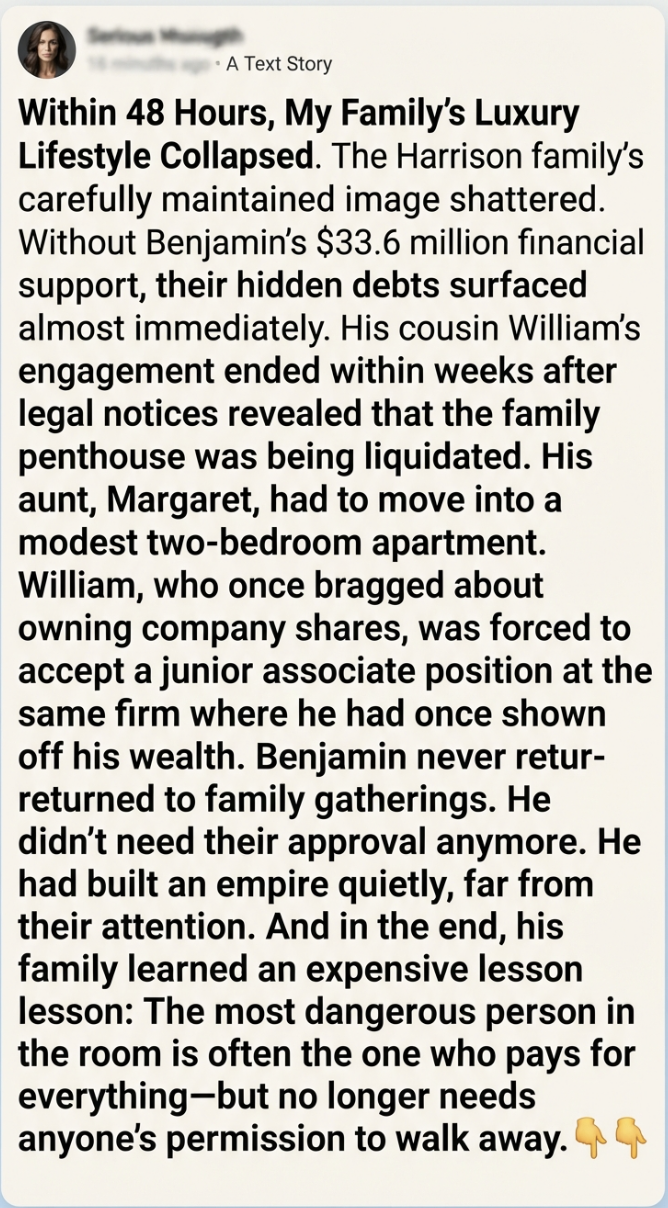
Eventually, Margaret moved into a modest two-bedroom apartment.
The move was not immediate, and it was not caused by one single action from me. It followed a complicated process involving debt, property obligations, negotiations, and financial decisions made over many years.
But the timing made the truth impossible to ignore.
The lifestyle she had presented as permanent had depended on financial support that was never guaranteed.
When a relative asked her whether she regretted the way she had treated me, she reportedly said:
“Benjamin has changed.”
Perhaps she was right.
I had changed.
But not in the way she believed.
I had not become cruel.
I had become unwilling to confuse love with unlimited access.
THE FAMILY’S FINAL ATTEMPT
Several months after the financial collapse began, my relatives requested a family meeting.
They wanted me to attend at a private office.
I agreed, but only with my attorney present.
When I arrived, Margaret, William, and two other relatives were waiting.
The atmosphere was tense.
Margaret looked older than I remembered.
William no longer wore the expensive watch he had once displayed at every gathering.
He sat with his arms crossed, avoiding eye contact.
Margaret spoke first.
“We want to resolve this as a family.”
“I’m willing to discuss documented obligations through the proper process.”
She frowned.
“Why must everything be legal?”
“Because informal promises created this situation.”
William leaned forward.
“You know we made mistakes.”
“I understand that.”
“We need another chance.”
I looked at him.
“What does another chance mean?”
He hesitated.
Margaret answered for him.
“You could provide a final amount to settle the immediate problems.”
“How much?”
She named a figure large enough to make the room fall silent.
I looked at my attorney.
Then I looked back at Margaret.
“Have you prepared a complete accounting of the existing funds, assets, debts, and obligations?”
She said nothing.
“Have all related entities disclosed their records?”
More silence.
“Have you agreed to independent oversight?”
William looked frustrated.
“You’re making this impossible.”
“No,” I said. “I’m asking for transparency before another dollar changes hands.”
Margaret’s expression hardened.
“You are punishing your family.”
I shook my head.
“Accountability is not punishment.”
She leaned back.
“You will regret turning your back on us.”
I looked at the people sitting around the table.
For years, I had feared losing their approval.
Now I understood that I had already lost something more important.
I had lost the illusion that their approval was freely given.
THE JOB WILLIAM NEVER EXPECTED TO TAKE
After the investment company failed to meet its obligations, William’s professional reputation suffered.
He had once spoken as though he were destined to become a senior executive.
He had introduced himself at social events as a major shareholder.
He had treated junior employees with condescension.
Now he needed stable employment.
Eventually, he accepted a junior associate position at the same firm where he had once boasted about his connections.
The position was legitimate, but it was far below the level he had claimed to hold.
He had to learn procedures he had previously dismissed.
He had to report to managers younger than himself.
He had to rebuild his professional credibility.
One afternoon, I saw him outside the office building.
He looked exhausted.
We stood several feet apart.
“Benjamin,” he said.
I nodded.
“How are you?”
“Working.”
He gave a bitter smile.
“I suppose you heard.”
“I heard you started a new position.”
“I never thought I’d be here.”
I said nothing.
After a moment, he asked:
“Do you enjoy this?”
The question surprised me.
“Enjoy what?”
“Watching us lose everything.”
I looked at him.
“I never wanted you to lose everything.”
“Then why didn’t you help?”
“Because helping you cannot mean pretending that nothing happened.”
He looked away.
“I thought you would always be there.”
“I was there.”
He swallowed.
“I know.”
It was the first time he had ever said those words.
But acknowledgment did not erase the past.
And forgiveness, if it ever came, would require more than a difficult conversation outside an office building.
THE FINAL FINANCIAL ACCOUNTING
The full review took months.
The final findings were not as simple as the family’s accusations had suggested.
There was no single document that explained every dollar.
Some funds had been used for legitimate expenses.
Some had been invested in businesses that later failed.
Some transfers required additional investigation.
Some obligations were subject to legal disputes and contractual interpretation.
But one conclusion became undeniable.
The family had repeatedly represented its financial condition inaccurately, relied on undisclosed liabilities, and expected me to continue supplying money without complete information.
The review also identified payments that had been described to me as business investments but had been used for personal lifestyle expenses.
I had not known the full extent of those transactions.
My attorneys advised me to pursue appropriate remedies where documentation supported them.
I did.
Not because I wanted revenge.
Because financial accountability mattered.
I reached negotiated arrangements in certain matters, pursued formal claims in others, and accepted that some funds might never be recovered.
The process was slow.
It was expensive.
It was emotionally exhausting.
But it gave me something my family had never given me.
A clear record.
WHAT I DID WITH MY MONEY AFTERWARD
For years, I had believed that wealth meant being able to solve everyone’s problems.
After the collapse, I developed a different understanding.
Wealth could provide security.
It could create opportunities.
It could support education, healthcare, and meaningful causes.
But money could not manufacture honesty.
It could not force gratitude.
And it could not turn a relationship built on dependence into a relationship built on trust.
I created a new set of financial rules.
No informal loans.
No undocumented guarantees.
No transfers made under emotional pressure.
No business investments without independent review.
No family member would receive money simply because they accused me of being disloyal.
I also began supporting organizations that helped people develop financial literacy and access education.
I wanted my money to create opportunities rather than preserve appearances.
My life became quieter.
I stopped attending gatherings where my presence was treated as a financial resource.
I stopped explaining every decision.
I stopped trying to convince people who had already decided that my value depended on what I could provide.
And slowly, I became comfortable with the silence.
THE LAST MESSAGE FROM MARGARET
Nearly a year after the family’s financial crisis began, I received a handwritten letter from Margaret.
I almost threw it away.
Instead, I opened it.
She wrote about the apartment.
About the difficulty of adjusting to a smaller life.
About how people who once surrounded her had stopped calling.
About how she had begun to understand that many of her relationships had been based on status.
Then she wrote:
“I thought keeping the family wealthy would keep us together. I did not realize that I was teaching everyone to measure love through money.”
I read the sentence several times.
The letter contained an apology, but it also contained explanations.
I did not consider the apology a complete resolution.
An apology could begin a conversation.
It could not erase financial damage.
It could not automatically rebuild trust.
I replied with a short letter.
I told her that I hoped she would find stability and peace.
I told her that any future financial discussions would need to be transparent and handled appropriately.
I did not promise to restore the old arrangement.
I did not offer another large transfer.
I did not return to the role I had spent years trying to escape.
THE FAMILY GATHERING I NEVER ATTENDED
A few months later, a relative invited me to a family gathering.
The invitation included a message:
“Everyone misses you. We should put the past behind us.”
I stared at the words.
Putting the past behind us sounded simple.
But the past included years of hidden debt, emotional pressure, financial misrepresentation, and relationships built around my willingness to pay.
I could forgive people without giving them unrestricted access to my life.
I could wish them well without returning to the same arrangement.
So I declined the invitation.
My response was polite.
There was no accusation.
No dramatic speech.
No public announcement.
I simply said I would not be attending.
For the first time, I did not feel guilty.
I felt free.
WHAT THE HARRISONS LEARNED
The Harrison family’s luxury lifestyle did not collapse because one person suddenly became powerful.
It collapsed because a financial system built on borrowed appearances, undisclosed obligations, and continuous outside support could not sustain itself forever.
My decision exposed weaknesses that had existed long before I stopped paying.
The penthouse, the business claims, the luxury events, and the public image had created the impression of permanent wealth.
But wealth without transparency is fragile.
Status without accountability is temporary.
And family loyalty without mutual respect becomes a form of control.
William eventually rebuilt parts of his career.
Margaret adjusted to her new circumstances.
Some relatives stopped speaking to me entirely.
Others reached out only after they needed something.
I learned to recognize the difference.
I did not spend my life trying to destroy the Harrison name.
I simply stopped carrying it on my back.
THE LESSON I WILL NEVER FORGET
For a long time, I believed the most dangerous thing a person could do was betray their family.
I was wrong.
Sometimes, the most dangerous thing is allowing people to believe they are entitled to everything you have.
Generosity without boundaries can become dependency.
Loyalty without honesty can become manipulation.
And love without accountability can leave everyone involved damaged.
My family once believed I was valuable because I could finance their lifestyle.
When the money stopped, their image began to unravel.
But my life did not end.
It became mine again.
I built my wealth quietly, and I rebuilt my peace even more quietly.
I no longer attend every gathering.
I no longer answer every demand.
I no longer confuse being needed with being loved.
And I no longer feel obligated to prove that I am a good person by sacrificing my future.
Because the truth is simple:
You can support your family without surrendering your boundaries.
You can forgive someone without funding their mistakes.
And you can walk away from people who only value what you provide without losing your own worth.
The Harrisons had spent years convincing the world that they owned everything.
But when the money stopped flowing, they discovered what they truly possessed.
Not lasting wealth.
Not unquestionable loyalty.
Not an untouchable family legacy.
Only a fragile image built on obligations they had refused to confront.
And I finally understood the lesson I should have learned years earlier:
THE MOST DANGEROUS PERSON IN THE ROOM IS OFTEN THE ONE WHO PAYS FOR EVERYTHING—BUT NO LONGER NEEDS ANYONE’S PERMISSION TO WALK AWAY.