“You are dead to this family, Sophia.”
My father said those words in front of nearly forty guests.
The music stopped.
The conversations faded.
And for a few seconds, all I could hear was the soft hum of the air conditioner above us.
I stood beside the birthday decorations I had personally arranged, looking at the enormous floral display, the imported desserts, and the gold lettering stretched across the ballroom wall.
HAPPY 60TH BIRTHDAY, WILLIAM.
My father’s name.
My family’s celebration.
And a bill totaling $64,000.
I had paid for nearly everything.
The venue.
The catering.
The decorations.
The entertainment.
The luxury transportation.
Even the private photographer my mother had insisted on hiring.
I had spent weeks organizing the event because my parents had told me it was their dream celebration.
I thought I was giving them a beautiful memory.
Instead, I was about to discover how quickly love could disappear when money stopped flowing.
My father pointed at me.
“You embarrassed us,” he said.
I looked at him in disbelief.
“Dad, I told you I couldn’t increase the budget again. The party already cost more than we planned.”
My mother, Helen, stood beside him with her arms folded.
“You always make everything about money.”
I almost laughed.
Everything about money?
I had spent years paying their bills.
Their mortgage.
Their vehicle leases.
Their insurance.
Their medical expenses.
Their vacations.
Their home renovations.
And now, after I refused to spend another $12,000 on last-minute upgrades, they were accusing me of being selfish.
My brother, Daniel, stood near the dessert table.
He didn’t say anything.
He simply looked away.
That hurt more than I expected.
Because Daniel knew exactly how much I had done for this family.
He had asked me for money more times than I could remember.
And I had always helped him.
Until that evening.
Until my father looked me in the eyes and said the words that changed everything.
“From this moment on, you are dead to this family.”
The room became completely silent.
I stared at him.
Then I nodded.
“Okay.”
My mother blinked.
“Don’t be dramatic, Sophia.”
“I’m not.”
I removed the small gold bracelet my mother had given me years earlier.
She had once told me it represented our unbreakable bond.
I placed it on the table beside the birthday cake.
Then I picked up my purse.
My father scoffed.
“Where do you think you’re going?”
“Home.”
“This is my birthday.”
“I know.”
“You’re leaving your own father’s celebration?”
I looked at the decorations, the expensive flowers, and the people who had come to enjoy a party I had funded.
“No,” I said quietly. “I’m leaving a family that just told me I don’t belong.”
Then I walked out.
I didn’t argue.
I didn’t cry in front of them.
I didn’t ask anyone to follow me.
I simply left.
And before the night was over, I made a decision that would change all of our lives.
THE DAUGHTER WHO BECAME THE FAMILY BANK
I hadn’t always been wealthy.
That was the part my family never seemed to understand.
They looked at my current lifestyle and assumed I had always been fortunate.
They saw my company.
They saw my apartment.
They saw the investments I had made.
They saw the way I could pay an unexpected bill without panicking.
But they never saw the years I spent building that stability.
My name is Sophia.
I started my career in business operations and financial technology.
For years, I worked long hours, learned new skills, and saved nearly every dollar I could.
While my friends spent weekends traveling, I often stayed home reviewing financial reports and studying investment opportunities.
I wasn’t obsessed with money.
I was afraid of instability.
I had grown up watching my parents struggle with debt.
Bills were often overdue.
Creditors called the house.
My father changed jobs several times.
My mother frequently worried about how they would pay for unexpected expenses.
When I finally became financially stable, I thought I could help them experience the security they had never had.
I paid off a portion of their mortgage.
Then I helped replace my father’s aging car.
When my mother needed medical treatment, I covered the expenses their insurance did not handle.
I didn’t keep a detailed record of every payment at first.
They were my parents.
I believed helping them was part of being a good daughter.
But generosity slowly became an expectation.
The first time my father asked me to cover their car lease, he said it would only be temporary.
“The business is slow this month,” he explained. “We’ll handle it ourselves soon.”
I agreed.
Then one month became six.
Six months became two years.
Eventually, my parents stopped asking whether I could afford the payments.
They simply assumed I would make them.
My mother began referring to the money as “family support.”
My father called it “your responsibility.”
Daniel was no different.
He needed help with rent.
Then a loan repayment.
Then money for a business idea that never became profitable.
Every time I hesitated, someone reminded me of everything my family had done for me when I was younger.
“You wouldn’t be where you are without us,” my mother would say.
It was true that they had raised me.
But I began to wonder when gratitude had become a debt with no end date.
THE PARTY THAT WAS NEVER ENOUGH
My father’s sixtieth birthday was supposed to be special.
He had talked about it for months.
He wanted an elegant celebration with close friends, business associates, relatives, and several people he described as “important connections.”
My mother created a long list of requirements.
A luxury ballroom.
A professional event planner.
A premium catering service.
Live music.
A customized cake.
A private transportation service.
A photographer.
A champagne tower.
I reminded her that we had agreed on a budget of $35,000.
She waved her hand.
“That was before we finalized the guest list.”
The guest list grew from sixty people to nearly one hundred and fifty.
The venue changed.
The menu became more expensive.
My father decided that the party needed a live band instead of a DJ.
Then my mother wanted a larger floral installation.
Then Daniel suggested a private after-party.
Every time I raised concerns, they made me feel like I was ruining something.
“Sophia, it’s your father’s sixtieth,” my mother said. “He only turns sixty once.”
I eventually agreed to a larger budget.
The total reached $52,000.
I told them clearly that I could not go beyond it.
My father nodded.
“That’s more than enough.”
But two weeks before the event, he called me.
“We need to make some changes.”
“What kind of changes?”
“The guests from my business circle are expecting a more impressive experience.”
I closed my eyes.
“Dad, we’ve already booked the venue and catering.”
“The venue is good, but we need the premium package.”
“How much?”
“About $8,500.”
“No.”
He went quiet.
Then he said, “You can’t be serious.”
“We already exceeded the original budget.”
“You have the money.”
“That doesn’t mean I should spend it.”
My father became irritated.
“You act like we’re asking you to buy a private island.”
“I’m asking you to stay within the budget we agreed on.”
My mother joined the call.
“You’re becoming so difficult.”
I looked at the financial spreadsheet on my screen.
The party had already cost more than I had planned to spend.
“I’m not paying for additional upgrades.”
My mother sighed.
“Fine. We’ll discuss it later.”
I thought the argument was over.
It wasn’t.
THE FINAL DEMAND
On the morning of the party, my mother called me while I was at the venue.
“Where are the additional decorations?”
“What decorations?”
“The gold ceiling installation.”
I looked up at the ballroom ceiling.
“The one we didn’t approve?”
“Your father wants it.”
“How much?”
“About $7,000.”
I felt my patience disappear.
“Mom, no. We’ve already paid for the event.”
“You’re embarrassing us.”
“I’m trying to prevent us from spending money we didn’t budget for.”
She lowered her voice.
“Do you know how much people are expecting from tonight?”
“People are expecting a birthday party.”
“They’re expecting your father to look successful.”
I looked at the workers arranging the tables.
“Dad’s success isn’t determined by how much I spend on decorations.”
My mother hung up.
Three hours later, I arrived at the ballroom.
The event looked beautiful.
The flowers were arranged perfectly.
The lighting was warm.
The tables were covered in white linen.
A large photograph of my father stood near the entrance.
I had spent the entire afternoon making sure everything was ready.
At 7:30 PM, the guests began arriving.
My father greeted them with a broad smile.
My mother introduced him to every important person.
Daniel stood near the bar, speaking to a group of friends.
For a short time, I allowed myself to relax.
Maybe the arguments had been worth it.
Maybe my father would appreciate the effort.
Maybe my family would finally understand that I had done this because I loved them.
Then the event planner approached me.
“Sophia, there’s an outstanding balance.”
I frowned.
“What balance?”
“The additional entertainment and upgraded catering.”
“Those weren’t approved.”
She showed me the invoice.
The total was now $64,000.
I stared at the number.
“Who authorized this?”
“Your mother signed the approval this afternoon.”
I felt my face grow hot.
I found my mother near the entrance.
“Why did you authorize additional expenses?”
She looked annoyed.
“Because your father deserves a proper celebration.”
“We agreed on the budget.”
“You can afford it.”
“That isn’t the point.”
My father appeared behind her.
“What is happening?”
I showed him the invoice.
“Dad, the party has gone over budget again. I’m not paying for additional expenses that I didn’t approve.”
His expression changed.
“Not tonight.”
“I’m not trying to ruin tonight. I’m asking you to take responsibility for the extra costs.”
He looked around.
Several guests were nearby.
His voice became louder.
“You always do this.”
“Do what?”
“Make everything about yourself.”
I stared at him.
“You authorized spending beyond the budget.”
“And you’re humiliating me in front of my guests.”
“I spoke to you privately.”
“You’re selfish.”
My mother stepped closer.
“Just pay the bill, Sophia.”
I shook my head.
“No.”
The word seemed to shock them.
My father stared at me.
“You’re refusing to pay for your own father’s birthday?”
“I paid for the entire event. I’m refusing to keep approving expenses you make without asking me.”
He pointed toward the ballroom.
“You think money makes you important?”
“No.”
“Then stop acting like you’re better than us.”
I felt something inside me break.
I had spent years trying to earn their approval.
Years believing that if I helped enough, sacrificed enough, and provided enough, they would eventually see me as more than a source of financial support.
But that night, I finally understood.
They didn’t want a daughter who could say no.
They wanted a daughter who would keep paying.
My father stepped closer.
“Maybe you should leave.”
I looked at him.
“Do you really want me to leave?”
He didn’t hesitate.
“You are dead to this family.”
The words landed harder than any financial loss.
I looked at my mother.
She didn’t stop him.
I looked at Daniel.
He remained silent.
And then I walked away.
THE MORNING EVERYTHING STOPPED
I didn’t sleep that night.
I sat in my apartment, still wearing the clothes I had worn to the party.
My phone was filled with missed calls.
My mother had sent several messages.
My father had sent one.
“You owe us an apology.”
I read it three times.
Then I opened my financial management application.
For years, I had maintained automatic payments for my family.
I had never thought of them as a system.
I had thought of them as love.
But the screen showed the reality.
- Father’s luxury vehicle lease.
- Mother’s insurance premium.
- Family medical payment plan.
- Parents’ home maintenance account.
- Utility bills.
- Daniel’s monthly housing support.
- Family credit card payments.
- Several subscription services.
- Private club membership.
- Property maintenance expenses.
The combined monthly cost was more than $31,000.
Over the previous eight years, I had contributed well over $2.4 million toward family expenses, including direct payments, emergency support, and major purchases.
I stared at the number.
I had never calculated it all together.
Because every payment had felt like a separate act of kindness.
A car payment here.
A medical bill there.
A loan repayment.
A vacation.
A renovation.
A transfer to help Daniel.
Individually, each amount seemed manageable.
Together, they had become a lifestyle.
A lifestyle that my family had started treating as their entitlement.
I opened a spreadsheet.
I listed every recurring payment.
Then I asked myself one question.
If they believed I was dead, why was I still responsible for keeping them financially comfortable?
At 7:05 AM, I began canceling the automatic payments.
I did not cancel essential coverage without considering the consequences.
Where possible, I followed the proper notice requirements and ensured that my parents would receive information about their own obligations.
I wasn’t trying to create a medical emergency or leave anyone without immediate access to necessary care.
I was ending my financial responsibility for expenses that belonged to adults who had chosen to reject me.
The luxury car lease was canceled according to its contractual process.
The insurance payment arrangements were discontinued with the required notice.
The medical support transfers were stopped, and I informed the relevant providers that future bills needed to be directed to the account holders.
I removed myself from recurring subscriptions and discretionary expenses.
Then I opened my banking application one final time.
The cancellation confirmations appeared one after another.
For years, I had been afraid of what would happen if I stopped helping.
That morning, I realized I had been ignoring another question:
What would happen to me if I never stopped?
THE FIRST CALL
At 7:42 AM, my phone rang.
My father.
I let it ring.
He called again.
Then again.
Finally, I answered.
“Sophia! What have you done?”
I looked out the window.
“Good morning, Dad.”
“Why was my car lease payment rejected?”
“Because I canceled the automatic payment arrangement.”
“You can’t do that!”
“I can stop paying for a vehicle that isn’t my responsibility.”
“That’s my car!”
“Then you need to make the payments.”
There was a long silence.
“You’re being vindictive.”
“No. I’m following through on what you said last night.”
“What did I say?”
“You said I was dead to the family.”
His voice changed.
“We were angry.”
“I believed you.”
“Sophia, don’t be ridiculous. You’re my daughter.”
“Then you shouldn’t have said those words.”
“Your mother and I are under a lot of stress.”
“I understand.”
“Then restore the payments.”
I closed my eyes.
There it was.
Not an apology.
Not accountability.
A demand.
“I won’t restore them.”
“You’re going to destroy this family.”
“No, Dad. I’m no longer funding expenses that you can manage yourselves.”
He started shouting.
I lowered the phone from my ear.
When I brought it back, his voice was quieter.
“Please, Sophia.”
It was the first time I had heard fear in his voice.
But fear was not the same as remorse.
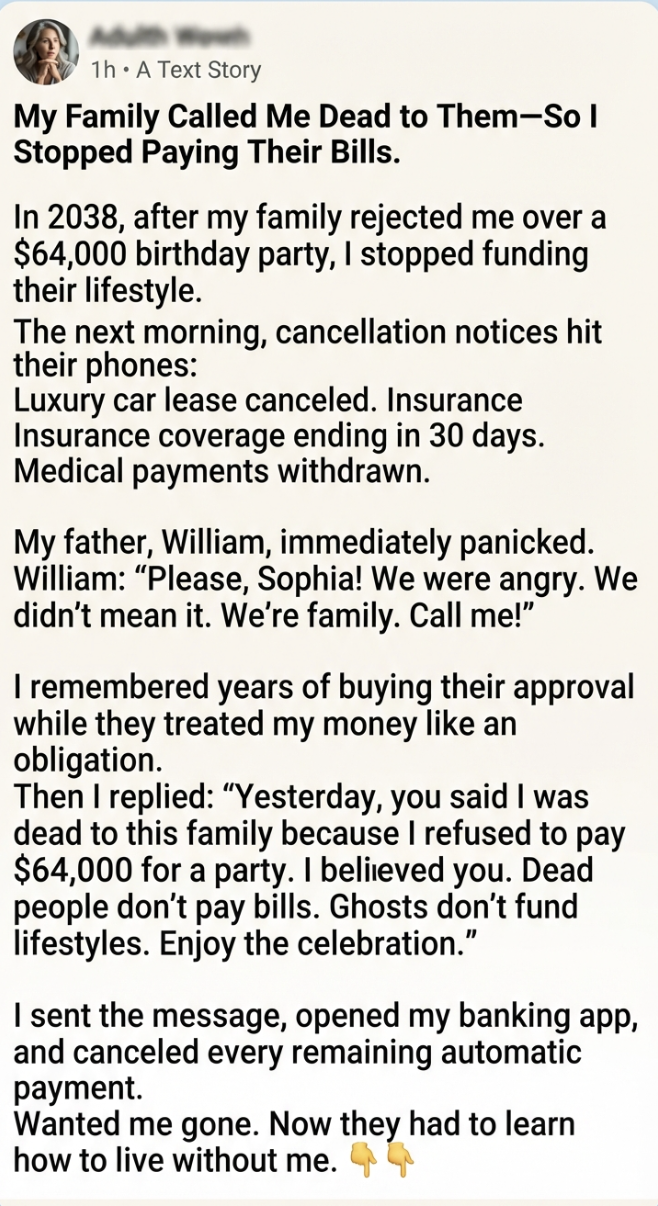
“Yesterday, you said I was dead to this family because I refused to pay $64,000 for a party,” I said.
He didn’t respond.
“I believed you.”
“Sophia—”
“Dead people don’t pay bills.”
My father inhaled sharply.
“Don’t say that.”
“Ghosts don’t fund lifestyles.”
I ended the call.
Then I sent him a message.
Yesterday, you said I was dead to this family because I refused to pay $64,000 for a party. I believed you. Dead people don’t pay bills. Ghosts don’t fund lifestyles. From today forward, you are responsible for your own expenses.
I pressed send.
Then I placed my phone face down.
For the first time in years, I didn’t wait for the next emergency.
THE FAMILY GROUP CHAT
By 8:15 AM, the family group chat was exploding.
MOM: What is happening?
DANIEL: Sophia, did you cancel the payments?
MOM: Your father is extremely upset.
DANIEL: My rent transfer didn’t come through.
DAD: Call me immediately.
I read the messages without responding.
Daniel called twice.
I answered on the third attempt.
“Are you serious?” he asked.
“About what?”
“My rent.”
“You need to arrange your own payment.”
“You can’t just stop helping me.”
“I can.”
“You promised you’d support me.”
“I promised to help when I could. I never promised to fund your life indefinitely.”
He laughed bitterly.
“So now you’re punishing everyone because Dad said something stupid?”
“No. I’m ending financial arrangements that have become unhealthy.”
“Mom says you’re having some kind of breakdown.”
I felt my jaw tighten.
“I’m not having a breakdown, Daniel.”
“Then act like a normal person.”
“Normal people don’t spend years paying bills for relatives who call them dead when they refuse an extra expense.”
He went silent.
Then he said:
“You think you’re better than us because you have money.”
“No. I think I deserve to have control over my own money.”
He hung up.
I sat at my desk for several minutes.
I had expected anger.
I had expected accusations.
But I hadn’t expected how quickly everyone would treat my boundaries as an attack.
Nobody asked whether I was okay.
Nobody asked how much pressure I had been carrying.
They asked when the money would return.
That was the answer I had been avoiding for years.
THE SECRET ACCOUNT
Three days after the party, I received a message from a financial advisor I had worked with for several years.
Her name was Evelyn.
She had helped me structure my business investments and organize my long-term financial plans.
She asked me to come to her office.
“I found something during our annual review,” she said.
I sat across from her.
“What kind of something?”
She opened a folder.
“Do you remember the family property trust you established five years ago?”
I nodded.
I had created the trust after helping my parents refinance their home.
At the time, my father had wanted to sell the property and move into a luxury apartment.
I had suggested a different arrangement.
I purchased the outstanding mortgage balance and funded major repairs.
The legal ownership structure was complicated, and my parents retained the right to live in the property under a formal agreement.
I had never intended to use the arrangement against them.
I had simply wanted to protect the home from being lost during a period of financial instability.
Evelyn continued.
“The trust has appreciated significantly.”
“How much?”
She slid a document across the desk.
I looked at the valuation.
The property, along with related investments I had funded through the trust, was now worth approximately $5.8 million.
I stared at the figure.
“I knew the property had increased in value, but I didn’t realize it had grown this much.”
“There are also other assets connected to your family support arrangements.”
She opened another document.
A portfolio of investments.
A commercial property share.
A reserve account.
A life insurance policy.
The combined value of assets I had placed under my own financial structure exceeded $9.4 million.
I leaned back.
“Why are you showing me this now?”
“Because the recent conflict made me concerned that you might make an emotional decision about the property.”
I frowned.
“What do you mean?”
“You have been paying expenses for your family, but some of those arrangements involve legal obligations, ownership rights, and tax considerations. You need to understand the difference between voluntarily providing support and being legally responsible for someone else’s debts.”
I nodded slowly.
“Does my family own any of these assets?”
“Your parents have specific rights under the agreements. But ownership and access are not the same thing. We need to review everything carefully before making changes.”
I looked down at the documents.
For years, I had believed my family depended entirely on my monthly payments.
I had not realized that I had also created a financial structure that protected several of their long-term assets.
The twist was not that I secretly owned every part of their lives.
The twist was that I had spent years protecting their future while they treated me as if I were disposable.
Evelyn closed the folder.
“Whatever you decide, make sure it is lawful, documented, and not driven by anger.”
I nodded.
“I don’t want revenge.”
“What do you want?”
I thought about my father’s voice.
The ballroom.
The words dead to this family.
“I want to stop confusing love with obligation.”
THE MEETING AT MY LAWYER’S OFFICE
I hired an independent attorney to review every financial arrangement involving my family.
I wanted no misunderstandings.
No threats.
No impulsive decisions.
No actions that could create unnecessary harm.
The attorney, Marcus, spent several days reviewing contracts, trust documents, payment records, and ownership agreements.
Then he explained the situation.
“You have been extremely generous,” he said. “But generosity doesn’t mean you should ignore your own legal and financial interests.”
“What can I do?”
“You can discontinue voluntary financial support. You can remove yourself from arrangements where the contracts permit it. But any shared obligations, guarantees, or property agreements must be handled according to their terms.”
“What about the house?”
“Your parents have the right to occupy it under the agreement. You cannot simply remove them because you’re angry.”
“I don’t want to remove them.”
“Good. Then we need to separate the property arrangement from the emotional conflict.”
I nodded.
That was exactly what I wanted.
I didn’t want my parents homeless.
I didn’t want their medical care interrupted.
I didn’t want to punish anyone for being dependent.
I wanted them to understand that dependence did not give them the right to insult me or control my money.
Marcus prepared a formal notice explaining that I would no longer provide discretionary financial support.
The letter included:
- The date financial support would end.
- The payments being discontinued.
- The obligations remaining with the account holders.
- The time available to transition certain arrangements.
- Contact information for the relevant service providers.
- A reminder that existing legal agreements would remain in force.
I read the letter carefully.
It wasn’t cruel.
It wasn’t emotional.
It didn’t mention the party.
It didn’t insult my family.
It simply established a boundary.
When I signed it, my hands didn’t shake.
I felt calm.
For the first time, I was making a financial decision without trying to earn someone’s approval.
THE FAMILY EMERGENCY
Two weeks after the party, my mother called.
Her voice was different.
Not angry.
Not commanding.
Afraid.
“Sophia, we need to talk.”
“Okay.”
“Your father has been trying to arrange the car payment, but the lease company needs updated financial information.”
“That’s between him and the company.”
“I know.”
She paused.
“Daniel is struggling too.”
“I understand.”
“Can you please help us transition?”
I sat quietly.
That was a reasonable request.
I had ended the payments, but I didn’t want people to be left confused about their obligations.
“I can provide a list of the arrangements and the deadlines,” I said. “I can also pay for an independent financial counselor to help you review your budget.”
My mother exhaled.
“Will you restore the payments?”
“No.”
She became silent.
“Not even temporarily?”
“No.”
“Your father is still angry.”
“I know.”
“He says you’re trying to teach us a lesson.”
“I’m trying to establish a boundary.”
She began to cry.
I felt the familiar urge to fix everything.
To say yes.
To make another transfer.
To restore the payments and pretend the birthday party had never happened.
But I had learned that ending a pattern was uncomfortable precisely because the pattern had benefited everyone except the person carrying the burden.
“Mom,” I said gently, “I can help you understand your options. I can help you find professional advice. But I cannot continue funding your lifestyle.”
“Are you really going to let us struggle?”
“I don’t want you to struggle. I want you to live within your own means.”
She didn’t answer.
Then she asked:
“Do you still love us?”
The question hurt.
“Yes,” I said. “But love doesn’t mean I have to keep paying for everything.”
She began crying harder.
We ended the call a few minutes later.
I sat alone in my apartment.
I loved my mother.
That was why the situation was so painful.
But love could not require me to surrender my boundaries every time someone became upset.
THE TRUTH ABOUT DANIEL
A month later, I learned something that made the entire situation more complicated.
Daniel had not been using all of the money I gave him for rent and living expenses.
He had been transferring portions of it into a private business account.
I discovered this when he asked me to help review his financial statements.
His business had been struggling for nearly two years.
He had borrowed money from several people.
He had missed tax payments.
He had used family support to cover expenses that were unrelated to the purpose he had originally described.
When I asked him about it, he became defensive.
“You said you would help me.”
“I did help you.”
“Then why are you interrogating me?”
“Because I need to understand what happened to the money.”
He pushed the papers across the table.
“I was trying to build something.”
“Then you should have told me.”
“You would have said no.”
I looked at him.
“Maybe. But you chose to hide it.”
He looked away.
I had spent years believing that my family was financially dependent on me because circumstances had been difficult.
Now I was discovering that some of the problems were being prolonged by decisions they refused to take responsibility for.
I didn’t demand repayment immediately.
I didn’t threaten him.
Instead, I told him that future financial assistance would only be considered through a formal written agreement, with clear limits and independent oversight.
He refused.
“I don’t need a contract from my sister.”
“Then you don’t need my money.”
He stood up.
“You’ve changed.”
“Yes,” I replied. “I finally started paying attention.”
THE OFFER I NEVER EXPECTED
Three months after the party, my father asked to meet me.
He wanted to speak at a quiet restaurant.
I agreed, but I told him that I would not discuss money unless we could have a respectful conversation.
He nodded.
When I arrived, he was already seated.
He looked older than he had at the birthday celebration.
His expensive watch was gone.
His usual confidence had faded.
For several minutes, neither of us spoke.
Then he said:
“I owe you an apology.”
I looked at him.
“Okay.”
He swallowed.
“I shouldn’t have said you were dead to the family.”
“No, you shouldn’t have.”
“I was angry.”
“You were angry because I refused to spend more money.”
He lowered his eyes.
“Yes.”
I waited.
He continued.
“I convinced myself that you were being selfish. But the truth is that I had become accustomed to you handling everything.”
I didn’t interrupt.
“I stopped thinking about what it cost you.”
That sentence was the first one that reached me.
Not because it repaired the damage.
But because it acknowledged it.
“Dad,” I said, “I never needed you to repay every dollar. I needed you to appreciate that I was helping because I loved you, not because you were entitled to my money.”
He nodded.
“I know that now.”
“Do you?”
He looked at me.
“Yes.”
I took a breath.
“Then understand that the payments won’t return.”
“I know.”
“You need to manage your own finances.”
“I know.”
“And if we are going to rebuild our relationship, it cannot be based on what I can provide.”
He nodded again.
Then he said something I never expected.
“I want to sell the luxury car.”
I looked at him.
“Why?”
“Because we can’t afford the lifestyle we were living.”
I didn’t celebrate.
I didn’t say I had told him so.
I simply nodded.
“That sounds like a responsible decision.”
He looked down at his hands.
“I thought success meant showing people that we were doing well.”
“And now?”
“Now I think success means being able to sleep at night without waiting for someone else to rescue you.”
I looked out the window.
For the first time, my father seemed to understand the difference between appearance and stability.
THE FAMILY MEETING
Six months after the birthday, I invited my parents and Daniel to my home.
I didn’t want another argument.
I wanted clarity.
I placed several folders on the table.
Inside were summaries of the financial arrangements I had ended, the legal agreements that remained active, and a transition plan prepared with professional assistance.
My mother looked nervous.
My father sat quietly.
Daniel kept his arms crossed.
I began.
“I want to explain what will happen from now on.”
Daniel interrupted.
“Are you going to lecture us?”
“No.”
“Then what is this?”
“A boundary meeting.”
My father looked at him.
“Let her speak.”
I continued.
“I will no longer pay discretionary bills for anyone in this family. That includes vehicles, vacations, personal subscriptions, housing support, and other lifestyle expenses.”
My mother lowered her head.
“I will honor existing legal obligations,” I said. “I will not abandon anyone in an emergency where immediate assistance is necessary and reasonable. But emergencies will be handled individually, with clear limits and professional guidance where needed.”
Daniel frowned.
“So we have to ask permission now?”
“No. You have to manage your own finances.”
My father nodded slowly.
I continued.
“The family property arrangements will remain in place according to the legal agreements. You have the rights outlined in those documents. I will not use ownership as a weapon.”
My mother looked at me.
“Then why are you doing all this?”
“Because I want our relationship to be based on something other than money.”
Nobody spoke.
I looked at Daniel.
“If you need help with your business, I can recommend a financial counselor. I can help you create a realistic plan. But I won’t provide unlimited funding.”
He stared at me.
Then, unexpectedly, he nodded.
“Okay.”
It wasn’t an apology.
It wasn’t a dramatic reconciliation.
But it was the first time he had accepted a boundary without immediately insulting me.
That was enough for that day.
THE HOUSE AND THE DECISION
A year after the birthday party, the family property trust became the subject of another difficult conversation.
The property had continued to increase in value.
My parents wanted to renovate the house again.
The estimated cost was $180,000.
My mother called me.
“We think the house needs an update.”
“Can you afford it?”
“Not without your help.”
“I won’t fund another luxury renovation.”
She sighed.
“It’s our home.”
“And you have the right to live there under the agreement. But the renovation isn’t my responsibility.”
“Could you at least consider it?”
“I’ll consider a necessary repair if there’s a genuine safety issue. I won’t pay for an expensive redesign.”
She became quiet.
Then she said:
“You used to say yes to everything.”
“I know.”
“Were you unhappy all those years?”
I thought about the question.
“Yes,” I said. “Sometimes I was.”
She began to cry.
I didn’t try to silence her.
I let her feel the truth of what I had said.
I had been generous.
But I had also been exhausted.
I had felt trapped by the fear that saying no would make me a bad daughter.
I had allowed my family to become dependent on a version of me that never rested, never refused, and never asked for anything in return.
That version of me was gone.
Not because I had stopped loving them.
Because I had finally learned to include myself in the definition of family.
THE LETTER I WROTE TO MY YOUNGER SELF
On the second anniversary of the birthday party, I wrote a letter to the person I had been before everything changed.
I remembered the young woman who had first started earning money.
She had believed that financial success would make her family feel safe.
She had believed that generosity could prevent conflict.
She had believed that if she worked hard enough, nobody would ever have a reason to reject her.
I wanted to tell her something.
You are allowed to help people without becoming responsible for their entire lives.
You are allowed to say no.
You are allowed to change your mind.
You are allowed to have financial goals that do not include rescuing everyone else.
And if someone tells you that you are dead to them because you refuse to pay for something, you do not have to prove that you are still worthy of love.
You can simply believe their words and step away from the role they assigned you.
I folded the letter and placed it in a drawer.
Then I returned to work.
Not because I was trying to escape my feelings.
Because I had built a life that deserved my attention.
THE UNEXPECTED PHONE CALL
Several months later, my mother called me late in the evening.
I almost didn’t answer.
But something in me told me to pick up.
“Hello?”
“Sophia?”
“Yes?”
“Your father had a health scare.”
I sat up immediately.
“Is he okay?”
“He’s at the hospital. The doctors are checking him.”
“Which hospital?”
She told me.
I grabbed my jacket and left.
I didn’t think about the bills.
I didn’t think about the birthday party.
I didn’t think about the argument.
I went because he was my father.
At the hospital, my mother sat in the waiting room.
She looked exhausted.
When she saw me, she stood up and hugged me.
For a moment, neither of us spoke.
Then she whispered:
“Thank you for coming.”
I nodded.
“Of course.”
My father was eventually cleared to return home after evaluation and follow-up instructions.
The situation wasn’t as severe as we had feared.
But it reminded me of something important.
Setting boundaries didn’t mean I had to become cold.
I could refuse to pay for a luxury car and still care about my father’s health.
I could stop funding a vacation and still visit my mother.
I could refuse to finance Daniel’s business and still wish him success.
Financial independence did not require emotional cruelty.
And love did not require financial surrender.
Those two truths could exist at the same time.
THE NEW FAMILY CELEBRATION
Three years after the incident, my father turned sixty-three.
There was no luxury ballroom.
No champagne tower.
No extravagant floral installation.
My mother organized a small gathering at home.
The guest list was limited.
The food was simple.
Everyone contributed something.
Daniel brought dessert.
My mother cooked several traditional dishes.
My father prepared the drinks.
I brought a framed photograph of the family from years earlier.
When I arrived, my father greeted me at the door.
“I’m glad you’re here,” he said.
“Happy birthday, Dad.”
He smiled.
“Thank you.”
We sat around the table.
There were no speeches about success.
No demands.
No arguments about money.
At one point, my father raised his glass.
“To family,” he said.
I looked at him.
He paused.
Then he added:
“And to respecting the people who make sacrifices for us.”
My mother reached for my hand.
Daniel looked down at his plate.
I didn’t need a dramatic apology in front of a room full of guests.
I didn’t need them to announce that I had been right.
I only needed the relationship to become honest.
My father turned toward me.
“Sophia, would you like to say something?”
I smiled.
“Yes.”
Everyone looked at me.
I lifted my glass.
“To learning that love should never be measured by what someone can afford to pay.”
My father nodded.
“And to learning that family means responsibility on both sides.”
We raised our glasses.
This time, the celebration didn’t cost $64,000.
But it meant more to me than any expensive event we had ever hosted.
WHAT I FINALLY UNDERSTOOD
For years, I thought my family needed my money.
The truth was more complicated.
They needed to learn how to manage their lives without treating me as their financial foundation.
And I needed to learn that I could love them without allowing them to control me through guilt.
I don’t regret every payment I made.
Some of those payments helped my parents through genuinely difficult times.
Some protected their health.
Some kept a roof over their heads.
Some gave my brother an opportunity.
Generosity is not a mistake simply because it is not appreciated.
But generosity without boundaries can become a pattern that harms everyone involved.
The person giving begins to feel exhausted and resentful.
The people receiving stop recognizing the sacrifice.
And eventually, a relationship that should be built on love becomes an arrangement based on expectation.
I didn’t stop paying their bills because I wanted them to suffer.
I stopped because I wanted my life to belong to me again.
I wanted to know that when I said yes, it was because I freely chose to help.
Not because I was afraid of being rejected.
Not because I was afraid of being called selfish.
Not because I believed my worth depended on how much I could provide.
My family eventually learned to live within a different financial reality.
My parents downsized several expenses.
Daniel restructured his business and began working with an independent financial advisor.
Our relationships were not perfect.
Some wounds took time to heal.
There were still difficult conversations.
But we no longer pretended that money was the same thing as love.
And I no longer confused being needed with being valued.
THE MESSAGE I NEVER SENT
Sometimes, I still think about the message I sent my father that morning.
Dead people don’t pay bills. Ghosts don’t fund lifestyles.
At the time, those words came from pain.
I wanted him to understand how deeply his rejection had hurt me.
But years later, I realized the most important part wasn’t the message I sent him.
It was the decision I made afterward.
I stopped trying to purchase belonging.
I stopped measuring my worth by how much I could give.
I stopped believing that a family could demand unlimited sacrifice and still call it love.
I began building a life where generosity was a choice, not a condition for acceptance.
And I learned that walking away from an unhealthy financial arrangement does not mean walking away from your humanity.
You can protect yourself without becoming cruel.
You can establish boundaries without seeking revenge.
You can love people without allowing them to use your love as a payment method.
THE MORAL
Your family may share your blood, but they do not own your income, your future, or your peace. Help because you choose to—not because guilt forces you to. And if someone tells you that you are dead to them when you refuse to fund their lifestyle, remember this: your value was never determined by the bills you paid.
You are allowed to stop financing a relationship that refuses to respect you.