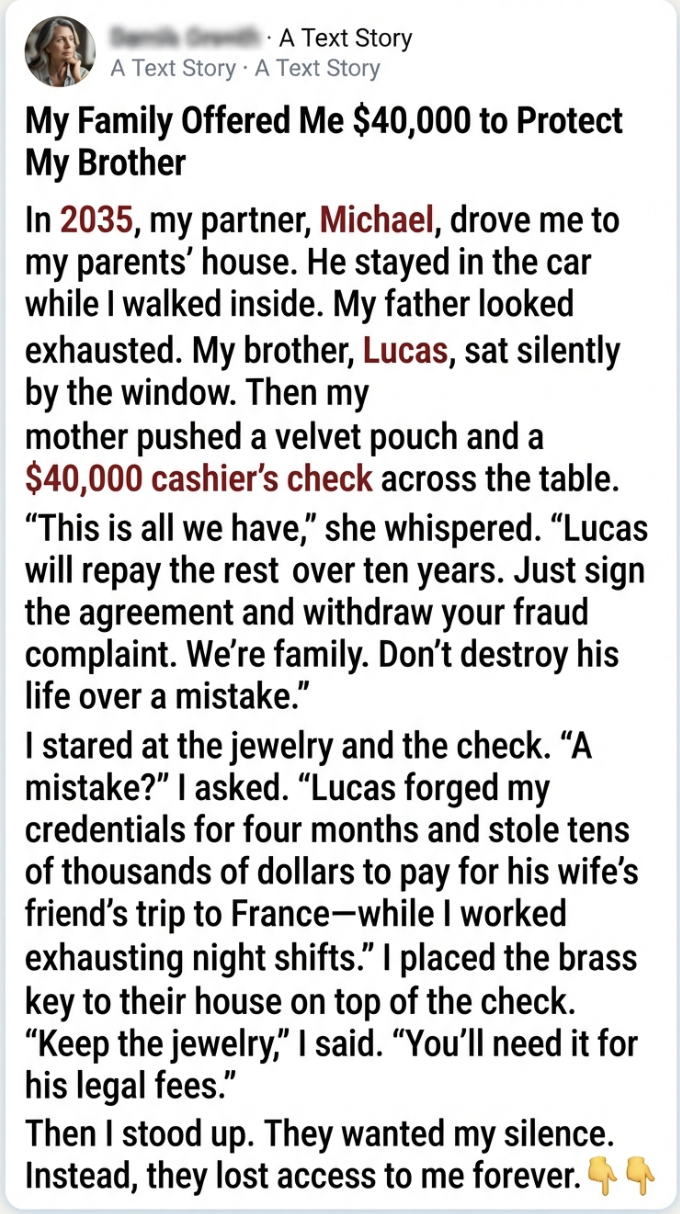
In 2035, my partner, Michael, drove me to my parents’ house.
Neither of us spoke much during the journey.
He knew why I was going.
He knew I didn’t want to go.
And he knew that, no matter what happened inside, I had already made a decision.
Before I opened the car door, Michael reached across the center console.
“You don’t have to stay longer than you want,” he said.
I nodded.
“I know.”
“If they pressure you, call me.”
“I will.”
He looked at me carefully.
“Are you sure you want to do this alone?”
I glanced toward my parents’ house.
“No,” I said honestly. “But I need to hear what they have to say.”
Michael squeezed my hand.
Then I stepped out of the car.
He stayed behind.
I walked toward the front door of the house where I had grown up.
The same house where my parents had celebrated my graduation.
The same house where my brother, Lucas, and I had once shared a bedroom.
The same house where I had spent years believing that family meant people would stand beside you when life became difficult.
I knocked.
My mother opened the door.
She looked older than she had a month earlier.
Her eyes were swollen.
“Come in,” she whispered.
I stepped inside.
The house was unusually quiet.
My father sat at the dining table, looking exhausted.
His shoulders were bent forward.
His hands were clasped together.
And by the living room window sat Lucas.
He didn’t look at me.
He stared outside as if the neighborhood were more interesting than the reason I had come.
I removed my coat.
“Where should I sit?”
My mother pointed toward the chair opposite my father.
I sat down.
Nobody spoke for several seconds.
Then my mother placed a small velvet pouch on the table.
Beside it, she put a $40,000 cashier’s check.
I stared at them.
“What is this?”
My mother swallowed.
“This is all we have available right now.”
I looked at my father.
He didn’t meet my eyes.
My mother continued.
“Lucas will repay the rest over ten years.”
I turned toward my brother.
He remained silent.
“Repay what?” I asked.
My mother’s hands began trembling.
“Everything that happened.”
I looked back at the pouch.
“What’s inside?”
“Jewelry.”
“What kind?”
“Your grandmother’s bracelets. Her earrings. A few pieces your father inherited.”
I looked at the check.
Then at Lucas.
Then back at my mother.
“You’re offering me jewelry and forty thousand dollars?”
She nodded.
“Please, sweetheart.”
My father finally spoke.
“Just listen to us.”
I leaned back.
“I’m listening.”
My mother pushed a document across the table.
It was several pages long.
At the top was a confidentiality agreement.
Below it were clauses about withdrawing my fraud complaint, releasing certain claims, and refraining from discussing the matter with third parties.
I read the first page.
Then the second.
My stomach tightened.
They hadn’t brought me there to apologize.
They had brought me there to negotiate my silence.
My mother folded her hands.
“Lucas made a terrible mistake.”
I looked toward my brother.
He still hadn’t spoken.
“A mistake?” I repeated.
“He was under pressure,” she said.
“Everyone is under pressure.”
“He didn’t know what else to do.”
I slowly placed the agreement on the table.
“Then let’s talk about what he did.”
Lucas finally looked at me.
His eyes were tired.
But I didn’t know whether he was ashamed or simply afraid of what would happen next.
Four months earlier, I had been working exhausting night shifts at a financial services company.
My schedule was brutal.
I often left home after sunset and returned when the streets were still dark.
I was responsible for reviewing account activity, processing documentation, and investigating discrepancies.
The work was demanding, but I took pride in doing it correctly.
My professional credentials were important to me.
I had spent years earning them.
Training.
Examinations.
Background checks.
Long hours.
Professional references.
I had worked for everything attached to my name.
Then an internal compliance review flagged several transactions associated with my employee credentials.
At first, I assumed it was an administrative error.
A system problem.
Perhaps a duplicated login.
But the records showed that my credentials had been used repeatedly during hours when I was not working.
Some approvals had been issued from locations I had never visited.
Certain transactions involved transfers to accounts connected to travel agencies and luxury service providers.
I reported the issue immediately.
The compliance team began investigating.
Then I received a call from my supervisor.
“Can you come in early tomorrow?”
“Is something wrong?”
“We need to discuss your access credentials.”
My stomach dropped.
I arrived at the office before sunrise.
The investigation team showed me a series of records.
Four months of activity.
Four months of transactions.
Four months of approvals connected to my professional identity.
Someone had been using my credentials.
And the evidence pointed toward Lucas.
My brother had somehow obtained access to information he should never have possessed.
He had used my credentials to authorize transactions.
He had altered records.
He had created the appearance that I had approved certain financial activity.
And the money?
It had been used to pay for expensive travel and luxury arrangements connected to his wife’s friend’s trip to France.
While I worked exhausting night shifts, someone was using my professional identity to fund a lifestyle I had never agreed to support.
The financial loss was significant.
But the damage to my reputation could have been much worse.
If the investigation had not uncovered the evidence, I might have been blamed for actions I never committed.
I could have lost my job.
My professional credentials could have been suspended.
My future could have been damaged by decisions I hadn’t made.
When the investigators asked whether I knew who had accessed my information, I told them the truth.
“I suspect my brother.”
I didn’t say it because I wanted revenge.
I said it because the records demanded an explanation.
THE FIRST FAMILY CALL
My mother called me the evening after Lucas was confronted.
I was sitting at my kitchen table, staring at a cup of coffee that had gone cold.
“Please don’t report him,” she said.
I closed my eyes.
“Mom, the investigation is already underway.”
“You can tell them it was a misunderstanding.”
“It wasn’t.”
“He didn’t mean to hurt you.”
“He used my credentials for four months.”
“He was desperate.”
“Then he should have asked for help.”
My mother began crying.
“He’s your brother.”
I looked at the dark window.
“I know.”
“You can’t destroy his life.”
I took a slow breath.
“Mom, he put my career at risk.”
“He’ll repay everything.”
“This isn’t only about money.”
“He’s willing to sign anything.”
“That’s not the point.”
“What is the point, then?”
I struggled to find the words.
“The point is that he used my identity and expected me to absorb the consequences.”
My mother was silent.
Then she said,
“Please think about the family.”
The call ended.
I sat in the dark for a long time.
I remembered being children.
Lucas had been the louder one.
The more confident one.
The one my parents always described as “a little reckless, but good-hearted.”
Whenever he made mistakes, someone fixed them.
When he damaged something, Dad paid for the repairs.
When he missed a deadline, Mom called the school.
When he borrowed money, I was encouraged to be understanding.
“He’s your brother,” they always said.
I had heard those words my entire life.
But I had never realized how easily they could become a demand.
THE NIGHT EVERYTHING CHANGED
A week after the investigation began, Lucas called me.
I almost didn’t answer.
“Hello?”
“Can we talk?”
“About what?”
“You know.”
I said nothing.
He exhaled.
“I didn’t think it would go this far.”
My hands tightened around the phone.
“You didn’t think what would go this far?”
“The transactions.”
“You used my credentials.”
“I was going to fix it.”
“By doing what?”
“I had a plan.”
“What plan?”
He didn’t answer.
I continued.
“You had four months to stop.”
“I was going to repay it.”
“With what?”
He became defensive.
“Why are you acting like I’m some criminal?”
I stared at the wall.
“Because you used my identity to authorize financial activity without my permission.”
“You’re making this sound worse than it was.”
“No, Lucas. I’m describing what happened.”
He began raising his voice.
“You’re my sister!”
“And you put my career at risk.”
“Family should help each other!”
“Family should not require someone to lie to protect them.”
He hung up.
That night, I couldn’t sleep.
Not because I doubted my decision.
Because I finally understood how little Lucas had considered what might happen to me.
He had thought about the money.
He had thought about the trip.
He had thought about avoiding consequences.
But apparently, he had never thought about my name.
My career.
My future.
My life.
THE MEETING AT MY PARENTS’ HOUSE
Now I sat across from my family with the $40,000 check and the velvet pouch between us.
My mother wiped her eyes.
“Lucas will repay everything over ten years.”
I looked at the agreement.
“Who wrote this?”
“His lawyer.”
“Of course.”
My father finally looked at me.
“Please don’t make this harder than it needs to be.”
I stared at him.
“Harder for whom?”
He looked away.
My mother leaned forward.
“You can withdraw the complaint. The company doesn’t have to know everything.”
I shook my head.
“The company already knows enough to investigate.”
“But you can tell them you don’t want to pursue it.”
“I don’t control their investigation.”
“Then tell them you forgive him.”
“Forgiveness doesn’t erase evidence.”
Lucas finally spoke.
“You’re acting like I wanted to hurt you.”
I turned toward him.
“Intent doesn’t erase consequences.”
He shook his head.
“I made a mistake.”
I looked at the documents.
“You forged my credentials for four months.”
“I was desperate.”
“You stole tens of thousands of dollars.”
“I was going to repay it.”
“You put my professional future at risk.”
He looked down.
I continued.
“And now everyone is asking me to sign an agreement that protects you from the consequences.”
My mother pushed the check closer.
“Please. Take the money.”
I looked at it.
Forty thousand dollars.
A number they believed might be enough to buy my silence.
But I knew what the money represented.
It wasn’t restitution.
It was a condition.
They wanted me to accept a private payment in exchange for withdrawing my complaint and restricting what I could say.
I looked at my father.
“Does this money come with any admission of wrongdoing?”
He frowned.
“What?”
“Does Lucas acknowledge what he did in this agreement?”
My mother hesitated.
I picked up the document.
The language was carefully written.
It described “misunderstandings,” “financial pressure,” and “a desire to resolve family conflict.”
But it avoided plainly acknowledging the unauthorized use of my credentials.
It was designed to protect Lucas.
Not to repair what he had damaged.
I placed the document back on the table.
“I won’t sign this.”
My mother began crying.
“Please don’t do this.”
I looked at her.
“I’m not doing this to you.”
“You’re sending your brother to court.”
“Lucas’s actions created the legal problem.”
“He’s still your brother.”
“And I’m still the person whose identity he used.”
My father stood abruptly.
“Enough!”
The room fell silent.
He pointed toward the document.
“You’re going to destroy this family over money?”
I looked at him.
“No.”
I reached for the velvet pouch.
“I’m refusing to destroy my future to protect someone who endangered it.”
I pushed the pouch back across the table.
“Keep the jewelry.”
My mother stared at me.
“What?”
“You’ll need it for his legal fees.”
My father’s face tightened.
Then I took the brass key to their house from my pocket.
It was an old key.
Heavy.
Worn smooth from years of use.
I placed it on top of the cashier’s check.
The sound of metal touching paper seemed louder than it should have been.
My mother stared at the key.
“What are you doing?”
“I won’t be responsible for this house anymore.”
My father looked at me.
“What does that mean?”
“It means you need to stop treating me like your emergency fund.”
“We never asked you to—”
I interrupted him gently.
“You asked me to sacrifice my career to protect Lucas.”
Nobody spoke.
I stood.
My chair moved backward across the floor.
“I’ve spent my entire life being told that family comes first.”
I looked at Lucas.
“But family doesn’t mean one person gets to endanger another and then demand silence.”
Lucas’s eyes filled with tears.
“Please.”
I looked at him.
“I hope you get the help you need.”
He lowered his head.
“But I won’t lie for you.”
I turned toward my mother.
“I love you.”
She began crying harder.
“But I can’t keep coming here to be pressured into accepting responsibility for someone else’s actions.”
My father said my name.
I stopped at the doorway.
He didn’t say anything else.
So I left.
THE CONSEQUENCES THEY COULDN’T NEGOTIATE AWAY
Michael was waiting in the car.
The moment I opened the door, he looked at me.
“Are you okay?”
I sat down.
“I don’t know.”
He didn’t ask me to explain immediately.
He simply started the engine.
After a few minutes, I said,
“They offered me forty thousand dollars.”
Michael glanced at me.
“To withdraw the complaint?”
I nodded.
He tightened his grip on the steering wheel.
“Did you sign?”
“No.”
He exhaled.
I looked out the window.
“They put my grandmother’s jewelry on the table.”
Michael remained quiet.
“They tried to make it sound like they were giving me everything they could.”
“And what did you feel?”
I thought about the question.
“Like they were asking me to put a price on my name.”
Michael reached for my hand.
“You don’t have to do that.”
“I know.”
“Do you?”
I looked at him.
For the first time that evening, I smiled.
“Yes.”
The investigation continued.
My employer secured my accounts and reviewed the evidence.
An independent digital-forensics team examined the access logs.
The records showed that my credentials had been used from devices and locations associated with Lucas.
The investigation also identified altered documents and unauthorized transactions.
I cooperated fully.
I provided records.
I answered questions.
I attended meetings with investigators and legal counsel.
I did not exaggerate what happened.
I did not invent evidence.
I did not make public accusations beyond what the legal process required.
I simply told the truth and allowed the evidence to be examined.
Eventually, Lucas faced formal legal proceedings.
Some matters were resolved through the court process.
Other financial questions required additional review.
The final consequences were not determined by my anger or my family’s pressure.
They were determined through evidence, legal representation, and the applicable process.
That mattered to me.
Because I wasn’t trying to punish my brother.
I was trying to make sure the truth was not buried under the word family.
THE MESSAGE FROM MY FATHER
Three months later, my father sent me a message.
It was short.
“I know you don’t want to hear from us. But I need you to know that I understand now that what Lucas did was wrong.”
I read it twice.
Then another message arrived.
“We should never have asked you to withdraw the complaint.”
I didn’t respond immediately.
A few minutes later, he wrote:
“Your mother is having a difficult time. So am I. But we know we made things worse by pressuring you.”
I set my phone down.
I wanted to believe him.
But apologies are not proof of change.
I had learned that the hard way.
The next day, I replied.
“I appreciate you acknowledging what happened. I hope Lucas takes responsibility and receives appropriate legal guidance. I also need time and distance. Please respect that.”
My father answered:
“We will.”
For once, he didn’t argue.
He didn’t say we’re family.
He didn’t tell me what I was supposed to do.
He simply accepted my boundary.
It wasn’t enough to repair everything.
But it was a beginning.
ONE YEAR LATER
A year after that meeting, my life had changed.
I no longer worked the same exhausting night-shift schedule.
My employer had supported me through the investigation, and I eventually moved into a role with more predictable hours.
I began rebuilding my savings.
I started therapy to process the betrayal and the pressure I had carried for years.
I also changed how I handled family requests.
I stopped answering immediately.
I stopped explaining myself repeatedly.
And I stopped believing that saying no made me a bad person.
My relationship with my parents remained distant.
We communicated occasionally.
Sometimes my mother sent messages asking how I was doing.
Sometimes I answered.
Sometimes I needed space.
I didn’t promise that everything would return to normal.
Because the old version of normal had required me to ignore too much.
One afternoon, Michael and I were sitting at a café when my phone rang.
It was Lucas.
I considered letting it go to voicemail.
Then I answered.
“Hello?”
He sounded different.
Less defensive.
More subdued.
“I wanted to say something.”
I waited.
“I was wrong.”
I said nothing.
“I kept telling myself I would fix everything before anyone found out.”
He paused.
“But I kept making it worse.”
I looked down at the table.
“I know.”
“I thought because we were family, you would protect me.”
I took a breath.
“That was the problem.”
“I know.”
He sounded as though he was struggling to speak.
“I didn’t think about what it would do to you.”
“No,” I said. “You didn’t.”
“I can’t change what happened.”
“No.”
“But I can stop making excuses.”
I looked out the café window.
“That matters.”
He was quiet.
Then he said,
“I don’t expect you to forgive me right now.”
I closed my eyes.
“Good.”
He let out a small, sad laugh.
“I deserve that.”
“No,” I said. “You deserve an honest process. And I deserve the freedom to decide what kind of relationship I want.”
“I understand.”
We ended the call a few minutes later.
I didn’t feel victorious.
I didn’t feel relieved.
I felt tired.
But beneath the tiredness was something else.
Peace.
Not complete peace.
Not the kind that makes the past disappear.
The kind that comes when you stop fighting against your own instincts to protect people who refuse to protect you.
WHAT I LEARNED FROM THE $40,000 CHECK
For years, I believed family loyalty meant staying quiet when someone you loved made a serious mistake.
I thought refusing to help would make me selfish.
I thought setting boundaries would make me cruel.
I thought saying no meant I was abandoning the people who raised me.
But I understand now.
Loyalty does not require dishonesty.
Love does not require you to sacrifice your identity.
And forgiveness does not mean withdrawing every boundary or preventing someone from facing the consequences of their actions.
My family offered me $40,000, jewelry, and a promise that Lucas would repay the rest over ten years.
But they were never truly offering to repair the damage.
They were asking me to exchange my silence for their comfort.
I refused.
Not because I hated my brother.
Not because I wanted my parents to suffer.
And not because money didn’t matter.
I refused because my name, my career, and my future were worth more than a cashier’s check.
The brass key I placed on that check was not a threat.
It was a boundary.
I was no longer willing to carry responsibility for a house, a brother, or a family system that treated my sacrifices as an obligation.
I still love my family.
But love no longer means giving them unlimited access to me.
They wanted my silence. Instead, I chose the truth.
And for the first time in my life, I understood that walking away from a harmful arrangement wasn’t the same as walking away from the people I loved.
Sometimes, it was the only way to stop losing myself.
Because family should never ask you to destroy your future to protect someone else’s wrongdoing—and no amount of money can make betrayal disappear.