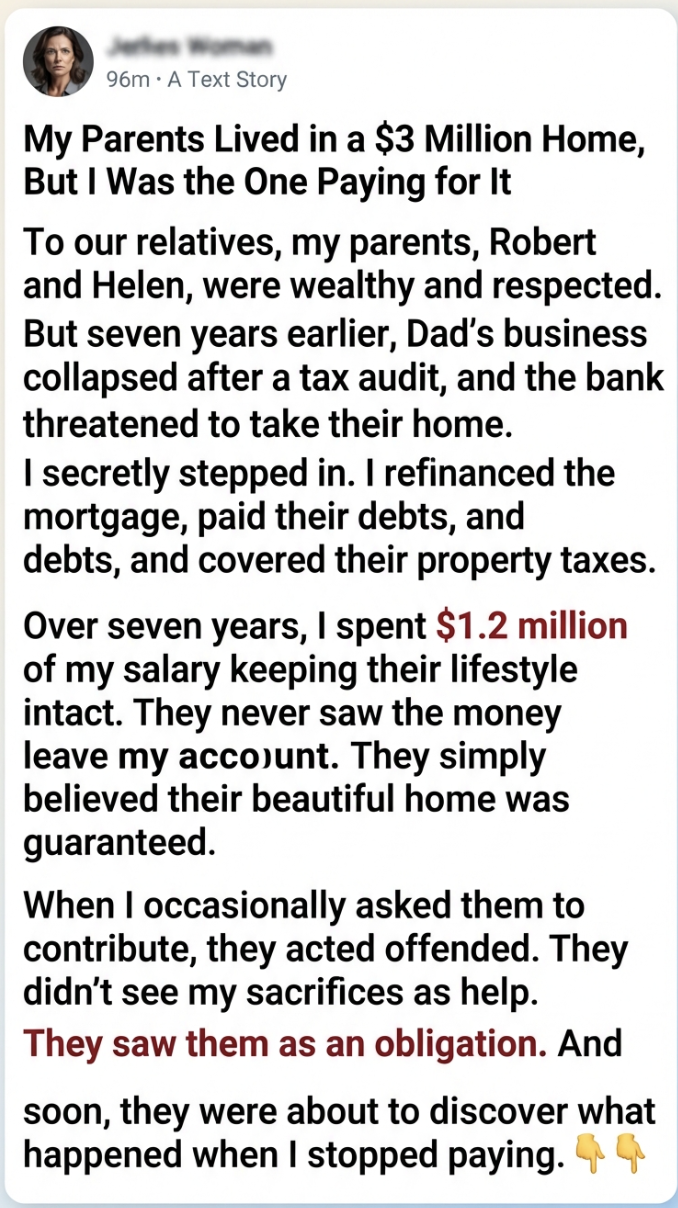
To our relatives, my parents, Robert and Helen, were wealthy.
They lived in a beautiful $3 million home on a quiet street lined with mature trees.
Their driveway held two expensive cars.
Their kitchen had marble countertops.
Their backyard was large enough for family gatherings, summer parties, and holiday dinners.
Whenever relatives visited, my father would proudly give them a tour.
“This is what hard work looks like,” he would say.
My mother would smile beside him.
Everyone believed they had built a comfortable life through determination and good business decisions.
Nobody knew the truth.
Not even most of our relatives.
Seven years earlier, my father’s business had collapsed after a tax audit uncovered serious financial problems.
The company had accumulated unpaid taxes, outstanding loans, and debts to several suppliers.
The bank threatened foreclosure.
Their home, which was worth approximately $3 million, was at risk.
I still remembered the day my father called me.
His voice was unusually quiet.
“Can you come over?”
I arrived that evening and found my parents sitting at the dining table.
There were unopened letters scattered across the surface.
My mother looked exhausted.
My father held a bank notice in his hand.
“We might lose the house,” he said.
I looked at the letter.
“How much do you owe?”
He hesitated.
“More than we can manage right now.”
“How much, Dad?”
He finally told me.
The number was enormous.
My parents had spent years living as if their income would never decline. They had taken loans against the business, expanded their lifestyle, and ignored warnings that their finances were becoming unstable.
Now the consequences had arrived.
My mother began crying.
“We raised you in this house,” she said. “We can’t lose it.”
I looked around the room.
The family photographs.
The furniture.
The memories.
I understood why the house mattered to them.
So I offered to help.
At first, I told myself it would be temporary.
I would refinance the mortgage, settle the most urgent debts, and help them get back on their feet.
My father promised me that his next business venture would succeed.
“We’ll pay you back,” he said.
I believed him.
I used my savings.
I refinanced the mortgage through a legal arrangement with professional advice.
I paid overdue property taxes.
I covered essential repairs.
I settled several debts that threatened the house.
Then I began transferring money every month.
At first, the payments were manageable.
Then they grew.
The property needed a new roof.
The insurance premiums increased.
The tax bill arrived.
My parents wanted to keep the cars, the landscaping service, and the expensive home maintenance.
Every time I suggested reducing expenses, my mother became defensive.
“This is our home,” she would say.
“I know, Mom.”
“We can’t start living like we’re poor.”
I wanted to ask whether protecting their image mattered more than protecting my future.
But I stayed quiet.
Over seven years, I spent approximately $1.8 million supporting the household, paying debts, covering taxes, and maintaining the lifestyle they refused to reconsider.
The money came from my salary, investments, and savings.
I delayed buying my own home.
I postponed starting a business.
I declined vacations.
I stopped making plans that required financial freedom.
Whenever I tried to discuss the arrangement, my parents reacted as though I had insulted them.
One evening, I sat with my father in the living room.
“Dad, we need a proper repayment plan.”
He looked up from his newspaper.
“A repayment plan?”
“Yes.”
“I thought we were family.”
“We are. That’s why I’ve helped.”
“Then why are you keeping track?”
I stared at him.
“Because it’s my money.”
His expression hardened.
“You make it sound like we’ve taken advantage of you.”
I didn’t answer.
He folded the newspaper.
“You have a good job. You’re doing fine.”
I almost laughed.
I was earning a decent salary.
But my bank account told a different story.
My parents saw the house.
They didn’t see my depleted savings.
They saw the landscaping.
They didn’t see the retirement contributions I had postponed.
They saw their lifestyle.
They didn’t see the opportunities I had sacrificed.
And the more I helped, the more they expected.
My mother began calling me about expenses before asking whether I could afford them.
“Your father’s car needs repairs.”
“Okay. How much?”
“The mechanic says it will be expensive.”
“Can he use a less expensive vehicle?”
“Why would you say that? Your father needs a reliable car.”
When the property taxes increased, she called again.
When the heating system needed replacement, she called again.
When my father wanted to renovate the guest bedroom, she called again.
Eventually, I realized something painful.
My parents no longer considered my help a sacrifice.
They considered it part of their household budget.
My income had become an invisible room in their house.
And they believed they owned it.
THE DAY I STOPPED PAYING
The decision came after a conversation I will never forget.
It was my mother’s birthday.
The entire family had gathered at the house.
My parents hosted a large dinner.
There was catered food, expensive wine for the adults, fresh flowers, and a professional photographer.
The event cost thousands of dollars.
I had paid for several of the arrangements.
After dinner, I found my father showing a relative the new entertainment system he had installed.
“It cost nearly $40,000,” he said proudly.
I stood in the doorway.
Forty thousand dollars.
I had recently postponed a medical appointment because I was trying to rebuild my emergency savings.
My father saw me.
“Come look at this, son.”
I walked over.
“Dad, when did you install this?”
“Last week.”
“How much did it cost?”
He waved his hand.
“Don’t worry about it.”
I stared at him.
“Who paid for it?”
He frowned.
“Why does that matter?”
I looked at my mother.
She suddenly became interested in arranging the flowers.
“Did you use the household account?” I asked.
My father shrugged.
“We had it handled.”
I knew what that meant.
They had used money I had transferred for household expenses.
Money intended for property taxes and essential repairs.
Money I had worked for.
Money I had already warned them not to spend on unnecessary renovations.
I waited until the guests left.
Then I sat across from my parents at the dining table.
“We need to change everything.”
My father sighed.
“Not this again.”
“No. This time, it’s final.”
My mother looked up.
“What are you talking about?”
“Starting next month, I will no longer pay for the house’s ordinary expenses.”
My father stared at me.
“You can’t be serious.”
“I am.”
“You know what will happen?”
“Yes.”
“Your mother and I could lose our home.”
I took a breath.
“I know. That’s why I’m giving you sixty days to create a realistic plan.”
My mother shook her head.
“After everything we’ve done for you?”
I looked at her.
“After everything I’ve done for you?”
She became silent.
My father stood.
“You’re our son. This is your responsibility.”
I felt the familiar pressure in my chest.
The guilt.
The fear.
The instinct to apologize and offer more money.
But this time, I didn’t surrender.
“No, Dad. Supporting you was my choice. It was never an unlimited obligation.”
He pointed toward the door.
“If you walk away, don’t expect us to forgive you.”
I nodded slowly.
“I hope one day you understand that I’m not walking away from you. I’m stepping away from paying for everything.”
My mother began crying.
I wanted to comfort her.
But I had comforted her for seven years while quietly falling behind in my own life.
This time, I left.
THE FIRST BILL
The first month was relatively quiet.
My parents assumed I would change my mind.
They had seen me give in before.
They believed the announcement was an emotional reaction.
Then the property tax notice arrived.
My mother called me.
“Did you forget to transfer the money?”
“No.”
“The payment is due next week.”
“You have the notice. You can contact the bank and discuss your options.”
“What options?”
“A payment plan, a budget adjustment, or selling an asset.”
She became angry.
“You’re telling us to sell our things?”
“I’m telling you to make a plan.”
“We shouldn’t have to do this.”
“I shouldn’t have had to pay for seven years without a plan either.”
She hung up.
The next week, my father called.
The insurance premium was due.
Then the landscaping company requested payment.
Then the repair contractor sent an overdue invoice.
One by one, the expenses that had always disappeared from their lives began appearing in front of them.
They had never learned the actual cost of maintaining their home.
They only knew that everything was handled.
Now they had to handle it themselves.
Within two months, my father sold one of his cars.
My mother canceled the private landscaping service.
They reduced their household staff.
They contacted the bank about restructuring the remaining mortgage.
It wasn’t easy.
But for the first time in years, they were making decisions based on their actual finances.
Not their image.
Not their relatives’ expectations.
Not the assumption that I would cover the difference.
THE FAMILY MEETING
Three months after I stopped paying, my parents invited everyone to a family meeting.
I almost didn’t attend.
My sister convinced me.
“Just go,” she said. “They want to talk.”
When I arrived, my parents were sitting in the living room.
Several relatives were present.
My aunt.
My uncle.
My sister.
And two cousins who had always praised my parents’ lifestyle.
My father stood.
“We have a family problem.”
I sat down.
He looked directly at me.
“Your brother has abandoned the house.”
One of my cousins gasped.
My mother wiped her eyes.
“He knows we can’t manage everything without him.”
I looked at the relatives around the room.
Nobody knew the complete story.
They had seen the beautiful home.
They had seen the dinners.
They had seen my parents’ expensive lifestyle.
They had never seen the payments leaving my accounts.
My father continued.
“He has the financial ability to help us, but he refuses.”
I reached into my bag and placed a folder on the coffee table.
My father frowned.
“What is that?”
“Seven years of financial records.”
The room became quiet.
I opened the folder.
Inside were bank transfers, invoices, tax payments, mortgage statements, repair bills, and records of debt settlements.
I had organized everything with the help of my accountant.
I didn’t raise my voice.
I didn’t insult anyone.
I simply placed the facts in front of them.
“I paid approximately $1.8 million over seven years.”
My aunt looked at the papers.
“Almost two million?”
I nodded.
My father shook his head.
“You’re exaggerating.”
I handed him a summary.
“These are the documented payments.”
He looked at the first page.
Then the second.
His expression changed.
My mother picked up a statement.
“I didn’t know it was this much.”
I looked at her.
“I tried to tell you.”
My cousin leaned forward.
“Why didn’t you say anything?”
I answered honestly.
“Because every time I tried, I was told it was my responsibility.”
Nobody spoke.
Then my sister asked the question that hurt the most.
“Why did you keep paying?”
I looked down at my hands.
“Because I thought helping my parents meant sacrificing whatever I had.”
I paused.
“Eventually, I realized that if I kept going, I wouldn’t have a life of my own.”
My father put the documents down.
“You’re making us look terrible.”
I looked at him.
“No. The records are showing what happened.”
My uncle cleared his throat.
“Robert, did you know he paid all of this?”
My father didn’t answer immediately.
Finally, he said,
“I knew he helped.”
My mother whispered,
“We didn’t know how much.”
I looked around the room.
“That’s the problem. Nobody asked.”
THE DECISION ABOUT THE HOUSE
The financial adviser my parents hired gave them several options.
They could sell the house and use the equity to settle remaining obligations.
They could refinance under stricter terms.
Or they could downsize to a more affordable property.
None of the choices were comfortable.
My mother initially refused to consider selling.
“This house is our identity,” she said.
But the numbers didn’t change because they disliked them.
The house was valuable.
Maintaining it was expensive.
And the fact that it represented their social status did not create income.
After several weeks of discussion, my parents chose to sell.
They purchased a smaller home.
They settled their outstanding obligations.
They retained enough money to live comfortably within a realistic budget.
It wasn’t the life they had once displayed.
But it was a life they could actually afford.
The day they moved out, I visited the old house.
The rooms were nearly empty.
The marble kitchen counters were still there.
The polished floors still reflected the afternoon light.
But the house no longer felt like a symbol of success.
It felt like a lesson.
My father stood beside me in the hallway.
“I thought you would always take care of us.”
I looked at him.
“I wanted to help you. I never promised to finance everything forever.”
He nodded.
“I know that now.”
My mother approached us.
She held an old family photograph.
“I was angry with you,” she said.
“I know.”
“I thought you were punishing us.”
“I wasn’t.”
“What were you doing?”
I looked at her.
“Trying to make sure I didn’t lose my entire future while protecting yours.”
She started crying.
This time, I hugged her.
Not because I felt obligated.
Because I wanted to.
There was a difference.
ONE YEAR LATER
A year after I stopped paying, my life looked completely different.
I had rebuilt my emergency savings.
I purchased a modest home of my own.
I restarted my retirement contributions.
I took a vacation without worrying about an unexpected call asking me to cover someone else’s expenses.
I also began working with a financial counselor to understand how my fear of disappointing my parents had influenced my decisions.
My relationship with them wasn’t perfect.
It couldn’t be repaired in a single conversation.
But it became more honest.
My father began discussing financial decisions openly.
My mother stopped treating every request for help as an emergency.
And when I offered assistance, it came with clear limits.
One evening, my father invited me to dinner at their new home.
The house was smaller.
The furniture was simpler.
There were no extravagant decorations.
But the atmosphere felt peaceful.
After dinner, he placed a small envelope on the table.
I opened it.
Inside was a repayment schedule.
I looked at him.
“What is this?”
“We can’t repay everything immediately,” he said. “But we can start.”
I stared at the document.
“You don’t have to do this.”
“Yes, we do.”
My mother sat beside him.
“We should have understood your sacrifices years ago.”
I folded the paper.
“Thank you.”
My father looked at me.
“Are we still your parents?”
I smiled.
“Of course.”
“Even after everything?”
“I’m your son. But I’m also a person with my own life.”
He nodded.
“I know.”
And this time, I believed him.
THE LESSON I NEVER EXPECTED TO LEARN
For seven years, my parents lived in a $3 million home.
Our relatives believed they were financially secure.
They believed my father had recovered from his business failure.
They believed my mother and father were living the life they had earned.
But behind the beautiful walls, someone else had been paying the bills.
Me.
I had spent approximately $1.8 million trying to protect my parents from the consequences of their decisions.
I thought that was what love required.
Now I understand that love and financial responsibility are not the same thing.
You can care about your parents without sacrificing your entire future.
You can offer help without becoming someone’s permanent source of money.
You can set boundaries without abandoning the people you love.
And you can say no without being cruel.
My parents didn’t lose their family when I stopped paying.
They lost the illusion that their lifestyle would continue without difficult decisions.
And I finally gained the courage to build a life that belonged to me.
Because the most painful part of being treated like an obligation isn’t the money you give away—it’s realizing how easily the people you love can forget that you are sacrificing something, too.