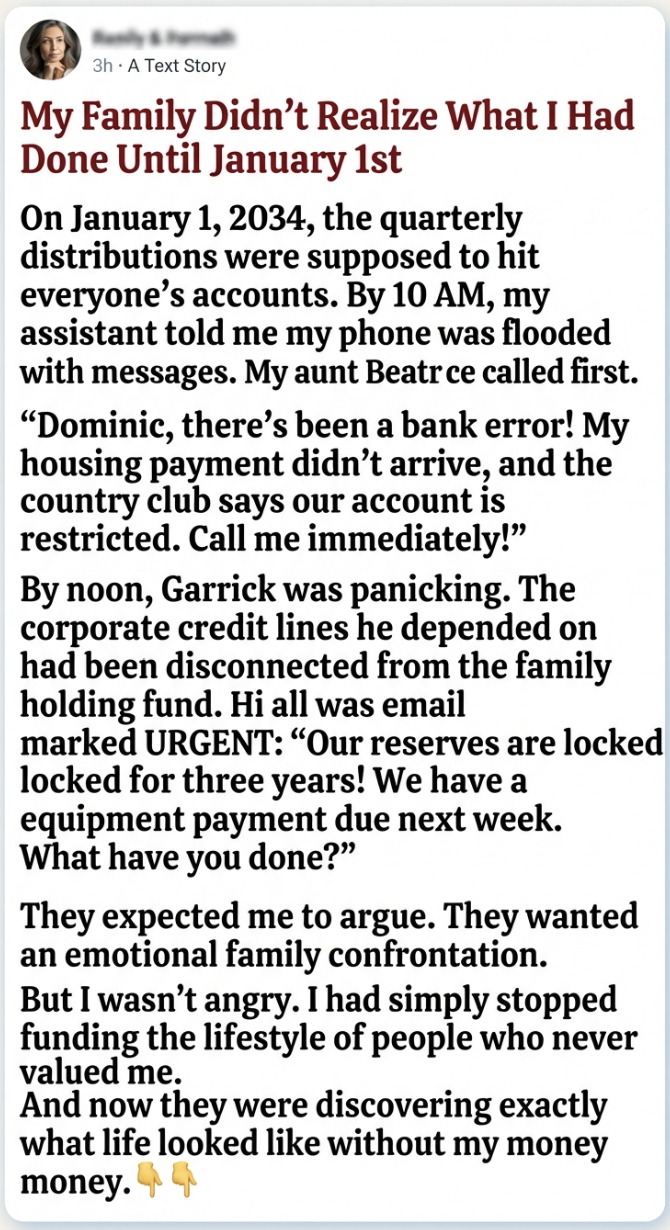
On January 1, 2034, my family’s quarterly distributions were supposed to arrive as usual.
For years, nobody questioned them.
The money appeared in their accounts.
Bills were paid.
Credit cards worked.
Mortgages cleared.
Country club memberships renewed.
Business expenses were covered.
And every time someone asked where the money came from, the answer was always the same.
“Family investments.”
What nobody asked was:
Who controlled those investments?
My name is Dominic.
And for almost eleven years, I had quietly managed the family holding structure.
I wasn’t the loudest person in the family.
I wasn’t the most celebrated.
I wasn’t even invited to every family event.
But I was the person who made sure the money kept moving.
When my aunt Beatrice needed help with her mortgage, I arranged it.
When my cousin’s business needed a temporary credit line, I approved it.
When Garrick wanted to expand his company, I helped structure the financing.
When someone had a tax problem, I found professionals to handle it.
When someone overspent, I quietly covered the difference.
Nobody called it my money.
They called it the family fund.
And because they believed it would always be there, they stopped appreciating what it cost to maintain.
Then I made a decision.
Not out of anger.
Not out of revenge.
And not because I wanted anyone to suffer.
I simply decided that the arrangement had to end.
I spent months restructuring the family finances.
Existing obligations were honored.
Legitimate business commitments were protected.
Trust accounts remained intact.
But the automatic lifestyle distributions were suspended.
The remaining funds were placed under new restrictions.
Some reserves were locked for three years.
And future distributions would require documented financial planning rather than automatic transfers.
I didn’t announce it.
I didn’t send a family email.
I didn’t threaten anyone.
I simply let the new system begin on January 1.
At 10:03 a.m., my assistant walked into my office.
“Dominic?”
I looked up.
“Yes?”
“Your phone has been going crazy.”
I glanced at it.
Twenty-three missed calls.
Thirty-seven messages.
My assistant frowned.
“Is everything okay?”
I smiled.
“Probably not.”
The first call came from Aunt Beatrice.
I answered.
“Hello?”
“Dominic!”
Her voice was shaking.
“There has been a bank error!”
“What happened?”
“My housing payment didn’t arrive.”
I said nothing.
“And the country club says my account is restricted!”
Still nothing.
“Dominic, call the bank!”
“I don’t think it’s a bank error.”
There was silence.
“What?”
“I think it’s exactly what the new agreement says.”
“What new agreement?”
“The one everyone received last month.”
“I didn’t read that!”
“I know.”
She took a breath.
“You can’t do this!”
“I didn’t cancel anything that wasn’t already subject to the new terms.”
“My mortgage is due!”
“Your mortgage is your responsibility.”
She became quiet.
Then she said something I had heard many times before.
“But we’re family.”
I closed my eyes.
“I know.”
“Then help me.”
“I’ve been helping you for eleven years.”
“You’re supposed to!”
That sentence told me everything.
Not thank you.
Not I’m sorry.
Not even I didn’t realize.
Just:
You’re supposed to.
I calmly replied,
“No, Beatrice. I was helping you because I chose to.”
She hung up.
At 11:17 a.m., another message arrived.
This time, from Garrick.
His subject line was:
URGENT — WHAT HAVE YOU DONE?
I opened it.
Dominic,
Our corporate credit lines have been disconnected from the family holding fund.
Our reserves are locked for three years.
We have an $800,000 equipment payment due next week.
Call me immediately.
I didn’t call.
Instead, I forwarded him the financial plan his own advisers had received six weeks earlier.
At the bottom was one sentence:
“The family holding fund will no longer function as an unrestricted lifestyle financing mechanism.”
Five minutes later, my phone rang.
Garrick.
I answered.
“What did you do?”
“I implemented the restructuring.”
“You froze our money!”
“No. I restricted funds according to the new structure.”
“You know we need that money!”
“I know.”
“Then release it!”
“No.”
He went silent.
Then his voice became angry.
“You can’t just decide this!”
“I can.”
“Who gave you the authority?”
I looked at the legal documents on my desk.
“The same family trust documents that gave me authority to manage the fund in the first place.”
He didn’t answer.
I continued.
“You’ve had access to the reports for years.”
“I didn’t think you’d actually do it.”
“That was the problem.”
“What problem?”
“You thought the system existed for you.”
He slammed the phone down.
By lunchtime, the family group chat had exploded.
BEATRICE:
Has anyone else had problems with their accounts?
GARRICK:
Dominic changed everything.
COUSIN:
What does that mean?
BEATRICE:
He cut the distributions.
GARRICK:
Not just distributions. Credit lines too.
Then someone asked the question nobody had thought to ask before.
“Wait. Was Dominic controlling all of this?”
The chat went silent.
I didn’t respond.
For years, they had assumed the money simply appeared.
Now they were discovering that money doesn’t simply appear.
Someone has to earn it.
Manage it.
Protect it.
Invest it.
And sometimes say no.
At 2:40 p.m., my mother called.
Her voice was different.
She wasn’t angry.
She sounded worried.
“Dominic?”
“Yes, Mom.”
“Did you really stop everyone’s payments?”
“I changed the system.”
“Why?”
I paused.
“Because nobody had asked how it was affecting me.”
“What do you mean?”
I leaned back.
“For eleven years, I’ve managed everything.”
“I know.”
“No, Mom. You knew I handled paperwork. You didn’t know what it meant.”
She was silent.
“I worked weekends.”
I continued.
“I dealt with banks, accountants, lawyers, tax advisers, investment managers, property managers, insurance companies, and business owners.”
“I didn’t realize.”
“That’s the point.”
She sighed.
“Why didn’t you tell us you were exhausted?”
I smiled sadly.
“Because every time I said I was busy, someone asked me to solve another problem.”
She didn’t respond.
Then she asked:
“Are you angry?”
“No.”
“Then why are you doing this?”
“Because I finally realized something.”
“What?”
“I was financing a lifestyle that made everyone dependent on me while making me invisible.”
She was quiet for a long time.
Finally, she said,
“What happens now?”
“Everyone lives within their own means.”
“And if they can’t?”
“They make changes.”
My mother sighed.
“You really won’t help them?”
“I will help someone who genuinely needs help.”
I paused.
“But I won’t fund someone else’s luxury because they refuse to change.”
That afternoon, the family held an emergency meeting without inviting me.
Apparently, they expected me to eventually panic and restore everything.
They were wrong.
Garrick reportedly spent two hours calling bankers.
Beatrice contacted her financial adviser.
My cousin started selling investments.
Another relative discovered that their monthly spending exceeded their actual income by more than $20,000.
For the first time in years, everyone had to look at their own numbers.
And the numbers were brutal.
They had mistaken financial support for financial independence.
They weren’t wealthy.
They were dependent.
That realization hurt.
Three weeks later, Garrick came to my office.
He didn’t bring lawyers.
He didn’t bring an accountant.
He didn’t bring a list of demands.
He simply sat across from me.
“I owe you an apology.”
I waited.
“I thought you were just managing paperwork.”
“I know.”
“I didn’t understand what you actually did.”
“I know.”
He looked down.
“I also didn’t realize how much we depended on you.”
I smiled.
“Neither did I.”
He laughed quietly.
Then he said,
“You know what’s embarrassing?”
“What?”
“I’ve spent ten years telling people I built my company.”
I waited.
He looked at me.
“A lot of it was built with your support.”
“That doesn’t make your work meaningless.”
“But it means I never learned how to stand without you.”
That was the first honest thing he’d ever said to me about money.
I leaned forward.
“You still have a business.”
“Yes.”
“You still have customers.”
“Yes.”
“You still have employees.”
“Yes.”
“Then build it without me.”
He nodded.
“What if I fail?”
“Then you’ll learn what I learned.”
“What?”
“How to build something that belongs to you.”
He smiled.
“That’s what you wanted all along?”
“Yes.”
“Why didn’t you tell us?”
I looked at him.
“Because I spent too long hoping you’d notice.”
He lowered his eyes.
“I should have.”
“Yes.”
That was all I said.
Months passed.
The family changed.
Not overnight.
Not perfectly.
But gradually.
Beatrice sold her country club membership and moved into a smaller home.
Garrick renegotiated his equipment financing and rebuilt his company’s cash reserves.
My cousin finally created a real budget.
My mother stopped asking me to solve everyone’s financial problems.
And I stopped apologizing for saying no.
One year later, we had another family dinner.
The atmosphere was different.
There were no luxury gifts.
No bragging.
No conversations about who had the biggest house.
Garrick raised his glass.
“To Dominic.”
Everyone looked at me.
He continued.
“The person we treated like a bank account for years.”
I laughed.
He smiled.
“And the person who finally taught us that family support should help someone become independent—not keep them dependent forever.”
My aunt Beatrice nodded.
“I hated you on January 1st.”
Everyone laughed.
She looked at me.
“Now I’m grateful.”
I raised my glass.
“To learning.”
That night, I went home feeling lighter than I had in years.
I hadn’t destroyed my family.
I hadn’t abandoned them.
I had simply stopped carrying responsibilities that belonged to other adults.
And that was the lesson I had needed to learn myself.
Sometimes people don’t realize how much you do for them until you stop doing it.
But setting a boundary isn’t cruelty.
Sometimes it’s the only way people discover their own strength.
On January 1, 2034, my family thought they had lost their money.
What they actually lost was their dependence on me.
And what I finally gained was something I hadn’t had in eleven years:
my own life.