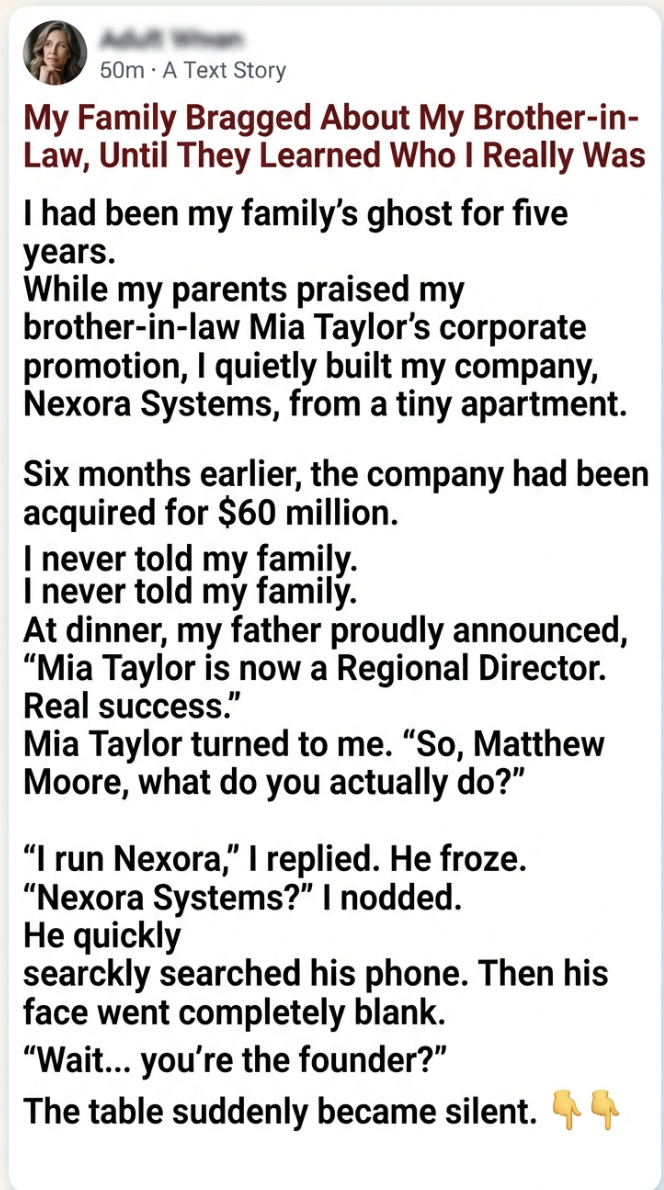
For five years, I had been my family’s ghost.
Not because I disappeared.
Because they stopped asking questions.
My name is Matthew Moore.
And while my family spent years celebrating my brother-in-law Mia Taylor’s corporate career, I was quietly building something they never knew existed.
A company called Nexora Systems.
I started it from a tiny apartment with an old laptop, a folding desk, and barely enough money to cover my rent.
There was no fancy office.
No investors waiting outside my door.
No family money.
Just long nights, failed prototypes, unpaid invoices, and a belief that the software I was building could solve a problem businesses had struggled with for years.
For the first two years, almost nobody knew what I was doing.
Including my family.
Whenever they asked, I simply said,
“I’m working on a software company.”
They never seemed interested.
My father would nod politely.
My mother would change the subject.
My sister would tell me about Mia’s latest promotion.
And Mia…
Mia loved talking about Mia.
Six months before that family dinner, Nexora Systems had been acquired.
The final valuation was $95 million.
My name appeared in the acquisition documents as founder and controlling shareholder.
I had signed the final papers in a conference room overlooking the city.
When the deal closed, I sat alone in my car afterward.
I didn’t celebrate.
I didn’t call my parents.
I didn’t post anything online.
I simply stared through the windshield and thought about the tiny apartment where Nexora had started.
Then I drove home.
I never told my family.
Not because I wanted revenge.
Because I had learned something over the years.
Whenever I succeeded at something small, they compared it to Mia.
So I stopped explaining myself.
I let them believe whatever they wanted.
Then came Sunday dinner.
My parents hosted everyone at their house.
The dining room was crowded.
My sister sat beside Mia.
My father stood at the head of the table holding a glass of wine.
He looked proud.
“Everyone,” he announced, “I have some wonderful news.”
Mia smiled.
My father continued.
“Mia has been promoted to Regional Director.”
Everyone applauded.
My mother hugged him.
My sister kissed his cheek.
“That is incredible!” she said.
Mia smiled modestly.
“Well, it took a lot of work.”
My father laughed.
“That’s what real success looks like.”
I continued eating.
Then my father looked toward me.
“And Matthew?”
I looked up.
He smiled.
“Maybe you can learn something from Mia.”
The table laughed.
I didn’t.
Mia leaned back in his chair.
“So, Matthew,” he said, “what do you actually do these days?”
The way he said actually made everyone smile.
I put my fork down.
“I run Nexora.”
Mia frowned.
“Nexora?”
“Nexora Systems.”
His expression changed.
I nodded.
He reached for his phone.
He typed the name.
Then he stopped.
His fingers froze.
He searched again.
His face slowly lost its color.
He looked at me.
Then at his screen.
Then back at me.
“Wait…”
Nobody spoke.
Mia swallowed.
“You’re talking about Nexora Systems?”
“Yes.”
“The enterprise software company?”
“Yes.”
He stared at me.
My father laughed.
“Why are you looking at him like that?”
Mia didn’t answer.
He turned his phone around.
The screen showed an article announcing the acquisition.
NEXORA SYSTEMS ACQUIRED IN $95 MILLION DEAL
Below the headline was a photograph.
Mine.
Mia looked at me again.
“You’re the founder?”
I nodded.
The table went completely silent.
My mother leaned closer.
“Matthew?”
“Yes.”
My sister picked up her phone.
She searched.
Then her eyes widened.
“That’s you.”
My father took her phone.
He read the article.
His expression changed several times.
Confusion.
Disbelief.
Then something I couldn’t identify.
He looked at me.
“You sold the company?”
“Six months ago.”
“For ninety-five million?”
“The transaction was valued at ninety-five million.”
Mia stared at me.
“But…”
He stopped.
I waited.
“But you said you were working on a small software company.”
“It was small when I started.”
My father slowly sat down.
“Why didn’t you tell us?”
I looked around the table.
“Would you have listened?”
Nobody answered.
I continued.
“For five years, every time I talked about Nexora, someone changed the subject.”
My mother looked uncomfortable.
“We didn’t understand what you were doing.”
“I know.”
“We thought you were struggling.”
“I was.”
She looked surprised.
“So you really did build it yourself?”
“Yes.”
Mia suddenly laughed.
It wasn’t a happy laugh.
It was nervous.
“So you mean all those times I joked about your little apartment…”
I looked at him.
“Yes.”
“And when I said you should get a real job…”
“Yes.”
He lowered his eyes.
My father stared at me.
“Why didn’t you tell me when the acquisition happened?”
I answered honestly.
“Because I didn’t know whether you wanted to know about me or just wanted another reason to compare me to Mia.”
That sentence hit harder than anything else I could have said.
Nobody moved.
Then my father quietly asked,
“Are you angry with us?”
I thought about it.
“I used to be.”
“And now?”
“Now I’m mostly tired.”
My mother reached across the table.
“I wish you had told us.”
“I wish you had asked.”
Silence.
Then Mia suddenly said,
“Congratulations.”
Everyone looked at him.
He stood.
“I mean it.”
I nodded.
“Thank you.”
He hesitated.
Then he added,
“I was wrong about you.”
I looked at him.
“You were.”
He gave a small smile.
“You really built all of that from nothing?”
“Not nothing.”
He raised an eyebrow.
I smiled.
“I had a laptop.”
A few people laughed.
Even my father smiled.
But I wasn’t finished.
“There was something else I never told anyone.”
My sister looked at me.
“What?”
“The acquisition wasn’t the first time Nexora was valued.”
My father frowned.
“What do you mean?”
“Two years before the acquisition, investors offered us $22 million.”
Mia stared.
“And you refused?”
“Yes.”
“Why?”
“Because I believed the company could become more valuable.”
My father shook his head slowly.
“You were carrying all of this while we thought you were unemployed.”
I shrugged.
“I wasn’t unemployed.”
“What were you?”
I looked around the table.
“Busy.”
That word changed something.
Because suddenly, everyone understood.
While they had been talking about me, I had been working.
While they were comparing salaries, I was building products.
While they celebrated promotions, I was signing contracts.
While they assumed I was failing, I was quietly becoming someone they would eventually read about in the news.
But the biggest surprise came later that night.
My father knocked on my apartment door.
I opened it.
He stood there alone.
“I want to apologize.”
I stepped aside.
He came in.
He looked around the apartment.
There was no luxury furniture.
No expensive decorations.
Just books, a desk, and several framed Nexora patents hanging on the wall.
He stared at them.
“This is where you built it?”
“Yes.”
He looked around again.
“All of it?”
“Most of it.”
He sat down.
Then he said something I never expected.
“I was proud of Mia because his success was visible.”
I listened.
“But I didn’t understand yours because it happened quietly.”
I nodded.
“That was partly my choice.”
“Why?”
“Because I wanted to know whether I could build something without needing anyone’s approval.”
My father looked down.
“And did you?”
I smiled.
“Yes.”
He nodded slowly.
Then he stood.
“I’m proud of you.”
Those four words were worth more than he probably realized.
Not because I needed his approval.
But because for the first time, he wasn’t comparing me to anyone.
He was simply seeing me.
Months later, my family still talked about Mia’s promotion.
But something had changed.
They stopped using his career as a weapon against mine.
My mother started asking about my new projects.
My sister asked me for advice about launching her own business.
And Mia?
He remained a Regional Director.
He also became one of the first people in my family to stop introducing me as “the quiet one.”
At a holiday gathering, someone asked him,
“So what does Matthew do?”
Mia smiled.
“You don’t know?”
The person shook his head.
Mia pointed toward me.
“He built Nexora.”
Then he added,
“And he sold it.”
Everyone laughed.
I did too.
Because the irony wasn’t lost on me.
For years, my family had thought success was something that needed to be announced.
A title.
A promotion.
A corner office.
A bigger salary.
A business card.
But I learned something different.
Real success doesn’t always arrive with applause.
Sometimes it looks like a person sitting alone in a tiny apartment at two in the morning, working on something nobody believes in.
Sometimes it takes years before anyone notices.
And sometimes the people who once underestimated you don’t finally see your worth until the world puts a number beside your name.
But by then, the number doesn’t matter anymore.
Because you already know who you are.
That night, my father raised his glass.
“To Matthew.”
I smiled.
He continued:
“To the son we didn’t understand soon enough.”
I lifted my glass.
And for the first time in five years, I didn’t feel like my family’s ghost.
I felt seen.
Because sometimes the most powerful response to being underestimated isn’t proving everyone wrong—it’s quietly becoming someone they can no longer overlook.