Two hours before the speeches began, my brother Christopher Miller had already made it clear how he felt about me.
It happened at Table 14.
The wedding was supposed to be a celebration of family.
Instead, Christopher turned it into a public reminder of everything he believed I had failed to become.
He leaned back in his chair, lifted his champagne glass, and smiled.
“You know what the problem is with some people?” he said loudly enough for everyone around the table to hear.
I looked at him.
“What?”
“They confuse being included with being important.”
A few relatives laughed awkwardly.
I didn’t.
Christopher had always been like this.
He was the golden son.
The one Dad trusted.
The one everyone expected to take over Vance Logistics, the family business our grandfather had started decades earlier.
I was the inconvenient sibling.
The one who had stepped away from the company after discovering accounting irregularities.
The one who refused to sign documents I believed were misleading.
The one Christopher called “disloyal.”
He leaned closer.
“You walked away from the family business,” he whispered.
“I walked away because I wouldn’t sign something I knew was wrong.”
His smile disappeared.
“You always think you’re smarter than everyone else.”
“No,” I said quietly. “I just don’t want to lie.”
His jaw tightened.
Then he stood.
“Enjoy the wedding.”
He walked away.
I thought that was the end of it.
I was wrong.
Two hours later, the speeches began.
The outdoor wedding tent glowed beneath hundreds of tiny fairy lights.
Guests laughed.
Servers moved between tables.
Music played softly in the background.
Then my father stepped onto the small stage.
He raised his glass.
“To family,” he said.
Everyone applauded.
He talked about our grandfather.
About sacrifice.
About building something that could survive generations.
About how the Miller family had always protected its name.
Then Dad turned toward Christopher.
“And now,” he announced, “I’d like my son Christopher to say a few words.”
The crowd applauded again.
Christopher stood.
He adjusted his jacket.
He smiled like a man who had just been handed a throne.
He took the microphone.
“Family,” he began.
The room became quiet.
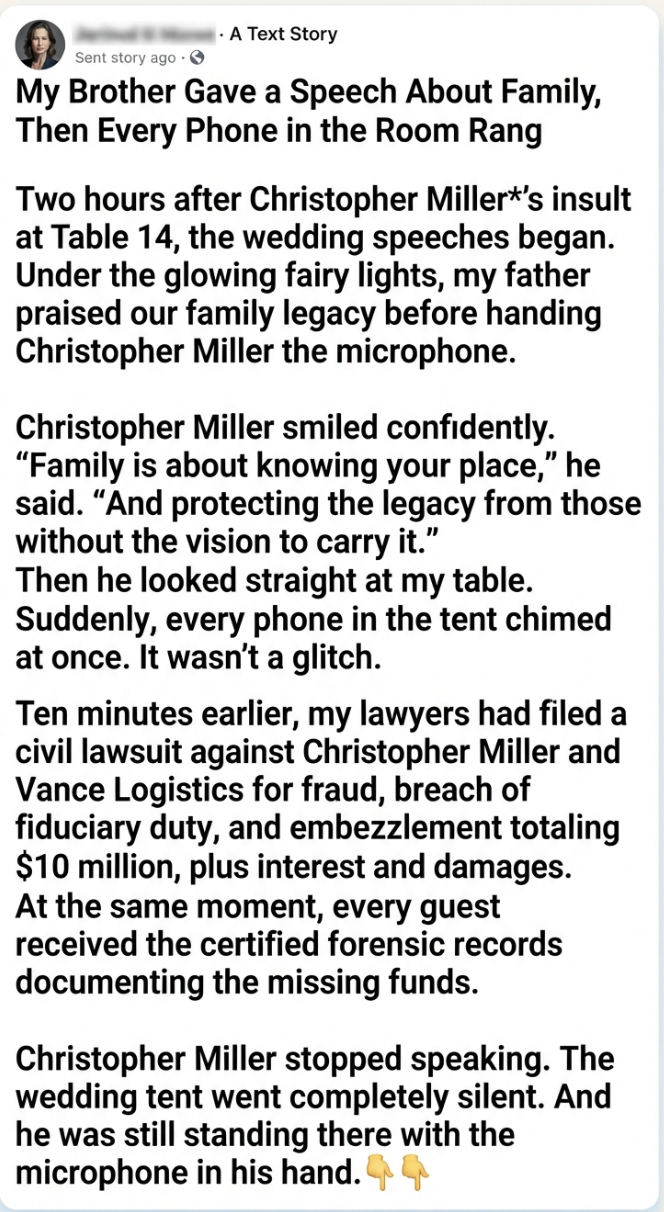
“Family is about knowing your place.”
Several people nodded.
Christopher continued.
“It means understanding who built the foundation and who has the vision to carry it forward.”
Then he looked directly at me.
“And sometimes, protecting a family’s legacy means making difficult decisions about who belongs in the future.”
My stomach tightened.
He was doing it again.
In front of everyone.
Christopher smiled.
“Not everyone has the discipline, loyalty, or vision required to carry a family legacy.”
Then he raised his glass.
“To those who know their place.”
Polite laughter scattered through the tent.
I didn’t move.
I didn’t need to.
Because ten minutes earlier, something had happened that Christopher knew nothing about.
My lawyers had filed a civil lawsuit against Christopher Miller and Vance Logistics.
The complaint alleged fraud, breach of fiduciary duty, and embezzlement involving approximately $10 million, along with claims for interest and damages.
But the lawsuit itself wasn’t the biggest surprise.
It was what came with it.
Certified forensic records.
Bank transfers.
Vendor invoices.
Internal accounting reports.
Payment approvals.
Emails.
And transaction records showing money moving through a network of companies that appeared to have no legitimate business purpose.
The records had been prepared by an independent forensic accounting team.
And at 8:47 p.m., the legal filing became public.
At 8:50 p.m., my attorneys sent a legally permitted notification package to the relevant parties.
At 8:52 p.m., several guests received copies of the filing and supporting records.
At 8:53 p.m., Christopher was still standing on the stage.
Then—
DING.
A phone chimed.
Christopher stopped.
Another phone.
DING.
Then another.
DING.
Within seconds, phones were lighting up across the entire tent.
Guests looked down.
One after another, screens illuminated.
Some people frowned.
Others whispered.
Someone near the front said,
“What is this?”
Christopher’s smile disappeared.
He looked toward my father.
Then toward the guests.
Then toward me.
My phone remained untouched on the table.
I didn’t need to look.
I already knew.
A guest opened the document.
“Christopher…”
He didn’t answer.
The guest continued reading.
“Is this about Vance Logistics?”
Another person stood.
“Why does this say ten million dollars?”
The room erupted into whispers.
Christopher lowered the microphone.
“What is this?”
Nobody answered.
My father looked at his phone.
His face changed.
I had never seen him look that way before.
He scrolled slowly.
Then stopped.
“Christopher.”
My brother turned toward him.
“Dad?”
“What did you do?”
Christopher’s face went pale.
“I didn’t do anything.”
My father’s voice became quieter.
“Then explain these transfers.”
Christopher looked around.
“Those are business expenses.”
A guest near the front shook his head.
“These aren’t business expenses.”
Christopher stared at him.
“How would you know?”
“Because my company was listed as one of the vendors.”
Silence.
The man held up his phone.
“We never received these payments.”
Christopher froze.
Another guest opened another document.
“This company doesn’t even have employees.”
Someone else said,
“Wait. This company is registered to an address in Delaware.”
Another voice:
“And this one has the same mailing address.”
The tent became increasingly chaotic.
Christopher turned toward me.
“You did this.”
I finally stood.
“No.”
“You planned this!”
“No.”
“You wanted to ruin my wedding speech!”
I looked at him.
“This isn’t about your speech.”
“Then why now?”
“Because the investigation was finished.”
He stared at me.
“You’ve been investigating me?”
“For months.”
My father turned toward me.
“Why didn’t you tell us?”
I looked at him.
“I tried.”
He didn’t answer.
I continued.
“I told you there were irregularities.”
“You accused your own brother.”
“No. I asked questions.”
Christopher stepped forward.
“You were always jealous.”
I shook my head.
“You keep thinking this is about you being successful.”
He stopped.
“It isn’t.”
I looked around the tent.
“This is about money that belonged to other people.”
The silence was absolute.
Then one of the attorneys who had attended the wedding stepped forward.
He had been sitting quietly near the back.
He spoke calmly.
“For clarity, the filing was submitted earlier this evening. The supporting records were provided to the appropriate parties through formal legal channels. The evidence will be addressed through the court process.”
Christopher stared at him.
“You’re her lawyer?”
“Yes.”
Christopher’s voice dropped.
“You knew?”
“Yes.”
“Everyone knew?”
“No.”
The lawyer looked at him.
“Not everyone.”
Christopher turned toward my father.
“Dad…”
My father didn’t respond.
Christopher’s confidence was gone.
The microphone was still in his hand.
The same microphone he had used to lecture everyone about family.
About legacy.
About knowing your place.
Now his hand was shaking.
Then something unexpected happened.
My mother stood.
She looked at Christopher.
“You told me she abandoned the company because she wasn’t capable.”
Christopher said nothing.
“You told me she was trying to damage your reputation.”
Still nothing.
“You told me she didn’t understand the business.”
Christopher lowered his eyes.
My mother looked at me.
“I should have listened.”
I didn’t know what to say.
Then my father removed his glasses.
He looked exhausted.
“Christopher,” he said quietly.
My brother finally looked up.
“Tell me one thing.”
“What?”
“Is any of it true?”
Christopher’s lips moved.
No words came out.
My father closed his eyes.
That was the answer.
The wedding continued, but not as planned.
Guests slowly left.
The music stopped.
The flowers remained.
The cake remained untouched.
And the fairy lights continued glowing above a celebration that had collapsed beneath the weight of the truth.
I walked outside.
The night air was cool.
A few minutes later, my father joined me.
He stood beside me without speaking.
Finally, he said,
“I thought family meant protecting each other.”
I looked at him.
“It does.”
“Then why did this happen?”
“Because protecting someone from consequences isn’t the same as protecting them.”
He looked toward the tent.
“I don’t know what happens now.”
“The court decides.”
“And the company?”
“That depends on what happens next.”
He nodded.
Then he asked the question I had been waiting for.
“Why didn’t you expose him publicly months ago?”
I looked back at the glowing tent.
“Because I wasn’t trying to destroy Christopher.”
I paused.
“I was trying to stop what he was doing.”
My father looked down.
For years, I had thought proving the truth would feel satisfying.
It didn’t.
It felt sad.
Because the person standing at the center of the scandal wasn’t a stranger.
He was my brother.
The next morning, the headlines began circulating through the business community.
Vance Logistics announced that Christopher would step away from his executive responsibilities while the allegations were reviewed.
An independent investigation was launched.
The company appointed outside counsel.
Accounts were examined.
Contracts were reviewed.
And the legal process began.
Months later, the investigation uncovered additional discrepancies.
Not everything Christopher had been accused of was ultimately proven, and some allegations remained contested.
But enough evidence existed to force major changes in the company.
Several unauthorized transactions were recovered.
Corporate controls were rebuilt.
Independent oversight was introduced.
And for the first time in years, nobody in our family could simply dismiss uncomfortable questions as “disloyalty.”
As for me, I never returned to Vance Logistics.
I built something of my own.
Smaller.
Quieter.
But honest.
One evening, almost a year after the wedding, I received a letter from my father.
There were only a few sentences.
“I used to think protecting the family meant protecting our name.
Now I understand that protecting a family sometimes means refusing to protect a lie.
I am sorry I didn’t understand the difference sooner.”
I kept that letter.
Not because it erased what happened.
It didn’t.
But because sometimes people finally understand the truth only after they have exhausted every excuse.
And Christopher’s wedding speech stayed with me for another reason.
He had said:
“Family is about knowing your place.”
He was right about one thing.
Everyone eventually finds their place.
But not because someone else assigns it to them.
You find it by the choices you make when nobody is watching.
Christopher had stood beneath the fairy lights believing he was defending our family’s legacy.
Ten minutes later, every phone in the room told a different story.
And the greatest lesson wasn’t that a secret had been exposed.
It was this:
A family’s legacy isn’t protected by silence, money, or a powerful name. It’s protected by what people are willing to do when the truth becomes inconvenient.
And that night, for the first time, everyone finally knew the truth.