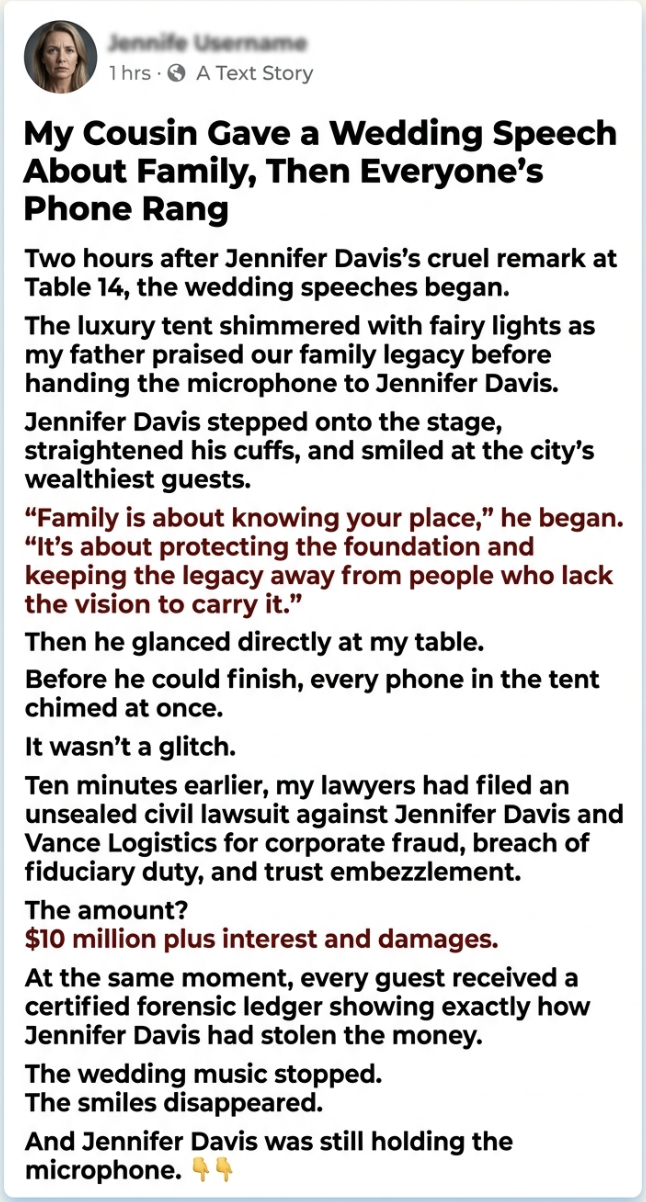
Two hours after Jennifer Davis made his cruel remark at Table 14, the wedding speeches began.
The luxury tent shimmered with fairy lights. Crystal glasses sparkled beneath the chandeliers, and the city’s wealthiest guests sat beneath white silk drapes while a string quartet played softly near the stage.
My father had spent the entire evening praising our family legacy.
He talked about loyalty.
Tradition.
Reputation.
The importance of protecting the family name.
Everyone knew what he was doing.
He was preparing the room for Jennifer.
My cousin had always been treated like the future of the family.
He wore tailored suits, drove expensive cars, and spoke as if every room had been built for him.
Meanwhile, I had spent the previous seven years working quietly inside Vance Logistics, the company my grandfather founded and my father now controlled.
I handled audits, contracts, vendor accounts, and financial restructuring.
I was the person people called when shipments disappeared, when numbers didn’t match, or when a client threatened to leave.
But at family events, my work was rarely mentioned.
Jennifer received applause for attending meetings.
I received criticism for asking questions.
Earlier that evening, at Table 14, Jennifer had leaned toward me with a smile that never reached his eyes.
“You should be grateful you’re even here,” he had whispered. “People like you should learn their place before they embarrass the family.”
I had looked at him calmly.
“Your place isn’t as secure as you think.”
He laughed.
Then he turned away and began telling the guests about his upcoming promotion.
He had no idea what was already happening behind the scenes.
Ten minutes before the speeches, my lawyers had filed an unsealed civil lawsuit against Jennifer Davis and Vance Logistics.
The claims included:
-
Corporate fraud
-
Breach of fiduciary duty
-
Misappropriation of company funds
-
Trust embezzlement
-
Falsified vendor contracts
-
Unlawful transfers through shell companies
The total amount requested was $10 million, plus interest and damages.
But the lawsuit was only the beginning.
The real evidence had been prepared in a certified forensic ledger.
It contained transaction histories, altered invoices, private emails, hidden ownership records, and payment trails connecting Jennifer to companies that had never completed a single legitimate shipment.
Every document had been reviewed by independent forensic accountants.
Every signature had been verified.
Every transfer had been traced.
And at exactly 8:42 p.m., the ledger was released to the wedding guests.
My father stood at the microphone and smiled proudly.
“Ladies and gentlemen,” he announced, “our family has always believed that legacy is protected by the people who understand its value.”
He paused for applause.
Then he handed the microphone to Jennifer.
Jennifer stepped onto the stage, straightened his cuffs, and looked across the tent.
He seemed completely relaxed.
He had no idea that the legal filing had already been delivered.
He had no idea that hundreds of guests were about to receive the same evidence.
He had no idea that his carefully built reputation was about to be questioned by everyone who mattered to him.
He lifted the microphone.
“Family,” he began, “is about knowing your place.”
Several guests nodded.
“It’s about protecting the foundation and keeping the legacy away from people who lack the vision to carry it.”
Then he glanced directly at my table.
His eyes stayed on me.
I didn’t look away.
Jennifer smiled.
“Some people spend their lives believing that hard work alone gives them the right to stand beside the people who built something meaningful.”
A few people laughed politely.
My mother looked pleased.
My father folded his arms.
Jennifer continued.
“But family is not charity. It is responsibility. It is loyalty. And sometimes, it means reminding certain people that they are guests in a world they did not create.”
He was about to continue when every phone in the tent chimed at once.
The sound rolled across the room like a wave.
One phone.
Then another.
Then hundreds.
The string quartet stopped playing.
Guests reached into their pockets.
Some frowned at their screens.
Others slowly lifted their heads.
A woman near the front whispered, “What is this?”
A man beside her opened an attachment.
Then his expression changed.
The wedding screens behind the stage flickered.
Instead of the couple’s photographs, a document appeared.
At the top were the words:
SUPERIOR COURT OF MASSACHUSETTS CIVIL COMPLAINT — VANCE LOGISTICS FINANCIAL MISCONDUCT
Below it were the names:
Plaintiff: The Vance Family Trust Defendants: Jennifer Davis and Vance Logistics
Jennifer stopped speaking.
The microphone remained close to his mouth.
His smile disappeared.
My father turned toward the screen.
“What is happening?” he demanded.
Another page appeared.
It showed a payment of $420,000 to a company called Harbor Meridian Consulting.
The company had no employees.
No warehouse.
No transportation licenses.
No documented clients.
But the account receiving the money was connected to a private holding company controlled by Jennifer.
A second document appeared.
Then a third.
The guests’ phones continued chiming as the forensic ledger opened automatically.
A detailed timeline filled their screens.
For six years, money had been removed from Vance Logistics through inflated invoices, duplicate shipping charges, and fake emergency contracts.
Jennifer had created a network of shell vendors.
He had approved payments to them.
He had used the family trust’s money to purchase a luxury apartment, two vehicles, private club memberships, and shares in a separate company.
The total amount traced so far was $10,284,619.73.
The tent fell silent.
Jennifer lowered the microphone.
“No,” he whispered.
My father stepped toward the stage.
“Turn that off.”
The event coordinator looked terrified.
“I can’t. The screens are connected to the presentation system.”
“Then disconnect it!”
But the information was no longer only on the screens.
It was already on every guest’s phone.
A certified copy of the lawsuit.
The forensic ledger.
The bank transfer records.
The email exchanges.
The trust documents.
And a short statement from my attorneys:
“The evidence has been independently verified and submitted with the complaint. Recipients are requested not to alter, delete, or distribute original records.”
Jennifer stared at the screen.
One email appeared.
It had been sent from his account to the company’s finance director.
“Move the payment through Harbor Meridian. Make sure Mary does not see the full vendor file.”
My name was there.
Clear and unmistakable.
The room turned toward me.
My mother’s face became pale.
My father looked as if someone had struck him.
Jennifer gripped the microphone.
“This is fabricated.”
Nobody answered.
Another document appeared.
This one showed a spreadsheet with a column labeled:
“Payments to be disguised as operational expenses.”
Beside it were amounts, dates, approval initials, and the names of the companies receiving the money.
Jennifer’s initials appeared repeatedly.
My father’s signature appeared on several authorization forms.
The guests began whispering.
“Did he approve these?”
“Is that his signature?”
“How long has this been happening?”
A board member named Mr. Reynolds stood from his table.
He had served on Vance Logistics’ advisory board for more than fifteen years.
He looked at my father.
“Richard, did you know about these transfers?”
My father’s jaw tightened.
“This is a private family matter.”
Mr. Reynolds shook his head.
“No. This is a corporate matter.”
Jennifer looked toward my father.
“Tell them it’s not true.”
My father said nothing.
That silence was the first thing that truly frightened Jennifer.
For years, my father had protected him.
He had dismissed every concern.
He had called my audits unnecessary.
He had accused me of jealousy.
But now, with the evidence displayed in front of the people who had built their careers around reputation, he had no easy explanation.
Jennifer stepped off the stage.
He approached me.
“You did this.”
I remained seated.
“I filed a lawsuit.”
“You planned this at my wedding?”
“This is not your wedding.”
His eyes flashed.
“It is my family’s wedding.”
“No,” I said. “It is a wedding. The lawsuit is about money that never belonged to you.”
He leaned closer.
“You’re destroying everything.”
I looked at the screen.
“You destroyed it when you stole from the trust.”
He glanced around.
The guests were no longer watching the bride and groom.
They were watching him.
The people he had tried to impress.
The investors he had tried to influence.
The relatives he had tried to dominate.
Every phone was now a witness.
My father finally reached the stage.
“Everyone needs to remain calm,” he announced.
A guest near the front raised her phone.
“Your name is on the authorization documents.”
“That does not prove anything.”
Another guest spoke.
“The ledger shows transfers from the trust into Jennifer’s private holding company.”
My father looked toward the event coordinator.
“Stop displaying these documents.”
The coordinator shook his head.
“The system is locked by the legal team.”
Jennifer turned to my father.
“Dad, do something!”
My father looked at him.
For the first time, he didn’t call him his son.
He didn’t defend him.
He simply asked, “Did you take the money?”
Jennifer’s face changed.
The question was quiet.
But everyone heard it.
“Of course not.”
“Then explain the accounts.”
“I was managing investments.”
“Why were the vendors fake?”
Jennifer looked away.
“Those were temporary structures.”
“Why did you hide them from the board?”
“I was protecting the company.”
“Why did you use trust funds to buy your apartment?”
Jennifer’s lips parted.
No answer came.
My mother began crying.
“This can’t be happening tonight.”
I looked at her.
“It didn’t happen tonight.”
She stared at me.
“It happened over six years.”
That was when the room truly understood.
This wasn’t a sudden family argument.
It wasn’t jealousy.
It wasn’t an emotional revenge story.
It was a carefully documented financial investigation that had been building for months.
The next document displayed was a report from an independent forensic accounting firm.
The report stated that the company’s internal controls had been deliberately bypassed.
Invoices had been altered after approval.
Vendor addresses had been reused.
Payments had been split into smaller amounts to avoid review.
And employees who questioned the transactions had been reassigned or dismissed.
One former finance employee, seated near the back, covered her mouth.
“I knew it,” she whispered.
Her husband looked at her.
“You knew?”
“I tried to tell them. They said I was being difficult.”
I turned toward her.
“I have your original report.”
She looked at me with tears in her eyes.
“You kept it?”
“I kept everything.”
Jennifer stepped backward.
A security officer moved toward him, not aggressively, but firmly.
He had been hired for the wedding because of the number of high-profile guests.
Now he stood between Jennifer and the exit.
Jennifer glared at him.
“Do you know who I am?”
The officer glanced at the documents on his phone.
“Yes.”
He paused.
“And I know you should speak with your attorney.”
A few guests looked down, uncomfortable.
The wedding had become something nobody would ever forget.
The bride, who had been standing near the stage, finally approached me.
“Mary,” she said quietly, “did you know this would happen?”
“I knew the lawsuit would be filed today.”
“But not here?”
“No.”
She looked at Jennifer.
“Why would you do this at the wedding?”
“I didn’t.”
She looked confused.
“Then why did everyone receive the documents?”
“Because the lawsuit was unsealed. The recipients were people who had received communications about the family trust and the company. The delivery was lawful.”
She stared at the screen.
Then she whispered, “I’m sorry.”
“You didn’t do this.”
“But I believed him.”
“So did everyone.”
The bride looked at Jennifer.
He was no longer the confident man who had taken the microphone.
He was pale, sweating, and surrounded by evidence.
My father came toward me.
His voice was low.
“Mary, we can handle this privately.”
“Privately?”
“Yes. We can negotiate.”
“About what?”
“The lawsuit.”
“There is nothing to negotiate tonight.”
“You’re part of this family.”
“I was part of this family when I warned you.”
He looked down.
I continued.
“I told you the vendor records were false. I told you the trust transfers were suspicious. I told you Jennifer was hiding accounts.”
“You were aggressive.”
“I was accurate.”
My father’s face tightened.
“You could have come to me again.”
“I came to you four times.”
He had no response.
I remembered every meeting.
Every dismissed report.
Every time he told me to stop attacking Jennifer.
Every time he said family loyalty mattered more than paperwork.
Now the paperwork was speaking for itself.
Martin Collins, my attorney, entered the tent with two members of the forensic accounting team.
He approached the stage and addressed the guests.
“Everyone, please understand that the documents you received are certified copies of filings and supporting evidence. The investigation remains ongoing. No one here is being asked to make a public statement tonight.”
A guest asked, “What happens next?”
Martin answered carefully.
“The court will determine the claims. The company’s board will review the evidence. Certain accounts have already been placed under legal restrictions, and further financial transfers are subject to court oversight.”
Jennifer’s eyes widened.
“You froze the accounts?”
Martin looked at him.
“Only the accounts identified in the court order.”
Jennifer turned to my father.
“Dad, I need access to my money.”
My father stared at him.
“What money?”
Jennifer’s expression collapsed.
The question exposed more than the lawsuit.
It revealed that even my father no longer knew how much Jennifer had taken.
The family’s carefully protected image had been built on ignorance.
And ignorance was no longer protecting anyone.
By midnight, the wedding had ended.
The bride and groom left through a private entrance.
Several guests stayed behind to speak with Martin.
Some wanted to provide information.
Others wanted to review their own business dealings with Vance Logistics.
The string quartet packed their instruments.
The candles burned low.
The beautiful tent looked strangely empty.
Jennifer stood near the entrance with his attorney.
Before he left, he looked at me one last time.
“You think you’ve won.”
I shook my head.
“This isn’t about winning.”
“You took my future.”
“No. You risked your future when you stole money.”
He looked furious.
“You’re still family.”
“That should have mattered to you before the first false invoice.”
He looked away.
His attorney guided him outside.
My father remained behind.
He seemed older than he had that morning.
For a long time, he said nothing.
Then he asked, “Why didn’t you tell me you had all this evidence?”
“I did.”
“You never showed me the full ledger.”
“You never asked for it.”
He sat down at the nearest table.
His shoulders dropped.
“I thought you hated Jennifer.”
“I hated what he was doing.”
“You made him look like a criminal in front of everyone.”
“I didn’t make the evidence.”
My father looked toward the empty stage.
“Your grandfather would have been devastated.”
“No,” I said quietly. “Grandfather would have wanted the truth found before the damage became worse.”
My father looked at me.
“Do you want the company?”
I considered the question.
“I want the company protected.”
“That’s not the same thing.”
“No. It isn’t.”
I told him that the company needed an independent board, transparent audits, employee protection, and a complete review of every trust-related transaction.
He nodded slowly.
“And Jennifer?”
“That is for the court and the board to decide.”
“You won’t help him?”
“I won’t help him hide.”
My father looked down at his hands.
For years, he had believed that protecting family meant protecting people from consequences.
Now he was learning that sometimes consequences were the only thing that could stop a family from destroying itself.
The case continued for months.
The court appointed an independent monitor to review Vance Logistics’ finances.
Several accounts were frozen.
The company’s board removed Jennifer from all financial authority.
The trust recovered a portion of the missing funds through emergency orders and asset restrictions.
Former employees came forward with additional evidence.
The total amount under investigation eventually exceeded $12 million.
Jennifer denied everything at first.
Then the emails were authenticated.
The signatures were verified.
The shell companies were traced.
The bank records matched the ledger.
His denials became harder to maintain.
My father resigned from the board while the investigation continued.
My mother stopped speaking publicly about family legacy.
And I accepted a temporary position overseeing the company’s financial recovery—not because I wanted control, but because I knew where the weaknesses were.
I created a new policy.
No family member could approve payments without independent review.
No trust funds could be transferred without board authorization.
Every vendor had to pass verification.
Every employee could report suspicious activity without retaliation.
And every financial statement had to be available for inspection.
The company survived.
Not unchanged.
But honest.
A year later, I returned to the same property where the wedding had taken place.
The tent was gone.
The grass had grown back.
There were no fairy lights, no crystal glasses, and no stage.
Only a quiet garden beneath the evening sky.
Martin stood beside me.
“Do you ever wish you had handled it differently?”
I thought about the microphone.
The ringing phones.
The shocked faces.
The moment Jennifer realized that his reputation could not protect him from documented facts.
“No,” I said. “I wish I had been believed earlier.”
Martin nodded.
“That is different.”
I looked across the garden.
My family had spent years preaching about legacy.
But they had confused legacy with appearances.
They thought a family name could protect bad decisions.
They thought loyalty meant silence.
They thought money could be hidden behind expensive weddings and polished speeches.
They were wrong.
A true legacy is not the size of a company.
It is not the number of people who applaud you.
It is not how impressive your family looks beneath a luxury tent.
A true legacy is what remains when the lights go out and the documents are opened.
That night, Jennifer had held a microphone and spoken about knowing one’s place.
Then every phone in the tent rang.
And the truth finally took the stage.
Because the people who lecture others about family loyalty should be prepared to explain what they did with the family’s money.