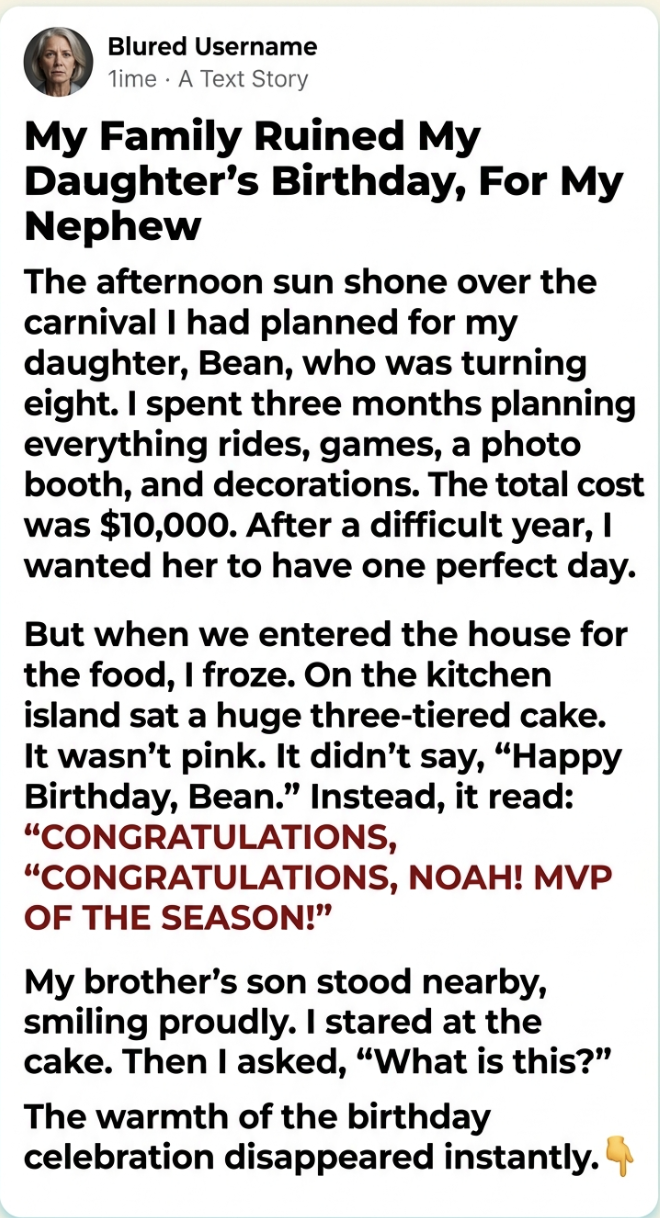
 The afternoon sun shone over the carnival I had planned for my daughter, Bean, who was turning eight.
I had spent three months organizing everything.
There were colorful rides, carnival games, a small photo booth, face painting, cotton candy, popcorn, and a decorated area where Bean could open her presents with her closest friends.
I had even arranged for her favorite singer from a children’s entertainment company to appear for thirty minutes.
The total cost was nearly $12,500.
Some people would say that was too much for a child’s birthday.
Maybe they were right.
But Bean had experienced a difficult year.
Her father and I had separated peacefully, but the changes had been hard on her. She had moved schools, lost touch with several friends, and spent many nights asking whether everything in her life would ever feel normal again.
She never demanded expensive things.
She never complained.
She only wanted one day when everyone she loved would be happy to celebrate her.
So I wanted to give her that.
Not because money could solve everything.
But because sometimes a child deserved a day filled with laughter instead of questions.
My family had promised to help with the food.
My mother, Linda, said she would prepare the main dishes.
My brother, Marcus, offered to bring drinks and desserts.
My sister-in-law, Tanya, said she would make sure the kitchen was ready for the guests.
I trusted them.
That was my first mistake.
The carnival took place in the backyard of my parents’ large house because it had more space than my apartment.
Bean spent the first two hours running from one ride to another.
Her face glowed as she collected small prizes.
She wore a pink dress with white stars, and her hair was tied into two little ponytails.
Every few minutes, she ran back to me and shouted:
“Mommy! Did you see that?”
“Yes, sweetheart,” I answered.
“Did you see me win?”
“I saw everything.”
She smiled as if those words were the greatest gift in the world.
For a while, everything was perfect.
Then, around four o’clock, the guests began moving inside for food.
Bean held my hand as we walked toward the kitchen.
I was thinking about the cake.
I had ordered a beautiful pink cake decorated with stars, butterflies, and a small sugar crown.
The bakery had written:
HAPPY 8TH BIRTHDAY, BEAN!
But when I entered the kitchen, I froze.
On the island sat a huge three-tiered cake.
It wasn’t pink.
It didn’t say, “Happy Birthday, Bean.”
Instead, it read:
CONGRATULATIONS, NOAH! MVP OF THE SEASON!
My brother’s son, Noah, stood nearby, smiling proudly.
He was holding a large sports trophy.
Several adults were gathered around him, clapping.
A banner had been hung across the wall.
It said:
NOAH’S CHAMPIONSHIP CELEBRATION
I stared at the cake.
Then I asked, “What is this?”
The room went quiet.
My mother looked up from a tray of food.
“Oh, Jenifer,” she said, as if I had interrupted something unimportant. “We decided to combine the celebrations.”
“Combine what celebrations?”
“Noah won the regional championship,” Marcus replied. “We couldn’t let the moment pass without celebrating him.”
I looked at Bean.
She was still holding my hand.
Her eyes moved from the cake to the banner.
Then she looked at me.
“Mommy,” she whispered, “where is my cake?”
I felt my chest tighten.
I had no answer.
I turned toward my mother.
“Where is the birthday cake I ordered?”
She waved her hand dismissively.
“Oh, that little cake? We put it in the garage refrigerator.”
“Why?”
“Because this cake was already paid for.”
I looked at Marcus.
“Who paid for it?”
He smiled.
“Mom and Dad helped.”
My mother immediately looked away.
I knew that smile.
It was the smile people wore when they were hiding something.
I walked to the refrigerator in the garage.
Inside was Bean’s cake.
The box had been pushed behind several trays of food.
The pink frosting had begun to soften.
The sugar stars were bent.
The words HAPPY 8TH BIRTHDAY, BEAN were partly covered by a container of potato salad.
I stood there silently.
Behind me, I heard Bean ask, “Can we sing my birthday song now?”
No one answered.
Instead, my father called from the kitchen:
“Everyone, come over here! Noah is going to cut the championship cake!”
The guests gathered around the island.
Phones came out.
People started recording.
Noah stood in front of the cake while my mother placed a hand on his shoulder.
“Make a wish, sweetheart,” she said.
Bean remained beside me in the doorway.
She watched as everyone sang for Noah.
Not one person sang for her.
Not one person mentioned that she was turning eight.
Not one person looked at the little girl whose birthday had brought them all together.
I knelt beside Bean.
“Sweetheart, do you want to go back outside?”
She shook her head.
“Did I do something wrong?”
The question broke something inside me.
“No,” I said immediately. “You did nothing wrong.”
“Then why is everyone celebrating Noah?”
I looked toward my family.
My mother was laughing.
My brother was taking pictures.
My father was telling guests how proud he was of his grandson.
I realized that the problem was not the cake.
It was not the banner.
It was not even the championship.
The problem was that my family had decided Bean’s special day could be replaced without asking me—or caring how she would feel.
I stood up.
“Mom,” I said, “we need to talk.”
She sighed.
“Not now, Jenifer. We’re celebrating.”
“This was supposed to be Bean’s birthday.”
“And she has a whole carnival outside.”
“She is eight years old. She doesn’t understand why everyone is singing for Noah while her cake is hidden in the garage.”
My mother’s expression hardened.
“You’re being dramatic.”
Marcus laughed.
“Come on. It’s not that serious.”
I looked at him.
“You think it’s not serious because it isn’t your daughter standing there wondering why her own family forgot her birthday.”
Tanya crossed her arms.
“No one forgot her birthday. We just thought Noah deserved recognition too.”
“Then why did you replace her cake?”
“We didn’t replace anything.”
I pointed toward the kitchen.
“Your banner is covering the birthday decorations I paid for. Her cake is in the garage. You used the kitchen, the food, and the guests for Noah’s party.”
My father finally turned toward me.
“Enough.”
I looked at him.
“Enough?”
“You’re embarrassing yourself.”
“No,” I said quietly. “You embarrassed my daughter.”
The room became uncomfortable.
Some guests looked down.
Others pretended to be busy with their plates.
My father lowered his voice.
“You always make everything about money and effort.”
I almost laughed.
“Money and effort?”
I looked around the room.
“I paid for the carnival. I paid for the rides. I paid for the food. I paid for the decorations. I paid for the photographer. I paid for the entertainment. And now you’ve taken the celebration I organized for my daughter and turned it into Noah’s event.”
Marcus shrugged.
“You can afford it.”
That sentence stayed in the air.
You can afford it.
As if being able to pay meant I had no right to care.
As if my money made my feelings less important.
As if my daughter’s birthday could be borrowed because I was the one who funded it.
I took Bean’s hand.
“We’re leaving.”
My mother stepped forward.
“Don’t be ridiculous. The children can still enjoy the party.”
Bean looked up at me.
“Mommy, can we go home?”
“Yes, sweetheart.”
We walked outside.
The carnival was still running.
The rides were turning.
The music was playing.
But the happiness had changed.
Bean no longer ran toward the games.
She walked beside me quietly.
At the gate, she stopped.
“Did Grandma forget me?”
I knelt in front of her.
“No, baby. Grandma made a very hurtful choice. That does not mean you are forgettable.”
“Did Noah do something bad?”
“No. This is not Noah’s fault.”
“Then whose fault is it?”
I looked at the house.
“The adults who should have known better.”
We went home.
I expected Bean to cry.
Instead, she became unusually quiet.
She removed her pink shoes, placed them neatly beside the door, and went to her room.
That hurt more than tears would have.
Children often cry when they feel safe.
When they don’t feel safe, they sometimes become silent.
I sat outside her bedroom for nearly an hour.
Finally, she opened the door.
“Mommy?”
“Yes?”
“Can we still have my birthday?”
I smiled through the tears in my eyes.
“Of course we can.”
“But the cake is ruined.”
“Then we’ll get another one.”
“And the guests?”
“We’ll invite the people who came to celebrate you.”
She thought about it.
“Can we have pancakes for dinner?”
I laughed softly.
“Yes. We can have pancakes for dinner.”
That night, I ordered a new cake.
I also called three of Bean’s closest friends and their parents.
I explained that the celebration had ended early and asked whether they could come over the following afternoon.
They all agreed.
The next day, we held a smaller birthday party in my apartment.
There were no expensive rides.
No huge decorations.
No three-tiered cake.
Just pancakes, balloons, music, and five children dancing in the living room.
Bean wore her pink dress again.
When we brought out the cake, everyone sang her name.
She closed her eyes and made a wish.
Then she opened them and smiled.
That smile reminded me why I had planned the entire celebration in the first place.
Not for the photographs.
Not for the money.
Not for my family’s approval.
For her.
After the party, I began reviewing my financial records.
I wanted to understand exactly how much I had been giving my parents and brother over the past few years.
I had always helped because I believed family support was normal.
But I discovered that my generosity had become a system.
I paid my parents’ property taxes.
I covered their home insurance.
I paid for repairs.
I helped Marcus with his business.
I paid Noah’s sports fees.
I bought his uniforms.
I paid for tournament travel.
I had even transferred money to Tanya for household expenses.
Over five years, the total exceeded $1.8 million.
I had never demanded repayment.
I had never asked for recognition.
But I had assumed that when the time came, my family would at least treat my daughter with love.
The birthday incident showed me that assumption had been foolish.
Three days later, my mother called.
“Are you still upset?” she asked.
“I’m not upset about a cake.”
“Well, you acted like it was the end of the world.”
“I acted like my daughter mattered.”
My mother sighed.
“Jenifer, Noah had just won something important. We wanted to celebrate him.”
“You could have celebrated him another day.”
“We thought you would understand.”
“I understand that you chose him over Bean.”
“That is not what happened.”
“It is exactly what happened.”
She became quiet.
Then she said, “You have always been jealous of the attention Jason and Noah receive.”
I felt my voice become calm.
“I am not jealous of a child. I am disappointed in adults.”
My mother ended the call.
That evening, Marcus sent me a message.
“You need to stop acting like your money gives you control over everyone.”
I stared at it.
Then I replied:
“My money does not give me control over anyone. It gives me the right to decide how it is used.”
He responded immediately.
“So now you’re threatening the family?”
I wrote back:
“No. I’m reviewing my financial support.”
He called me selfish.
My father called me ungrateful.
Tanya sent a long message about family unity.
But no one asked how Bean was feeling.
No one apologized to her.
No one said, “We’re sorry we made your birthday about someone else.”
That was when I made my decision.
I did not announce it.
I did not threaten them.
I simply stopped every unnecessary payment.
The property taxes were no longer automatic.
The household allowance ended.
Marcus’s business support stopped.
Noah’s sports expenses were removed from my account.
The extra cards were canceled.
The monthly transfer to my parents was reduced to a small amount for essential medical expenses only.
Then I sent one message to the family group chat.
“Beginning next month, I will no longer fund luxury expenses, personal spending, business losses, or activities that are not my responsibility. Essential medical support will continue under a written agreement. Please make your own financial arrangements.”
The response was immediate.
My father called me a disgrace.
My mother said I was punishing a child.
Marcus accused me of destroying his business.
I replied only once:
“I am not punishing anyone. I am ending an arrangement that has become unhealthy.”
The next morning, Marcus appeared at my apartment.
He was furious.
“You can’t just stop paying for Noah’s training,” he said.
“I can.”
“He has a tournament next month.”
“You can pay for it.”
“You know how expensive it is.”
“Yes.”
“Then why would you do this?”
I looked at him.
“Because I paid for Bean’s birthday, and your family turned it into Noah’s celebration.”
“That was one mistake.”
“No. It was the moment I finally noticed the pattern.”
“What pattern?”
“You expect me to provide. You expect me to stay quiet. You expect me to accept being insulted because I can afford to help.”
He shook his head.
“You’re making this about yourself.”
“I am allowed to matter in my own life.”
Marcus looked away.
Then he said something that confirmed everything.
“Bean still had a carnival.”
I felt my heart sink.
He still did not understand.
The carnival was never the point.
The point was that my daughter had stood in a room full of family and wondered why she was not worth celebrating.
I said, “You are not welcome to ask me for money again until you understand what happened.”
He left angrily.
A week later, my father demanded a family meeting.
This time, I agreed—but only with my attorney present.
When I arrived at my parents’ house, the atmosphere was tense.
My mother sat on the sofa.
My father stood near the fireplace.
Marcus and Tanya sat together.
Jason was there too, even though the issue had nothing to do with him.
My father began.
“You have humiliated this family.”
I placed a folder on the table.
“No. We are here because the family’s financial arrangements need to be clarified.”
He frowned.
“What is that?”
“A complete record of my support over the last five years.”
I opened the folder.
“Property taxes. Insurance. Medical expenses. Home repairs. Business funding. Noah’s sports fees. Travel. Household allowances. Credit cards.”
My mother looked nervous.
I continued.
“The total is approximately $1.8 million.”
Jason whistled.
Marcus stared at the papers.
My father said, “You’re keeping score?”
“No. I’m establishing facts.”
I turned to Marcus.
“You said my money does not give me control. I agree. But my money also does not belong to you.”
Then I looked at my mother.
“You said I was punishing Noah. I am not. Noah is a child. He did nothing wrong. The adults used his achievement to replace Bean’s birthday.”
Tanya began to cry.
“We didn’t mean to hurt her.”
“But you did.”
My father shook his head.
“You are destroying family unity over a birthday party.”
I looked at him.
“Family unity cannot depend on one person paying for everyone while receiving no respect.”
No one spoke.
I opened the final document.
It was a revised financial agreement prepared by Martin Collins.
“From now on, any support I provide will be documented. Essential medical care will be covered. The residence agreement will remain in place. But there will be no more luxury spending, personal allowances, business bailouts, or payments made without my approval.”
My father looked furious.
“You think you can control us with paperwork?”
“No,” I replied. “I’m using paperwork so no one can control me with guilt.”
My mother lowered her eyes.
For the first time, she seemed to understand that I was not bluffing.
Then Bean walked into the room.
I had not expected her to come inside, but she had been waiting with a family friend in the hallway.
She held a small paper bag.
“Mommy, I made something for Grandma.”
My mother immediately stood.
“Bean, sweetheart…”
Bean approached her and handed over the bag.
Inside was a handmade card.
On the front, Bean had written:
“THANK YOU FOR MY BIRTHDAY.”
My mother began crying.
She opened it.
Inside was a drawing of the carnival.
There were rides, balloons, and a large pink cake.
At the bottom, Bean had written:
“I WISH EVERYONE COULD HAVE A HAPPY DAY.”
My mother covered her mouth.
Bean looked up at her.
“Grandma, next time can we celebrate my birthday first?”
The room became completely silent.
My mother knelt in front of her.
“Yes,” she whispered. “Next time, we will.”
Bean nodded.
Then she took my hand.
“Can we go home now?”
I kissed the top of her head.
“Yes, baby.”
As we walked toward the door, my father called my name.
“Jenifer.”
I turned.
He looked uncomfortable.
“I’m sorry.”
I waited.
He continued.
“We should have kept your daughter’s birthday about her.”
It was not a perfect apology.
He did not mention the money.
He did not mention the years of disrespect.
But it was the first time he admitted that they had made a mistake without blaming me.
I nodded.
“Thank you.”
Then I left.
The financial changes were difficult at first.
My parents had to reduce their spending.
Marcus had to find other investors.
Tanya returned several luxury purchases.
Jason stopped asking me for money after Martin sent him a formal notice.
Noah continued playing sports.
His parents simply learned to budget for it themselves.
And Bean?
She became happier.
Not because we spent more money.
Because she no longer believed she had to compete for her family’s attention.
A month later, my mother invited us over for dinner.
When we arrived, there was a small cake on the table.
It was pink.
It had white stars.
And across the top were the words:
“BEAN, YOU ARE LOVED.”
My mother stood beside it.
“I know this is late,” she said. “But I wanted to do it properly.”
Bean looked at the cake.
Then she looked at me.
I nodded.
She smiled.
My mother lit the candles.
Everyone sang for Bean.
This time, no one interrupted.
No one brought out another banner.
No one compared her to Noah.
When Bean finished making her wish, she blew out the candles.
Then she cut the first slice and handed it to my mother.
“Here, Grandma.”
My mother cried again.
But this time, the tears were different.
They were not tears of guilt alone.
They were tears of understanding.
After dinner, my mother pulled me aside.
“I thought you were angry because we spent money on Noah,” she said.
“I wasn’t.”
“I know that now.”
She looked toward Bean, who was playing with Noah in the living room.
“We made her feel invisible.”
“Yes.”
“And we made you feel invisible too.”
I did not answer immediately.
Then I said, “I have felt invisible for years.”
My mother looked down.
“I’m sorry.”
“I believe you.”
“But things won’t go back to how they were.”
“No,” I said. “They shouldn’t.”
She nodded slowly.
“I understand.”
I hope she did.
Because the lesson was not that parents should never help relatives.
The lesson was not that money is evil.
The lesson was that generosity without boundaries can teach people to mistake kindness for obligation.
I had paid for my family’s comfort for years.
But I had failed to protect something more important: the emotional safety of my own child.
That birthday changed me.
I stopped measuring love by how much I could afford to give.
I stopped believing that keeping the peace meant accepting disrespect.
And I stopped allowing my family to use my generosity as permission to overlook my daughter.
Bean still talks about her eighth birthday.
She remembers the rides.
She remembers the pancakes.
She remembers the pink cake.
But she no longer remembers the huge championship cake in the kitchen.
That is what I wanted.
I wanted the hurtful moment to become smaller than the love that followed.
I wanted her to learn that being overlooked once does not mean she is unimportant.
And I wanted her to know that her mother would always stand beside her.
Because a child’s birthday is not just a party.
It is a message.
It tells a child:
You matter.
You are loved.
Your happiness deserves space.
My family tried to take that message away from Bean for the sake of my nephew.
But they failed.
Because I finally understood something I should have understood years earlier:
You can help your family financially without handing them the right to decide whose feelings matter.
And sometimes, the most loving thing a parent can do is stop paying for everyone else’s comfort—and start protecting their child’s heart.