I didn’t confront them.
I didn’t shout.
I didn’t send a long message explaining how deeply they had hurt me.
I simply returned the will to the safe, locked it, and walked away.
That was the last time I entered my parents’ study as the daughter who still believed their love could be earned.
That night, I opened my banking app.
For nearly ten years, I had scheduled a transfer of $30,000 every month to my parents.
The money paid their mortgage, country club fees, insurance, household staff, luxury shopping, and expensive vacations.
It also helped cover the lifestyle of my cousin Jason, the unemployed “golden child” my father always called his real son.
I had paid their medical bills.
I had saved their mansion from foreclosure.
I had covered their taxes.
I had even paid several of Jason’s debts because my parents insisted he was “going through a difficult period.”
But after reading the new will, I finally understood the truth.
They had not considered me their daughter.
They had considered me their financial solution.
The will left their estate to Jason.
The mansion.
The vacation property.
The investments.
The family jewelry.
Everything.
My name appeared only once, under a section explaining why I was excluded.
According to my father, I had already benefited from the family’s support.
That sentence stayed in my mind as I canceled the transfer.
I looked at the confirmation screen.
Recurring payment canceled.
Then I canceled every card linked to my accounts.
The household card.
The country club card.
The travel card.
The emergency card my mother used for shopping.
The card Jason used for “business expenses.”
One by one, they disappeared from my account.
I did not cancel my parents’ medical insurance.
That was not revenge.
That was a boundary.
I would not allow someone to suffer medically because they had treated me badly.
But I would no longer pay for luxury.
I would no longer finance comfort while being described as cold.
I would no longer reward people who had already decided I was not worthy of their love.
Then I turned off my phone.
For three weeks, I disappeared.
I stayed at a quiet hotel near the coast, where no one knew my family and no one asked me to solve a financial crisis.
I walked along the beach in the mornings.
I read books in the afternoons.
I slept without checking whether a payment had cleared.
For the first time in years, I woke up without a message from my mother demanding money.
No list of expenses.
No reminder about the mortgage.
No request to pay Jason’s rent.
No accusation that I had forgotten my responsibilities.
The silence felt unfamiliar.
At first, I felt guilty.
I wondered whether my parents were worried.
I wondered whether my mother had become ill.
I wondered whether my father had finally realized how much I had done.
Then I remembered the will.
I remembered the words:
“She is useful while she continues providing support.”
The guilt slowly became clarity.
They had not called because they missed me.
They had not called because they were concerned.
They had not called because they loved me.
They had simply not noticed that I was gone.
They only noticed when the money stopped.
On the first of the month, my phone was still turned off.
When I switched it on that afternoon, I found twenty-seven missed calls.
Most were from my mother.
Several were from my father.
Three were from Jason.
There were also messages from the bank.
Mortgage payment failed.
Country club payment declined.
Credit card account restricted.
Then I saw my mother’s text.
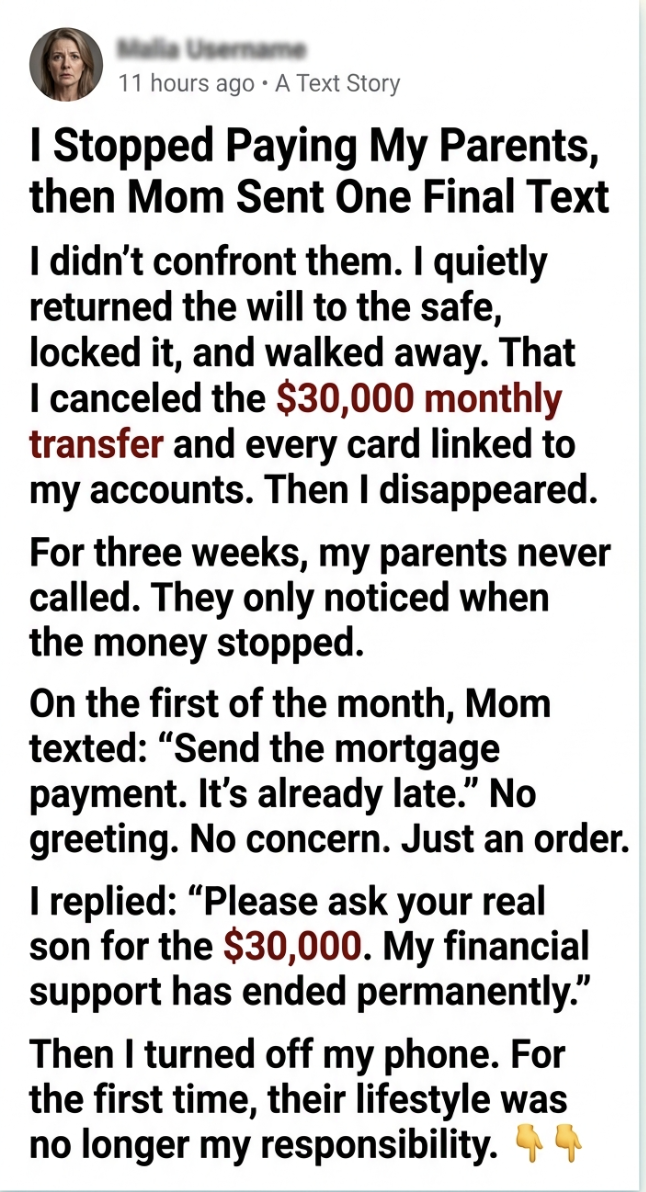
“Send the mortgage payment. It’s already late.”
No greeting.
No explanation.
No “How are you?”
Just an order.
I stared at the message.
For a moment, I considered replying immediately.
Old habits are difficult to break.
Then I typed:
“Please ask your real son for the $30,000. My financial support has ended permanently.”
I read it once.
Then I sent it.
After that, I turned off my phone again.
For the first time, their lifestyle was no longer my responsibility.
I expected anger.
I expected threats.
I expected my father to accuse me of destroying the family.
But I did not expect the message that arrived later that night.
When I turned my phone on again, there was one text from my mother.
Only one.
It said:
“You don’t understand what you’ve done. Your father never told you the whole truth about the will.”
I read it twice.
Then a second message appeared.
“Please come home before Jason finds out.”
My hands became cold.
Jason finds out what?
I called my attorney, Martin Collins, immediately.
He answered on the second ring.
“Jenifer, are you safe?”
“Yes. But my mother says Dad never told me the whole truth about the will.”
Martin was silent.
That silence told me more than his words could have.
“What do you know?” I asked.
“Not enough to discuss over the phone,” he replied. “Can you come to my office tomorrow morning?”
“Martin, what is happening?”
He took a breath.
“Your parents’ new will was not the only document prepared recently.”
“What other document?”
“A private trust agreement.”
My heart began pounding.
“Whose trust?”
“Yours.”
I could barely speak.
“My trust?”
“Yes. And it appears your father attempted to alter it.”
I sat down on the edge of the bed.
For years, I had believed my parents’ wealth belonged to them.
I had believed the mansion was theirs.
I had believed the investments were theirs.
I had believed I was simply helping them survive.
But Martin had already confirmed that I legally owned the mansion and vacation property through holding companies I had created during the foreclosure crisis.
Now he was telling me there was another trust.
“What did Dad try to do?” I asked.
“We’ll discuss it tomorrow,” he said. “Bring every document you have.”
I barely slept that night.
The next morning, I arrived at Martin’s office before nine.
He was waiting with two thick folders.
One was labeled:
FAMILY ESTATE
The other was labeled:
JENIFER — PRIVATE TRUST
I sat across from him.
“What is this?”
Martin opened the first folder.
“Several years ago, before your parents’ financial problems became public, your grandfather created a private family trust.”
“My grandfather died before I started working.”
“I know.”
“Why was I never told?”
“Because your father was appointed temporary trustee.”
I stared at him.
“Temporary?”
“Yes. The trust was intended to benefit you after you reached a certain age or established financial independence. Your grandfather believed you were the most responsible person in the family.”
I looked down at the documents.
“How much was in it?”
Martin turned a page.
“Originally, approximately $2.8 million.”
I felt numb.
“Originally?”
“The trust was funded with investment accounts, company shares, and several properties. Over time, the value increased significantly.”
“How significantly?”
Martin pushed another document toward me.
The number at the bottom made me stop breathing for a moment.
Estimated current value: $17.4 million.
I looked at him.
“Why didn’t I know about this?”
“Because your father never disclosed the trust to you.”
“Was he allowed to do that?”
“Not legally.”
Martin explained that my grandfather had named my father as trustee only to manage the assets until I was ready to control them.
The trust required annual statements.
It required the trustee to act in my best interest.
It prohibited the trustee from using trust assets for personal expenses or distributing them to unrelated beneficiaries.
My father had violated nearly every requirement.
He had used trust income to support my parents’ lifestyle.
He had transferred money to Jason.
He had listed trust assets as part of the family estate.
And the new will attempted to give those assets to Jason.
“That’s why they never valued me,” I whispered.
Martin shook his head.
“No. That’s why they needed you to remain unaware.”
He opened the second folder.
Inside were bank statements, property records, and a letter from my grandfather.
The letter had been written more than ten years earlier.
I read it slowly.
“My dear Jenifer, if you are reading this, it means you are finally old enough to understand the difference between love and control. I have watched your father confuse loyalty with obedience and generosity with ownership. I want you to know that the assets in this trust are yours—not because you are perfect, but because you have always shown the judgment and responsibility this family needs. Never allow anyone to convince you that your worth depends on what you provide.”
My eyes filled with tears.
My grandfather had known.
He had understood the family long before I did.
Martin continued.
“Your father recently contacted the trust administrator. He tried to transfer several assets into a family estate account.”
“Why?”
“To make them appear available for distribution under the new will.”
“And Jason?”
“Jason was listed as the primary beneficiary.”
I leaned back in my chair.
The new will was not simply an insult.
It was part of a plan.
My parents had spent years allowing me to fund their lifestyle while hiding a trust worth millions.
They wanted me to keep paying their expenses.
They wanted the family assets to appear available for Jason.
And they hoped I would never discover that the money was legally mine.
“Why did my mother text me?” I asked.
Martin looked toward the folder.
“Because she may have discovered that your father’s plan is failing.”
“What plan?”
He placed one final document on the table.
It was a draft agreement between my father and Jason.
The agreement stated that Jason would receive control of the family estate after my parents’ deaths.
In exchange, Jason had promised to provide for them.
But the agreement contained a disturbing clause.
If the estate was insufficient, Jason could use “family-managed assets” to satisfy the parents’ remaining expenses.
Those assets included properties and accounts connected to my trust.
Jason had agreed to take control of money that did not belong to him.
I felt anger rise inside me.
Not because they wanted to leave him money.
But because they had planned to use my work, my money, and my future to reward someone who had never respected me.
I looked at Martin.
“What happens now?”
“We notify the trust administrator, freeze all unauthorized transfers, and send formal demands for an accounting.”
“And my parents?”
“They will need to explain every dollar.”
“And Jason?”
“He will need to explain why he signed an agreement involving assets he did not own.”
I nodded.
For the first time, I did not feel powerless.
I felt prepared.
That afternoon, I returned to my parents’ mansion.
My mother opened the door.
She looked exhausted.
The expensive clothes were gone.
The designer handbag was missing.
Her face appeared older than it had three weeks earlier.
“Jenifer,” she whispered.
My father stood behind her.
Jason was sitting in the living room, staring at his phone.
When he saw me, he stood.
“You finally came back,” he said angrily. “Do you know what you’ve done to us?”
I looked at him.
“No. Tell me.”
“You canceled everything. The mortgage, the cards, the country club. You made us look like we were broke.”
“You were broke.”
My father stepped forward.
“Watch your tone.”
I placed a folder on the table.
“No. You watch yours.”
My mother began to cry.
Jason glanced at the folder.
“What is that?”
“The documents you should have read before signing your agreement.”
My father’s face changed.
“You spoke to Martin.”
“Yes.”
“You had no right.”
“I had every right. The trust is mine.”
Jason looked at my father.
“What trust?”
My father said nothing.
I opened the folder.
“My grandfather created a trust for me worth approximately $17.4 million. Dad was appointed trustee. He was required to protect the assets and provide annual statements.”
Jason stared at him.
“You told me the family estate was worth less than that.”
My father’s jaw tightened.
I continued.
“He used trust income to fund this mansion. He transferred money to you. He tried to move trust assets into the family estate so they could be distributed under the new will.”
Jason turned toward my father.
“You said everything was yours.”
My mother covered her face.
My father finally spoke.
“You don’t understand the arrangement.”
“I understand it better than you think.”
I placed the new will beside the trust documents.
“You excluded me from the will because you said I had already benefited from family support. But the truth is that you were supposed to manage assets for my benefit.”
My father looked away.
I opened the page containing his personal statement.
“Jenifer is emotionally distant and has never demonstrated the warmth Jason has shown this family.”
I looked directly at him.
“You wrote that I was not loving enough. But you never told me my grandfather left me a trust. You used my money to support Jason. You planned to give him assets that were never yours.”
My mother whispered, “Your father was trying to protect the family.”
“No,” I said. “He was trying to control the family.”
Jason stepped toward the table.
“How much money did you say the trust was worth?”
“Approximately $17.4 million.”
His eyes widened.
“Then I’m entitled to part of it.”
“No.”
“But we’re family.”
“You signed a contract promising to control assets you did not own.”
“I didn’t know.”
“That is not my responsibility.”
Jason looked at my father.
“You lied to me.”
My father snapped, “I did what was necessary.”
“No,” I said. “You did what was convenient.”
The room fell silent.
Then my mother spoke.
“There’s something else.”
My father turned sharply toward her.
“Helen.”
She ignored him.
“Jenifer deserves to know.”
I looked at her.
“What?”
My mother wiped her tears.
“The reason your grandfather created the trust was not only because he trusted you.”
“What do you mean?”
She glanced at my father.
“He knew your father had already taken money from the family business.”
My father’s face went pale.
I looked at him.
“What money?”
My mother continued.
“Years ago, Richard used company funds to cover Jason’s debts. Your grandfather discovered it. He wanted to remove Richard as trustee, but Richard convinced him that he could repair the situation.”
Martin had not mentioned this.
I felt as if another piece of the family’s history had opened beneath my feet.
“How much?” I asked.
My mother hesitated.
“More than $1 million.”
My father shouted, “That was not your story to tell!”
“It was never yours to hide,” she replied.
For the first time, my parents began arguing in front of me.
My father accused my mother of betrayal.
My mother accused him of destroying the family.
Jason stood between them, confused and furious.
I watched them and realized something painful.
They had built their entire family around secrets.
My father hid money from my grandfather.
My mother hid the trust from me.
They hid Jason’s payments from me.
They hid their financial collapse behind luxury.
And all of them had expected me to keep paying without asking questions.
I gathered the documents.
“I’m not here to punish you,” I said.
My father laughed bitterly.
“You already have.”
“No. Consequences are not punishment.”
I looked at my mother.
“I will continue covering necessary medical care under a supervised arrangement. But the luxury spending ends. The mansion will remain available to you under a legal residence agreement, provided you follow the terms.”
My father opened his mouth.
I raised my hand.
“You will not refinance it. You will not transfer it. You will not use it as collateral. And you will not allow Jason to manage it.”
Jason looked offended.
“What about me?”
“You need to find employment and repay what you can.”
“You can’t tell me what to do.”
“No,” I replied. “But I can stop funding what you refuse to take responsibility for.”
My father stared at me.
“You’re destroying the family legacy.”
I shook my head.
“No. I’m stopping the family from destroying me.”
The legal process took several months.
The trust administrator conducted a full investigation.
My father was removed as trustee.
The unauthorized transfers were documented.
Some funds were recovered.
Others became the subject of repayment agreements.
The new will was invalidated where it attempted to distribute assets that did not belong to my parents.
Jason’s agreement was canceled.
He had to move out of the mansion and find his own place.
At first, he blamed me.
Then he blamed my father.
Eventually, he stopped calling.
My parents remained in the mansion under the agreement I created.
Their lifestyle became simpler.
They sold several cars.
They ended their country club membership.
They stopped traveling every few months.
My mother began volunteering at a local clinic.
My father, for the first time in decades, had to manage a budget.
He hated it.
But he slowly learned that a comfortable life was not the same as an expensive one.
Months later, my father asked to meet me alone.
We sat in the small garden behind the mansion.
He looked older.
Not poor.
Not helpless.
Just tired.
“I thought you would always help us,” he said.
“I did help you.”
“You know what I mean.”
I looked at him.
“You thought I would keep helping even after I knew you never planned to value me.”
He lowered his eyes.
“I didn’t know how to deal with Jason.”
“You protected him from every consequence.”
“He needed us.”
“So did I.”
My father was silent.
I continued.
“You called Jason your real son. You called me a cold accountant. But I was the one paying for your life while you were secretly planning to give him everything.”
“I was wrong.”
The words were quiet.
But they were the first honest words he had given me in years.
I did not immediately forgive him.
I did not hug him.
I did not promise that everything would return to normal.
I simply said, “You need to understand that I am not your wallet anymore.”
He nodded.
“I know.”
“And I’m not going to earn love by paying for it.”
“I know.”
That was the beginning of a different relationship.
Not perfect.
Not close.
But honest.
My mother eventually apologized too.
She admitted that she had known about the trust for years.
She said my father convinced her that revealing it would cause conflict.
I told her that silence had also been a choice.
She accepted that.
For the first time, she stopped asking me for money.
Instead, she asked whether I had eaten.
Whether I was sleeping enough.
Whether I was happy.
Small questions.
Ordinary questions.
Questions she should have asked years earlier.
I did not become cruel.
I did not abandon my parents.
But I stopped confusing financial support with love.
I created a formal family assistance fund with clear limits.
Medical care.
Basic housing.
Emergency needs.
Nothing more.
Every payment required documentation.
Every agreement was written.
Every boundary was clear.
Some relatives accused me of becoming heartless.
Others said I should forget the past.
But I knew the truth.
A person can be generous without being available for exploitation.
A daughter can forgive without surrendering control of her life.
And family can be loved without being financed endlessly.
One evening, I received a final message from my mother.
It said:
“I’m sorry we only noticed you when the money stopped. I wish we had noticed you when you were tired, when you were lonely, and when you needed us. You were never just our wallet. We treated you like one. That was our failure.”
I read the message slowly.
Then I replied:
“I hope we can build something more honest from now on.”
I did not promise more money.
I did not promise to forget.
I promised only honesty.
And that was enough.
For nearly ten years, I had paid for my parents’ luxury life.
I thought the money would earn me love.
Instead, it revealed what they truly believed I was worth.
Then I found their new will.
It showed me the betrayal.
The hidden trust showed me the larger truth.
And canceling the $30,000 transfer taught me the most important lesson of all:
When people only value what you provide, stopping the payment is not cruelty. Sometimes, it is the first honest conversation you have ever had.