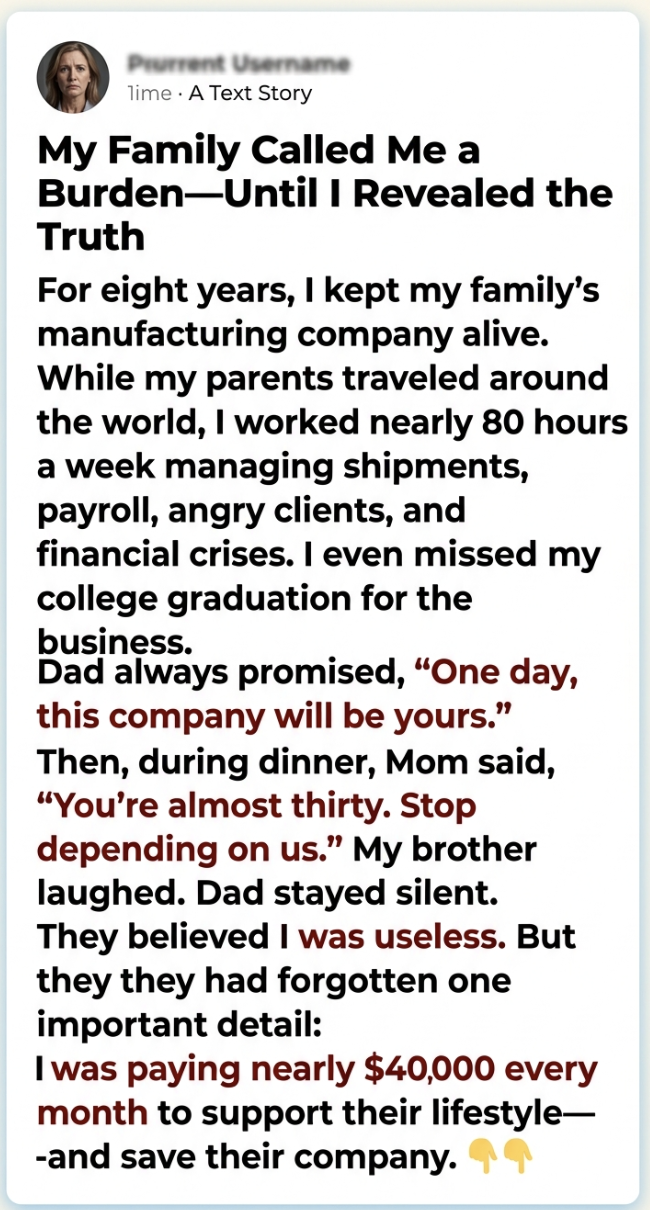
For eight years, I kept my family’s manufacturing company alive.
While my parents traveled around the world, I worked nearly eighty hours a week managing shipments, payroll, angry clients, supplier disputes, and financial crises.
I missed birthdays.
I missed holidays.
I even missed my college graduation because one of our largest clients threatened to cancel a contract unless I personally fixed a shipment problem.
Dad always promised me the same thing.
“One day, this company will be yours.”
I believed him.
That promise was the reason I stayed.
The company was called Harrison Manufacturing, founded by my grandfather and later handed to my father, Michael Harrison.
It produced industrial parts for construction companies, shipping firms, and equipment manufacturers.
When I first joined, the company was already struggling.
Orders were delayed.
Invoices were unpaid.
The payroll system was outdated.
Several major clients were preparing to leave.
I was only twenty-one, but I worked day and night to stabilize everything.
I created a digital inventory system.
I renegotiated supplier contracts.
I found cheaper shipping routes.
I built relationships with clients my father had ignored.
Within two years, the company was profitable again.
Within five years, annual revenue had tripled.
By the eighth year, Harrison Manufacturing was generating more than $20 million in yearly sales.
But my family still treated me like an assistant.
Dad took credit for every success.
Mom introduced me to people as “the son who helps around the business.”
My brother, Ryan, rarely worked more than a few hours a week, yet he received a company car, a generous salary, and a private office.
I received promises.
Then came the dinner that changed everything.
It was a Thursday evening.
My parents had returned from a luxury vacation in Europe. They spent most of dinner discussing hotels, restaurants, and the next trip they wanted to take.
I sat quietly, checking a message from our accounting manager.
A major supplier had placed our account on hold because my father had used company funds to pay for a private yacht deposit.
I had already transferred money from my personal account to prevent the shipment from being canceled.
Again.
Mom noticed me looking at my phone.
“Can you stop working for one evening?” she asked.
“I’m just handling a supplier issue.”
“You’re always handling something,” she said. “That’s the problem.”
I looked up.
“What do you mean?”
She placed her fork down.
“You’re almost thirty. You need to stop depending on us.”
I thought I had misheard her.
“Depending on you?”
Ryan laughed from across the table.
“You act like the company owes you a life.”
I stared at him.
“The company?”
Dad remained silent.
Mom continued, “You’re too comfortable here. You have no ambition outside this business.”
I felt my chest tighten.
For eight years, I had worked almost eighty hours every week.
I had sacrificed my education, my health, and nearly every personal plan I had made.
And they were calling me dependent.
I looked at my father.
“Dad, is that how you see me?”
He avoided my eyes.
“You’re family,” he said. “We all contribute in different ways.”
Ryan smiled.
“Some of us contribute ideas. Some of us just do the boring work.”
I slowly placed my phone on the table.
“Interesting.”
Mom frowned.
“What’s that supposed to mean?”
“Nothing,” I said. “I’m just beginning to understand something.”
“What?”
I looked at all three of them.
“You believe I need this family more than this family needs me.”
No one responded.
I stood up.
Dad finally spoke.
“Don’t be dramatic. Sit down.”
But I was finished.
I went home and opened the financial folder I had maintained for years.
Inside were bank transfers, payment records, supplier receipts, payroll advances, personal loans, and emergency expenses.
I had never kept these records to punish my family.
I kept them because I had learned that verbal promises disappeared whenever money became inconvenient.
The total was staggering.
Over eight years, I had personally paid:
- $1.2 million in company emergency funding
- $640,000 in payroll and supplier advances
- $310,000 in business loans
- $185,000 in vehicle and travel expenses
- $420,000 in family housing and lifestyle costs
- $96,000 in personal loans to my parents and brother
The grand total was nearly:
$2.85 million.
And that did not include the value of my unpaid labor.
I had been paying nearly $40,000 every month to support their lifestyle and keep their company alive.
The next morning, I called our attorney, Ms. Bennett.
“I need to review the company ownership documents,” I said.
She paused.
“Is something wrong?”
“I think I’ve been operating under a misunderstanding.”
“What kind of misunderstanding?”
“My father always told me the company would one day be mine.”
“Was that promise ever put in writing?”
“No.”
“Then we need to discuss your legal position immediately.”
That sentence changed everything.
For years, I had assumed loyalty would eventually be rewarded.
But loyalty was not ownership.
Hard work was not a contract.
And a promise made over dinner was not protection.
Ms. Bennett reviewed the records and discovered something even more troubling.
My father had quietly transferred a large portion of the company’s shares to Ryan two years earlier.
Ryan owned 35 percent of the business.
I owned nothing.
Not one share.
Not one voting right.
Not even a formal executive title.
I had built the systems, repaired the finances, saved the clients, and funded the emergencies—but legally, I was still just an employee.
Worse, the company owed me millions in documented advances.
My father had classified most of the money as “temporary family support.”
That meant he expected me to forget it.
Ms. Bennett looked at me across her office.
“You have two choices,” she said. “You can continue working under the current arrangement, or you can formally demand repayment and separate your services from the company.”
“What happens if I leave?”
She didn’t hesitate.
“The company will lose access to the systems you created, the contracts you manage, and the funding you’ve been providing.”
I looked down at the documents.
For the first time, I understood why my father had never wanted anything in writing.
He didn’t want to give me ownership.
He wanted to keep me useful.
That afternoon, I sent him a formal notice.
It was simple and professional.
I informed him that I would no longer provide unpaid personal funding, emergency loans, or executive-level services without a written agreement.
I also requested repayment of the documented advances.
My father called within three minutes.
“What is this?” he shouted.
“A financial notice.”
“You can’t do this to your own family.”
“I’m not doing anything to the family. I’m ending an arrangement that was never fair.”
Ryan called next.
“You’re threatening the company?”
“No. I’m asking the company to pay its debts.”
“You’re being selfish.”
I looked at the repayment spreadsheet.
“Selfish people don’t spend eight years saving a business they don’t own.”
That evening, Mom sent me a long message.
She said I was ungrateful.
She said my father had given me a job when no one else would.
She said family members should help each other without counting every dollar.
I replied with one sentence:
“Then why did you count every dollar when deciding what I deserved?”
The next week, the company began to struggle.
Without my personal funding, payroll could not be covered.
Without my supplier relationships, shipments were delayed.
Without my systems, the warehouse inventory became inaccurate.
Without my client contacts, two major customers threatened to terminate their contracts.
Dad called repeatedly.
I ignored the first few calls.
Then he left a voicemail.
“Please come back. We can discuss your position.”
I listened to it twice.
He didn’t say he was sorry.
He didn’t say he had been wrong.
He simply wanted me back.
I agreed to meet him at the company headquarters.
When I arrived, the office looked completely different.
Employees were anxious.
The warehouse manager was arguing with accounting.
The production floor had stopped twice that morning because materials had not arrived.
Dad stood in his office with Ryan beside him.
“You’ve made your point,” Dad said.
“No,” I replied. “I made a boundary.”
Ryan crossed his arms.
“You’re enjoying this.”
“I’m not enjoying watching employees worry about their paychecks.”
“Then fix it.”
I looked at him.
“Under what authority?”
He opened his mouth but said nothing.
Dad stepped forward.
“We can make you vice president.”
“Will I receive ownership?”
“We’ll discuss it.”
“Will you sign a repayment agreement?”
“We’ll discuss that too.”
“Will Ryan return the shares you transferred to him?”
Dad’s face tightened.
“That’s a private family matter.”
I nodded.
“Then this is not a business discussion.”
I turned to leave.
Dad grabbed my arm.
“You’re destroying everything your grandfather built.”
I gently pulled away.
“No, Dad. I’m refusing to destroy myself to protect what you refused to manage.”
Two days later, Harrison Manufacturing’s largest client requested a meeting.
They had heard about the internal conflict and wanted assurances that their orders would be completed.
Dad asked me to attend.
I agreed—but only with Ms. Bennett present.
At the meeting, the client’s director looked directly at me.
“Are you still responsible for operations?”
I answered honestly.
“Not without a formal agreement.”
The director nodded.
“We have trusted you for years. Can you guarantee delivery?”
“I can guarantee it through a new company that I control.”
Dad’s expression changed.
“What new company?”
I placed a folder on the table.
Three months earlier, I had quietly registered Northstar Industrial Solutions.
I had hired a small team, secured warehouse space, and developed a new logistics platform based on the systems I had created for Harrison Manufacturing.
I had not stolen any confidential information.
I had built my own tools from scratch.
I had simply stopped waiting for permission to create my future.
The client reviewed the proposal.
Then they offered Northstar a contract worth $6.4 million.
Dad stood up.
“You can’t take our clients.”
The director calmly replied, “We are choosing the company that can fulfill our orders.”
I looked at my father.
“That’s what customers do. They choose reliability.”
Within six months, Northstar became profitable.
Within a year, it had contracts across three countries.
I hired former Harrison employees who wanted stable work and fair treatment.
I offered clear salaries, reasonable hours, health benefits, and written agreements.
No one had to sacrifice their entire life for a promise.
Meanwhile, Harrison Manufacturing faced an audit.
The auditors discovered that my father had used company funds for personal travel, luxury purchases, and private investments.
They also discovered the undocumented transfers to Ryan.
The company’s board demanded explanations.
For the first time, my father had to answer questions without hiding behind the word “family.”
The legal process took months.
Eventually, an independent review confirmed that I had personally funded nearly $2.85 million in company and family expenses.
The company was ordered to repay a portion immediately, with the remainder placed under a structured agreement.
Ryan had to return several improperly transferred shares.
My father was removed as managing director.
The company survived—but it no longer belonged entirely to him.
One evening, he came to my office.
He looked older than I remembered.
“I never thought you would leave,” he said.
“I never thought you would make me feel like I had to.”
He sat across from me.
“I thought you were loyal.”
“I was.”
“Then why did you do this?”
I looked at him.
“Because loyalty without respect becomes exploitation.”
He stared at the floor.
“I was going to give you the company.”
“Eventually?”
“Yes.”
“After how many more years?”
He had no answer.
I continued, “You kept telling me the company would be mine one day because it kept me working today.”
His eyes filled with regret.
“I didn’t realize how much you had sacrificed.”
“That was because you never asked.”
He looked up.
“Can we fix this?”
I thought about the years I had lost.
The graduation ceremony I missed.
The holidays I skipped.
The friends I stopped calling.
The dreams I postponed.
“We can have a relationship,” I said. “But it will not be built on unpaid work or empty promises.”
He nodded slowly.
“And the company?”
“The company must operate like a business now.”
He accepted that.
It was the first time he had ever done so.
Months later, Mom contacted me.
She asked whether I would continue paying for their luxury apartment.
I told her no.
She asked whether I would cover Ryan’s debts.
I told her no.
She asked whether I could at least pay for their next vacation.
I said nothing for a moment.
Then I replied:
“You called me a burden while I was paying nearly $40,000 every month to keep your life comfortable. I’m not your burden, Mom. I was your support system. And support systems need boundaries too.”
She never answered.
I did not feel victorious.
I felt free.
Years later, Northstar opened a new headquarters.
At the entrance, I placed a simple plaque:
“Built on accountability, not promises.”
My employees often asked why I cared so much about written agreements and fair compensation.
I told them the truth.
“Because people should never have to destroy themselves to prove they are loyal.”
I still loved my family.
But love no longer meant unlimited access to my time, money, or future.
I had finally learned that being needed was not the same as being valued.
My father had called me a burden because he believed I depended on him.
He had forgotten one important detail.
For eight years, I had been the one keeping his company alive.
And when I finally stopped, the truth became impossible to ignore:
I was never the burden.
I was the foundation they kept pretending they had built themselves.