In the fall of 2021, I was nineteen years old, living in a tiny college dorm room with a broken desk, a noisy heater, and barely enough space for my textbooks.
I had one thing that made me feel safe: my college fund.
It contained $160,000, money my grandparents had saved for my education and future. My father, Robert, was the trustee until I turned twenty-one. I trusted him completely.
Every month, I checked the account and watched the balance remain untouched.
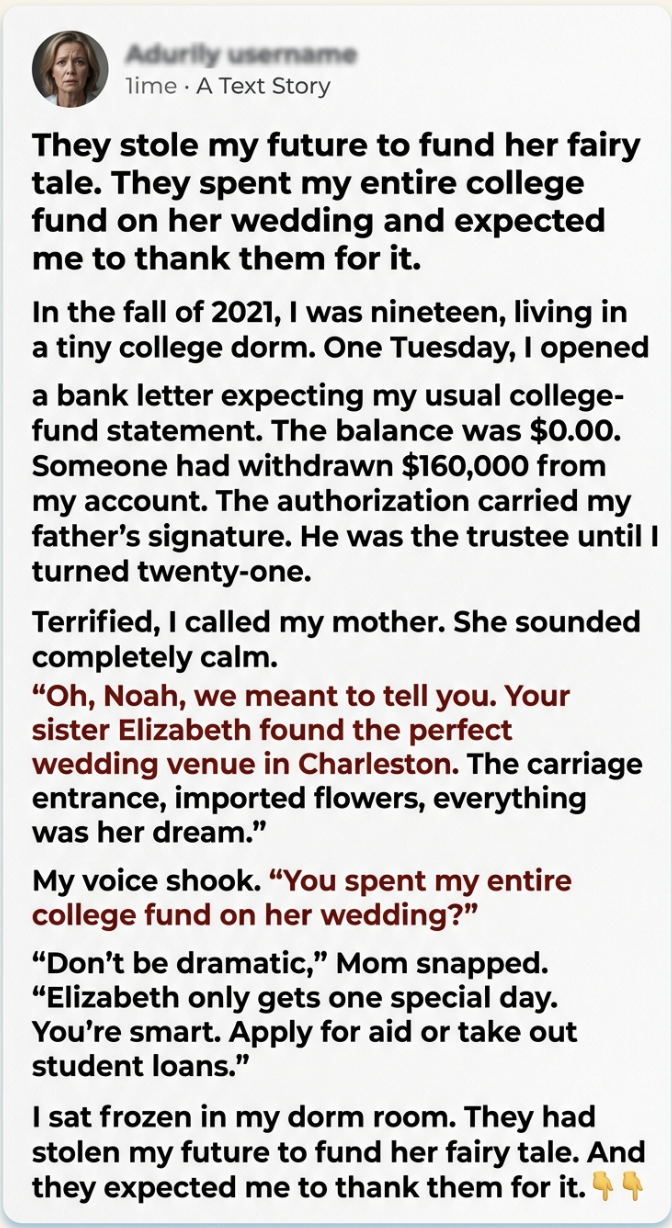
That Tuesday, I opened a letter from the bank expecting another routine statement.
Instead, I saw:
ACCOUNT BALANCE: $0.00
At first, I thought it was a mistake.
I refreshed the banking app.
The number didn’t change.
I called the bank, and the representative confirmed that the entire amount had been withdrawn three days earlier.
The authorization carried my father’s signature.
My hands went cold.
I immediately called my mother, Patricia.
She answered on the second ring.
“Mom, something is wrong with my college account. The bank says the money is gone.”
There was a pause.
Then she sighed, almost impatiently.
“Oh, Noah. We meant to tell you.”
My stomach tightened.
“What do you mean, you meant to tell me?”
“Elizabeth found the perfect wedding venue in Charleston,” she said. “The carriage entrance, imported flowers, the historic ballroom—it was everything she dreamed of.”
I stared at the wall.
“Mom… what are you saying?”
“We used the money for Elizabeth’s wedding.”
My voice barely came out.
“You spent my entire college fund on her wedding?”
“Don’t be dramatic,” she snapped. “Elizabeth only gets one special day. You’re smart. You can apply for financial aid or take out student loans.”
I couldn’t speak.
My sister, Elizabeth, was twenty-four. She had always been treated like the family’s precious jewel. Her birthdays were extravagant. Her mistakes were forgiven. Her dreams were considered emergencies.
I had learned to be independent because no one ever gave me another choice.
But this was different.
They hadn’t simply favored Elizabeth.
They had stolen my future.
I called my father that evening.
He didn’t apologize.
Instead, he said, “Your mother already explained. It was a family decision.”
“A family decision?” I asked. “It was my account.”
“You’re young,” he replied. “You don’t understand how these things work.”
“I understand that you took money meant for my education.”
His voice hardened.
“Elizabeth’s wedding was important. Your sister has always needed more support than you.”
That sentence hurt more than the missing money.
Not because it was new—but because it confirmed everything I had spent years pretending not to notice.
I asked him why he never discussed it with me.
He answered, “Because you would have said no.”
I sat on the edge of my bed, staring at the floor.
“So you knew it was wrong.”
He hung up.
The next morning, I contacted the bank again and requested every document connected to the withdrawal.
The representative told me that the transfer had been made to a wedding-planning company. The payment description read:
ELIZABETH ROBERTS — PRIVATE WEDDING EXPENSES
I saved every document.
Then I called my grandfather’s attorney, the man who had helped establish the college fund.
His name was Mr. Collins.
When I explained what happened, he became very quiet.
“Your father was trustee,” he said carefully. “But that does not mean he had unlimited authority.”
“What does that mean?”
“It means the money was restricted for your education and reasonable future expenses. A wedding is not the same thing.”
For the first time since opening the bank letter, I felt a small spark of hope.
Mr. Collins asked me to send him the withdrawal records.
Two days later, he called me back.
“Noah,” he said, “there is something you need to know.”
My heart began pounding.
“What?”
“Your grandfather included a condition in the trust documents. If the trustee used the funds for anything unrelated to your education, the trustee could be removed and held personally responsible.”
I closed my eyes.
“Can I get the money back?”
“Possibly. But it may take time.”
I looked around my tiny dorm room.
I had no money for tuition.
No money for books.
No money for rent.
And my family had spent everything on flowers, champagne, and a ballroom.
I decided not to tell them about the attorney.
Instead, I applied for scholarships, worked nights at the campus library, and took extra shifts at a nearby restaurant.
I slept four or five hours a night.
Some days, I ate instant noodles for dinner.
When Elizabeth posted wedding photos online, I saw the imported flowers, the luxury decorations, the designer dress, and the smiling faces of my parents.
The caption read:
“The perfect day, made possible by the people who love me most.”
I stared at that sentence for a long time.
Then I closed the app.
I stopped asking my family for help.
I stopped explaining how difficult things had become.
And slowly, I stopped expecting them to care.
Three years passed.
By 2024, I had graduated with honors.
I had also built a small financial-technology company with two classmates. We created software that helped small businesses detect suspicious transactions and prevent financial fraud.
At first, the company operated from a rented room above a grocery store.
We worked late nights, drank cheap coffee, and celebrated every new client.
Then a major investment firm discovered our software.
Within eighteen months, our company was valued at $18 million.
I didn’t tell my family.
They found out through an online business article.
My mother called me immediately.
“Noah! Why didn’t you tell us?”
I almost laughed.
“You never asked.”
“That’s not fair,” she said. “We’re your parents.”
I looked at the framed graduation photo on my desk.
“You used my college fund for Elizabeth’s wedding.”
“That was years ago,” she replied. “You turned out fine.”
That sentence stayed with me.
They believed the fact that I survived meant they had done nothing wrong.
A few weeks later, my father called.
His voice sounded unusually friendly.
“We should meet,” he said. “There are some family matters we need to discuss.”
I agreed to meet at a quiet restaurant.
When I arrived, both my parents were already seated.
Elizabeth was there too.
She looked different from the wedding photos. Her smile was gone, and she kept checking her phone.
My father stood up and hugged me.
I didn’t hug him back.
“We’re proud of you,” my mother said.
I sat down.
“What do you need?”
My father exchanged a glance with Elizabeth.
Then he explained.
Elizabeth’s husband had lost his business. Their investments had collapsed. They had accumulated debts from luxury purchases, property loans, and unpaid taxes.
The total was nearly $2 million.
My mother reached across the table.
“We thought you could help.”
I looked at Elizabeth.
She avoided my eyes.
My father said, “You’re successful now. You have access to investors and banks. You could solve this.”
I asked, “How much do you want?”
“Just enough to stabilize everything,” he replied. “Maybe $2 million.”
I almost smiled.
“Maybe?”
My mother frowned.
“Noah, this is a family emergency.”
I placed a folder on the table.
My father stared at it.
“What is that?”
“Documents.”
I opened the folder and slid the first page toward him.
It was the original trust agreement.
His face changed immediately.
“You still have that?”
“I kept everything.”
I placed the bank withdrawal records beside it.
Then I showed him the wedding payment authorization bearing his signature.
Elizabeth looked confused.
“What does this have to do with us?”
I turned toward her.
“Your wedding was paid for with my college fund.”
She shook her head.
“I didn’t know that.”
“I believe you didn’t ask.”
My father leaned forward.
“Noah, we already discussed this.”
“No,” I said calmly. “You explained it. You never took responsibility.”
My mother’s voice became sharp.
“We gave you a wonderful childhood.”
“You gave Elizabeth a wedding,” I replied. “You gave me debt, sleepless nights, and years of wondering whether my education mattered to you.”
My father looked at the trust agreement again.
Mr. Collins had prepared a legal notice years earlier, but I had never filed it.
I had been too young, too exhausted, and too afraid of destroying what remained of my family.
Now I was no longer afraid.
“I could have taken legal action in 2021,” I said. “The trust allowed me to recover the money from the trustee personally.”
My father’s face went pale.
“But you didn’t.”
“No. I chose to build my life instead.”
My mother whispered, “Then why bring this up now?”
“Because you came here asking me to rescue the people who destroyed my future.”
The table fell silent.
Elizabeth finally spoke.
“Noah, I’m sorry. I didn’t know.”
I believed her.
But I also knew that ignorance did not erase the consequences.
I turned to her.
“I don’t hate you, Elizabeth. But I’m not responsible for your debts.”
She lowered her eyes.
My father’s voice cracked.
“We’re still your family.”
I looked at him.
“Family doesn’t take someone’s education fund and call it love.”
No one answered.
I closed the folder.
“I won’t give you the $2 million.”
My mother began crying.
My father stared at the table.
Elizabeth covered her face with both hands.
For years, I had imagined this moment.
I had imagined shouting.
I had imagined humiliating them.
I had imagined making them feel the same pain they had caused me.
But when the moment finally came, I felt no satisfaction.
Only exhaustion.
I stood up.
“I hope you find a way forward,” I said. “But it won’t be through me.”
As I walked toward the door, my father called my name.
“Noah.”
I stopped.
He sounded smaller than I had ever heard him.
“I was wrong.”
I turned around.
He continued, “I thought you would always understand. I thought because you were strong, you could handle it.”
I nodded slowly.
“That was the problem. You confused my strength with permission to hurt me.”
He looked down.
“I’m sorry.”
It was the apology I had waited years to hear.
But it didn’t return my lost college years.
It didn’t erase the nights I worked instead of studied.
It didn’t undo the trust I had lost.
I accepted the apology.
I simply didn’t offer them my future again.
Months later, I established a scholarship through my company for students whose educational funds had been misused, stolen, or lost because of family financial abuse.
The first recipient was a nineteen-year-old student named Maya, who had been forced to leave school after her guardian emptied her savings.
When I handed her the scholarship letter, she began crying.
“I don’t know how to thank you,” she said.
I smiled.
“You don’t have to thank me. Just finish what you started.”
That evening, I returned to my office and looked at the city lights outside the window.
I still remembered the bank letter.
I still remembered the balance: $0.00.
But that number no longer represented my future.
It represented the moment I learned that I could lose everything—and still build something of my own.
My parents believed they had taken my future to create Elizabeth’s perfect day.
They were wrong.
They took money.
They took time.
They took trust.
But they did not take my ability to rebuild.
And in the end, the greatest revenge was not watching them struggle.
It was becoming the person they had never believed I could be.
They spent my future on a wedding.
I used the loss to build a life they could never control.