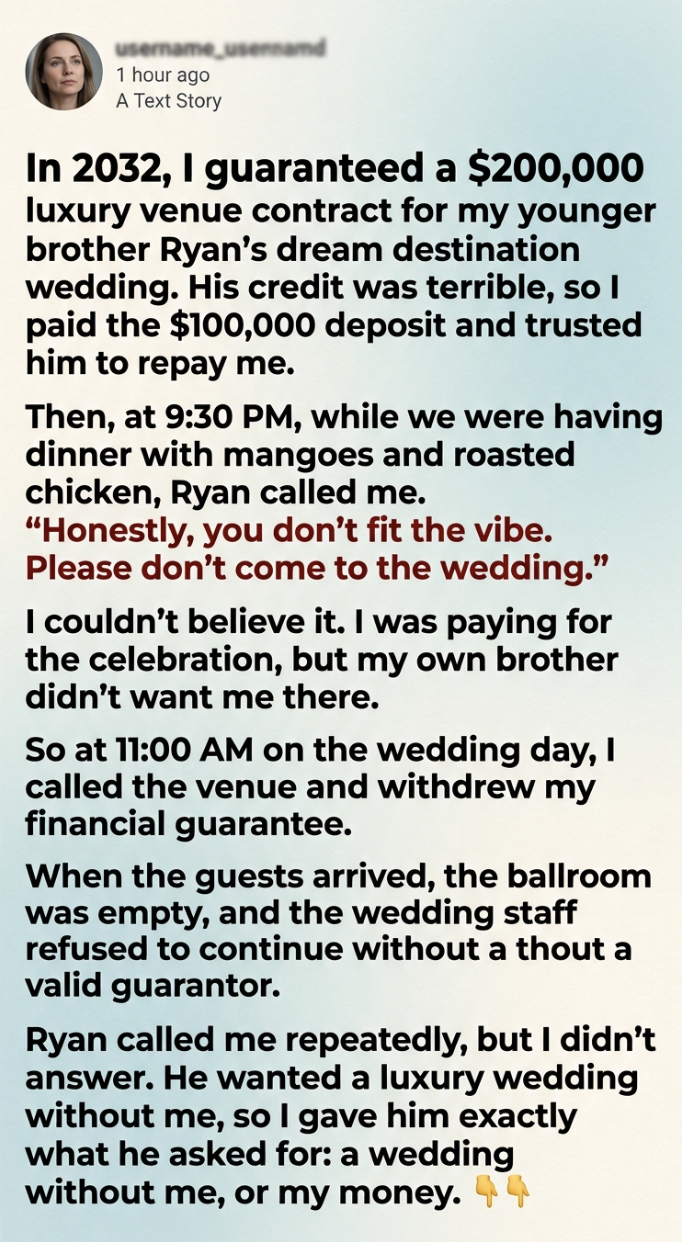
In 2032, I thought I was helping my younger brother Ryan build the wedding he had always dreamed of.
I didn’t realize I was financing a celebration I wasn’t even welcome to attend.
Ryan had always wanted a destination wedding.
Not an ordinary wedding.
He wanted a luxury resort, a massive ballroom, a private dinner, live entertainment, expensive flowers, custom decorations, and enough champagne and gourmet food to make the entire weekend look like something from a celebrity magazine.
The total contract was $200,000.
There was just one problem.
Ryan’s credit was terrible.
He had missed payments.
He had accumulated debt.
And the venue refused to finalize the contract without a qualified financial guarantor.
Ryan came to me.
“You’re the only person who can help me.”
I should have asked more questions.
Instead, I trusted my brother.
I signed the guarantee.
Then I paid the $100,000 deposit.
Ryan promised he would repay me before the wedding.
“I’m serious,” he said. “I’ll pay you back.”
I believed him.
Because he was my brother.
For months, I helped him coordinate vendors and review contracts.
I even helped negotiate a few of the venue’s terms.
I wasn’t trying to control his wedding.
I just wanted him to have the day he dreamed about.
Then everything changed one evening.
It was 9:30 PM.
I was sitting at the dinner table with Ryan and our parents.
We had mangoes and roasted chicken in the middle of the table.
Everyone was talking about the wedding.
My mother was discussing the flowers.
My father was joking about the guest list.
Ryan suddenly looked at his phone.
Then he looked at me.
“There’s something I need to tell you.”
I smiled.
“What?”
He hesitated.
Then he said:
“Honestly, you don’t really fit the vibe.”
I thought he was joking.
“What do you mean?”
“I mean… I don’t think you should come to the wedding.”
The room went silent.
I stared at him.
“You’re serious?”
He nodded.
“I just want the wedding to feel a certain way.”
I couldn’t understand what I was hearing.
“You don’t want your own brother at your wedding?”
“It’s not personal.”
I looked at my parents.
Neither of them said anything.
I looked back at Ryan.
“I’m the person who guaranteed the venue.”
“I know.”
“I paid $100,000.”
“I know.”
“And you don’t want me there?”
Ryan sighed.
“Exactly.”
I sat there for several seconds.
Then I quietly put down my fork.
“Okay.”
Ryan looked relieved.
Maybe he expected an argument.
Maybe he expected me to beg.
Maybe he thought I’d eventually show up anyway.
He didn’t understand something.
I wasn’t angry because I wasn’t invited.
I was hurt because he had separated my money from my presence as if one mattered and the other didn’t.
He wanted my financial support.
But he didn’t want me as family.
That distinction changed everything.
I went home that night and opened the wedding contract.
My name was clearly listed as the financial guarantor.
The deposit was connected to my payment.
And without my guarantee, Ryan’s credit wasn’t sufficient to continue the agreement.
I didn’t cancel anything that night.
I waited.
I wanted to make sure I wasn’t reacting emotionally.
For several days, I thought about it.
Maybe Ryan would apologize.
Maybe my parents would tell him he had gone too far.
Maybe someone would call.
Nobody did.
Instead, I heard through relatives that Ryan was telling people:
“My brother is helping financially, but he probably won’t be around much anyway.”
That sentence told me everything.
To him, I wasn’t family.
I was funding.
So on the morning of the wedding, I made one phone call.
It was 11:00 AM.
I called the venue.
“I’m listed as the financial guarantor for Ryan’s wedding.”
“Yes, sir.”
“I need to withdraw my guarantee.”
There was a pause.
“Are you sure?”
“Yes.”
The representative reviewed the contract.
“Without an approved guarantor, the venue cannot release the remaining services.”
“I understand.”
“What about the $100,000 deposit?”
I took a breath.
“Handle it according to the contract.”
I wasn’t calling to get revenge.
I wasn’t demanding my money back.
I simply refused to guarantee another person’s financial obligation after being explicitly told I wasn’t welcome at the event.
The venue contacted Ryan.
He called me immediately.
Once.
Twice.
Five times.
Then twelve.
I didn’t answer.
Messages appeared on my phone.
“WHAT DID YOU DO?”
Then:
“CALL ME NOW.”
Then:
“THE VENUE SAYS YOU WITHDREW THE GUARANTEE.”
I turned my phone face down.
At the resort, guests began arriving.
Some had traveled across the country.
Some had flown internationally.
They were dressed beautifully.
They carried gifts.
They expected a luxury wedding.
But the ballroom wasn’t ready.
The staff couldn’t proceed without a valid financial guarantor.
Ryan tried calling the venue manager.
He showed them the original contract.
But the venue explained that the contract was no longer financially secured.
The wedding couldn’t continue under the original terms.
His guests waited.
The decorations remained boxed.
The musicians didn’t set up.
The catering team didn’t release the food.
The ballroom stayed empty.
And slowly, the truth spread through the guests.
Ryan’s brother had withdrawn the guarantee.
The person he had told not to attend had been the person making the entire event financially possible.
My parents called me next.
My mother was furious.
“How could you do this to Ryan on his wedding day?”
I finally answered.
“How could Ryan tell me not to come to his wedding after I paid $100,000 for it?”
She became quiet.
“He didn’t mean it that way.”
“He said exactly what he meant.”
My father joined the call.
“You’re embarrassing the family.”
I replied:
“No. Ryan made a choice about who belongs at his wedding. I’m respecting his choice.”
“But the guests are already there!”
“I know.”
“Fix this!”
I looked at the contract on my desk.
“I can’t fix a problem I didn’t create.”
Then I hung up.
A few hours later, Ryan finally reached me through a relative’s phone.
His voice sounded completely different.
“You’ve ruined everything.”
I answered calmly.
“No, Ryan. I didn’t ruin your wedding.”
“You withdrew the money!”
“I withdrew my guarantee.”
“You knew what would happen!”
“Yes.”
He was silent.
Then he said:
“You’re my brother.”
I replied:
“And that’s why I helped you in the first place.”
He didn’t respond.
I continued.
“You told me I didn’t fit the vibe. You didn’t want me there. You made it very clear that my presence was unwanted.”
I paused.
“So I respected your decision.”
Ryan’s voice cracked.
“But I didn’t mean for you to take the money away.”
I closed my eyes.
“That was the problem.”
He didn’t understand.
“You wanted the benefit of having me as your brother without treating me like one.”
There was silence.
Finally, Ryan asked:
“Can we fix this?”
I looked at the wedding contract one last time.
“Not today.”
The wedding didn’t happen as planned.
But something else happened that afternoon.
Ryan finally faced the financial reality he had been avoiding.
He couldn’t keep planning a $200,000 wedding while depending on someone else’s credit.
He had to take responsibility for his own debts.
My parents had to confront something they had ignored for years.
They had taught Ryan that someone would always rescue him.
And they had taught me the opposite.
Build your own future.
For years, I had resented that difference.
But that day, I realized it had shaped me.
I didn’t need anyone to guarantee my life.
I had learned to stand on my own.
Ryan eventually apologized.
Not for the canceled wedding.
For the sentence that caused it.
“I shouldn’t have told you that you didn’t fit the vibe,” he said.
I nodded.
“No. You shouldn’t have.”
“I was embarrassed about my financial situation.”
“I understand.”
“I thought having you there would remind people that you needed to help me.”
I looked at him.
“That was exactly what I needed you to understand.”
“What?”
“I wasn’t helping you because I wanted everyone to know I had money.”
“I know.”
“I helped because I thought you were my brother.”
Ryan looked down.
For the first time, he understood that the $100,000 had never been the real issue.
The real issue was respect.
Months later, Ryan held a much smaller wedding.
There was no $200,000 ballroom.
No extravagant destination package.
No massive guest list.
But this time, he paid for it himself.
And this time, he invited me.
I went.
Not because I had forgotten what happened.
Not because the money had been returned.
And certainly not because I needed his approval.
I went because Ryan had finally learned the difference between having someone in your life and having access to what they can provide.
We eventually rebuilt our relationship slowly.
Trust didn’t return overnight.
But it returned honestly.
Looking back, I don’t regret withdrawing that guarantee.
Some people think the lesson was:
“Never help your family financially.”
That’s not what I learned.
I learned something much simpler.
Helping someone is a choice.
Being family is a relationship.
And nobody should expect one while refusing to offer the other.
Ryan wanted a luxury wedding without me.
So I gave him exactly what he asked for.
A wedding without me—and without my money.
Because sometimes the most important boundary you can set isn’t about money at all.
It’s about making sure people understand that your generosity is not an obligation, and your love should never be treated like a credit line.