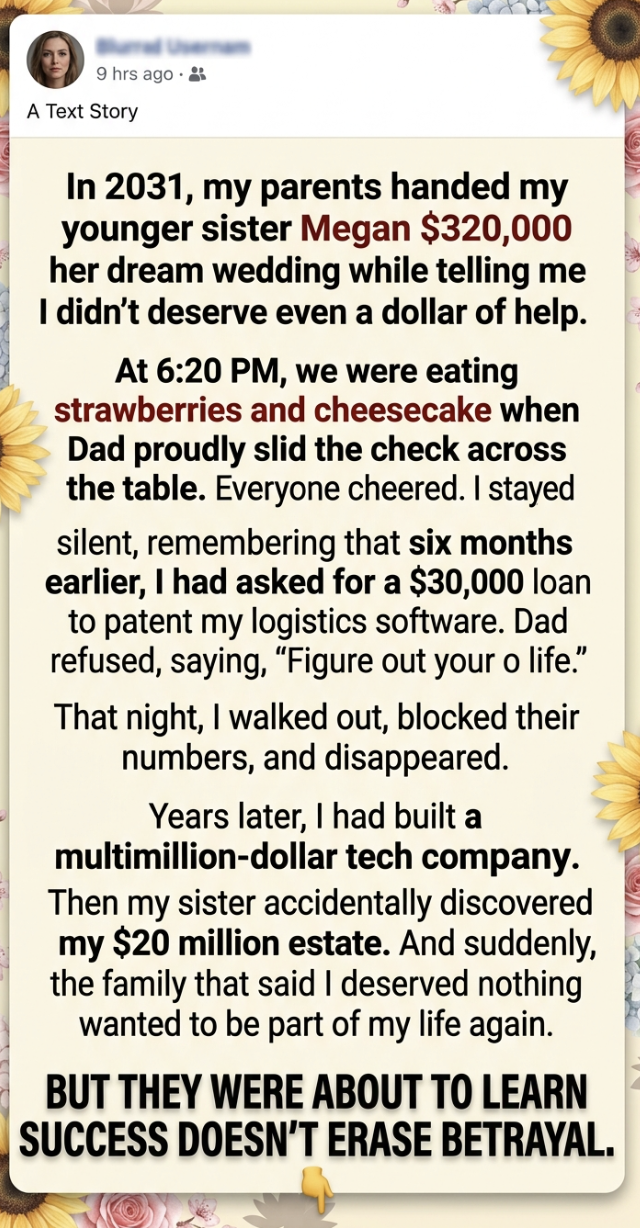
In 2031, my parents handed my younger sister Megan a check for $320,000.
It was supposed to be the happiest night of her life.
Instead, it became the night I finally understood exactly where I stood in my family.
We were sitting around my parents’ dining table at 6:20 PM, surrounded by strawberries, cheesecake, sparkling drinks, and the kind of expensive decorations my mother usually saved for Christmas.
Megan had just announced her wedding date.
Dad smiled proudly.
Then he reached into his jacket and placed a white envelope on the table.
“Megan,” he said, “your mother and I want you to have this.”
She opened it.
Her eyes widened.
$320,000.
For several seconds, nobody spoke.
Then Mom started crying.
Megan screamed.
My cousins clapped.
Dad leaned back in his chair, looking like he had just accomplished something extraordinary.
“This is for your wedding,” he said. “You deserve to have everything you’ve dreamed of.”
Everyone congratulated her.
Everyone except me.
I quietly looked down at my plate.
Six months earlier, I had sat in that same house asking my father for something completely different.
Not a gift.
Not $320,000.
Not even $100,000.
I had asked for a $30,000 loan.
I had already developed a logistics software platform that could help shipping companies reduce delays and fuel costs. I had customers interested. I had spent years developing the technology.
But I needed $30,000 to file the final patents and protect the software before competitors could copy it.
I went to Dad because I thought family was supposed to help family.
I was wrong.
He looked at my proposal, pushed the papers back toward me, and said:
“Figure out your own life.”
I reminded him I wasn’t asking for free money.
“I’ll pay every dollar back.”
He shook his head.
“You’re always chasing some new idea. Megan is getting married. She needs real support.”
Mom didn’t say anything.
That silence hurt almost more than Dad’s words.
So I left.
That night, I blocked their numbers.
I stopped visiting.
I stopped explaining myself.
And I disappeared.
At first, they probably assumed I would eventually come crawling back.
I didn’t.
Instead, I worked.
Every morning, I started before sunrise.
Every night, I worked until my eyes hurt.
I lost sleep.
I lost friends.
I lost relationships.
But I never lost sight of the one thing I wanted.
I wanted my software to work.
And eventually, it did.
A small shipping company became five.
Five became twenty.
Then international logistics companies started calling.
My software didn’t just track shipments.
It predicted delays before they happened.
It optimized routes.
It reduced fuel consumption.
It helped companies save millions.
Investors eventually came knocking.
I said no to most of them.
I didn’t want anyone owning the thing my family had told me wasn’t worth $30,000.
By 2034, my company was valued at more than $85 million.
By 2037, my personal assets had crossed $20 million.
But I kept my life private.
No luxury cars.
No interviews.
No social media posts about money.
I still wore simple clothes.
I still worked from the same quiet office.
And I never contacted my family.
Then, one afternoon, everything changed.
My sister Megan accidentally discovered who I had become.
She was attending a technology conference with her husband when she saw my company’s logo on a massive screen.
She stopped walking.
My photograph appeared during a presentation about young technology founders.
Underneath it was my name.
Megan stared at the screen.
Then she whispered:
“No way.”
She searched my company.
Then my name.
Then the company’s valuation.
Then my estimated ownership.
She found an article mentioning my private investment portfolio.
Another mentioned my real-estate holdings.
And eventually, she found something that made her hands shake.
A financial publication had estimated that my estate was worth approximately $20 million.
Megan called Mom immediately.
Then Dad.
Within twenty-four hours, my entire family knew.
And suddenly, I started receiving messages from numbers I didn’t recognize.
“We miss you.”
“We should talk.”
“Family is more important than money.”
“Your mother has been worried about you.”
I didn’t respond.
Then Megan showed up at my office.
She looked different from the sister who had received the $320,000 check.
She looked nervous.
She sat across from me and stared at the floor.
“I didn’t know,” she said.
I nodded.
“I know.”
“Dad didn’t know either.”
I almost laughed.
“He knew exactly what he was doing.”
Megan swallowed.
“I was wrong too.”
I looked at her.
“You were twenty-eight years old. You didn’t owe me money.”
“I didn’t mean the money.”
She paused.
“I mean the way I acted that night.”
For the first time, she looked directly at me.
“I saw Dad give me $320,000, and I celebrated. I never once asked why he wouldn’t give you $30,000.”
That sentence stayed in the room.
Then Megan revealed something I didn’t know.
She had recently found an old folder in my mother’s bedroom.
Inside were financial documents from six months before my request.
One document showed that Dad had actually reviewed my software proposal.
Another showed that he had contacted one of his business friends about it.
And the final document contained a handwritten note.
“Don’t invest. If it fails, we’ll lose the money. If it succeeds, he’ll think he did it without us.”
I stared at the page.
My father hadn’t simply refused to help me.
He had made a decision about my future.
He wanted me to struggle alone.
But that wasn’t the biggest secret.
Megan reached into her bag and placed another document on my desk.
It was an old trust agreement.
My grandfather had created it years earlier.
According to the document, my parents had access to a family investment account—but only temporarily.
The money they gave Megan for her wedding hadn’t come entirely from their personal savings.
It had come from an account my grandfather had originally intended to divide equally between his grandchildren.
My share had been quietly moved into a separate trust.
My parents had never told me.
I stared at the number.
It was much larger than $30,000.
Much larger than the wedding check.
The trust had grown for years.
And because I had never touched it, it had continued accumulating investments.
The estimated value was now nearly $4.8 million.
Megan looked embarrassed.
“They were going to tell you eventually.”
I shook my head.
“No. They weren’t.”
She didn’t argue.
A week later, Dad finally came to see me.
He stood outside my office for almost ten minutes before coming inside.
For the first time in my life, he looked uncertain.
“I made mistakes,” he said.
I sat quietly.
He continued.
“I thought you were being reckless.”
“You thought I was going to fail.”
“Yes.”
“And Megan?”
He looked down.
“I thought she needed us more.”
I nodded.
Then I asked the question I had carried for years.
“Dad, if my company had failed, would you ever have come looking for me?”
He didn’t answer.
That was the answer.
My mother arrived later.
She cried.
She told me she regretted staying silent.
She said she had always believed Dad was trying to protect the family.
I told her something she never expected to hear.
“Sometimes protecting one child means hurting another.”
Nobody spoke.
I didn’t forgive them that day.
I didn’t throw them out either.
Instead, I gave them something they hadn’t expected.
The truth.
I told them I didn’t need their money.
I didn’t need their approval.
And I certainly didn’t need them suddenly treating me like family because they had discovered my bank balance.
But I did want one thing.
An honest relationship.
No money.
No business deals.
No requests.
No expectations.
Just honesty.
Megan started visiting me occasionally.
Not asking for anything.
Not talking about my company.
Sometimes we’d just sit and eat cheesecake like we used to when we were younger.
Eventually, I helped her with something far more important than her wedding.
I helped her understand that her value wasn’t determined by how much our parents spent on her.
And I finally understood something too.
That $30,000 loan I was denied wasn’t the reason I became successful.
The betrayal was.
It forced me to stop waiting for someone to believe in me.
I learned to believe in myself.
Years later, Dad asked me if I still regretted that night in 2031.
I smiled.
“No.”
He looked surprised.
“Why not?”
“Because that was the night I stopped asking my family for permission to become who I wanted to be.”
He looked down.
I continued:
“You gave Megan $320,000 because you believed her dream deserved support.”
I paused.
“I’m glad you did.”
Dad looked at me.
“Why?”
“Because if you had given me that $30,000, I might have spent the rest of my life believing I needed your approval.”
He didn’t say anything.
And for the first time, neither did I.
I simply stood up and walked away.
Because success had changed my life.
But it hadn’t changed the truth.
Money can open doors.
Success can change your circumstances.
But neither can erase the moment someone made you feel like you weren’t worth helping.
And sometimes, the greatest victory isn’t becoming rich enough for the people who rejected you to come back.
It’s becoming strong enough to decide whether they deserve a place in your life when they finally do.