For years, my family had one word for me.
Failure.
They never said it directly.
They didn’t need to.
I could hear it in their jokes.
See it in their expressions.
Feel it whenever someone asked what I was doing with my life.
My name is Daniel.
And for most of my twenties, my family believed I was the relative who had never figured things out.
They were wrong.
They simply never stayed long enough to see what I was building.
The last time my entire family had seen me, I was twenty-six.
I had just left a small company I had helped build.
The business wasn’t failing.
But my relatives didn’t know that.
All they knew was that I had walked away from a comfortable job.
My mother, Patricia, had asked me:
“So what are you going to do now?”
“Build something of my own.”
She laughed.
“Of course you are.”
My uncle James laughed too.
“Daniel, you’ve got to stop chasing these crazy ideas.”
I smiled.
“Maybe.”
Then I left.
I didn’t tell them where I was going.
I didn’t tell them who I was working with.
And I certainly didn’t tell them what I was building.
Over the next few years, I disappeared from family gatherings.
Not completely.
I still sent birthday messages.
Still called my mother occasionally.
Still sent gifts during holidays.
But I stopped explaining my life.
Because every explanation became another opportunity for someone to tell me I was making the wrong decision.
So I became quiet.
And I worked.
My first year was difficult.
My second year was worse.
There were months when I wondered whether I had made a terrible mistake.
But I kept going.
I had discovered a problem in the financial technology industry.
Small businesses were losing enormous amounts of money because their payment systems were fragmented and outdated.
I built software that connected accounting, payments, inventory, and fraud detection into one platform.
At first, only a few companies used it.
Then dozens.
Then hundreds.
Eventually, major companies began signing contracts.
Investors became interested.
Our small team became a large company.
And one morning, I realized something strange.
I wasn’t trying to prove my family wrong anymore.
I was simply building the life I wanted.
By 2029, the company was valued at more than $300 million.
I owned a significant portion.
I had a comfortable home.
A strong team.
A life I was proud of.
But I still didn’t tell my family.
Then came the reunion.
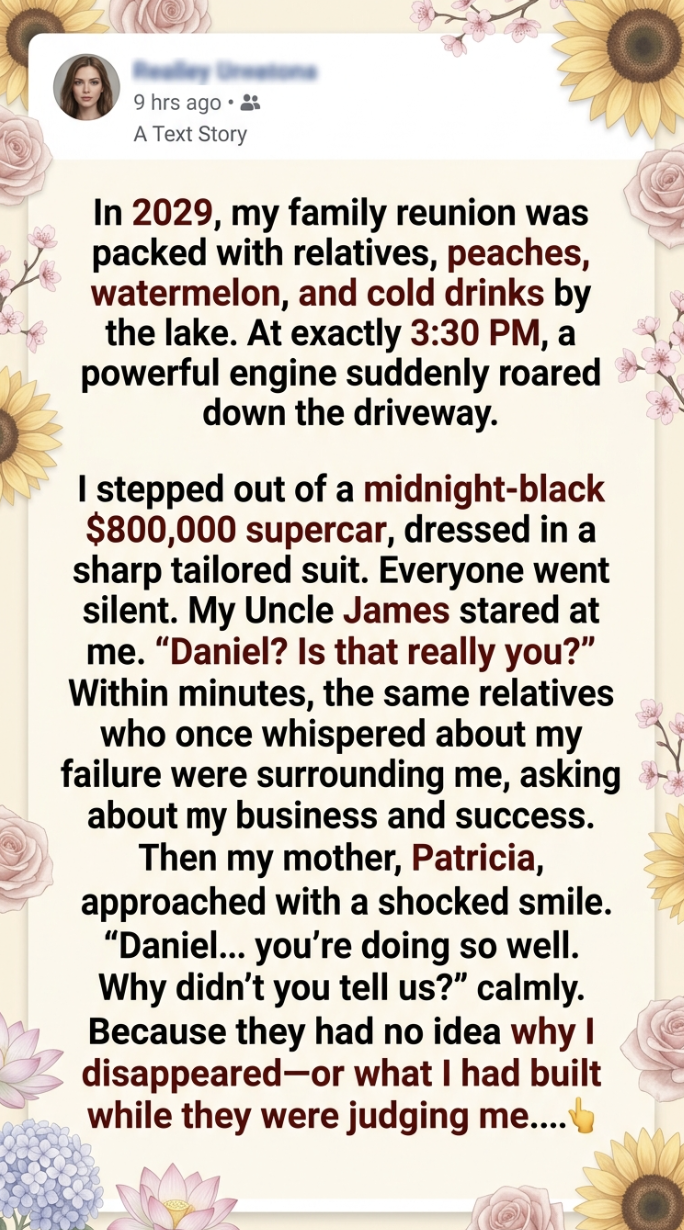
The family reunion was held at the old lake house.
Everyone was there.
Uncles.
Aunts.
Cousins.
Children running around.
Tables filled with peaches, watermelon, sandwiches, and cold drinks.
Music played near the lake.
People laughed beneath the afternoon sun.
I hadn’t been to one of these gatherings in years.
I almost didn’t go.
Then I changed my mind.
Not to show off.
Not to prove anything.
I simply wanted to see everyone again.
At exactly 3:30 PM, I turned onto the driveway.
The engine of my midnight-black supercar echoed between the trees.
People stopped talking.
Heads turned.
The car rolled slowly toward the house.
Then stopped.
I stepped out.
Tailored suit.
Dark shoes.
Calm expression.
For several seconds, nobody recognized me.
Then my uncle James walked closer.
He stared at me.
“Daniel?”
I smiled.
“Hi, Uncle James.”
His eyes widened.
“Is that really you?”
“Yes.”
He looked at the car.
Then at me.
Then back at the car.
“What happened to you?”
I laughed softly.
“Nothing happened.”
I closed the door.
“I just kept working.”
Within minutes, people surrounded me.
The same relatives who had once ignored me suddenly wanted answers.
“What business are you in?”
“How much is your company worth?”
“Where do you live?”
“Is that car really yours?”
“How did you become so successful?”
My cousin asked if I could introduce him to investors.
Another wanted advice about starting a business.
Someone else asked whether I was hiring.
I answered politely.
But I noticed something.
They weren’t asking about me.
They were asking about what I had.
Then my mother approached.
Patricia stared at me.
Her expression was somewhere between shock and confusion.
“Daniel.”
“Hi, Mom.”
“You’re doing so well.”
I smiled.
“I’ve been doing okay.”
She looked at the car again.
“Why didn’t you ever tell us?”
I looked at her.
Because I had spent years thinking about that question.
Then I answered:
“Because every time I tried to tell you about my plans, you told me they would fail.”
She looked hurt.
I continued.
“So I stopped explaining.”
She was quiet.
Then she whispered:
“We thought you were struggling.”
“I was.”
She looked surprised.
“For a long time,” I said.
“But struggling doesn’t mean failing.”
My mother looked down.
I could see she was remembering every conversation.
Every joke.
Every time she had asked when I was going to get a “real job.”
Then she asked:
“So why did you disappear?”
That was the question I had been waiting for.
I looked toward the lake.
“Because I needed to find out who I was without everyone telling me who I should be.”
Nobody spoke.
Then Uncle James stepped forward.
“Daniel, we didn’t mean anything by those comments.”
I looked at him.
“I know.”
“We were trying to help.”
“I know.”
He smiled awkwardly.
“But you have to admit, we were surprised.”
“I’m sure.”
Then he asked:
“How did you actually build all this?”
I smiled.
“Quietly.”
He laughed.
“No, seriously.”
“I worked.”
“That’s it?”
“That’s most of it.”
I paused.
“I failed privately. Learned privately. Improved privately.”
I looked around at everyone.
“While you were discussing whether I was succeeding, I was busy becoming better.”
Nobody had an answer.
That evening, my mother asked me to walk with her.
We went toward the lake.
She looked older than I remembered.
“I owe you an apology.”
I didn’t respond.
She continued.
“I thought I was protecting you.”
“From what?”
“Failure.”
I smiled sadly.
“You were afraid of me failing.”
“Yes.”
“But you never realized that I was already learning.”
She nodded.
Then she said something unexpected.
“Your father knew.”
I stopped walking.
“Knew what?”
“He knew your company was successful.”
I stared at her.
“How?”
“He had contacted one of your former colleagues.”
I felt uncomfortable.
“Why?”
She hesitated.
“He wanted to know whether you had really made it.”
I shook my head.
“So he knew?”
“Yes.”
“And he still didn’t call?”
My mother looked away.
“He was embarrassed.”
That answer surprised me more than anything.
My father had always been the proud one.
He had taught me that success meant being respected.
But when I became successful without his approval, he didn’t know how to approach me.
My mother told me he had followed the company’s growth quietly.
He had read articles about it.
Watched interviews.
Even attended one public business conference without telling me.
He knew.
He just couldn’t admit that the son he had underestimated had built something extraordinary.
I didn’t feel angry.
I felt sad.
Because success should have been something we celebrated together.
Instead, pride had turned it into distance.
The next morning, I woke early.
The lake was quiet.
I found my father sitting alone near the dock.
He looked at me.
Then smiled.
“Your mother told me you know.”
“I do.”
He nodded.
“I was wrong.”
I sat beside him.
For a while, we watched the water.
Then he said:
“I spent years thinking success meant having people look up to you.”
I listened.
“Then you came home.”
He smiled.
“And everyone suddenly looked at you.”
I laughed softly.
He continued:
“I realized something.”
“What?”
“You never needed them to look at you.”
He paused.
“You were too busy building.”
That was the closest my father had ever come to saying he was proud of me.
And somehow, it was enough.
Before I left the reunion, my mother hugged me.
Not because of the car.
Not because of the company.
Just because I was her son.
“Will you come next year?” she asked.
I smiled.
“Maybe.”
She laughed.
“You’re still difficult.”
“Probably.”
Then I looked at her.
“But I’ll call you.”
She nodded.
“That would be enough.”
I walked back toward my car.
Everyone was watching.
But this time, I didn’t care.
The supercar was impressive.
The company was valuable.
The suit looked good.
But none of those things were the real victory.
The real victory was standing in the same place where I had once been called unsuccessful and realizing I no longer needed anyone there to validate me.
I had spent years trying to prove that I wasn’t a failure.
Eventually, I stopped proving anything.
I simply built.
Quietly.
Patiently.
Consistently.
And when my family finally saw the result, I didn’t need to say:
“I told you so.”
I only needed to say:
“You stopped asking about me before I stopped believing in myself.”
Because sometimes people don’t see your progress—not because you aren’t growing, but because they decided who you were before you had the chance to become someone new.
Never let someone else’s opinion become the ceiling of your ambition.
Build quietly.
Let your results speak.
And when they finally notice—
you won’t need an explanation.