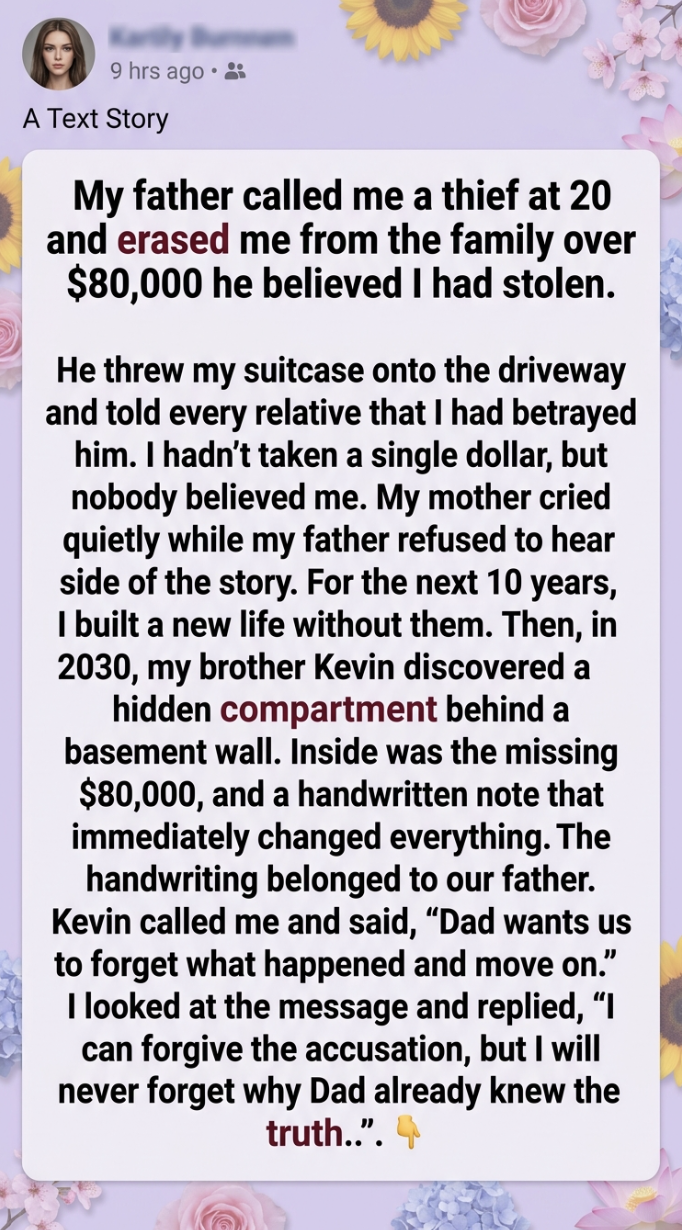
My father called me a thief when I was twenty years old.
He didn’t ask questions.
He didn’t investigate.
He didn’t believe me.
He simply decided I was guilty.
Two days earlier, his emergency cash had disappeared from a locked safe.
$80,000.
I remember standing in the hallway when he confronted me.
His face was red.
His hands were shaking.
“Where is it?”
I stared at him.
“What?”
“The money.”
“I don’t know what you’re talking about.”
He pointed toward my bedroom.
“You’re the only one who was home.”
I shook my head.
“I don’t even know the combination to your safe.”
He didn’t care.
“You bought a car.”
I looked at him in disbelief.
“The car I bought with my savings?”
“You expect me to believe a twenty-year-old suddenly has enough money for a car?”
“I worked for it.”
He laughed bitterly.
“You’re a thief.”
My mother, Diane, stood behind him.
She was crying.
But she said nothing.
I looked at her.
“Mom?”
She looked away.
That hurt more than anything my father said.
Then Dad opened the front door.
He threw my suitcase onto the driveway.
“You’re a thief,” he said.
“And thieves don’t carry my last name.”
I stood there with my suitcase beside me.
Twenty years old.
No family.
No explanation.
No chance to defend myself.
Before I walked away, my father called every relative.
He told them I had stolen from him.
By that evening, the entire family believed I was guilty.
I became the story everyone whispered about.
The son who betrayed his father.
The greedy kid who stole family money.
The disappointment.
The thief.
Nobody asked me what happened.
Nobody wanted to hear my side.
So I stopped trying to explain.
I left.
And I didn’t come back.
The first year was brutal.
I slept in a tiny apartment.
Worked whatever jobs I could find.
Saved every dollar.
There were nights when I sat alone wondering whether my father would ever call.
He didn’t.
My mother didn’t either.
Neither did my relatives.
I eventually stopped checking my phone.
Then something inside me changed.
I realized I could spend the rest of my life trying to prove I wasn’t a thief.
Or I could build a life so strong that their accusation no longer controlled me.
I chose the second.
I started a small business.
It failed.
I started another.
That one survived.
I learned.
I worked.
I made mistakes.
I kept going.
Over the next ten years, my life slowly changed.
By the time I was thirty, I owned a successful company.
I had a home.
A stable life.
People around me who trusted me.
But there was still one unanswered question.
Who had taken the $80,000?
I had asked myself that question thousands of times.
I knew I hadn’t done it.
But I never knew what had actually happened.
Until 2030.
My brother Kevin called me on a Thursday night.
I almost didn’t answer.
We hadn’t spoken properly in years.
When I saw his name on my phone, I hesitated.
Then I answered.
“Hello?”
He didn’t speak immediately.
His breathing sounded strange.
“It’s me.”
“I know.”
“I found something.”
“What?”
He lowered his voice.
“Dad’s old safe.”
My stomach tightened.
“What about it?”
“I was renovating the basement.”
He paused.
“There was a wall panel behind the old storage shelves.”
“And?”
“I found a hidden compartment.”
I sat down.
“What was inside?”
Kevin took a breath.
“The money.”
I couldn’t speak.
He continued.
“Eighty thousand dollars.”
My heart started pounding.
“Are you sure?”
“Yes.”
“Is it the same money?”
“There are old bank wrappers and Dad’s markings on the envelopes.”
Then he said:
“There was something else.”
“What?”
“A note.”
“From who?”
“Dad.”
I closed my eyes.
“Read it.”
Kevin hesitated.
“I don’t think I should.”
“Kevin.”
He sighed.
“Okay.”
Then he read:
“I know what happened. I know he didn’t take it.”
Everything around me seemed to disappear.
For ten years, I had lived with a lie.
And my father had known.
I whispered:
“What else?”
Kevin continued.
“I moved the money myself. I needed to hide it temporarily, and when the situation became complicated, I let everyone believe what they already suspected.”
I couldn’t breathe for a moment.
“What situation?”
Kevin said:
“I don’t know.”
Then he added:
“But there’s another page.”
My hands tightened around the phone.
“What does it say?”
Kevin read slowly.
“If Kevin ever finds this, tell him the truth before it is too late.”
Silence.
Then Kevin said:
“I think Dad knew you were innocent.”
I stared at the wall.
“He knew.”
“Yes.”
“He knew for ten years?”
“I think so.”
I ended the call.
Not because I was angry at Kevin.
Because I didn’t know what I was feeling.
The next morning, Kevin sent me photographs.
The hidden compartment.
The cash.
The note.
And another document.
It was a bank withdrawal record from ten years earlier.
The $80,000 had been withdrawn by my father.
Not me.
My name wasn’t anywhere on it.
The evidence had always existed.
Dad could have cleared my name years ago.
He chose not to.
I drove to my childhood home.
I hadn’t been there in ten years.
My father opened the door.
He looked older.
Smaller.
For a few seconds, neither of us spoke.
Then he said:
“Kevin told me you were coming.”
I looked at him.
“You knew.”
He lowered his eyes.
“Yes.”
One word.
Ten years of pain inside one word.
“You knew I didn’t steal it.”
“Yes.”
“Then why did you let everyone believe I did?”
He didn’t answer.
“Why did you throw me out?”
Silence.
“Why did Mom let me leave?”
He looked toward the kitchen.
“She was afraid.”
“Afraid of what?”
“Of me.”
That answer stunned me.
My father sat down.
“I was angry,” he said.
“Angry about money?”
“No.”
He looked at me.
“About losing control.”
I didn’t understand.
So he finally told me the part he’d hidden for a decade.
The money had originally been taken out of the safe because my father had discovered that someone had been accessing one of his private business accounts.
He suspected an employee.
Then he discovered the person had connections to someone in our extended family.
Dad withdrew the $80,000 because he planned to use it as part of an investigation.
He hid it in the basement compartment.
Then the investigation became complicated.
Someone threatened to expose financial information that could damage the family business.
Dad panicked.
When the money was discovered missing from the safe, he realized nobody knew where it had gone.
Instead of admitting that he had hidden it, he blamed me.
Why?
Because I was the easiest person to blame.
I was young.
I had recently bought a car.
And I had no power in the family.
My father thought the accusation would disappear with time.
It didn’t.
It destroyed my life.
He knew that.
And still, he stayed silent.
I looked at him.
“You ruined ten years of my life because you were too proud to admit you made a mistake.”
He closed his eyes.
“Yes.”
My voice became quiet.
“You didn’t just accuse me.”
I paused.
“You let everyone believe I was a bad person.”
He nodded.
“I know.”
“You let Mom watch me leave.”
“She regrets that every day.”
I looked toward the kitchen.
“Where is she?”
He said quietly:
“She wants to see you.”
My mother was sitting at the kitchen table.
When she saw me, she started crying.
I stood there.
For ten years, I had imagined this moment.
Sometimes I imagined screaming.
Sometimes I imagined walking away.
Instead, I simply said:
“Why didn’t you believe me?”
She covered her face.
“I did.”
I froze.
“What?”
“I believed you.”
My heart sank.
“Then why didn’t you say anything?”
She cried harder.
“Because your father told me everything would be fixed.”
“Was it?”
“No.”
She shook her head.
“It never was.”
She reached for my hand.
I didn’t move at first.
Then I let her hold it.
“I should have protected you,” she whispered.
“Yes,” I said.
“I know.”
And for the first time in ten years, my mother apologized without making excuses.
My father then handed me the original note.
The one Kevin had found.
There was another sentence on the back.
I had never seen it before.
“My son deserved better than the truth I was too afraid to tell.”
I read it twice.
Then I folded the paper.
My father looked at me.
“Can you forgive me?”
I thought about that question.
Forgiveness wasn’t simple.
Ten years couldn’t disappear because someone finally admitted the truth.
So I answered honestly.
“I don’t know.”
He nodded.
“I understand.”
“But I don’t want to spend the rest of my life carrying this.”
He looked at me.
“So I’ll try.”
Tears filled his eyes.
“That’s more than I deserve.”
Maybe he was right.
But forgiveness isn’t always about what someone deserves.
Sometimes it’s about deciding what you no longer want to carry.
The family eventually learned the truth.
My father told everyone.
He admitted that I had never stolen the money.
The relatives who had ignored me began calling.
Some apologized.
Some asked to meet.
Some tried to explain why they had believed my father.
I didn’t need their explanations.
I only needed the truth to finally exist where the lie had existed for ten years.
Kevin was the one person I stayed close to.
He had found the compartment.
He had called me.
And he had given me the truth when everyone else had spent a decade avoiding it.
Years later, the basement was completely renovated.
The hidden compartment was removed.
But Kevin kept the old wall panel.
He gave it to me.
I almost threw it away.
Instead, I kept it.
Not because I wanted to remember the betrayal.
Because I wanted to remember how a hidden truth can survive for years and still eventually find its way into the light.
I never got my twenty years back.
I couldn’t recover the birthdays I missed.
The holidays.
The family dinners.
The years when my mother watched me grow from a distance.
But I had built something else.
A life based on trust.
Not fear.
Not accusations.
Not someone’s approval.
And when people eventually asked me what I learned from those ten years, I always gave the same answer:
“Being falsely accused can break your heart, but it doesn’t have to define your life.”
My father thought calling me a thief would erase me.
Instead, it forced me to become someone who no longer needed his approval.
And perhaps the hardest truth of all was this:
The $80,000 had been hidden behind a wall for ten years.
But the real secret wasn’t where the money was.
It was that my father had known I was innocent—and chose silence anyway.
Some wounds don’t heal because the truth finally appears.
They heal when you finally decide that the truth will no longer control who you become.