For years, my family had a name for me.
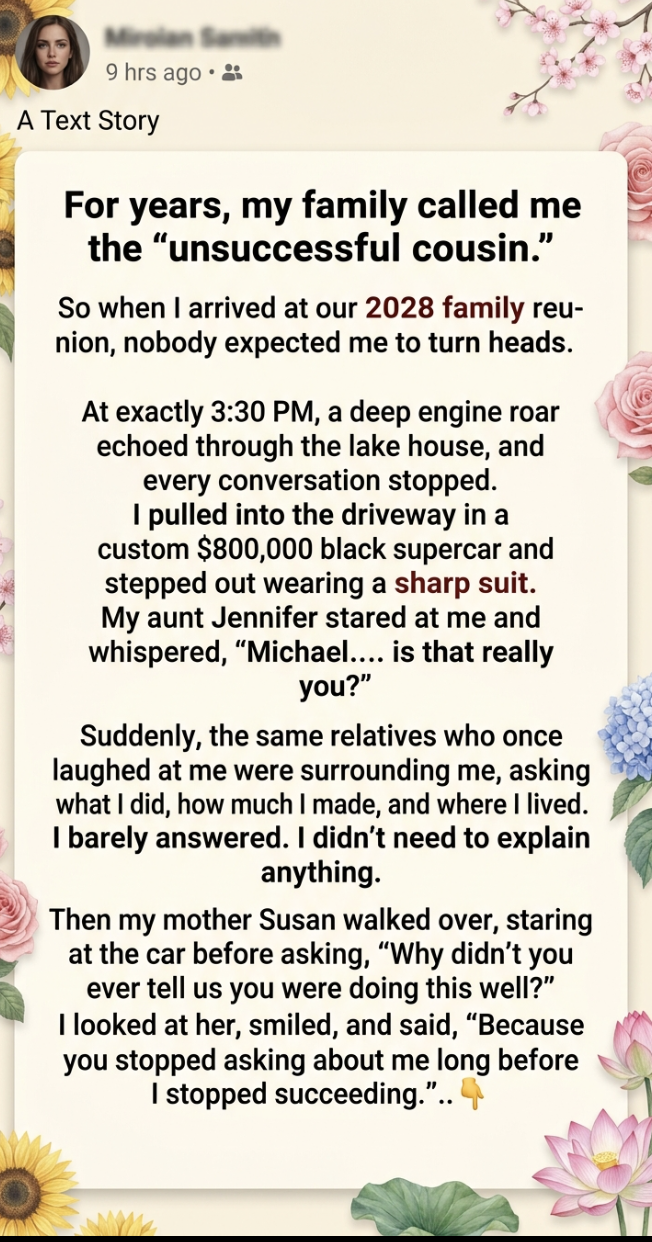
The unsuccessful cousin.
Nobody officially said it to my face.
They didn’t have to.
I could hear it in the jokes.
See it in the smiles.
Feel it whenever conversations about careers, houses, and money came up.
My cousins had impressive jobs.
One owned a restaurant.
Another had become a real estate investor.
My younger cousin had just bought a house.
And then there was me.
Michael.
The cousin everyone assumed was still “figuring things out.”
At family dinners, my aunt Jennifer would sometimes ask:
“So, Michael… how’s that little business going?”
The word little always sounded intentional.
I usually smiled.
“It’s going fine.”
She would nod sympathetically.
“That’s good.”
Then she’d turn toward someone else.
Nobody really asked questions.
Nobody wanted details.
Because they had already decided what my life looked like.
They were wrong.
They just didn’t know it yet.
Six years earlier, I had started a small technology company.
It wasn’t glamorous.
No fancy office.
No expensive car.
No social media announcements.
Just three people working from a tiny rented office and trying to build something useful.
Our first year was difficult.
The second year was worse.
There were nights when I wondered whether I’d made the biggest mistake of my life.
But I kept working.
I learned.
I hired carefully.
I found investors.
Eventually, the company began growing.
Then it grew quickly.
By 2028, we had clients in several countries.
Our software was being used by major companies.
And I had quietly become the majority owner of a business worth far more than anyone in my family could have imagined.
But I didn’t tell them.
Not because I wanted to punish them.
I simply stopped feeling the need to explain myself.
Years earlier, I had tried.
I once told my mother, Susan, that the company was doing well.
She smiled.
“That’s nice.”
Then she asked:
“So when are you going to get a real job?”
That was the last time I talked about my business with her.
Then came the family reunion.
The lake house belonged to my grandparents.
Every few years, the entire family gathered there.
In 2028, everyone arrived early.
I deliberately came late.
Not for attention.
I simply had a business meeting that morning.
At 3:30 PM, I turned onto the long driveway.
The lake house appeared between the trees.
I slowed down.
Then I heard it.
The sound of the engine.
Deep.
Powerful.
Impossible to ignore.
As I pulled into the driveway, conversations stopped.
People turned.
Someone dropped a cup.
My custom $800,000 black supercar rolled to a stop.
I opened the door.
Stepped out.
Adjusted my jacket.
And looked toward the house.
For a few seconds, nobody recognized me.
Then my aunt Jennifer walked forward.
She stared.
Her mouth opened slightly.
“Michael?”
I smiled.
“Hi, Aunt Jennifer.”
She looked at the car.
Then at me.
“Is that really you?”
“Last time I checked.”
She laughed nervously.
“You look… different.”
“I’ve been busy.”
That was when everyone started coming toward me.
Cousins.
Aunts.
Uncles.
People who had barely spoken to me in years.
Suddenly, everyone had questions.
“What do you do?”
“Where do you live?”
“How much is that car?”
“Is that your company?”
“Are you married?”
“How successful is the business?”
“Why didn’t you tell us?”
I answered only a few.
“Technology.”
“California.”
“Yes, it’s mine.”
Then I smiled.
I didn’t need to explain the rest.
Because for years, they had never been interested enough to ask.
Then my mother approached.
Susan stopped beside the car.
She stared at it.
Then at me.
“You have an $800,000 car?”
“Yes.”
She looked genuinely confused.
“Michael…”
She paused.
“Why didn’t you ever tell us you were doing this well?”
I looked at her.
There was no anger in my voice.
Only honesty.
“Because you stopped asking about me long before I stopped succeeding.”
Nobody spoke.
My mother looked away.
I could see the words had landed harder than I expected.
Then my uncle laughed awkwardly.
“Come on, Michael. We were only joking all those years.”
I looked at him.
“Maybe.”
I paused.
“But you were joking about a life you never bothered to understand.”
That evening, dinner was different.
Everyone suddenly wanted me sitting beside them.
My cousin offered me a drink.
My aunt asked about my company.
Another relative wanted to know whether I could help his son find a job.
Someone else asked whether I was looking for investors.
I listened.
And slowly, I noticed something.
They weren’t asking about me.
They were asking about what I could do for them.
That realization hurt more than the old jokes.
Because I had secretly hoped that success would make my family proud.
Instead, it made them interested.
Then something unexpected happened.
My aunt Jennifer pulled me aside.
“I owe you an apology.”
I looked at her.
“For what?”
She lowered her voice.
“I knew what they were saying about you.”
I didn’t respond.
She continued.
“Your mother told everyone you were struggling.”
I frowned.
“What?”
“She said your business was failing.”
My mother had told them that?
Jennifer nodded.
“She didn’t want anyone asking you for money because she thought you might become embarrassed.”
I was confused.
“That doesn’t make sense.”
“There’s more.”
She looked around before continuing.
“Your father had been asking questions about your company.”
I froze.
“What kind of questions?”
“Ownership.”
My stomach tightened.
“Why?”
Jennifer sighed.
“Because your father believed you had inherited money from your grandfather and were hiding it.”
I almost laughed.
I hadn’t inherited millions.
I had built the company myself.
Then Jennifer said something that made everything click.
“Your father tried to contact one of your early investors.”
I stared at her.
“He did what?”
“He wanted to know how much your company was worth.”
Suddenly, the family jokes looked different.
Maybe they hadn’t simply underestimated me.
Maybe someone had been watching me.
Later that night, I found my father standing alone near the dock.
Robert had always been proud.
He rarely admitted mistakes.
I walked toward him.
“Dad.”
He turned.
“Your mother told me about the car.”
“I figured.”
He looked at the lake.
“You really built all this yourself?”
“Yes.”
“How much is the company worth?”
I smiled.
“You finally asked.”
He looked uncomfortable.
“I was trying to understand.”
“You could have asked me six years ago.”
He nodded.
“I know.”
Then he said something I never expected.
“I was jealous.”
I stared at him.
He continued.
“I thought you were wasting your life. Then I realized you were building something I couldn’t control.”
I didn’t say anything.
“That scared me,” he admitted.
“Why?”
“Because I spent my whole life believing I knew what success looked like.”
He looked at me.
“And you proved I didn’t.”
The next morning, everyone gathered for breakfast.
My father stood up.
“I owe Michael an apology.”
The room became quiet.
He looked at me.
“I spent years calling him unsuccessful because I couldn’t see what he was building.”
Then he turned toward everyone else.
“And when he stopped explaining himself, we assumed he had nothing to say.”
My mother lowered her head.
I didn’t expect an apology.
But I appreciated it.
Then my mother came over.
She sat beside me.
“I’m sorry,” she whispered.
I looked at her.
“For what?”
“For making you feel like you had to prove yourself.”
I thought about everything.
The jokes.
The questions.
The dismissive comments.
The years of silence.
Then I said:
“You don’t have to understand everything I do.”
She nodded.
“I know.”
“But if you’re going to be part of my life,” I continued, “I need you to care about me even when you don’t know how successful I am.”
Her eyes filled with tears.
“I do.”
I believed she wanted to.
Whether she could change was something only time would prove.
Before I left the reunion, my youngest cousin ran outside.
He looked at the car.
Then at me.
“Michael?”
“Yes?”
“Can I ask you something?”
“Sure.”
“How did you become successful?”
I smiled.
“By being unsuccessful for a very long time.”
He laughed.
I continued:
“Seriously. I failed more times than you know.”
He looked confused.
“But you have that.”
He pointed at the car.
I shook my head.
“The car isn’t the success.”
“Then what is?”
I looked back at the lake house.
“Being able to build a life that doesn’t require strangers to approve of it.”
He nodded slowly.
Then he asked:
“Can you teach me?”
I smiled.
“Absolutely.”
I drove away that afternoon.
The same family was standing in the driveway.
But something had changed.
Not because of the car.
Not because of my money.
Not because they suddenly discovered I had succeeded.
They had finally discovered that the person they had labeled a failure had been quietly building a life they never bothered to ask about.
And as I drove down the road, I thought about the sentence I’d told my mother.
“You stopped asking about me long before I stopped succeeding.”
It wasn’t meant to hurt her.
It was simply the truth.
Because success isn’t always loud.
Sometimes it happens quietly.
Behind closed doors.
During long nights.
Through failures nobody sees.
And sometimes the people who underestimate you aren’t watching your journey closely enough to realize you’ve already arrived.
Never measure your progress by the applause of people who ignored your struggle.
Build your life anyway.
And when they finally notice—
you won’t need to explain a thing.