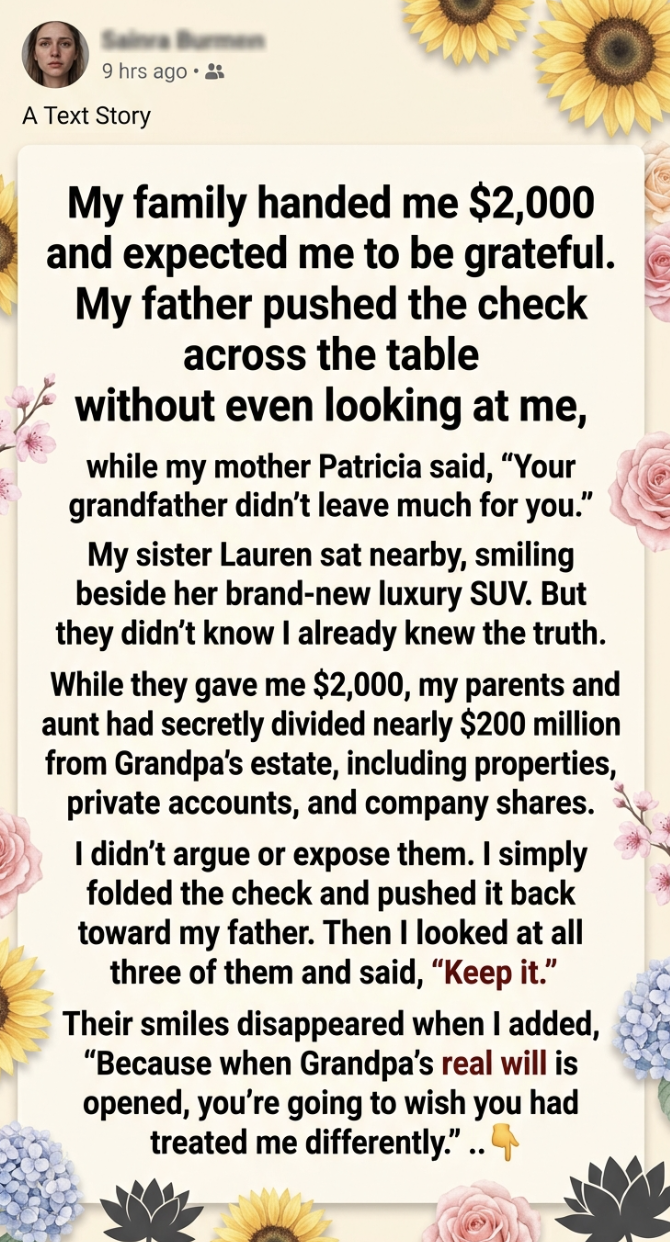
My father pushed the check across the table.
He didn’t even look at me.
$2,000.
That was supposedly my share of my grandfather’s estate.
My mother, Patricia, sat beside him with her hands folded neatly in her lap.
She gave me the kind of smile people use when they think they’re being generous.
“Your grandfather didn’t leave much for you,” she said.
Across the room, my sister Lauren was admiring her new luxury SUV through the window.
She had received hers only weeks earlier.
Nobody had explained where the money came from.
Nobody needed to.
I already knew.
I looked at the check.
Then at my father.
Then at my mother.
“That’s it?”
My father finally looked up.
“What did you expect?”
I didn’t answer.
Because I already knew what they had been hiding.
For months, my parents and my aunt had been quietly dividing Grandpa’s estate.
Properties.
Private accounts.
Company shares.
Investment portfolios.
The total value was close to $240 million.
And somehow, my share had become $2,000.
My father tapped the check.
“Take it.”
My mother added:
“You should be grateful. Grandpa was old. He didn’t have the resources people think he had.”
I almost smiled.
Grandpa had once told me something very different.
He had looked me directly in the eyes and said:
“People will show you who they are when they think you have nothing to give them.”
At the time, I didn’t understand.
Now I did.
I picked up the check.
My family watched me.
Then I folded it once.
Twice.
And pushed it back toward my father.
“Keep it.”
His eyebrows lifted.
“What?”
“Keep the $2,000.”
My mother frowned.
“Don’t be dramatic.”
I looked at all three of them.
Then I said:
“Because when Grandpa’s real will is opened, you’re going to wish you had treated me differently.”
Nobody spoke.
Lauren stopped looking at her phone.
My father slowly leaned back.
“What did you just say?”
I stood.
“You heard me.”
Then I walked out.
I didn’t slam the door.
I didn’t threaten anyone.
I didn’t reveal what I knew.
Because I wanted to see how far they would go before the truth caught them.
The story actually began six months earlier.
Grandpa had been sick for a while.
He had always been private about his finances.
Even his children didn’t know everything.
But I was different.
I spent time with him.
Not because of money.
I visited him when he was lonely.
I helped organize his old photographs.
I listened to stories about his first business.
He would sometimes ask me to sit beside him in his study.
One evening, he handed me an old brass key.
I asked what it opened.
He smiled.
“You’ll know when the time comes.”
I laughed.
“I hope that’s not your way of being mysterious.”
He smiled again.
“I’m afraid it is.”
A few weeks later, he passed away.
The funeral was heartbreaking.
But after it ended, something strange happened.
My parents became extremely busy.
They began meeting with lawyers.
My aunt started visiting Grandpa’s office.
Lauren suddenly had a new SUV.
And whenever I asked about the estate, my father said:
“There’s nothing significant.”
I believed him at first.
Then I noticed something.
Grandpa’s longtime attorney, Mr. Bennett, had stopped returning my parents’ calls.
That seemed unusual.
Grandpa had trusted him for decades.
So I contacted him.
He agreed to meet me.
But he wouldn’t discuss the estate over the phone.
When I arrived at his office, he locked the door.
Then he asked:
“Has your family given you anything?”
I said:
“Two thousand dollars.”
He stared at me.
Then slowly shook his head.
“I thought so.”
My stomach tightened.
“What does that mean?”
He opened a drawer.
Inside was a sealed envelope.
My name was written across it.
To be opened only in Olivia’s presence.
I stared at it.
“What’s inside?”
Mr. Bennett looked at me.
“Your grandfather’s final instructions.”
He told me something I hadn’t known.
Grandpa had created a new estate plan shortly before his death.
The old will was no longer the controlling document.
And the changes were significant.
Very significant.
I asked why my family was acting like I had inherited almost nothing.
Mr. Bennett answered carefully.
“Because they haven’t told you the truth.”
He explained that Grandpa had anticipated exactly this situation.
He knew some members of the family cared more about the estate than they did about him.
So he had structured the estate differently.
The first version of his plan had divided everything among his children.
Then he changed his mind.
Not because he hated them.
Because he had learned how they behaved when money was involved.
The new plan contained conditions.
And one of those conditions required an independent accounting of the estate before anyone could receive certain assets.
My parents hadn’t completed that process.
Instead, they had started distributing property among themselves.
The SUV Lauren was driving?
Purchased using money from an estate account.
The new investment property my aunt had acquired?
Connected to Grandpa’s holdings.
Several transfers had already been made.
And they were all documented.
I looked at Mr. Bennett.
“Can they do that?”
He shook his head.
“Not legally.”
Then he placed another document in front of me.
It was a letter from Grandpa.
I recognized his handwriting immediately.
My hands trembled as I opened it.
The first sentence said:
“If you’re reading this, then they have probably already told you that I left you very little.”
I stopped.
Mr. Bennett watched silently.
I continued.
Grandpa wrote that he had deliberately kept the new will confidential.
He wanted to know what would happen if everyone believed I had been excluded.
Would my parents still treat me like family?
Would my sister still speak to me?
Would they invite me to family dinners?
Would they ask how I was doing?
Or would they suddenly decide I wasn’t worth much?
Then came the line that broke my heart.
“Olivia, never let anyone convince you that your value is measured by what I leave you.”
I had to stop reading.
I wiped my eyes.
Grandpa wasn’t simply leaving me money.
He was testing the people around me.
And they had failed.
The real will was finally opened two weeks later.
Everyone was present.
My father looked confident.
My mother looked nervous.
Lauren kept checking her phone.
My aunt sat quietly in the corner.
Mr. Bennett entered the room carrying a thick folder.
He placed it on the table.
Then he said:
“This is your father’s final will.”
My father immediately objected.
“We already handled the distribution.”
Mr. Bennett looked at him.
“No.”
He opened the folder.
“You distributed assets before the estate was legally finalized.”
My mother’s face went pale.
“That isn’t possible.”
“It is.”
He began listing the assets.
The properties.
The investment accounts.
The company shares.
The private accounts.
Everything they had quietly divided.
Then he explained the new arrangement.
The majority of Grandpa’s estate would be placed into a family foundation.
A smaller portion would go to his children—but only after the estate’s assets were properly returned and accounted for.
And a significant portion would go to me.
Not because I was his favorite.
Because Grandpa had created a separate trust for me years earlier.
The trust was worth approximately $82 million.
My father stared at the documents.
Lauren looked at me.
“You knew?”
I shook my head.
“I knew there was another will.”
My father slammed his hand against the table.
“Why didn’t you tell us?”
I looked at him.
“Why didn’t you tell me about the $240 million?”
Silence.
Nobody had an answer.
Then Mr. Bennett revealed one final condition.
Grandpa had included a clause.
If any beneficiary attempted to conceal estate assets or distribute them improperly, their inheritance could be reduced or redirected.
My father looked stunned.
My mother began crying.
Lauren whispered:
“So the SUV…”
Mr. Bennett nodded.
“It will need to be returned or accounted for as an estate asset.”
Lauren looked at me.
Her face had completely changed.
A few weeks earlier, she had smiled while I was handed a $2,000 check.
Now she couldn’t look me in the eyes.
My father finally spoke.
“Why would Dad do this to us?”
I answered quietly.
“He didn’t.”
Everyone looked at me.
“He didn’t do this to you.”
I paused.
“You did this to yourselves.”
After the meeting, my father came to see me.
He didn’t bring lawyers.
He didn’t bring documents.
He just stood outside my apartment.
When I opened the door, he looked exhausted.
“I was wrong,” he said.
I didn’t answer.
“I thought you wouldn’t care about the money.”
I looked at him.
“That wasn’t the problem.”
“What was?”
“You decided I was worth $2,000.”
He looked down.
“I thought we were protecting the family.”
“You were protecting the money.”
He didn’t argue.
That was the first honest conversation we’d had in years.
Then he said something unexpected.
“Your grandfather knew.”
“Knew what?”
“That we’d do this.”
I nodded.
“Yes.”
He looked at me.
“And he knew you’d forgive us?”
I shook my head.
“No.”
I paused.
“He knew I would eventually understand that I didn’t need to.”
Months later, the estate was settled properly.
The family foundation was established.
Several properties were sold.
The improperly transferred money was returned.
Lauren’s SUV was gone.
My aunt lost several investments she had assumed were already hers.
My parents had to rebuild their finances honestly.
As for me, I didn’t buy a mansion.
I didn’t buy a fleet of cars.
I didn’t announce my inheritance on social media.
I did something much quieter.
I used part of the trust to establish a scholarship in Grandpa’s name.
It helped young people who had the ambition to build something but didn’t have the financial support to begin.
At the opening ceremony, my father stood beside me.
He looked at the plaque.
Then he said:
“Your grandfather would have liked this.”
I smiled.
“I think so.”
He looked at me.
“Do you hate us?”
I thought about the $2,000 check.
The secret accounts.
The lies.
The way they had looked at me when they thought I had nothing.
Then I answered:
“No.”
He seemed surprised.
“I don’t hate you.”
I paused.
“But I won’t ever confuse family with entitlement again.”
He nodded slowly.
And for the first time, he understood.
I kept the original $2,000 check.
Not because I wanted the money.
Because it became a reminder.
A reminder of the day my family thought they knew my worth.
They saw a person receiving $2,000.
Grandpa saw something else.
He saw someone who didn’t need an inheritance to know who she was.
And in the end, that was the greatest thing he left me.
Not the $82 million trust.
Not the properties.
Not the investments.
But the certainty that my worth had never depended on what my family was willing to give me.
Sometimes people reveal themselves when they think you’ve lost everything.
And sometimes the greatest inheritance isn’t the fortune waiting in a lawyer’s office.
It’s discovering who would still love you if the fortune disappeared.